
Journalist

Kim Yeon-jae
duswogmlwo77@ajupress.com
-
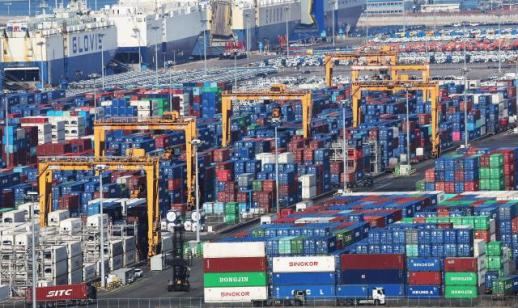 Exports feed black in Korea's C/A surplus for 33rd month in Jan, U.S. stock invest narrows SEOUL, March 06 (AJP) - South Korea extended its current-account surplus streak to a 33rd consecutive month in January, though the black figure narrowed from the record level seen the previous month as investment in overseas securities cooled from the frenetic pace of late last year. The current account surplus reached $13.26 billion in January, narrowing from $18.7 billion in the previous month, according to the Bank of Korea (BOK) on Friday. The robust surplus was fed by exports that surged 30 percent on year to $65.51 billion, more than doubling the pace of the 13-percent annual gain in the previous month. Imports also rose 7 percent from a year earlier to $50.34 billion, faster than the 1.7-percent increase recorded a month earlier. The services account remained in the red with a $3.8 billion deficit, largely weighed down by outbound travel. The travel account logged a deficit of $1.74 billion. The primary income account posted a $2.72 billion surplus. Investment income totaled $2.86 billion, down from $4.9 billion in the previous month as dividend income narrowed to $2.3 billion from $3.7 billion. The secondary income account recorded a $830 million deficit as outbound remittances from South Korea outpaced inflows from abroad. Overseas investment by South Korean residents rose $13.46 billion, easing slightly from $14.37 billion in December. Their investment still dwarfed foreign investment in Korean securities, which increased $4.69 billion — mostly in bonds — slowing from $5.68 billion the previous month. Reserve assets — assets held by state authorities to support the currency and meet foreign obligations — decreased by $4.83 billion, widening from a $4.44 billion decline a month earlier. The trade balance also revealed a heavy reliance on a few key sectors. Semiconductor exports skyrocketed 102.5 percent year on year to $20.69 billion, more than doubling in value. Shipments of information and communication devices, including smartphones, surged 66 percent to $4.48 billion. Automobile exports rose 19 percent from a year earlier to $5.74 billion, underpinned by record January sales in the United States by Hyundai Motor and Kia, driven by high-margin models such as hybrids. Ship exports fell 1.5 percent to $2.36 billion, the third consecutive monthly drop since the sector posted a 135-percent jump in October. Exports to the United States jumped 29.4 percent to $12.0 billion, sharply accelerating from 3.7 percent growth in December and a contraction in November. Shipments to China also surged 46.8 percent to $13.51 billion, up from 10-percent growth in December. Imports also reflected skewed activity in Korea's industrial sector. Purchases of precision machinery jumped 31.6 percent on year to $6.81 billion, with semiconductor manufacturing equipment accounting for nearly half of that total at $2.94 billion, a 61.7-percent surge. Imports of raw materials broadly declined. Crude oil imports fell 12.8 percent from a year earlier to $6.19 billion, while gas imports dropped 12.5 percent to $2.7 billion. 2026-03-06 09:45:47
 -
 Equity issues ground to a halt, bond offerings surge in Seoul in Jan SEOUL, March 06 (AJP) - Stock issues virtually came to a halt in January amid overheat concerns while bond issues — particularly in one- to five-year maturities — surged in Seoul, reflecting fears of borrowing rates going higher. According to the Financial Supervisory Service on Friday, total offerings in Korean equities and bonds in January came to 17.7440 trillion won ($12 billion), down 226.4 billion won, or 1.3 percent, from the previous month. Stock issuance totaled 108.2 billion won, off 2.4 trillion won, or 95.7 percent, from 2.4880 trillion won a month earlier and 85.4 percent from a year earlier against the base effect of large-size rights offerings in December, including Hanon Systems (980 billion won) and KDB Life Insurance (500 billion won). Rights offerings raised 28.7 billion won, down 98.5 percent from the previous month. Initial public offerings totaled two deals worth 79.5 billion won, a decline of 86.6 percent. Corporate bond issuance, in contrast, surged to 17.6358 trillion won, up 2.1534 trillion won, or 13.9 percent, from the previous month. Issuance of general corporate bonds jumped to 7.1765 trillion won from 230 billion won, an increase of 3,020.2 percent, as companies mostly in AA or higher investment grade rushed to issue debt on signs of higher yields in U.S. Treasuries and Korean government bonds. For general corporate bonds, refinancing accounted for 5.5010 trillion won, or 76.7 percent of the total, while operating funds and facility investment made up 18.9 percent and 4.5 percent, respectively. By credit rating, AA or higher issues represented 93.6 percent, and by maturity, midterm bonds accounted for 98.5 percent. Financial bond issuance fell 29.4 percent from the previous month to 9.7141 trillion won. As of the end of January, outstanding corporate bonds totaled 752.8585 trillion won, down 0.5 percent from a month earlier. Issuance of commercial paper and short-term bonds in January totaled 154.7302 trillion won, down 24.0329 trillion won, or 13.4 percent, from the previous month. Commercial paper rose 8.2 percent to 46.8926 trillion won, but short-term bonds fell 20.4 percent to 107.8376 trillion won, pulling down the overall total. 2026-03-06 08:52:20
 -
 Value-up index hit record highs in pre-war rally in Seoul SEOUL, Mar 05 (AJP) - The South Korean "Value-up Index", a specialized stock market benchmark launched by the Korea Exchange (KRX) as a centerpiece of the government-led corporate value-up program, reached an all-time high last month. The index was buoyed by a wave of share buybacks, cancellations, and enhanced shareholder return policies, alongside improving earnings across sectors including semiconductors, industrials, and finance. According to the "Monthly Corporate Value Enhancement Status" report released by the Korea Exchange (KRX) on Thursday, five new companies filed value-up disclosures in February. They were SeAH Steel Holdings from the KOSPI, and four Kosdaq-listed firms; Gold & S, Seoul Electronics & Telecom, JYP Entertainment, and i-SENS. While the initiative was initially led by large-cap KOSPI stocks, the trend is increasingly spreading to the Kosdaq market. To date, a total of 181 companies have filed value-up plans, comprising 132 from the KOSPI and 49 from the Kosdaq. On Feb. 26, the Value-up Index peaked at 2,836.31 points, representing a 185.9 percent surge since its inception on Sept. 30, 2024 (992.13 points). During the same period, the index’s performance outpaced the KOSPI—which also hit a record high of 6,307.27 points—by a margin of 42.7 percentage points. Capital has been flooding into Value-up related Exchange Traded Funds (ETFs). As of late February, the net assets of 13 listed Value-up ETFs reached 2.7 trillion won, a staggering 446.3 percent increase since their initial launch on Nov. 4, 2024. Both indices suffered sharp declines recently following the U.S. invasion of Iran and the blockade of the Strait of Hormuz. The KOSPI, which stood at the 6,300 level on Monday, plummeted by nearly 1,200 points (20 percent) over Tuesday and Wednesday, before rebounding 9.6 percent on Thursday to close at 5,583.90. The Value-up Index similarly dropped by over 500 points from Feb. 27 through Wednesday, before gaining 225 points (9.7 percent) on Thursday to finish at 2,532.38. Corporate efforts to enhance valuation are becoming increasingly tangible. Eleven firms, including JB Financial Group, Woori Financial Group, Meritz Financial Group, and INNOX Advanced Materials, have filed progress reports at least once a year since their initial disclosures. Meritz Financial Group, for one, has disclosed its progress eight times, providing quarterly updates since its first filing last July. Shareholder return policies are also expanding. Last month, KB Financial Group decided to buy back and cancel 600 billion won worth of its own shares. DB Insurance and Meritz Financial Group also announced plans to cancel shares worth 800 billion won and 700 billion won, respectively. The number of companies providing English-language disclosures for foreign investors has also been on the rise, increasing steadily from 74 in November last year to 82 last month. Under the revision of the Enforcement Decree of the Restriction of Special Taxation Act, which went into effect this February, high-dividend companies must file corporate value enhancement plans to satisfy tax incentive requirements. "We plan to support these companies through briefing sessions and one-on-one consulting to ensure smooth disclosure filings." the KRX stated. 2026-03-05 17:12:14
 -
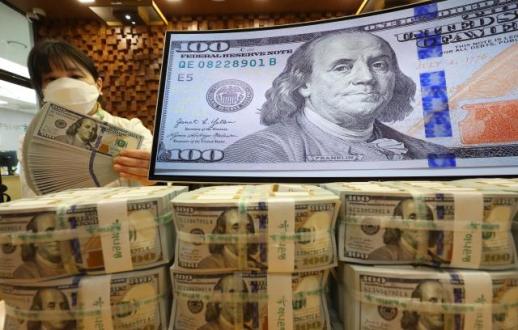 Korea's FX reserves rise in Feb on debt issue amid war-time volatility SEOUL, Mar 05 (AJP) - South Korea’s foreign exchange reserves increased for the first time in three months in February, helped by a $3 billion overseas debt issuance aimed at bolstering ammunition to stabilize the Korean won against major currencies. However, questions remain over how long the increase can be sustained, with the local currency hovering near crisis-era levels in the war aftermath. Foreign reserves rose $1.72 billion from the previous month to $427.67 billion as of end-February — the first increase since November — according to data released Thursday by the Bank of Korea (BOK). The BOK attributed the monthly rise to the successful issuance of foreign exchange stabilization bonds and subsequent investment gains from those funds. Earlier in the month, the central bank tapped global markets with a $3 billion bond issuance to strengthen its intervention capacity. The government issued the U.S. dollar-denominated bonds on Feb. 5, aiming to calm the exchange rate and respond to shifting market dynamics. FX reserves had been declining as authorities intervened to buttress the won, which weakened sharply against major currencies amid rapid capital outflows into U.S. securities. Korean financial authorities deployed a total of $4.7 billion — including $2.6 billion in December and $2.1 billion in January — primarily through a currency swap arrangement between the BOK and the National Pension Service. The currency’s average exchange rate in December consequently appreciated 2 percent to 1,434.9 won per dollar from November’s 1,464.8. It gained a further 0.6 percent in January to 1,427, aided by a broader softening of the U.S. dollar. Those gains were largely erased after the launch of U.S.-Israeli attacks on Iran last Friday and the widening conflict across the Middle East following Iran’s retaliatory strikes on neighboring countries. The dollar briefly surged to around 1,480 won as the KOSPI lost more than 20 percent in two sessions after the war broke out. It later eased to 1,463.50 won as of 8:00 a.m. Thursday amid a partial recovery in oil prices. Despite the volatility, South Korea’s standing in global FX reserve rankings remains largely intact. The country slipped to 10th place globally, losing its ninth-place position to Hong Kong. The shift was primarily driven by the Hong Kong Monetary Authority (HKMA), whose reserves rose $7.7 billion to $435.6 billion in January after realizing substantial gains from asset management operations. 2026-03-05 08:36:46
 -
 BOK issues verbal intervention amid near-4% slide in won since war outbreak SEOUL, Mar 04 (AJP) - The Bank of Korea (BOK) issued a verbal intervention Wednesday, pledging a “timely” response after the Korean won briefly touched crisis-era levels around 1,500 per U.S. dollar amid escalating tensions in the Middle East and rising oil concerns. The warning came after the dollar in the offshore market climbed above the 1,500-won mark overnight — the first time since March 2007 in the aftermath of the global financial crisis. BOK Governor Rhee Chang-yong postponed his departure for Thailand, where he was scheduled to attend an International Monetary Fund conference, and instead presided over an emergency meeting at the central bank. “Volatility in financial markets — including foreign exchange, interest rates and equities — may be inevitable depending on developments in the Middle East,” the bank said in a statement after the meeting. The BOK warned it would respond to “excessive movements” that diverge from economic fundamentals and work with the government to correct any “one-sided” market bias. Seeking to calm investors, the central bank said Korea’s financial system remains liquid and that key external risk indicators — including sovereign borrowing spreads and credit default swap (CDS) premiums — remain stable. As of Tuesday, the CDS premium stood at 25.555 basis points, up 0.53 percent from the previous day. Although the premium had declined for seven consecutive trading days since Feb. 23, it remained near the psychological stability threshold of 25 basis points. By comparison, during the global financial crisis CDS spreads fluctuated around 600 basis points. As of 11:11 a.m., the Korean won traded at 1,480.30 per dollar, marking a decline of nearly 3.9 percent from its Feb. 26 close before the weekend attacks on Iran. 2026-03-04 11:32:25
 -
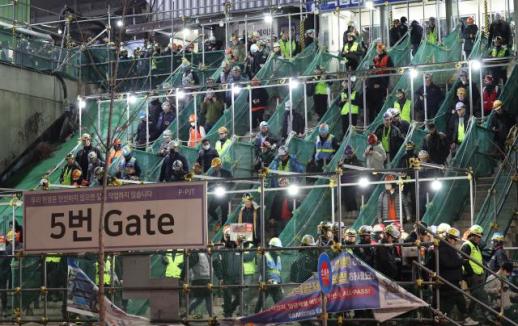 UPDATE: Korea's factory output turns negative in Jan on reduced chip activity **Additional data information added** SEOUL, Mar 04 (AJP) - South Korea’s factory output turned negative for the first time in three months in January on slower semiconductor and construction activity, underlining the fragility of the economic recovery as the year-end base effect faded. Mining and manufacturing output fell 1.3 percent in January from the previous month — the first decline since October, according to data released by the Ministry of Statistics and Data Wednesday. The downturn was driven largely by shipbuilding and semiconductor production. Output from “other transport equipment,” which includes tankers and container ships, shrank 17.8 percent from a month earlier. Semiconductors — a linchpin of the Korean economy — saw production fall 4.4 percent from the previous month and 5.2 percent from a year earlier. Reflecting the slowdown, the average capacity utilization rate for manufacturers slipped 1.4 percentage points to 71.2 percent, while inventories rose 0.2 percent during the same period. Mining and manufacturing shipments also decreased 1.4 percent from the previous month. “The growth trajectory for high-value-added products, such as High Bandwidth Memory (HBM), remains robust,” said Lee Doo-won, director general for economic trend statistics, noting that the pace of semiconductor production growth had already begun to slow since September. Domestic machinery orders edged down 0.1 percent from a year earlier. While private-sector orders rose 4.1 percent, a 53.1 percent plunge in public-sector orders — following a massive 93.2 percent surge the previous month — dragged down the overall figure. “The decline in public machinery orders in January indicates that new large-scale social overhead capital (SOC) projects have entered a lull,” Lee said. The construction sector also swung sharply lower as the year-end spending boost evaporated. Construction investment, which had jumped 12.1 percent in December, plunged 11.3 percent in January, erasing the earlier gains. “A strong base effect was at play following the push-out style of construction completions in December, as both the public and private sectors rushed to exhaust year-end budgets,” Lee added. Despite the current slump, the outlook for construction showed tentative improvement, with total orders rising 35.8 percent from a year earlier. Building orders increased 24.1 percent, while civil engineering orders — including railways — surged 70.5 percent. Still, Lee struck a cautious note, warning that first-quarter performance warrants close monitoring as the January decline came in sharper than expected. A split economic outlook Facility investment provided a bright spot – at least for now, rebounding 6.8 percent from the previous month. The recovery was led by a 41.1 percent surge in semiconductor manufacturing equipment and a 16 percent increase in automotive investment, fueled by a wave of corporate vehicle replacements at the start of the year. While the spillover of export strength into facility investment is a positive signal, the ministry remained cautious. “Uncertainty remains high regarding when the construction sector — which still faces a thin order backlog — will bottom out and rebound,” the ministry said. Economic indicators also showed a notable divergence between current conditions and future expectations. The cyclical component of the coincident composite index, which measures the present economic climate, remained unchanged at 99. In contrast, the cyclical component of the leading composite index — a gauge of future trends — rose 0.7 points to 102.3. A reading of 100 marks the threshold between expansion and contraction. The gap suggests that while optimism about a future recovery is building, the immediate reality remains challenging. “The leading index rose due to a sharp increase in exports, but it is still difficult to say the economy has fully recovered,” the ministry said, pointing to the disconnect between the two indicators. Korea’s exports in January surged 33.9 percent from a year earlier to $65.85 billion, while the monthly trade balance recorded a surplus of $8.7 billion — the 12th consecutive month in the black, according to the Ministry of Trade, Industry and Energy. However, retail sales for food and other non-durable goods — a barometer of household sentiment — plunged 5.4 percent year on year, far steeper than the 0.5 percent decline recorded the previous month. By sector, sales at supermarkets and convenience stores fell 13.8 percent, while those at large hypermarkets tumbled 20.1 percent, reflecting tightening household spending. 2026-03-04 09:48:26
 -
 Middle East Crisis: Brewing oil shock sparks tantrum across Seoul markets SEOUL, Mar 03 (AJP) - Oil supply disruption following the closure of the Strait of Hormuz — the critical artery through which most Middle Eastern crude flows to Asia — is raising fears of another wave of currency volatility and fuel-driven inflation, analysts warned. Iran’s Revolutionary Guards declared the waterway shut, threatening to “set on fire” vessels entering waters bordering Iran. The strait handles roughly 20 percent of global oil supplies and about 80 percent of crude bound for Asia, including South Korea. East Asia remains heavily dependent on Middle Eastern crude. South Korea, alongside Japan, stands out for its high concentration risk and limited import diversification. According to the Korea International Trade Association (KITA), crude imports from five countries — Saudi Arabia, Kuwait, the United Arab Emirates, Qatar and Iraq — accounted for 69 percent of South Korea’s total oil imports in January. Saudi Arabia alone represented nearly half of that volume. Compounding tensions, Iran launched a drone attack on Saudi Aramco’s largest refinery in Ras Tanura. Although Saudi forces intercepted the drones and prevented severe structural damage, fires in the vicinity forced a temporary suspension of operations. Markets reacted immediately. While the UAE suspended Dubai crude trading, Brent crude futures — the global benchmark substitute — surged 8.11 percent on Sunday to $78.36 per barrel. As of 3 p.m. Tuesday, Brent climbed further to $81.24, nearly 30 percent above the $60 range where prices hovered at the start of the year. Oil prices exert a defining influence on consumer inflation. When Dubai crude surpassed $100 per barrel during the Arab Spring uprisings, South Korea’s inflation rate climbed toward 4 percent. Fuel prices are already responding. Gasoline prices in Seoul, which stood at 1,749.65 won ($1.20) per liter last Saturday, rose to 1,768.38 won by March 2 — an increase of more than 1 percent in just three days. Given the typical lag in retail price adjustments, further increases are widely expected. “A 10 percent rise in international oil prices is estimated to lift South Korea’s CPI growth by approximately 0.22 percentage points,” said Kwon Hee-jin, a researcher at KB Securities. Kwon also warned of prolonged instability, noting that unlike Venezuela’s internal collapse, Iran retains strong hardline political and military backing — raising the risk of sustained conflict. Seoul markets suffered one of their steepest declines in recent years. The KOSPI plunged 452.22 points, or 7.24 percent, to close at 5,791.91 — marking one of its sharpest single-day losses. The stock and bond markets both endured heavy selling despite Financial Services Commission Chairman Lee Eog-weon’s pledge Sunday to deploy more than 100 trillion won in market stabilization funds. The Korean won slid 2.9 percent from Friday’s close to 1,467.50 per U.S. dollar on Tuesday, reflecting intensifying capital outflows. The bond market also turned volatile. The three-year government bond yield surged 13.9 basis points to 3.180 percent, while the 10-year yield climbed 14.8 basis points to 3.594 percent — the largest increase since Jan. 20, when yields spiked following President Lee Jae Myung’s signal of a supplementary budget. The sharper rise in short-term yields relative to long-term rates suggests heightened sensitivity to inflation and exchange-rate risks, while also signaling that expectations for further Bank of Korea rate cuts are fading. Safe-haven dynamics were mixed. Gold prices surged past $5,400 per troy ounce as of Sunday, while the Dollar Index rose for three consecutive sessions to 98.42. Yet U.S. Treasury yields moved higher instead of falling, with the 10-year yield jumping 9.3 basis points to 4.036 percent overnight — reflecting investor bets that surging oil prices will reignite inflation. The Bank of Korea’s New York office noted that the likelihood of a near-term Federal Reserve rate cut has “virtually disappeared,” limiting room for the BOK to pursue its own easing cycle. “With short-term inflation expected to rise, it will be difficult for the Fed to maintain accommodative policies,” the BOK’s New York desk said, pointing to unusual weakness in U.S. Treasuries. Meritz Securities researcher Lee Seung-hoon warned that the upper bound for the U.S. 10-year yield could extend toward 4.5 percent, with Korea’s 10-year yield potentially approaching 4 percent. “Bond investors are selling on inflation sensitivity rather than rotating into safe havens,” Lee said. Some analysts, however, remain skeptical that the crisis will become protracted. “If the Strait of Hormuz remains closed for an extended period, pressure from China — one of Iran’s key economic partners — will intensify,” Lee said, predicting Iran may ultimately de-escalate. Ahn Hyun-kook, a researcher at Hanwha Investment & Securities, drew parallels to last year’s tariff escalation. “During the tariff war, President Trump stepped back when market reactions exceeded expectations,” Ahn said. “While Trump may hold leverage on tariffs, he does not control oil prices in the same way.” The Bank of Korea’s London office also assessed that high-intensity combat could conclude within one to two weeks, citing constraints on ammunition reserves on both sides — shorter than earlier projections of four to five weeks. 2026-03-03 17:34:55
 -
 Korea's one-winged rally: stock and economy reliant on chips SEOUL, Feb 27 (AJP) - From eye-popping KOSPI gains — more than doubling since the start of 2025 — to growth rebounding toward a potential rate of around 2 percent, South Korea’s economy appears, at first glance, to be regaining momentum. But strip away the semiconductor effect, and the underlying picture remains fragile. After an almost uninterrupted rally since year-end, the benchmark KOSPI briefly traded above 6,300 this week — only a month after celebrating the 5,000 milestone. It ended Friday at 6,244.13, taking a modest breather after a near 50 percent surge in the first two months of the year. The rally has been driven overwhelmingly by semiconductor bellwethers. Samsung Electronics is trading around 200,000 won ($141) per share, while SK hynix has crossed 1 million won ($709). Both companies are projected to post more than $100 billion in operating profit amid explosive demand for high-bandwidth memory powering artificial intelligence infrastructure. Growth upgraded — but narrowly based The semiconductor boom has lifted broader growth forecasts. The Bank of Korea (BOK) on Thursday revised up its 2026 growth estimate to 2 percent from 1.8 percent, following 1 percent growth in 2025. The IMF and OECD have also projected expansion near 2.1 percent. Yet the structure of that growth is increasingly concentrated. Excluding the IT sector, growth would slow to around 1.4 percent, according to the BOK. The growth gap between the IT sector and other industries widened from roughly 5 percentage points in the second half of 2024 to 9.5 percentage points by the third quarter of 2025. Construction investment — a key gauge of domestic demand — is projected to contract 2.1 percent this year. As high-value jobs cluster in semiconductors and other advanced manufacturing, income disparities are widening. Wages in IT manufacturing have risen since 2025, while pay levels in other sectors have stagnated or declined. The stock market reflects the same imbalance. On Wednesday, when the KOSPI broke through 6,000, Samsung Electronics rose 1.75 percent to 203,500 won and SK hynix gained 1.3 percent to 1,018,000 won. Yet nearly 60 percent of listed stocks — about 1,400 issues — declined that day. Together, Samsung Electronics and SK hynix now account for roughly 40 percent of total KOSPI market capitalization with valuation topping 2,000 trillion won. When President Lee Jae Myung took office on June 4, their combined market cap stood near 700 trillion won. Samsung Electronics on Thursday joined the exclusive $1-trillion market-cap club. Such concentration raises vulnerability concerns. “South Korean stocks could fluctuate more significantly than those of other nations in the event of a global slowdown or supply chain disruption,” the Korea Center for International Finance (KCIF) warned Friday, citing excessive semiconductor concentration in the domestic market. K-shaped growth in focus Policymakers are increasingly acknowledging the imbalance. In the BOK’s latest six-month dot plot, four out of 21 rate projections pointed to a 25-basis-point cut to 2.25 percent. While most members favored holding rates steady, the presence of easing signals suggests that some policymakers are weighing sectoral weakness beneath headline growth. “Our economy appears to be moving toward 2 percent growth based on outward indicators, but a closer look reveals the challenge of K-shaped growth,” President Lee Jae Myung said at a growth strategy meeting on Jan. 9. Governor Rhee Chang-yong noted that stagnation in non-IT sectors remains a concern. “There were arguments that the stagnation of other industries due to K-shaped growth must be taken into account,” he said, without specifying individual committee views. Economists warn that divergence between sectors could translate into deeper polarization. “The gap in economic growth leads to a gap in the stock market, which in turn widens income and asset disparities,” said Kim Gwang-suk, head of the Economic Research Office at the Korea Institute for Industrial Economics & Trade (KIET). “Support should focus on non-semiconductor industries such as agriculture and chemicals, rather than sectors that have already achieved self-sustainability.” Others argue that boosting productivity through technological innovation may offer a longer-term solution. “Physical AI — applying software intelligence to physical industrial environments — can significantly enhance productivity if implemented effectively,” said Yoo Seung-joo, professor of computer engineering at Seoul National University. Korea possesses a strong industrial base capable of adopting such solutions, said Hwang Soo-wook, a researcher at Meritz Securities, adding that broader AI deployment across manufacturing sites could narrow productivity gaps. 2026-02-27 16:33:50
 -
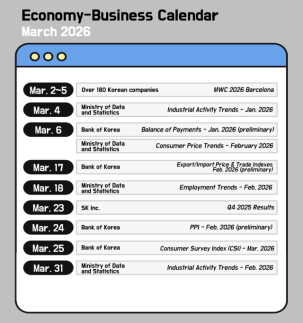 Korean Economy/Business Calendar SEOUL, Feb 27 (AJP) - Mar. 2–5 (Mon–Thu) MWC 2026 Barcelona - Over 180 Korean companies Mar. 4 (Wed) Jan. 2026 Industrial Activity Trends - Ministry of Data and Statistics Mar. 6 (Fri) Jan. 2026 Balance of Payments (Preliminary) - Bank of Korea February 2026 Consumer Price Trends - Ministry of Data and Statistics Mar. 17 (Tue) Feb. 2026 Export/Import Price & Trade Indexes (Preliminary) - Bank of Korea Mar. 18 (Wed) Feb. 2026 Employment Trends - Ministry of Data and Statistics Mar. 23 (Mon) (Mon) Q4 2025 Results - SK Inc. Mar. 24 (Tue) Feb. 2026 PPI (Preliminary) - Bank of Korea Mar. 25 (Wed) Mar. 2026 Consumer Survey Index (CSI) - Bank of Korea Mar. 31 (Tue) Feb. 2026 Industrial Activity Trends - Ministry of Data and Statistics *Major Shareholders' Annual General Meetings (AGM) Mar 18 (Wed) - Samsung Electronics Mar 20 (Fri) - Samsung Biologics - Samsung C&T - LG Energy Solution - Kia Mar 23 (Mon) - LG Electronics - NAVER Mar 24 (Tue) - POSCO Holdings - Celltrion 2026-02-27 16:11:14
 -
 NPS enjoys record returns on two-year KOSPI rally SEOUL, February 27 (AJP) -South Korea’s National Pension Service (NPS) posted a record annual investment return of 18.82 percent in 2025 — the highest since its establishment in 1988 and outperforming major global pension peers — driven by an exceptionally strong domestic equity rally. The double-digit return generated 231.6 trillion won in earnings, nearly five times its annual pension payout of 49.7 trillion won, and lifted total assets under management to 1,458 trillion won, the fund said Thursday. The cumulative average annual return since inception reached 8.04 percent. The NPS outperformed major overseas pension funds on a calendar-year basis. Japan’s Government Pension Investment Fund returned 12.3 percent, Norway’s Government Pension Fund Global gained 15.1 percent, Canada Pension Plan Investment Board posted 7.7 percent, while the Netherlands’ ABP recorded a negative 1.6 percent return. By asset class, domestic equities delivered an exceptional 82.44 percent return, leading overall performance. Overseas equities gained 19.74 percent, domestic bonds returned 0.84 percent, overseas bonds rose 3.77 percent and alternative investments yielded 8.03 percent. The NPS attributed the sharp rise in domestic stocks to a rally in artificial intelligence- and semiconductor-related shares, along with expectations for government capital market reforms. The benchmark KOSPI index soared 75.63 percent in 2025, far outpacing the global average gain of 22 percent. Overseas equities remained resilient despite uncertainties surrounding U.S. tariff policy, supported by solid earnings from global technology companies. Domestic bonds posted modest gains following two benchmark rate cuts and signs of economic recovery. Overseas bonds also generated positive returns, benefiting from three U.S. rate cuts and declining yields amid growth concerns. Returns from alternative investments reflected valuation gains and realized profits, the fund said. NPS Chairman Kim Sung-joo said the record performance stemmed from disciplined risk management, diversified asset allocation and continued improvements in operational infrastructure, including the performance-based compensation system. “In particular, the strong rise in domestic equities contributed significantly,” Kim said, adding that the fund would further strengthen investment capabilities and pursue flexible asset allocation and regional diversification to secure stable long-term returns. The final evaluation of the 2025 fund management performance will be confirmed by the Fund Management Committee around the end of June following a review by its risk management and compensation advisory panel. Early indicators suggest momentum has carried into 2026. Market observers estimate the NPS could already be seeing returns of around 9 percent for the year to date, supported by a sharp rally in Korean equities during the first two months. Samsung Electronics on Thursday joined the $1 trillion market capitalization club, while the KOSPI has surged close to 50 percent so far this year, extending a powerful two-year rally. 2026-02-27 14:52:40