
Journalist

Kim Yeon-je
duswogmlwo77@ajupress.com
-
 Retail traders bet on US markets as KOSPI rally continues SEOUL, Jan. 7 (AJP) - While the KOSPI continues its record-breaking rally on Wednesday, breaching the 4,600-level for the first time in history, the unwavering appetite of South Korean retail investors for U.S. equities remains a dominant market force. According to data from Koscom ETF CHECK, the most net-purchased ETFs by retail investors over the past week were the TIGER US S&P 500 and KODEX US S&P 500. Individual traders poured nearly 350 billion Korean won (US$241.7 million) into these two funds, with net purchases of 225.9 billion won and 121 billion won, respectively. The preference for Wall Street extended to tech-heavy indices, as retail investors also snatched up 96.0 billion won of KODEX US Nasdaq 100 and 77.6 billion won of TIGER US Nasdaq 100, signaling a persistent bias toward U.S. growth stocks. This exodus of capital into overseas markets is a long-standing trend rather than a fleeting phenomenon. Between January and October last year, South Koreans invested a net $117.1 billion in overseas securities — comprising $89.9 billion in equities and $27.2 billion in bonds. October alone recorded a record $17.3 billion outflow. Data from the Bank of Korea further underscores this imbalance; while domestic investment in foreign securities jumped by $17.27 billion, foreign investment in South Korean equities grew by a mere $5.2 billion, highlighting a stark divergence in market confidence. Ironically, the most popular domestic equity ETF among retail investors was the KODEX 200 Futures Inverse 2X, known colloquially as the "Gop-bus" - which tracks twice the inverse of the KOSPI 200's daily performance. Retail traders bet 116.4 billion won on a market downturn, despite the ETF plunging 15.93 percent over the past week as the index continued to climb - suggesting that a significant segment of the retail market expects an imminent correction following the recent streak of record highs. Institutional investors, in contrast, are doubling down on the domestic rally. Over the past week, institutions focused their buying on the KODEX Leverage and KODEX KOSDAQ 150 Leverage, with net purchases of 85.8 billion won and 79.8 billion won, respectively. These leverage products provide twice the daily return of their underlying indices, reflecting institutional confidence that the domestic bull market still has room to run despite the height of the current valuation. Brokerages are fueling this optimism by aggressively raising their year-end targets. Yuanta Securities recently hiked its 2026 KOSPI forecast range to 4,200–5,200 points from 3,800–4,600, while Kiwoom Securities raised its band to 3,900–5,200 points. On Tuesday, Korea Investment & Securities significantly upgraded its KOSPI target to 5,650 from 4,600, citing the high probability of further upward revisions in operating profit forecasts for semiconductor giants. However, the narrow breadth of the rally remains a point of skepticism for individual investors. The surge in the KOSPI is almost entirely dependent on a few mega-cap stocks like Samsung Electronics and SK hynix. The combined market capitalization of these two firms has reached 1,374.8 trillion won, accounting for a staggering 36.6 percent of the total KOSPI value as of Wednesday. Historical data also serves as a cautionary tale; while the KOSPI saw explosive growth during the "Three Lows" boom of 1987–1988 and the short-term recovery after the 1997 Asian financial crisis, these rallies were often followed by stagnant or sharply declining markets, such as the 50.92 percent crash in 2000 following the IT bubble. Analysts suggest that the anxiety over domestic volatility is driving the demand for global asset allocation toward U.S. markets. Even among experts, measuring appropriate valuations for the KOSPI has become a challenge due to its rapid ascent. "It is historically unprecedented for the KOSPI to lead global markets with such a dominant growth rate," said an analyst at a major brokerage, on condition of anonymity, adding that market sentiment is likely to remain volatile for the time being, although the ceiling for the index remains high. 2026-01-07 17:23:29
 -
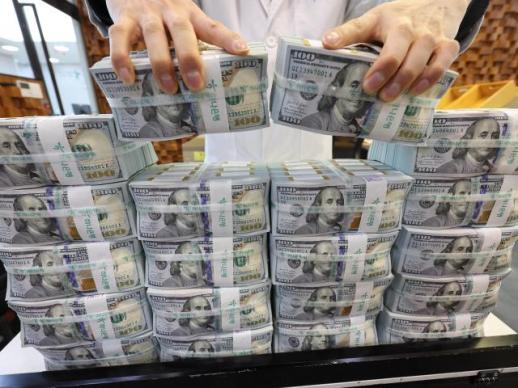 Seoul's all-out defense of the won takes heavy toll on FX reserves Dec SEOUL, January 06 (AJP) - South Korea’s foreign-exchange reserves fell by nearly $3 billion in December, marking the largest monthly decline among major reserve-holding economies and underscoring the cost of aggressive market intervention to defend the won. According to data released Tuesday by the Bank of Korea, the country’s FX reserves stood at $428.05 billion at end-December 2025, down $2.6 billion from the previous month. While the headline figure remains substantial, the contraction represents the second-steepest December decline on record, surpassed only by the nearly $4 billion plunge during the 1997 Asian financial crisis, when South Korea sought an IMF bailout. The drawdown is notable not only for its size but also for its timing. December is typically a month when global financial institutions build up foreign-currency buffers to meet capital-adequacy requirements under Bank for International Settlements Basel III rules, which recommend a common equity Tier 1 ratio of at least 10.5 percent, including a 2.5-percentage-point capital conservation buffer introduced after the 2008 global financial crisis. In recent years, South Korea followed that seasonal pattern. FX reserves increased in December 2023 and 2024, and even during periods of acute stress the year-end drawdowns were modest. During the 2022 “Legoland” municipal debt default, which rattled domestic credit markets, December reserves fell by just $140 million. At the height of the 2008 global financial crisis, the December decline was limited to about $600 million. An outlier among major reserve holders The divergence between Seoul and its peers was stark. China, the world’s largest reserve holder, added roughly $30 billion to its reserves in December. Japan, ranked second, increased its holdings by around $120 billion, while India added $45 billion, the second-largest increase after Japan. Even Russia, in war-related hemorrhage and sweeping sanctions, recorded a net increase of about $1.5 billion in reserves. The comparison suggests that Korea drew down reserves more aggressively than economies grappling with far more severe external shocks. Other countries did post declines, but for fundamentally different reasons. Switzerland saw a roughly $5 billion drop, largely reflecting valuation effects from a stronger Swiss franc and a weaker U.S. dollar, rather than active intervention. Saudi Arabia’s estimated $15 billion decline reflects deliberate spending to finance large-scale projects such as the Neom giga-city. Korea’s case stands apart. The reserve loss was driven primarily by direct and sustained intervention in the currency market to curb the won’s slide amid renewed dollar strength following the U.S. military operation in Venezuela. Market stability remains a key concern for regulators. As of September, South Korean banks posted a total capital ratio of 15.87 percent, according to the Financial Supervisory Service, a level that appears comfortable on paper. However, during its annual consultation in November, the International Monetary Fund urged Seoul to maintain even higher buffers, citing rapidly rising household debt—now estimated at 2,000 trillion won (about $1.4 trillion)—which is growing faster than in most advanced economies. If government intervention continues, analysts warn that FX reserves could remain under pressure through the end of January. The broader impact on the private financial system may become clearer in March, when the FSS releases updated capital-adequacy data for banks. “Measures to address exchange-rate volatility led to the decrease in reserves,” the Bank of Korea said in its statement. A central-bank official, speaking on condition of anonymity, said the private and institutional sectors are expected to maintain precautionary measures until the exchange rate stabilizes, but declined to comment on how deeply the interventions may be affecting banks’ capital positions. 2026-01-06 17:32:29
 -
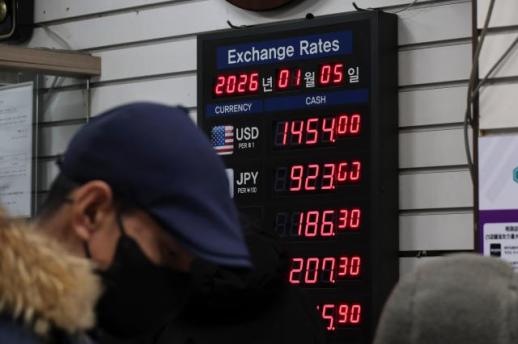 Korea's FX reserves recede by near $3 billion Dec amid won defense efforts FX rates displayed at a currency exchange shop in Seoul’s Myeong-dong on Jan. 5, 2026. AJP You Na-hyun SEOUL, January 06 (AJP) -South Korea’s foreign exchange reserves fell by $2.6 billion in December from the previous month — the first decline in seven months — signaling stepped-up dollar-selling intervention to shore up the won, which had hovered near crisis-era lows. According to a report released Tuesday by the Bank of Korea, the country’s foreign exchange reserves stood at $428.05 billion at the end of December, down from $430.66 billion a month earlier. The reserves had dropped to $404.6 billion at the end of May, the lowest level in nearly five years, after the dollar surged to the 1,480-won range in April amid a tariff barrage from the new Trump administration. They then recovered steadily, topping $430 billion for the first time in three years and three months in November. That milestone proved short-lived, however, as the dollar revisited the 1,480-won range late in the year. Authorities encouraged the National Pension Service and other institutional investors to hedge their dollar exposure to stabilize the won as it edged closer to the psychologically sensitive 1,490-per-dollar level, while mobilizing a range of incentives to prompt the sale of dollar assets. A Bank of Korea official attributed part of the earlier increase in reserves to quarter-end effects, including a rise in foreign-currency deposits at financial institutions and valuation gains from converting non-dollar assets into U.S. dollars. At the same time, measures aimed at curbing foreign-exchange market volatility weighed on the total. These included smoothing operations in both the spot and forward markets, as well as hedging activity by the pension fund, the official said. By asset class, securities — such as government and corporate bonds — fell by $8.22 billion to $371.12 billion, suggesting the divestment of foreign-currency-denominated papers to secure ammunition for won-stabilization efforts. Deposits, by contrast, increased by $5.44 billion to $31.87 billion. Holdings of the International Monetary Fund’s special drawing rights rose $150 million to $15.89 billion, while gold holdings were unchanged at $4.79 billion, as they are recorded at purchase price rather than market value. As of the end of November, South Korea’s foreign exchange reserves ranked ninth globally at $430.7 billion. China topped the list with $3.3464 trillion, followed by Japan ($1.3594 trillion), Switzerland ($1.0588 trillion), Russia ($734.6 billion), India ($687.9 billion), Taiwan ($599.8 billion), Germany ($552.3 billion) and Saudi Arabia ($463.7 billion). The dollar has returned toward the 1,450-won level after all-out year-end stabilization efforts from authorities upon a renewed flight to safe-haven assets following the Venezuela crisis. 2026-01-06 07:44:34
 -
 Asian markets surge to record highs as CES week kicks off SEOUL, January 05 (AJP) - Asian equity markets rallied in a synchronized surge on Monday as investor focus shifted to major technology players ahead of the Consumer Electronics Show (CES) 2026 in Las Vegas. Benchmarks in Seoul and Taipei led the advance, with both markets scaling fresh record highs. South Korea’s benchmark KOSPI jumped 3.43 percent to close at 4,457.52, marking its sharpest daily gain this year and pushing the index to the doorstep of the 4,500 level after surpassing its previous all-time high. Foreign investors drove the rally with net purchases of 2.17 trillion won (about $1.5 billion), while retail and institutional investors booked profits, selling 1.5 trillion won and 703 billion won, respectively. Despite a firmer U.S. dollar amid geopolitical tensions — including a U.S. military operation in Venezuela — the won–dollar exchange rate held nearly flat at 1,446.8 as of 5 p.m. The stability was widely attributed to heavy foreign inflows into Korean tech stocks and continued vigilance by foreign-exchange authorities. Tech leads the charge Blue-chip technology names powered the rally. Samsung Electronics, a flagship CES participant, surged 7.47 percent to a record 138,100 won. Sentiment was buoyed by upbeat brokerage views, with Sangsangin Investment & Securities lifting its 2026 target price to 150,000 won. At CES, Samsung is set to unveil its “Affectionate Intelligence” concept for integrated home appliances. SK hynix, the global leader in high-bandwidth memory (HBM), rose 2.81 percent to a new peak of 696,000 won as it prepares to highlight its role as a “full-stack memory provider.” Optimism spilled over to supply-chain plays, with Hanmi Semiconductor surging 15.8 percent in regular trading before leaping another 23 percent to 178,000 won in after-hours Nextrade (NXT) trading. Energy, utilities and refiners rally Energy and utility stocks also logged outsized gains. Doosan Enerbility soared 10.64 percent to 83,200 won, tracking last week’s rally in U.S. small modular reactor (SMR) names. Korea Electric Power Corporation climbed 7.2 percent to 49,850 won. Manufacturers tied to transformers and high-voltage equipment advanced sharply, with Iljin Electric up 7.23 percent, HD Hyundai Electric gaining 6 percent, and Hyosung Heavy Industries rising 3.7 percent. Refiners joined the rally on expectations of improving margins and reduced Middle East dependence as Washington signaled a push to boost oil production in Venezuela. S-Oil gained 5.35 percent, while SK Innovation added 2.8 percent. Hyundai Motor Company and LG Energy Solution rose 2 percent and 2.9 percent, respectively, as both companies look to showcase new initiatives at CES. The tech-heavy KOSDAQ advanced a more modest 1.26 percent to 957.50, led by aerospace names. Innospace jumped 14.7 percent to 15,570 won, rebounding from earlier launch setbacks, while Nara Space Technology surged 10.1 percent to 31,050 won. Regional markets ride the CES wave Japan’s Nikkei 225 rallied 2.97 percent to 51,832.80, fueled by a broad semiconductor upswing. Chip-testing specialist Advantest climbed 7.84 percent to 21,175 yen, while Tokyo Electron, Disco and Ibiden gained between 6 percent and 8 percent. Toyota Motor Corporation added 1.28 percent. Taiwan’s TAIEX rose 2.57 percent to 30,105.54, extending gains ahead of CES. TSMC jumped 5.36 percent to a record 1,670 Taiwan dollars, cementing its position as the world’s sixth-largest company by market capitalization. MediaTek and Foxconn rose 3.74 percent and 1.08 percent, respectively. On the mainland, China’s Shanghai Composite gained 1.38 percent and the Shenzhen Component climbed 2.24 percent as CES-driven tech optimism lifted sentiment. Hong Kong’s Hang Seng Index, however, ended flat at 26,326.84, with lingering geopolitical uncertainty prompting a more cautious stance among some foreign investors. 2026-01-05 17:25:57
 -
 US surprise armed intervention in Venezuela renews flight to safe-haven assets SEOUL, January 05 (AJP) - The United States’ surprise armed intervention in Venezuela is sending shockwaves through global markets, rekindling demand for traditional safe-haven assets as investors reassess geopolitical risk. The overnight operation targeting Venezuela’s leadership — followed by U.S. President Donald Trump publicly touting it as an “incredible thing” that could be repeated because “nobody can stop us” — has raised fears that Washington’s actions may send the wrong signal to other expansion-minded powers, notably China and Russia. As of 1:50 p.m. Monday, gold surged 2 percent to $4,416 per troy ounce, nearing last year’s record high of $4,565. Silver jumped 5.9 percent to $75. The U.S. Dollar Index edged up 0.3 percent to 98.71, underscoring renewed demand for dollar-denominated safe assets. Asian Currencies Buckle Under Dollar Strength The rush into safe havens weighed on Asian currencies, traditionally vulnerable during periods of heightened geopolitical stress. The Korean won slipped 0.3 percent to 1,447 per dollar, while the Japanese yen weakened 0.1 percent to 157 per dollar by 2 p.m., both struggling against the greenback despite verbal interventions and hints of additional rate hikes from their respective monetary authorities. Precious Metals Take Center Stage Gold and silver remain at the heart of the current market rally. In 2025, gold prices climbed 65 percent, while silver soared an extraordinary 160 percent, driven by its dual role as both a safe-haven asset and a critical industrial input. Persistent supply deficits in silver have amplified its price swings during periods of stress. Earlier warnings that the rally had become overstretched briefly materialized in a correction, with gold falling 4 percent and silver dropping 10 percent. The Venezuelan operation, however, has abruptly reversed expectations of a cooling market. Geopolitical Shock Overrides Prior Forecasts Before the strikes, several analysts — including Avi Gilburt of ElliottWaveTrader — had expected safe-haven gains to be capped this year, projecting gold to peak near $5,000 and silver to face resistance in the $75–$80 range. Those projections were upended as U.S. military action injected fresh geopolitical uncertainty into markets. Historically, bullion has served as a frontline hedge during global shocks. Gold and silver jumped 5.7 percent and 5.2 percent, respectively, on the day of the September 11 attacks, and rose 3.2 percent and 4.5 percent following Russia’s invasion of Ukraine. “Geopolitical uncertainty directly translates into increased demand for gold, silver and other safe-haven assets,” said Kim Doo-eun, senior research fellow at Hana Securities. Citing precedents such as the Iraq War and 9/11, Kim said prices could climb an additional 10 to 20 percent, warning that markets are particularly sensitive to actions perceived as setting dangerous precedents. ‘Wrong Signal’ Risk Looms Large Concerns are mounting that Washington’s logic in Venezuela could be mirrored elsewhere. “The logic used by the U.S. could be co-opted by China to justify a crackdown on so-called separatist forces in Taiwan, or by Russia to rationalize further military action in Ukraine,” said Lee Jun-seok, leader of the Reform Party, in a Facebook post Sunday. Lee also warned that North Korea — long accused of cyberattacks and illicit activities — could respond with provocation amid heightened global tensions. Similar concerns were echoed by Kenneth Rogoff, Maurits C. Boas Professor at Harvard University, who said at the American Economic Association meeting that the Venezuelan operation could serve as a future military pretext for China over Taiwan. Rally Faces Structural Limits Despite the sharp move, analysts are doubtful of a prolonged surge. “Safe-haven assets typically require a broader economic slowdown to sustain a long-term rally,” Kim of Hana Securities said. “From that perspective, it is unlikely that gold and silver can maintain this pace indefinitely.” Choi Jin-young, a commodity analyst at Daishin Securities, projected that while precious metals may continue to rise through the first half of the year, demand could soften in the second half as capital rotates toward energy markets. Rising oil and gas prices often divert investment away from bullion. Venezuela’s oil production — accounting for less than 1 percent of global output — is unlikely to trigger a supply shock large enough to stabilize energy markets in the near term, Choi added. 2026-01-05 16:32:52
 -
 Squeezed by lunch inflation, Korean salaried workers find traditional meals increasingly pricey SEOUL, January 02 (AJP) - With lunch inflation continuing to climb, the typical midday meal for South Korea’s salaried workers is quietly changing. Once a go-to comfort food, hot or cold noodle dishes are becoming noticeably more expensive, driven largely by rising import costs. Kalguksu — the traditional knife-cut noodle soup — has reached a fresh record high, reflecting the prolonged impact of a weak won and higher input prices. According to data from the Korea Consumer Agency, the average price of a bowl of kalguksu in Seoul stood at 9,846 won ($6.82) as of November 2025, up 4.91 percent from a year earlier and edging closer to the psychologically important 10,000-won mark. Among major dining-out items tracked by the agency, kalguksu posted the second-largest annual price increase, trailing only gimbap. Other popular meals such as naengmyeon (cold noodles) and bibimbap also recorded notable price hikes. Overall, noodle prices have been rising by an average of about 5 percent annually since 2023, reflecting sustained cost pressure in the food sector. Analysts point to currency weakness as the main driver. Between November 2024 and November 2025, the average won-dollar exchange rate climbed 4.3 percent, from 1,395 won to 1,455 won per dollar. Over the same period, international wheat prices on the Chicago Board of Trade remained relatively stable, suggesting that exchange-rate effects — rather than global commodity spikes — are pushing up costs. South Korea depends on imports for nearly 98 percent of its wheat consumption, with domestic self-sufficiency hovering around just 2 percent. As a result, fluctuations in the currency are quickly passed on to food prices, especially for flour-based dishes. A walk through Seoul’s Jongno district on Friday showed that many restaurants now charge 10,000 won or more for a bowl of kalguksu, while eateries offering the dish for under 9,000 won have become increasingly hard to find. As traditional meals grow pricier, fast-food chains are moving quickly to position themselves as cheaper lunch alternatives. Major franchises now offer set menus priced between 6,000 won and 7,000 won — up to 40 percent cheaper than a typical bowl of kalguksu. Burger King, for example, has rolled out “two for 6,000 won” deals on Whopper Jr. sets. McDonald’s and Mom’s Touch, a domestic chicken-burger chain, also maintain lunch menus priced at around 6,300 won and 7,000 won, respectively. The shift toward burgers and fast food is also reflected in corporate earnings. Amid persistent meal-price inflation since 2024, McDonald’s Korea posted record annual revenue of 1.29 trillion won and returned to operating profit for the first time in eight years. Mom’s Touch likewise reported record results, with consolidated revenue of 417.9 billion won and operating profit of 73.4 billion won. Burger King Korea also delivered strong performance, logging 792.7 billion won in revenue and 38.4 billion won in operating profit, underscoring how value-oriented menus are reshaping lunchtime consumption patterns. As everyday meals grow more expensive, the humble lunch — once a small pleasure in the middle of the workday — is becoming another pressure point for Korea’s salaried workers, highlighting how currency weakness and food inflation are quietly reshaping daily life. 2026-01-02 17:15:27
 -
 China's silver export curb adds cost pressure on Korea' tech activities SEOUL, January 02 (AJP) - China’s move to tighten controls on silver exports is set to add fresh cost pressure on South Korean industries heavily reliant on the precious metal, at a time when prices are already surging on strong demand from high-tech and clean-energy sectors. From Jan. 1, exporters in China must obtain government approval to ship silver overseas, after Beijing added the metal to its “2026 List of Goods Subject to Export Licensing Administration.” The measure places silver alongside tungsten, antimony and rare earth elements — materials China has increasingly treated as strategic assets in its economic and technological rivalry with the United States. China dominates the global silver supply chain, accounting for an estimated 60 to 70 percent of internationally traded refined silver. It also ranks second worldwide in silver reserves and mine output, trailing only Mexico, reinforcing its position as a pivotal player capable of influencing global supply conditions. The policy comes as silver has emerged as “the new gold,” buoyed by soaring demand tied to its wide industrial applications and its appeal as a hedge asset. Silver futures surged more than 150 percent in 2025, rising from around $20 per troy ounce at the start of the year to about $71 by the final trading session — the strongest gain among major commodities. The rally was driven by five consecutive years of global supply deficits and a weakening U.S. dollar, which boosted demand for safe-haven assets. Although prices briefly retreated from a late-December peak of $86 per ounce, China’s export curbs reignited market momentum. Silver prices jumped about 3 percent on Friday, approaching $73 per ounce as of 1:30 p.m. For South Korea, the trend poses a growing headwind. Silver is a critical input across the country’s high-tech manufacturing base, including electronics, semiconductors and advanced materials, as well as a key component of the domestic smelting industry. The metal plays an increasingly central role in the AI and digital era due to its superior electrical conductivity — the highest among major metals. It is used as a protective coating to prevent copper oxidation in printed circuit boards, and as electrodes in multilayer ceramic capacitors (MLCCs), both of which are essential components in smartphones, data centers and AI servers. Beyond electronics, silver is indispensable in solar panels, where silver paste converts sunlight into electricity. It is also used, alongside platinum, as a catalyst in water electrolysis systems for hydrogen fuel production. As a result, rising silver prices directly translate into higher costs and weaker margins across a wide range of advanced industries. The burden is already showing up in trade data. According to the Bank of Korea, import prices for the “other precious metals” category — which includes silver — surged 66 percent year on year in November, exacerbated by both higher global prices and the weak won. Korea Zinc, one of the world’s largest non-ferrous metal producers, is particularly exposed. Silver accounts for more than 30 percent of the company’s total revenue, surpassing even zinc, its flagship product. With ore procurement costs climbing, analysts warn that profit margins could come under mounting pressure. Wall Street expects the rally to continue. Goldman Sachs has forecast silver prices could reach $100 per troy ounce in 2026, while Citigroup projects a potential peak of up to $110, underscoring the long-term supply tightness surrounding the metal. 2026-01-02 14:47:17
 -
 KOSPI kicks off new year while most Asian markets stay closed SEOUL, January 2 (AJP) - Most Asian bourses remained closed for New Year celebrations on Friday, while South Korea's stock market opened an hour later than usual, amid expectations of reaching a new all-time high for the year. With Taiwan's TAIEX and Hong Kong's Hang Seng Index open, South Korea's benchmark KOSPI opened higher, up 0.57 percent at 4,238. Having already surpassed its previous intraday peak, attention now turns to whether it can close above its record high of 4,221.87. The rally is being led by retail investors, who have net purchased 110.6 billion Korean won (US$76.7 million) worth of shares. In contrast, foreign and institutional investors have offloaded 81 billion won and 35 billion won, respectively. Blue-chip stocks gained ground across the board. Samsung Electronics rose 2.6 percent to 123,000 won, continuing its record-breaking streak, while SK hynix posted a more modest gain of 0.8 percent to trade at 657,000 won. The semiconductor sector maintains its upward momentum as global demand remains robust and domestic and foreign brokerages continue to raise earnings forecasts for both tech giants. Celltrion emerged as the standout performer, surging 9.5 percent to 198,500 won. The surge followed a preliminary disclosure projecting a more than 140 percent increase in operating profit compared to the same period last year. However, some firms faced significant headwinds. Korea Zinc dropped 2.4 percent to 1,285,000 won during the morning trade following the Chinese government's announcement of export controls on silver. The move raised concerns over supply disruptions and potential margin erosion for the non-ferrous metal producer. In the currency market, the won weakened slightly against the greenback, trading at 1,440.50 per dollar. Meanwhile, Taiwan's TAIEX rose 0.4 percent to 29,050.75, with Taiwan Semiconductor Manufacturing Co. (TSMC) gaining 0.3 percent to 1,555 Taiwan dollars ($49.6). MediaTek led the gains on the index, jumping 1.75 percent to 1,455 Taiwan dollars. The Hang Seng Index opened 0.87 percent higher at 25,860, recording the strongest start among Asian markets. Heavyweight Tencent Holdings edged up 0.25 percent to 600 Hong Kong dollars ($77), while Alibaba Group gained 0.28 percent to 143 Hong Kong dollars. Tech giant Xiaomi also traded up 0.3 percent at 39.5 Hong Kong dollars. 2026-01-02 11:16:53
 -
 Stock boom, currency bust: Korea's uneven market rally may spill into 2026 SEOUL, December 31 (AJP) - Roaring stock prices and a tumbling currency defined South Korea’s financial markets in 2025 — a divergence that may persist well into next year. The benchmark KOSPI closed the year Tuesday at 4,214.17, up 75.6 percent from a year earlier, while the tech-heavy KOSDAQ jumped 37 percent to 925.47. Both far outperformed regional peers, powered by surging demand for semiconductors, shipbuilding and defense-related stocks. Chipmakers were the undisputed champions. Samsung Electronics surged 125 percent to close at 119,900 won ($82.9), while SK hynix soared 250 percent to 651,000 won. Together, the two now account for more than one-third of the KOSPI’s total market capitalization, underscoring the market’s heavy concentration in artificial intelligence–linked plays. Shipbuilders also enjoyed a banner year. Hanwha Ocean jumped 204 percent to 113,600 won, driven by its strategic alignment with U.S. industrial policy, including the acquisition of Philly Shipyard. The move has positioned the company to secure lucrative U.S. naval maintenance, repair and overhaul (MRO) contracts, alongside a strong backlog of LNG carrier orders. Defense stocks delivered similarly robust gains. Hanwha Systems rose 140.7 percent, while LIG Nex1 climbed 90.9 percent, defying earlier expectations that easing tensions in the Middle East would dampen demand. Instead, the prolonged war in Ukraine and an intensifying global arms race continued to provide strong tailwinds. “Semiconductor stocks are expected to account for more than half of the KOSPI’s projected 14 percent return in 2026,” said Lee Jae-man, a researcher at Hana Securities, adding that defense companies are also poised for further upside as the government earmarks a record share of its research and development budget for military technologies. Lee singled out Hanwha Ocean for its strengthening pricing power and expanding profit margins. Bullish outlook — with caveats Market sentiment remains broadly optimistic. Daishin Securities and NH Investment & Securities project the KOSPI could peak between 5,300 and 5,500, supported by synchronized monetary easing and fiscal stimulus across major economies. Lee Kyung-min, a strategist at Daishin, said the rally reflects a coordinated global shift toward rate cuts, suggesting the cyclical bull market could extend at least through the first half of 2026. Government-led “value-up” initiatives have also helped narrow the so-called Korea discount. Measures such as tax incentives for higher dividend payouts, tighter fiduciary duties for corporate directors, and plans to expand pension fund investment into the KOSDAQ have bolstered investor confidence. Still, risks are mounting. Analysts warn of renewed talk of an AI bubble and the possibility of a sharper-than-expected policy pivot if inflation reaccelerates. “A liquidity squeeze following the end of the global easing cycle could trigger a market correction,” Hana Securities cautioned, noting that renewed inflation pressure in the United States could quickly sour risk sentiment. Won weakness clouds the rally In stark contrast to soaring equities, the Korean won remained among the weakest major currencies. It closed the year at 1,445.4 per dollar, down nearly 9 percent from its high earlier in May. The divergence between stocks and the currency is highly unusual. “It is unprecedented for the KOSPI to break above 4,000 while the exchange rate stays entrenched above the 1,400-won level,” said Kim Hak-kyun, managing director at Shinyoung Securities. A key driver has been the surge in overseas investment by Korean residents. From January to October, net outbound investment reached a record $117.1 billion, with $17.3 billion flowing out in October alone — the largest monthly outflow on record. The wide interest-rate gap between South Korea and the United States continues to weigh on the won. While the Federal Reserve has begun easing, its policy rate of 3.75 percent still far exceeds the Bank of Korea’s 2.5 percent, limiting Seoul’s room to maneuver. The central bank remains constrained by household debt exceeding 1,000 trillion won, making rate hikes politically and economically untenable. “Unless the U.S. economy deteriorates sharply, downward pressure on the won is likely to persist,” said Moon Jung-hee, an economist at KB Kookmin Bank. Some relief may come from policy and structural developments. The government’s foreign-exchange stabilization measures and South Korea’s inclusion in the World Government Bond Index (WGBI) next April could provide a floor for the currency. “The WGBI inclusion alone could attract stable long-term inflows, potentially pulling the exchange rate back toward the low-1,400 range,” said Seo Jeong-hoon, a researcher at Hana Bank. He added that a possible policy shift at the U.S. Federal Reserve under a Trump administration more inclined toward monetary easing could give the won additional breathing room by late 2026. 2025-12-31 16:43:44
 -
 Korean Economy/Business Calendar SEOUL, December 31 (AJP) - Jan 8 (Thu) 3rd–4th Quarter 2025 Flow of Funds (Preliminary) - Bank of Korea Jan 2nd week (estimate) Q4 Results (Preliminary) - Samsung Electronics Q4 Results (Preliminary) - LG Electronics Q4 Results (Preliminary) - LG Energy Solution Jan 14 (Wed) Dec. 2025 Export and Import Price Index & Terms of Trade Index (Preliminary) - Bank of Korea Dec. 2025 Annual Employment Trends - Ministry of Data and Statistics Nov. 2025 Household Income and Expenditure Trends - Bank of Korea Jan 20 (Tue) Dec. 2025 Producer Price Index (Preliminary) - Bank of Korea Jan 22 (Thu) 4Q & 2025 GDP (Preliminary) - Bank of Korea Jan 23 (Fri) Jan. 2026 Consumer Sentiment Index - Bank of Korea Jan 4th Week (estimate) Q4 Results - SK hynix Q4 Results - Hyundai Motor & Kia Jan 27 (Tue) Jan. 2026 BSI & ESI - Bank of Korea Dec. 2025 Weighted Average Rate - Bank of Korea Jan 28 (Wed) Nov. 2025 Population Trends - Ministry of Data and Statistics Jan 30 (Fri) Dec. & 2025 Industrial Activity Trends - Ministry of Data and Statistics 2025-12-31 15:04:30