
Journalist

Candice Kim and Seo Hye Seung
ellenshs@ajunews.com
-
 AJP Eye: Samsung strike crisis lays bare Korea's dependence on one company SEOUL, May 18 (AJP) -A rare coalition of voices — the government, opposition politicians and even the central bank — has united this week to try to head off a walkout at the world's largest memory chipmaker, underscoring the outsized weight of Samsung Electronics - responsible for roughly one-fifth of South Korea's exports and the benchmark KOSPI index. What began as a labor dispute over bonuses has rapidly become a national economic and political flashpoint, exposing how deeply the country's economy, financial markets and policy stability remain tied to the fortunes of a single corporate giant. Samsung Electronics labor and management resumed talks Monday — a second round of post-mediation negotiations at the Central Labor Relations Commission in Sejong — with three days left before the union's planned 18-day general strike, set to begin May 21. Negotiators remained deadlocked in the backdrop of heavy pressure. "It's a parallel line," commission chairman Park Soo-geun told reporters repeatedly outside the mediation room when asked whether any progress had been made. No compromise proposal had been drafted as of late afternoon. The marathon negotiations, which began at 10 a.m. Monday and were scheduled to continue Tuesday, are widely viewed as the final realistic opportunity to avert the first prolonged large-scale strike in Samsung's semiconductor division. At the heart of the standoff is the union's demand to abolish the existing 50 percent cap on performance bonuses and lock in a formula allocating 15 percent of operating profit to bonus pools. Management has countered with a three-year proposal that would preserve the current Overall Performance Incentive framework while setting aside additional profit-sharing funds only if the Device Solutions division's operating profit surpasses 200 trillion won ($145 billion). An emergency report recently submitted by the Bank of Korea to the presidential office warned that an 18-day strike followed by a prolonged production recovery could shave as much as 0.5 percentage point off South Korea's economic growth this year. The central bank estimated semiconductor production losses at around 30 trillion won if memory chip lines suffer a full shutdown and require three additional weeks to normalize — effectively erasing roughly 15 trillion won in GDP value-added from an economy forecast to grow about 2.5 percent this year. The central bank reportedly modeled multiple scenarios based on shutdown rates, supply chain disruptions and global chip pricing. The concern reflects the uniquely fragile structure of chip fabrication. Unlike conventional manufacturing, semiconductor production flows continuously around the clock, with wafers moving through tightly synchronized processes measured in seconds. Even small delays can ripple across entire facilities. Industry watchers estimate Samsung's memory operations alone could lose nearly 900 billion won per day if wafers miss designated processing windows and must be discarded. Samsung controls more than 40 percent of the global DRAM market, meaning any disruption would reverberate across global electronics supply chains and could trigger sharp price increases in memory chips used in smartphones, AI servers and personal computers. The government's increasingly direct intervention illustrates the scale of concern. Prime Minister Kim Min-seok warned over the weekend that the upcoming talks represented "effectively the last chance" to prevent a strike, while officials openly raised the possibility of invoking emergency arbitration powers — a rarely used measure that can suspend strikes deemed harmful to the national economy. President Lee Jae Myung added further pressure Monday in a lengthy social media post, acknowledging that labor rights are constitutionally protected but arguing they may be limited "for public welfare" so long as their essential substance is not violated. "In a free democratic and capitalist market economy like South Korea, labor must be respected as much as business, and management rights must be respected as much as labor rights," Lee wrote. His remarks were widely interpreted as a warning that the administration remains prepared to escalate intervention if negotiations collapse. The political establishment, business groups and shareholder activists have since joined the pressure campaign. Six major business lobbies — including the Korea Enterprises Federation and the Korea Chamber of Commerce and Industry — issued a joint statement urging the union to stand down and calling on the government to invoke emergency arbitration immediately if a walkout proceeds. A retail shareholder advocacy group warned separately that institutionalizing fixed profit-sharing formulas could infringe on shareholder property rights and conflict with corporate capital principles. The union fired back, accusing the government of acting as Samsung's spokesperson rather than an impartial mediator. The National Samsung Electronics Union argued that official warnings about "months-long paralysis" overstated operational realities, noting that semiconductor facilities routinely undergo temporary shutdowns and maintenance without catastrophic consequences. Adding another dimension to the confrontation, a Suwon court on Monday partially granted Samsung's injunction request to prohibit illegal strike actions. The court barred the union from occupying production and research facilities and ordered workers responsible for critical safety, drainage, ventilation and wafer protection to maintain normal staffing throughout any strike — effectively ensuring roughly 7,000 essential employees remain on site and reducing the likelihood of a complete plant shutdown. Still, industry experts warned that even without a full shutdown, prolonged labor disruption could severely damage productivity, delay equipment maintenance and disrupt high-value process calibration. "Even slight imbalances in one section of the semiconductor flow can trigger a domino effect across upstream and downstream processes," one industry executive said. The confrontation has also become a broader symbol of South Korea's economic concentration risk. For decades, Samsung Electronics has functioned not merely as a corporation but as a pillar of national growth — driving exports, tax revenue, pension returns and market sentiment. That central role has grown more pronounced during the global AI boom, with Samsung and rival SK hynix powering much of Korea's recent stock market rally. A prolonged disruption now threatens not only chip exports but also currency stability, investor confidence and broader perceptions of Korea's economic resilience. As the clock ticks toward a potential disruption in global chip supplies, South Korea this week finds itself confronting an uncomfortable reality: a labor dispute inside Samsung Electronics has become a stress test for the limits of the country’s entire economic model. 2026-05-18 18:35:07
 -
 Son Heung-min heads to fourth World Cup as Korea names 26-man squad SEOUL, May 17 (AJP) - Son Heung-min will lead South Korea to his fourth and possibly final World Cup after head coach Hong Myung-bo named the 26-man squad for the 2026 tournament on Saturday. Hong announced the roster in Seoul, selecting three forwards, 10 midfielders, 10 defenders and three goalkeepers for the June 11-July 19 World Cup in North America. South Korea competes in Group A against Czechia, South Africa and Mexico, with all three group-stage matches to be played in Mexico. Son, now with Los Angeles FC, will become only the fourth South Korean player to appear in four World Cups, joining Hong Myung-bo, Hwang Sun-hong and former goalkeeper Lee Woon-jae. The 33-year-old previously played at the 2014 Brazil, 2018 Russia and 2022 Qatar tournaments. Key European-based players Lee Kang-in of Paris Saint-Germain and Kim Min-jae of Bayern Munich were also included, along with Mainz midfielder Lee Jae-sung and Feyenoord midfielder Hwang In-beom, who is recovering from an ankle injury. Besiktas forward Oh Hyeon-gyu earned his first World Cup call-up after serving as a reserve player at the 2022 tournament, when Son was recovering from a facial fracture but ultimately played all four matches in Qatar wearing a protective mask. Jens Castrop of Borussia Monchengladbach also made history as the first foreign-born player of mixed heritage to be named to South Korea’s World Cup squad. The 22-year-old was born to a Korean mother and German father. Gangwon FC defender Lee Gi-hyuk was among the surprise selections. The left-footed center back, who has only one senior cap, was chosen to help fill the gap left by injured defender Kim Ju-sung. Veteran goalkeepers Kim Seung-gyu and Jo Hyeon-woo were both included, continuing their long-running competition for the No. 1 spot. Kim, 35, is the oldest player in the squad, while Castrop and Stoke City midfielder Bae Jun-ho, both 22, are the youngest. Hong also named three “training partners”: Jeonbuk midfielder Kang Sang-yoon, Jeonbuk defender Cho Wi-je and FC Seoul goalkeeper Yoon Ki-wook. South Korea will open its campaign against Czechia in Guadalajara on June 11, followed by Mexico on June 18 and South Africa in Monterrey on June 24. The team will depart for Salt Lake City on Monday for altitude training before playing friendlies against Trinidad and Tobago and El Salvador. South Korea will then move to its base camp in Guadalajara on June 5. Hong said the expanded 48-team tournament, staged across three countries for the first time, would test teams’ ability to cope with travel, altitude and climate conditions. “We will try to turn these challenges into opportunities to pull off surprises,” Hong said. “We have always been underdogs at World Cups, and this year’s tournament will be a good opportunity for us to stage an upset.” 2026-05-17 06:16:37
 -
 India Day Celebrated on the Han River: A Cultural Exchange May brought an early summer to the Han River. Under a clear blue sky without a hint of fine dust, brilliant sunlight danced on the silver waves. That afternoon, fresh green buds painted the Yeouido riverside in vivid colors, while an unfamiliar scent wafted through the river breeze—an aromatic blend of saffron, turmeric, and cardamom, a smell rarely encountered in the heart of Seoul.People paused, their ears perked up, and they found themselves walking toward the source of the enticing aroma.This was the inaugural 'India Day' event organized by the Indian Embassy in South Korea. Booths lined both sides of the venue, symbolizing India's 28 states. Cultures from North and South India, as well as from the eastern and western regions, were showcased along the riverside. Saffron, cobalt blue, crimson, and golden fabrics fluttered in the May breeze, while traditional dances and songs performed by Indians from various regions filled the stage.As attendees followed the scent of spices, they soon found themselves clapping along to the unfamiliar rhythms.Gokarnal Das, the Indian Ambassador to South Korea, joked, "We specially ordered the weather from India for today." Indeed, the riverside in Yeouido felt more like a festive square in an Indian city than a part of Seoul. People arrived on bikes, couples strolled with their dogs, and families lined up for henna experiences, mingling naturally under the tents.However, the significance of the Han River on this day cannot be fully captured by the aroma of spices or the vibrant dances.India is home to 1.47 billion people, representing a diverse tapestry of cultures. It is not a monolithic nation; it comprises 28 states, hundreds of tribes, dozens of official languages, and a civilization with thousands of years of history. Hinduism, Islam, Buddhism, and Sikhism all have roots in this land, which is home to one of the world's oldest urban civilizations.How have we understood such a country until now?Curry and yoga. Bollywood and IT developers. For a long time, this has been the extent of how Korean society has engaged with India. Conversely, for Indians, Korea has been synonymous with Samsung, Hyundai, and K-pop. The two great civilizations have reduced each other to a few keywords over the years.This disparity is reflected in numbers. Approximately 18,000 Indians reside in South Korea, while the number of Koreans living in India is even lower. Although trade has rapidly expanded, there remains a significant gap in language and talent to truly understand each other. The recent Korea-India summit, which had to rely on double interpretation due to the absence of a Hindi interpreter, highlights this reality. While the economies have already shaken hands, the people and cultures have yet to exchange a proper greeting.As the global balance of power shifts, India is no longer a distant land.Emerging as a strategic counterbalance between the United States and China, India is the world's most populous country and a key market for Korean companies over the next decade. Geopolitically and economically, India has become a crucial partner for Korea. However, true partnership cannot be built solely on agreements and trade statistics. It requires an understanding of each other's histories, sharing meals, and experiencing each other's rhythms.Thus, the scenes along the Han River that day created memories that will last longer than any diplomatic document.Citizens gathered in the shade of trees, listening to the sounds of traditional Indian instruments. Children widened their eyes at the unfamiliar scent of spices. Young couples laughed as henna designs were drawn on their hands. A middle-aged man fumbled through a conversation with an Indian booth operator while savoring a plate of biryani. These moments etched a deeper connection between the two nations than any official statement could.The initial encounters between civilizations are often simple. They begin with smells, sounds, tastes, and gestures. A bowl of curry can bridge gaps more effectively than grand declarations, and a hand drawing henna can build connections more meaningfully than a handshake between leaders.Ambassador Gokarnal Das remarked, "As the saying goes, when hearts connect, today’s gathering symbolizes the unity of Korean and Indian cultures." Kwak Young-gil, chairman of the Aju Media Group, added, "This is not just a cultural event; it is a moment for both countries to understand each other's histories and cultures and to forge future innovations and friendships together."The Han River is inherently an open space. It is a place where anyone can pass through, linger, and mingle. It is not just the river of Seoul citizens but belongs to everyone who traverses this city. Symbolically, on that open riverside, Seoul and Delhi, Busan and Mumbai, kimchi and curry, K-pop and Bollywood flowed side by side.Perhaps these two civilizations are just beginning to discover each other. Some may say it is too late. However, considering the day when the child who first paused to smell the spices on the Han River grows up and thinks about visiting India, today may not be such a late start after all.* This article has been translated by AI. 2026-05-17 06:07:36
 -
 AJP Market Watch: Black Friday's reality check as the spread has spoken SEOUL, May 16 (AJP) -There is one number that explains Friday better than any index chart. On May 15, the yield gap between Korea's 10-year government bond and its U.S. equivalent compressed to roughly 27 basis points. That is historically thin. An emerging market sovereign with Korea's energy-import dependence, household debt burden, and geopolitical exposure normally commands a meaningfully larger cushion above U.S. Treasuries. A thinning of that cushion can be a warning that global capital has begun whether the terms of staying in Korea still make sense. On Black Friday, enough of it decided they did not. The Kospi plunged 6.12 percent to wipe all of its weekly gains to close at 7,493.18 after touching 8,046.78 intraday. The won broke through 1,500 per dollar. The 10-year Korea Treasury bond yield spiked 13.2 basis points in a single session to 4.217 percent. Equities, bonds, and the currency moved against Korea at the same time — the textbook anatomy of an emerging-market risk-off episode, not a routine profit-taking day. Japan fell 1.99 percent and Taiwan 1.39 percent on the same session. Korea's far deeper loss was not coincidental. It was the price of having built one of the world's most concentrated single-factor markets — AI and semiconductors — and then pretending that concentration carried no risk. How the spread got this thin The compression did not happen overnight. The Kospi had risen 77.81 percent since year-end 2025, driven almost entirely by semiconductor and AI names. Samsung Electronics and SK hynix surged 9 percent and 19 percent respectively in May alone before Black Friday's reversal. The 50-day dispersion ratio reached 131 percent on May 14 — a level historically associated with sharp near-term corrections and one that, during the dot-com bubble, preceded pullbacks within one to three weeks. Foreign investors piled in throughout, accumulating positions that made them the most exposed constituency the moment sentiment turned. The market had, in effect, willed a world into existence where AI enthusiasm permanently suppressed every other variable: interest rates, energy prices, geopolitical risk, currency. That world ended on Black Friday when global bond markets delivered a coordinated and unambiguous rebuke. The global rout that changed the equation The 10-year U.S. Treasury yield settled at 4.595 percent, its highest closing level since February 2025. The 30-year rose roughly 12 basis points to 5.127 percent, its highest since 2007. Japan's 30-year yield broke above 4 percent for the first time in history, while the 10-year JGB briefly touched 2.72 percent — a 29-year high — after Japan's April corporate goods price index came in at 4.9 precent year-on-year, nearly double the market's 3.0-percent forecast. The U.K.'s 30-year gilt surged 19 basis points to 5.85 percent, its highest since 1998. Market watchers noted the U.S. move was "a direct result of what's happening in non-U.S. yields" — when quality sovereign bonds offer more elsewhere, Treasuries must rise to compete. The thread connecting every market was energy. The Strait of Hormuz remains effectively shut. President Trump's visit to Beijing produced no diplomatic progress on the Iran conflict. U.S. crude rose 4.2 percent to $105.42 a barrel. WTI is now 76.19 eprcent above its year-end 2024 level; Brent is 73.74 percent higher. With roughly 20 percent of the world's seaborne oil transiting the Strait, the market has stopped treating the disruption as temporary. Energy costs are being priced as a structural, multi-quarter inflation input — and interest rates, by extension, as higher for longer than anyone had been willing to admit. The spread of barely 27 basis points between Korean and U.S. sovereign bonds can mean the carry advantage of holding Korean bonds over Treasuries has effectively vanished. For foreign investors running dollar-denominated portfolios, the question becomes brutal in its simplicity: why accept Korean sovereign risk, currency risk, and geopolitical risk for a spread that barely covers transaction costs? On Black Friday, the answer was: they won't. Foreigners net-sold 6.3173 trillion won of Kospi-listed shares in a single session on Friday, pushing their cumulative 2026 net equity selling to 98.2 trillion won across seven consecutive days of outflows. The won's close at 1,500.8 — up 0.66 prercent on the day and 4.29 percent above year-end — was the currency market's verdict on the same calculation. On the same day, the dollar index moved only 0.30 percent. USDJPY was nearly flat. A won above 1,500 raises the won-denominated cost of every barrel of $105 oil directly and immediately. A new member, a new arithmetic It is into this environment — rising yields, a vanishing spread, a won through 1,500, and imported inflation accelerating — that the Bank of Korea's Monetary Policy Board convenes on May 28. Shin Sung-hwan, the BOK's most consistent dovish voice — the author of seven dissenting opinions, five of which called for rate cuts — retired this week. His seat was filled by Kim Jin-ill, a former Korea University professor who held his inauguration ceremony at the BOK on Black Friday afternoon, four days after the Korea Federation of Banks recommended him to succeed Shin. His term began immediately upon Shin's retirement, in accordance with the Bank of Korea Act. Kim is not merely less dovish than his predecessor. He is pointedly hawkish, and has not tried to conceal it. He spent combined years at the Federal Reserve as an invited economist — from 1996 to 1998 and from 2003 to 2010 — and brings that institutional grounding directly to his policy instincts. After his nomination, he said that if he were to place a dot on a hypothetical BOK dot plot, it would sit "half a click" — 0.125 percentage points — above the board's average or median. He framed that not as a temporary lean but as a reflection of his foundational view that price stability is a central bank's non-negotiable core mandate. That view aligns him squarely with BOK Governor Shin Hyun-song, himself a financial-stability hawk who in 2008 advocated preemptive rate hikes. Kim's opening words at his inauguration made the direction unmistakable. He began by pointing out that "inflationary concerns have intensified due to high oil prices caused by the war in the Middle East" and named exchange rate risks from capital outflows as a second front. The board's balance has shifted. Under former Governor Rhee, the benchmark rate was held at 2.5 percent through seven consecutive sessions ending April 10, a freeze justified partly by the need to shield households carrying roughly 2,000 trillion won ($1.36 trillion) in debt. The Fed closes the exit What the BOK's new composition signals domestically, the Fed's transition confirms from the outside. Kevin Warsh — the "hawkish dove" who once argued for simultaneous balance-sheet reduction and rate cuts — now leads the institution. He inherits an inflation problem: U.S. April CPI came in at 3.8 perccent, the highest in roughly three years. CME FedWatch data shows markets pricing a 50 percent probability of a 25-basis-point Fed hike by December, up from 13.6 percent just one week earlier. Fed presidents in Chicago and Boston have already floated rate increases aloud. This external configuration closes the BOK's room to maneuver. If the Fed holds or hikes and U.S. yields continue rising, Korea's 27-basis-point spread compresses further — or inverts at shorter maturities. None of this forecloses the long-term investment case. The semiconductor cycle has not reversed. Samsung's and SK hynix's order books remain strong. Customer deposits above 130 trillion won confirm that domestic liquidity has not fled. The Kospi still trades nearly 80 percent above year-end 2025, which imply considerable optimism about the AI earnings cycle, regardless of Friday's steep retreat. Some of that optimism is warranted. But the government's priority should not be defending the stock index. It should be stabilizing the won and the bond market, managing the systemic exposure embedded in 2,000 trillion won of household debt, and preserving the policy credibility that short-term market appeasement would erode. What the Seoul market witnessed this week was a correction toward a reality that the sovereign spread had been quietly signaling for weeks. On Black Friday, the rest of the market finally caught up. 2026-05-16 08:41:23
 -
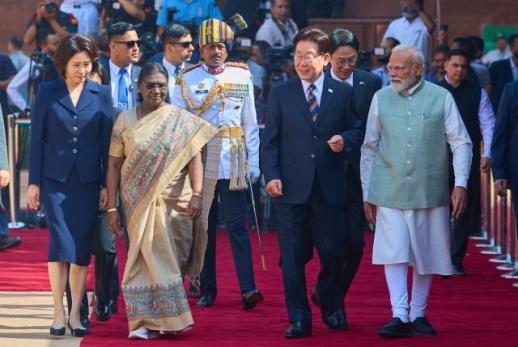 Korea and India in One Frame: Bridging a translation gap SEOUL, May 15 (AJP) -The meeting between South Korean President Lee Jae Myung and Indian Prime Minister Narendra Modi in New Delhi on April 20 was amicable, but slow. The words of both leaders traveled through English first then into Hindi because the Korean entourage lacked a translator who spoke Hindi. Technically, communication occurred. But something was lost in that detour, and everyone in the room knew it. Back at home, Lee complained out loud. At a cabinet meeting on April 28, he rebuked Foreign Minister Cho Hyun directly: find a way, he said, to make sure this never happens again. Train someone. Grow one. It is absurd, he argued, to navigate a country of 1.4 billion people through double translation. The rebuke was warranted. But the problem it exposed runs deeper than a staffing gap in the foreign ministry. Korea and India are not strangers by any reasonable measure. They share a continent. They share the memory of colonial humiliation and the hard-won pride of recovery. They share booming trade figures, growing diplomatic ties, and — increasingly — the attention of the same geopolitical moment. And yet, for decades, India has occupied a curious blind spot in the Korean imagination: present in the abstract, absent in the particular. A civilization of 1.47 billion people, reduced in popular consciousness to a handful of images. The interpreter was missing because, for a long time, the genuine curiosity was too. Language is a measure of intent. The languages a nation chooses to learn are a record of where it has decided to look. By that measure, India has long sat outside Korea's field of vision. Not out of hostility — out of something perhaps more consequential: indifference dressed as familiarity. This is what made the response to this year's Korea-India Essay and AI Video and cohosted by the Indian Cultural Centre and the Embassy of India in Seoul and Aju Press (AJP). Over 550 people answered to our call. They were students, writers, and ordinary citizens who had decided, for reasons of their own, to look. What they saw was worth recording. Sonali Ray, whose essay One Frame, Two Worlds took the top prize, wrote about kimchi and Indian achar — not as the same food, but as the same idea. Two cultures that understood, long before modern science confirmed it, that fermentation is philosophy: the patient transformation of humble ingredients into something alive and complex. She wrote about Korean pojangmacha and Indian dhabas operating on identical democratic principles — honest food, generous portions, a cook with opinions no critic could shake. She wrote about the way a Korean grandmother's doenjang jjigae and an Indian mother's dal speak the same grammar of love: slow-cooked, unpretentious, irreplaceable. These are not the observations of someone looking at a foreign country. They are the observations of someone recognizing a reflection. Kim Ji-young, who took the gold prize, arrived at India from a different direction — through language itself. In Hindi, she discovered, a single word carries two opposite meanings: kal means both yesterday and tomorrow. For a student of Hindi, it is an early lesson in grammar. For Kim, it became something else: a lens through which to examine a culture that refuses the false comfort of finality. She encountered this refusal everywhere — in the Indian professor who answered questions with a tilt of the head meaning perhaps, in the philosopher Sri Aurobindo's words that man is a transitional being, never complete, always becoming. She returned to Korea with a quieter mind and a more honest question: why are we so desperate to conclude? It is a question worth sitting with. Korea is a society that has, at remarkable speed, built extraordinary things. That speed has costs. Among them is a certain intolerance for ambiguity — a cultural impatience that manifests in everything from the pressure to declare one's MBTI type within minutes of meeting a stranger, to the fear that a classroom moment of genuine connection might constitute a legal liability. Kim's essay does not argue for India over Korea. It argues for what each might offer the other: that a civilization comfortable with kal — yesterday and tomorrow in a single breath — might have something to teach one that has forgotten how to wait. This is what cultural exchange looks like when it works. Not the exchange of tourist impressions, not the soft diplomacy of trade delegations, but the slow, unglamorous work of one person genuinely trying to understand how another civilization has organized its experience of being human. The awards ceremony takes place tomorrow, May 16th, at Yeouido Hangang Park, alongside India Day festivities that will fill the riverbank with color, music, and the specific warmth of two cultures meeting in the open air. It is, by any measure, a small event. It will not produce a Hindi interpreter overnight. It will not, by itself, close the distance that an empty chair at a translation table exposed. But 550 people looked toward India this year and found, in that looking, something that surprised them. A word that contains its own opposite. A pickle that is not the same pickle but the same wisdom. A civilization that has been there all along, patient as fermentation, waiting to be seen whole. The summit will happen again. Next time, perhaps, the words will travel direct. 2026-05-15 14:09:47
 -
 Korea-India Cultural Contest Highlights Language Barriers and Understanding There was no Hindi interpreter present. In a meeting with a country of 1.5 billion people, South Korea could not provide a single person fluent in that language. Instead, a double interpretation through English conveyed the words of both leaders.During a Cabinet meeting on April 28, President Lee Jae-myung directly reprimanded Foreign Minister Park Jin. "We need to ensure that we can avoid double interpretation in the future by training at least one person in special education," he said.While the reprimand focused on the lack of personnel, it also highlighted a more uncomfortable reality. South Korea and India are both located on the Asian continent, share thousands of years of civilization, and have experienced colonial pain together. Despite having established diplomatic relations long ago and increasing trade each year, the two countries still feel distant from one another. The absence of a single interpreter was not a coincidence but a result of structural indifference.Language is a measure of interest. The languages we choose to learn reflect how seriously we regard those countries. By that standard, India has long been a low priority.To bridge this gap, the Indian Cultural Center in Korea, the Indian Embassy, and Aju Media collaborated to launch the '2026 Korea-India AI Video and Essay Contest,' which drew a passionate response from about 550 participants. The responses were remarkable.Sonali Ray, who won the essay grand prize, compared Seoul's Gwangjang Market with India's bazaars. She noted that while kimchi and achar (Indian pickles) are not the same food, they share a common philosophy. Both civilizations understood the wisdom of transforming simple ingredients into something complex and vibrant through fermentation and patience.Kim Ji-young, who won the gold prize, approached India from a different angle. His essay began with the observation that the Hindi words for 'yesterday' and 'tomorrow' are expressed with the same term, 'kal.' This led him to reflect on India's philosophy of rejecting definitive conclusions.Quoting independence activist Aurobindo, who said, "Humans are transitional beings and never complete," he quietly examined the impatience of modern Korean society, which often defines each other by four letters of the MBTI. In a country where yesterday is tomorrow and tomorrow is yesterday, he learned a life attitude of not rushing to conclusions.Ultimately, the two essays, though expressed in different languages, convey the same message: we have not known India well enough.Kim Dong-hee's AI video titled 'Together We Soar Higher,' which won the top prize in the video category, captured a similar sentiment in a different format. It showcased what could emerge when Korea's planning capabilities meet India's creative sensibilities in a rapidly changing digital environment.Double interpretation is a language issue. However, at a deeper level, it is a matter of understanding. The 550 participants took the opportunity to explore India through this contest. They researched Indian cuisine, read about Indian history, and pondered the meaning of a single Hindi word. Each of these actions, in a different way but no less significant, helped bridge the distance between the two countries.On May 16, an India Culture Day event will be held at Yeouido Hangang Park. Contest winners will stand on the podium that day. As the colors and sounds of India spread over the Han River, it may mark the first scene where the distance of double interpretation transforms into a bridge of bilingual understanding. In a country where yesterday and tomorrow are the same word, we are just beginning to greet that nation properly.* This article has been translated by AI. 2026-05-15 13:26:10
 -
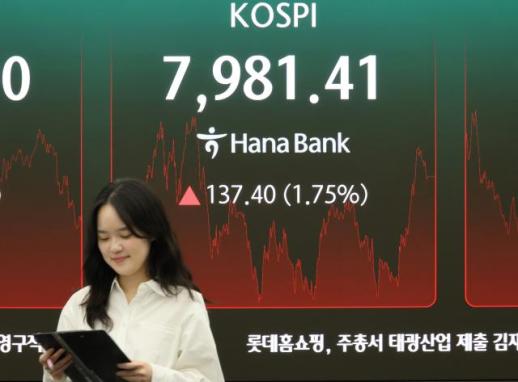 AI Reshapes Asia's Industrial Landscape When the U.S. market falters, the KOSPI often follows suit. A downturn in China's economy typically leads to sell-offs in South Korea. This year, however, is different. Neither the Middle East conflict nor the U.S.-China power struggle has managed to shake the markets. This week, the key variable was expected to be the U.S.-China summit. Yet, the KOSPI continues its march toward an all-time high. Having already surged nearly 80% this year, it is achieving the best performance among major global indices. South Korea has surpassed the United Kingdom to become the eighth-largest stock market in the world, valued at $4.04 trillion. Six of the world's top ten stock markets are now in Asia. The market is beginning to prioritize AI over geopolitical concerns. This is not merely a thematic rally; the industrial order itself is changing. Even a single response from ChatGPT relies on GPUs, memory, power grids, and data centers to function. While AI may appear to be software, it actually operates on a vast hardware supply chain, with Asia at its core. Taiwan dominates the foundry sector. Without TSMC, there is no AI. Over 90% of the world's most advanced chip production passes through this company. In the first quarter of 2026, TSMC's revenue increased by 35% year-on-year to $35.6 billion, with net profit soaring by 58%. This year, its capital expenditure guidance is set to reach up to $56 billion, a 40% increase from the previous year. TSMC's clients are expected to spend over $1.2 trillion on data center capital expenditures by 2028. South Korea controls the memory bottleneck. In the AI era, High Bandwidth Memory (HBM) is not just a common component; it is a critical infrastructure that determines processing speed. SK Hynix is projected to surpass Samsung for the first time in operating profit in 2025, reaching 47.2 trillion won, with its stock price rising by 210%. The company holds a market share of 57-62% in HBM, and its production for 2026 is already sold out. Bank of America has labeled this year as a "1990s-style memory supercycle." This fervor is spreading beyond semiconductors to power equipment, transformers, shipbuilding, and batteries. This is why HD Hyundai Electric and LS ELECTRIC have backlogs filled for several years. Japan supplies the equipment needed to manufacture chips. Tokyo Electron, Advantest, and Lasertec benefit every time TSMC and SK Hynix expand their operations. The Nikkei 225 index surpassed 60,000 for the first time in April 2026, soaring 5.58% on the first trading day after Golden Week, led by SoftBank, which rose 18%. JP Morgan's year-end target is set at 70,000. China and Hong Kong are building their own ecosystems. With advanced chip imports from NVIDIA blocked, China surprised the world with its DeepSeek R1. The Hang Seng Index rose by 28% in 2025. Alibaba announced a $52 billion investment in AI infrastructure over three years. The price-to-earnings ratio for Hang Seng Tech is 24, lower than the Nasdaq 100's ratio of 25-31. While the U.S. has created a leading model, China is constructing a parallel ecosystem around it. The structural logic is straightforward. Software originated in the U.S., but the supply chain that powers it is in Asia. Once, Asia was known as the "world's factory" based on cheap labor. Now, it is shifting to become the central axis of critical infrastructure supporting the global AI system. What is happening in the market is not just a technological rally; it is a once-in-a-generation shift in industrial value. The KOSPI stands at the center of this flow. This is why the market remains resilient despite bubble concerns; investors are betting on a reorganization of the industrial order rather than a short-term trend. Intelligence was born in California. However, the power, memory, semiconductors, and factories that make that intelligence operational now pulse from Asia.* This article has been translated by AI. 2026-05-14 17:51:32
 -
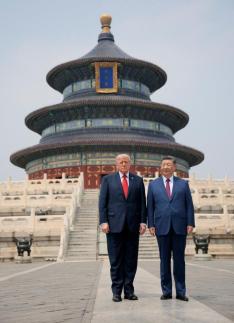 China Insight: What the rain-soaked Temple of Heaven revealed about Trump-Xi summit President Donald Trump and President Xi Jinping met once again in Beijing on May 14. A summit between the leader of the world’s foremost superpower and the head of the world’s second-largest economy invariably carries global significance. Yet this meeting possessed an unusually heavy symbolism and strategic gravity. The wars in Ukraine and the Middle East, the intensifying contest for artificial intelligence supremacy, the semiconductor conflict, the Taiwan question, rare-earth export controls, supply-chain restructuring, the future of dollar dominance, and the internationalization of the yuan have all converged at the same historical moment. This summit was therefore far more than a routine diplomatic engagement. In many respects, it amounted to a grand strategic exploration of who will shape the architecture of the mid-21st century world order — and how that order will ultimately be constructed. The United States seeks to preserve the existing framework of global primacy. China, meanwhile, seeks to accelerate the emergence of a multipolar order. Between those two ambitions, the world watches with equal measures of anxiety and expectation. The two leaders met for more than two hours at the Great Hall of the People in Beijing. Following the formal talks, they moved together to the Temple of Heaven, the sacred imperial site where Chinese emperors once prayed for peace, prosperity, and abundant harvests under the Mandate of Heaven. A state banquet followed later that evening. China’s decision to include the Temple of Heaven in the summit itinerary was no accident. The site is far more than a tourist destination. It is one of the great symbolic spaces of Chinese civilization itself — a place where the emperors of the Ming and Qing dynasties affirmed what traditional China regarded as heavenly legitimacy and cosmic order. It represents continuity, historical consciousness, and civilizational permanence. The image of Trump and Xi walking together along the rain-darkened stone paths of the Temple of Heaven therefore carried extraordinary symbolic weight. Trump reportedly remarked only briefly that the scene was “beautiful.” More notable was his unusual restraint regarding Taiwan, a subject on which he has often spoken bluntly in the past. The silence itself was revealing. It reflected the complicated strategic reality now confronting the United States. America remains the world’s most powerful nation. Yet it no longer possesses the effortless strategic dominance that defined the immediate post-Cold War era. The war in Ukraine drags on. Conflict between Iran and Israel threatens to widen across the Middle East. Inside the United States, fiscal deficits, high interest rates, industrial hollowing, and deepening social polarization continue to intensify. Washington seeks to contain China’s rise in artificial intelligence and advanced semiconductors. Yet it also understands an uncomfortable reality: the global supply chain itself cannot easily function without China. Beijing faces its own profound vulnerabilities. China’s property crisis, local-government debt burdens, youth unemployment, and weak domestic consumption have created structural strains throughout the economy. Nevertheless, China remains the world’s largest manufacturing power and continues to dominate critical sectors ranging from rare earths and batteries to solar panels and electric vehicles. Above all, Beijing sought through this summit to project an unmistakable message to the world: China considers itself not merely a modern nation-state, but a civilization-state standing as an equal to the United States. That is precisely why the Temple of Heaven mattered. The United States is a relatively young republic, barely 250 years old. China sees itself as the inheritor of a civilization stretching back five millennia. Xi Jinping’s decision to host Trump at the Temple of Heaven was therefore not simply ceremonial diplomacy. It was an assertion that China is not a temporary geopolitical actor, but an enduring civilization shaped by history, philosophy, and cultural continuity. The summit itself revolved around six principal themes. The first was trade and tariffs. Trump, acutely aware of American farmers and industrial workers as a crucial political constituency, is believed to have pressed strongly for expanded Chinese purchases of American soybeans, grain, and agricultural products, while continuing to raise concerns about trade imbalances. China, facing slowing economic momentum, likewise requires a degree of stability in access to American markets. The second issue was semiconductors and artificial intelligence. The United States has tightened restrictions on exports of advanced AI chips and semiconductor technologies in an effort to slow China’s technological ascent. China, meanwhile, has accelerated domestic substitution efforts centered around companies such as Huawei. This is no longer merely a technological competition. It is increasingly a struggle over who will shape the operating system of the future global civilization. The third issue concerned rare earths and supply chains. China has increasingly employed rare-earth export controls as a strategic instrument. Because critical sectors — electric vehicles, semiconductors, defense systems, and renewable energy infrastructure — remain deeply dependent upon Chinese-controlled supply chains, Washington’s efforts to diversify away from China face immense practical limitations. The fourth issue was Taiwan. It was perhaps the most sensitive topic of the summit and also the one approached with the greatest caution. Xi reportedly warned that mishandling the Taiwan issue could dangerously increase the possibility of direct confrontation between the two powers. The United States cannot easily abandon Taiwan, yet neither can it afford a full-scale military conflict with China. As a result, the Taiwan Strait is increasingly emerging as one of the world’s most dangerous geopolitical flashpoints. The fifth issue involved the Middle East. As tensions between Iran and Israel intensify, Washington increasingly recognizes the importance of China’s relationship with Tehran. China has sought to present itself as a stabilizing diplomatic force in the region, particularly after previously helping facilitate rapprochement between Saudi Arabia and Iran. The sixth issue concerned the deeper structure of the global financial system itself. Beneath the formal agenda lay an invisible but highly consequential competition between dollar dominance and the internationalization of the Chinese yuan. Should the yuan continue expanding its role in energy settlements and global trade, the foundations of the postwar financial order could gradually begin to shift. Yet perhaps the summit’s most important message was this: even amid rivalry, dialogue continues. The United States and China compete fiercely, but they also remain deeply dependent upon one another. China cannot easily thrive without the American market and financial system. Nor can the United States fully disentangle itself from the manufacturing and supply-chain infrastructure centered in China. The global economy itself would struggle to survive a complete rupture between the two powers. For Northeast Asia, the summit may mark the beginning of a new strategic phase. China will likely intensify efforts to limit American involvement in Taiwan. The United States, meanwhile, is expected to deepen security coordination with Japan and South Korea. Japan may continue accelerating military normalization, while North Korea will closely monitor every shift in the relationship between Washington and Beijing. In that sense, Northeast Asia is increasingly becoming the principal front line of great-power competition. The original Cold War was centered largely upon military confrontation between the United States and the Soviet Union. The emerging strategic rivalry of the 21st century, however, is likely to be far more complex — an intertwined contest involving artificial intelligence, semiconductors, energy systems, maritime power, finance, and supply chains. What, then, should South Korea understand from all this? Seoul must look not through the lens of emotion, but through the lens of structure. The United States remains South Korea’s indispensable security ally. China remains one of its most important economic partners. Korea cannot survive by choosing only one side in absolute terms. Its challenge is therefore not blind alignment, but the cultivation of strategic balance grounded in technological strength, industrial competitiveness, and diplomatic sophistication. South Korea already possesses globally competitive capabilities in semiconductors, artificial intelligence, shipbuilding, nuclear energy, batteries, and defense manufacturing. The essential task is not to think of Korea merely as a “middle power,” but as a genuine strategic state capable of exercising meaningful influence within a rapidly changing Northeast Asian order. The rain falling over the Temple of Heaven was more than weather. It may well have been a signal that the world itself is entering a new season. And along those rain-soaked paths, America and China — two powers moving according to profoundly different historical clocks — were quietly calculating the future of the same world. *The author is a senior columnist of AJP. 2026-05-14 16:47:17
 -
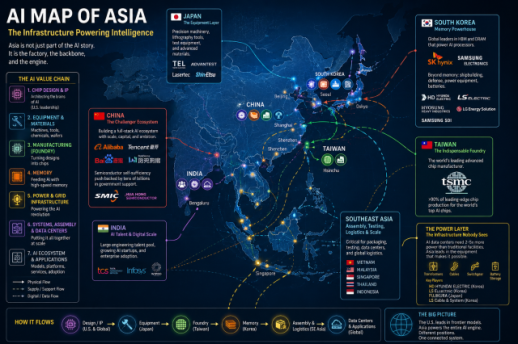 ASIA INSIGHTS: How Asia is redrawn into the AI map SEOUL, May 14 (AJP) -The software was written in California. The intelligence is being manufactured in Asia. A Bloomberg chart circulating this week tells the story cleanly: South Korea has overtaken the United Kingdom to become the world's eighth-largest stock market, at $4.04 trillion. Six of the ten largest equity markets on Earth now sit in Asia. The United States ushered the generative AI era. But the East building its physical infrastructure is collecting the dividend. This is not a coincidence. It is the logical consequence of how artificial intelligence actually works. Every AI query, response, every generated image begins not with software but with hardware: electrons moving through silicon, copper, and exotic materials assembled to nanometer tolerances. That supply chain runs through Asia. Understanding how each major market fits into it reveals not a single AI boom but four distinct ones, each feeding into the next. Taiwan: The Indispensable Foundry Without TSMC, there is no AI at scale. The pure-play foundry controls more than 90% of the world's leading-edge chip production. Nvidia's Blackwell GPUs, AMD's MI series, Apple's M-chips — all fabbed in Taiwan. In Q1 2026, TSMC reported revenue of $35.6 billion, up 35% year-on-year, with profit jumping 58%. Capital expenditure for 2026 is guided at $52–56 billion, a 37% increase, signaling management sees no demand ceiling. Goldman Sachs estimates Taiwan's market is "well over 80%" exposed to AI-related revenue. TSMC's largest customers are collectively planning over $1.2 trillion in data center capex through 2028. Almost all of it flows through Hsinchu. South Korea: The Memory Monopoly If Taiwan is the foundry, South Korea is the memory bank — and in AI, memory is no longer a commodity. It is a chokepoint. High-Bandwidth Memory, or HBM, sits alongside AI processors and feeds them data at speeds standard DRAM cannot approach. The world's HBM comes overwhelmingly from two companies in Gyeonggi Province. SK Hynix beat Samsung in operating profit for the first time in 2025, posting a record 47.2 trillion won for the year. Its stock rallied more than 210%. The KOSPI has gained nearly 80 percent in just five months into the year to become the world's best-performing major index. SK hynix holds a 57–62% share of the global HBM market, supplies Nvidia almost exclusively, and has already sold out its entire 2026 capacity. The Bank of America calls 2026 a "memory supercycle similar to the boom of the 1990s," projecting the HBM market to reach $54.6 billion — up 58 percent year-on-year. The stock rally however goes broader than memory. Investors have poured into shipbuilding, defense, power equipment, and cultural exports. HD Hyundai Electric, LS Electric, and Hyosung Heavy Industries carry order books extending years forward as AI data centers drive unprecedented electricity demand. Goldman Sachs has noted Korea's market is "deeper and broader" than Taiwan's — a rare thing to say about a market whose memory champions alone have rewritten the rules of the semiconductor industry. Japan: The Equipment Layer Japan's role sits one layer upstream: the machines that make the chips. Tokyo Electron, Advantest, and Lasertec supply the lithography tools and test equipment that TSMC and SK Hynix depend on to scale. The Nikkei 225 crossed 60,000 for the first time in history on April 23, 2026. On May 7, markets reopened after Golden Week and immediately priced in a global AI rally that had run in their absence — the index surged 5.58 percent, its largest single-day point gain ever, led by SoftBank (+18.44%), Tokyo Electron (+9%), and Advantest (+7%). J.P. Morgan has set a year-end 2026 Nikkei target of 70,000. SoftBank deserves a sentence of its own. Once mocked for Vision Fund losses, Masayoshi Son's bets on Arm Holdings and OpenAI have made the company, in the words of one analyst, "the listed proxy for OpenAI and Arm." Japan's decades of stagnation have found, in AI infrastructure demand, a genuine secular growth engine. China and Hong Kong: The Challenger Ecosystem China's position is the most contested and the most consequential to watch. Blocked from advanced Nvidia chips since 2022, Chinese companies have responded by building a parallel AI ecosystem. DeepSeek's R1 model, released in January 2025, claimed performance comparable to OpenAI's best systems at a fraction of the cost — and rattled global markets. The Hang Seng Tech Index surged nearly 30 percent in the weeks that followed. Alibaba, which has pledged $52 billion over three years in AI infrastructure, added $153 billion in market value from its January 2025 lows. Chinese chipmakers SMIC and Hua Hong Semiconductor have rallied as Beijing backs semiconductor self-sufficiency with incentives reportedly worth up to $70 billion. The valuation case is straightforward: Hang Seng Tech trades at roughly 24 times forward earnings versus 25–31 times for the Nasdaq 100. UBS rates Chinese tech "most attractive," citing rapid AI monetization and policy support. The U.S. built the leading models; China is building a parallel ecosystem around them. There is a layer beneath the semiconductors that deserves attention: the power grid itself. AI data centers consume electricity at two to five times the rate of conventional facilities, creating a global shortage of high-voltage transformers, cables, and switchgear — equipment made disproportionately in Asia. Korea's HD Hyundai Electric dominates ultra-high-voltage transformer supply for North America. LG Energy Solution and Samsung SDI supply large-scale battery storage systems stabilizing AI campus power grids. Japan's Fujikura, a cable specialist, has been among the surprise winners of the infrastructure buildout. Every kilowatt delivered to a GPU cluster passes through equipment increasingly likely to carry an Asian manufacturer's nameplate. The structural thesis is simple. AI is a software product requiring a hardware supply chain of extraordinary complexity. The software came from the United States. The hardware supply chain is Asian — from the foundries of Taiwan to the memory fabs of Korea, from Japan's equipment makers to China's challenger chipmakers, down to the transformers and cables that keep the whole system powered. The intelligence was born in California. The factory floor is in Asia. 2026-05-14 14:09:13
 -
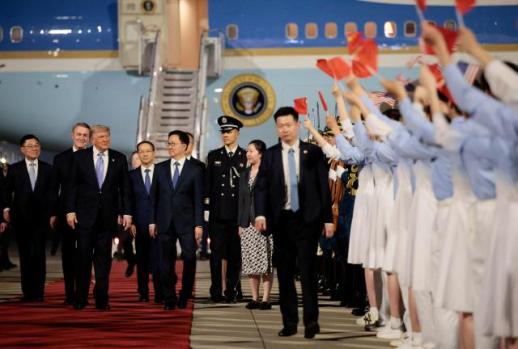 Trump-Xi summit to test fragile détente as CEOs descend on Beijing SEOUL, May 14 (AJP) -U.S. President Donald Trump and Chinese President Xi Jinping for two days from Thursday engage a high-stakes and closely-watched summit in Beijing as war in the Middle East, tariff disputes and the global artificial intelligence race reshape the balance between the world’s two largest economies. While both sides are expected to emphasize symbolism and stability in public, the summit is emerging as a transactional negotiation over tariffs, semiconductors, energy security and Taiwan, with a heavyweight U.S. business delegation underscoring how corporate America remains deeply tied to China despite escalating geopolitical rivalry. Trump on Wednesday evening arrived in Beijing seeking Chinese cooperation on multiple fronts: easing pressure on American farmers through larger agricultural purchases, stabilizing supply chains for rare earth minerals, and leveraging Beijing’s influence over Iran to reopen the Strait of Hormuz, a critical artery for global oil shipments. Xi is expected to push for tariff relief, softer export controls on advanced semiconductors and reduced U.S. military support for Taiwan. The summit comes at a delicate moment for both leaders. Trump enters Beijing amid criticism over the economic fallout from the Iran conflict and rising questions about America’s strategic overstretch. Xi faces mounting pressure from China’s slowing economy, weak domestic demand and worsening deflationary pressure. Analysts say both leaders need visible wins without appearing to concede too much strategically. Still, beneath the ceremonial choreography lies a more fundamental rivalry. Washington increasingly sees China’s industrial strategy and export-driven manufacturing dominance as a long-term threat to U.S. economic security. A report released this week by the U.S. Chamber of Commerce and Rhodium Group described China’s policy direction as an “industrial policy of everything,” warning that Beijing’s state-backed expansion into sectors ranging from AI to raw materials is narrowing the room for Western competitors. Tariffs are expected to dominate much of the negotiations. Although portions of Trump’s sweeping tariff regime have been challenged in U.S. courts, the administration is preparing additional trade actions linked to forced labor and industrial production concerns tied to China. Beijing is expected to press hard for lower tariff barriers, though Washington faces political constraints in appearing softer toward its biggest strategic competitor. Another central issue will be semiconductors and AI. Xi is reportedly seeking broader access to advanced U.S. chips after Washington partially loosened restrictions on exports of Nvidia’s H200 processors while continuing to block the company’s top-tier Blackwell systems. U.S. officials, meanwhile, remain concerned about China’s advances in AI, military-civil fusion technologies and rare earth export controls that have exposed vulnerabilities in American supply chains. Taiwan remains the summit’s most politically sensitive fault line. Chinese officials are expected to push Trump to shift Washington’s longstanding position from “not supporting” Taiwanese independence toward explicitly “opposing” it — a wording change that would signal a major diplomatic concession to Beijing. Trump has also indicated willingness to discuss a multibillion-dollar U.S. arms package for Taiwan during talks with Xi. The composition of the U.S. delegation accompanying Trump highlights the business stakes surrounding the summit. More than a dozen top executives traveled to Beijing, including Tesla and SpaceX CEO Elon Musk, Apple CEO Tim Cook, Nvidia CEO Jensen Huang, BlackRock Chairman Larry Fink, Boeing CEO Kelly Ortberg and Goldman Sachs CEO David Solomon. The lineup reflects how deeply intertwined U.S. corporations remain with the Chinese market despite years of “decoupling” rhetoric. For technology firms such as Nvidia, Qualcomm, Micron and Apple, China remains a critical manufacturing base and consumer market. Boeing is seeking to revive aircraft sales to Chinese airlines after years of trade tensions and regulatory freezes, while financial firms including BlackRock, Citi and Goldman Sachs continue to pursue long-term expansion in China’s capital markets. The presence of Elon Musk is particularly notable. Tesla’s Shanghai Gigafactory remains one of the company’s most important production hubs, while Musk has maintained unusually close ties with Chinese officials compared with many U.S. executives. His attendance signals that Beijing still views select American corporate leaders as potential stabilizers in an otherwise deteriorating bilateral relationship. The delegation also reveals Washington’s competing priorities. Alongside national security concerns over semiconductors and strategic industries, the administration is simultaneously seeking export deals, investment opportunities and supply-chain stability. Analysts say the summit illustrates the contradiction at the heart of current U.S.-China policy: intensifying strategic rivalry paired with continued economic interdependence. For Seoul and other Asian economies caught between the two powers, the outcome could have direct implications for semiconductors, energy prices, shipping routes and regional security architecture. Korea’s export-heavy economy remains particularly exposed to any changes in U.S.-China trade policy, Taiwan tensions or disruptions in the Strait of Hormuz, through which much of Asia’s imported crude oil passes. 2026-05-14 09:39:49