

May brought an early summer to the Han River. Under a clear blue sky without a hint of fine dust, brilliant sunlight danced on the silver waves. That afternoon, fresh green buds painted the Yeouido riverside in vivid colors, while an unfamiliar scent wafted through the river breeze—an aromatic blend of saffron, turmeric, and cardamom, a smell rarely encountered in the heart of Seoul.
People paused, their ears perked up, and they found themselves walking toward the source of the enticing aroma.
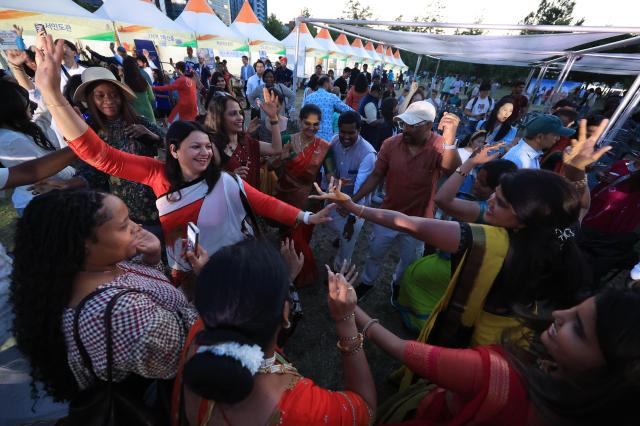
This was the inaugural 'India Day' event organized by the Indian Embassy in South Korea. Booths lined both sides of the venue, symbolizing India's 28 states. Cultures from North and South India, as well as from the eastern and western regions, were showcased along the riverside. Saffron, cobalt blue, crimson, and golden fabrics fluttered in the May breeze, while traditional dances and songs performed by Indians from various regions filled the stage.
As attendees followed the scent of spices, they soon found themselves clapping along to the unfamiliar rhythms.
Gokarnal Das, the Indian Ambassador to South Korea, joked, "We specially ordered the weather from India for today." Indeed, the riverside in Yeouido felt more like a festive square in an Indian city than a part of Seoul. People arrived on bikes, couples strolled with their dogs, and families lined up for henna experiences, mingling naturally under the tents.

However, the significance of the Han River on this day cannot be fully captured by the aroma of spices or the vibrant dances.
India is home to 1.47 billion people, representing a diverse tapestry of cultures. It is not a monolithic nation; it comprises 28 states, hundreds of tribes, dozens of official languages, and a civilization with thousands of years of history. Hinduism, Islam, Buddhism, and Sikhism all have roots in this land, which is home to one of the world's oldest urban civilizations.
How have we understood such a country until now?
Curry and yoga. Bollywood and IT developers. For a long time, this has been the extent of how Korean society has engaged with India. Conversely, for Indians, Korea has been synonymous with Samsung, Hyundai, and K-pop. The two great civilizations have reduced each other to a few keywords over the years.
This disparity is reflected in numbers. Approximately 18,000 Indians reside in South Korea, while the number of Koreans living in India is even lower. Although trade has rapidly expanded, there remains a significant gap in language and talent to truly understand each other. The recent Korea-India summit, which had to rely on double interpretation due to the absence of a Hindi interpreter, highlights this reality. While the economies have already shaken hands, the people and cultures have yet to exchange a proper greeting.
As the global balance of power shifts, India is no longer a distant land.
Emerging as a strategic counterbalance between the United States and China, India is the world's most populous country and a key market for Korean companies over the next decade. Geopolitically and economically, India has become a crucial partner for Korea. However, true partnership cannot be built solely on agreements and trade statistics. It requires an understanding of each other's histories, sharing meals, and experiencing each other's rhythms.
Thus, the scenes along the Han River that day created memories that will last longer than any diplomatic document.
Citizens gathered in the shade of trees, listening to the sounds of traditional Indian instruments. Children widened their eyes at the unfamiliar scent of spices. Young couples laughed as henna designs were drawn on their hands. A middle-aged man fumbled through a conversation with an Indian booth operator while savoring a plate of biryani. These moments etched a deeper connection between the two nations than any official statement could.
The initial encounters between civilizations are often simple. They begin with smells, sounds, tastes, and gestures. A bowl of curry can bridge gaps more effectively than grand declarations, and a hand drawing henna can build connections more meaningfully than a handshake between leaders.
Ambassador Gokarnal Das remarked, "As the saying goes, when hearts connect, today’s gathering symbolizes the unity of Korean and Indian cultures." Kwak Young-gil, chairman of the Aju Media Group, added, "This is not just a cultural event; it is a moment for both countries to understand each other's histories and cultures and to forge future innovations and friendships together."
The Han River is inherently an open space. It is a place where anyone can pass through, linger, and mingle. It is not just the river of Seoul citizens but belongs to everyone who traverses this city. Symbolically, on that open riverside, Seoul and Delhi, Busan and Mumbai, kimchi and curry, K-pop and Bollywood flowed side by side.
Perhaps these two civilizations are just beginning to discover each other. Some may say it is too late. However, considering the day when the child who first paused to smell the spices on the Han River grows up and thinks about visiting India, today may not be such a late start after all.
* This article has been translated by AI.
Copyright ⓒ Aju Press All rights reserved.