

Journalist

Oh Joo-Seok
farbrother@ajunews.com
-
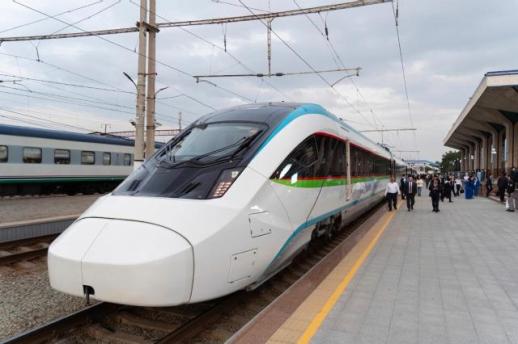 Hyundai Rotem’s Korean-Built High-Speed Train Begins Commercial Service in Uzbekistan Korean-built high-speed trains have entered service on a major rail route in Uzbekistan, marking their first commercial operation overseas. Hyundai Rotem said May 6 that it began revenue service for the new high-speed rolling stock on May 5 local time. The trains will run on the country’s longest rail line, about 1,020 kilometers (634 miles), linking the capital, Tashkent, with Khiva, a Silk Road city in the west. The fleet consists of 42 cars, with seven cars per trainset, designed based on the KTX-Eum (EMU-260). The trains have a top speed of 250 kph (155 mph) and can carry up to 389 passengers. Hyundai Rotem said the distributed-power design offers better acceleration and deceleration efficiency than the locomotive-style high-speed trains previously used locally. Seating is divided into three classes: VIP, business and economy. Hyundai Rotem said the trains were tailored for local conditions, including dust-resistant design for extreme heat and desert environments, to provide safe and comfortable long-distance travel. The company signed a supply contract in 2024 with Uzbekistan Railways (UTY), which it described as the first overseas export of a domestically developed Korean high-speed train. Hyundai Rotem said more than 600 South Korean parts suppliers involved in the project will be able to demonstrate to global markets a stable production, delivery and handover supply chain built with the company. The company said it expects the launch to help improve Uzbekistan’s transportation infrastructure and left open the possibility of entering Vietnam’s high-speed rail market. On April 23, Hyundai Rotem signed a 491 billion won contract with Vietnam’s THACO Group for the Ho Chi Minh City Metro Line 2 project. A Hyundai Rotem official said the company is moving into commercial operations after holding a launch ceremony in November and starting test runs this year. The official said the company will work to expand additional export bases, including Vietnam, where it has already entered the market.* This article has been translated by AI. 2026-05-06 09:39:16
 -
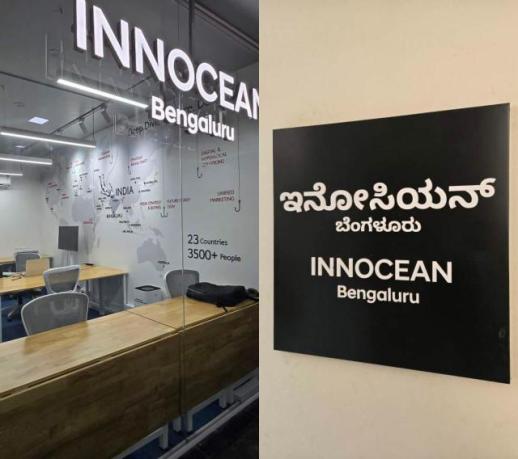 Innocean Opens Bengaluru Office to Expand in India’s Fast-Growing Ad Market Hyundai Motor Group affiliate Innocean said it is stepping up its push into the global advertising market by establishing a base in Bengaluru, India, as it looks for growth outside a shrinking domestic market. Innocean said May 6 it has opened a local office in Bengaluru — often called India’s Silicon Valley — and will expand its role into a tech-based business solutions hub that combines data, AI and content. Bengaluru is one of India’s key growth centers, home to tech companies, startups and global capability centers. Innocean India said it will build a hybrid business model at the new office by pairing data- and AI-driven performance and predictive analytics with content and platform planning. It also plans to strengthen its role as an offshoring service hub for the company’s global network. India is drawing attention as a new growth market for global advertising. With a population of more than 1.42 billion this year, it is one of the world’s largest consumer markets. Advertising-spend forecasts for major global markets show India’s ad market reached $13.8 billion (about 20.3895 trillion won) last year and is expected to grow 8% this year and 9.7% next year. By contrast, South Korea’s ad market has been contracting. According to the 2024 survey on the domestic broadcasting industry released last year by the Korea Communications Commission, broadcast advertising revenue totaled 2.3073 trillion won, down 183.2 billion won (7.4%) from a year earlier. Innocean India said it plans to expand client touchpoints and strengthen marketing execution, focusing on high-growth industries. Innocean established its India unit in 2005, its first overseas subsidiary, to secure opportunities including Bollywood. As of last year, non-affiliate clients accounted for a share in the 30% range, and the company said it has built a growth structure based on competitiveness in external markets. Chief Executive Officer Kim Jeong-a said the launch of the Bengaluru base is “not simply a regional expansion, but an important turning point for Innocean as it evolves beyond an agency into new business areas.” 2026-05-06 09:03:00
 -
 Boryeong-AMA International Motor Festival Aims to Become Asia’s Top Event "Honestly, I came because I love cars. Seeing two race cars drifting together gave me a real adrenaline rush," said Yosep, 26, from Puerto Rico, who attended the 2026 Boryeong·AMA International Motor Festival. On May 2, the area around the Mud Expo Plaza in Boryeong, South Chungcheong province, filled early with engine noise and cheers. At the gymkhana and drifting venues, the sound of tires scraping the pavement rarely let up. Crowds packed the stands for a gymkhana exchange event featuring Asian national team-level drivers from South Korea, Thailand, Singapore and Taiwan. Each time a driver threaded cones and obstacles at speed, spectators erupted. Drivers competed under the same conditions in Toyota Prius hybrid vehicles. Fans also raised smartphones to record drifting demonstrations by popular drivers including Choi Jun. Organizers said the biggest change this year was a stronger focus on hands-on experiences. Instead of simply looking at cars, visitors were encouraged to get in them. The 73,430-square-meter (about 22,000-pyeong) Mud Expo Plaza was lined with vehicles ranging from the latest sports cars to tuned cars and campers. Many visitors sat inside or inspected interiors up close. Kim Si-ho, 17, from Seongnam, Gyeonggi province, said, "It was great to be able to ride in cars you don't usually get to see," adding, "I'm studying an automotive field, and I think it will help with my career path." A Toyota Gazoo Racing (GR) booth in the center of the venue drew steady traffic from motorsports fans, with attention on display models such as the GR86 sports car and a GR Supra stock car. Some visitors also tried a simulator set up separately. At experience booths for advance reservation holders, tire squeal continued throughout the day. Toyota Korea ran slalom, lane-change and drifting programs. In a drifting ride-along with a professional driver, participants felt the car push outward at higher speeds in an understeer moment, then swing into oversteer as the rear slid and the vehicle began circling. Organizers said the GR86's low center of gravity helped keep the spins stable. The Boryeong·AMA International Motor Festival began in 2011 as an on-campus event at Ajou Motor College. It has since grown into a major local festival alongside Boryeong's Mud Festival, becoming a regional signature event within five years of being held around Boryeong Beach. Organizers said more than 140,000 people attended on the first day of the opening ceremony. Ajou Motor College and the city of Boryeong said they want to expand the festival internationally. Park Sang-hyeon, a professor in Ajou Motor College's motorsports program, said the event is widening exchanges with overseas drivers centered on key disciplines such as gymkhana and drifting. "Our goal is to gradually expand the scale and grow it beyond Korea into the No. 1 motor festival in Asia," Park said. This year's gymkhana Asia top-eight exchange event included many drivers from Asian countries including Singapore, Thailand and Taiwan who are active in an organization under the Fédération Internationale de l'Automobile, organizers said. They said they plan to strengthen the event's international competition character through a broader global network. Organizers also said discussions are underway to bring in global brands beyond Toyota, saying participation by major automakers could expand experience programs and raise the event's industrial value. Park said the festival has grown to a global scale with support for grassroots motorsports from Toyota Chairman Akio Toyoda, adding that the number of domestic and overseas manufacturers seeking to participate continues to rise and the event could be larger next year. Boryeong officials also said they want to make the motor festival a core local attraction. Mayor Kim Dong-il said about 200,000 people visited last year's event, generating an estimated 19 billion won in production-inducing effects. "We will foster it as one of Boryeong's two major festivals along with the Mud Festival," Kim said. According to the city, the Mud Festival that opened last July drew about 1.69 million visitors over 17 days and produced an estimated 94 billion won in production-inducing effects. The city said that, measured by impact relative to duration, the AMA International Motor Festival delivered similar results. Ajou Motor College said it is emphasizing its role linking education and industry, with ambitions to boost the region through international exchange. President Han Myeong-seok said students took part in planning and running the event. "This event is a hands-on educational site where students participate in the entire process from planning to operations," Han said. "We will grow it into a platform that connects industry, the region and talent." 2026-05-03 15:03:41
 -
 Jeep Rubicon Tops 1 Million in Global Cumulative Sales Jeep said on the 30th that global cumulative sales of its Rubicon models have surpassed 1 million units. Rubicon is positioned as the top tier of Jeep’s off-road lineup and a benchmark for rough-terrain capability worldwide. In South Korea, Rubicon trims accounted for a growing share of Wrangler and Gladiator sales over the past three years, rising from 61% in 2023 to 72.4% in 2024 and more than 73.4% last year, reaching 78.7% as of March this year. The Rubicon name comes from the notorious Rubicon Trail in California’s Sierra Nevada. When the Jeep Wrangler Rubicon debuted in 2003, it drew attention for offering off-road readiness without requiring separate modifications. Key features included Tru-Lok electronic front and rear axle-locking differentials and a Rock-Trac part-time transfer case with a 4:1 ratio, Jeep said. Jeep said the Gladiator Rubicon extended Rubicon DNA into the pickup segment. It is the only pickup to earn Trail Rated certification, the company said, demonstrating stable performance across varied off-road conditions. With towing capacity of up to 2,721 kilograms, it has broadened options for outdoor use and helped define what Jeep describes as an off-road lifestyle beyond basic transportation.* This article has been translated by AI. 2026-04-30 17:16:29
 -
 Tariff Refunds, USMCA Review Roil U.S. Auto Market; Hyundai’s Response in Focus A U.S. Supreme Court ruling has set tariff refund procedures in motion, signaling shifts in profit expectations for U.S. automakers. For foreign brands operating in the United States, uncertainty is growing as the U.S.-Mexico-Canada Agreement, or USMCA, heads toward a scheduled review. Attention is also on how Hyundai Motor Group, which has been posting strong U.S. results, will respond. Industry officials said April 30 that General Motors expects about $500 million (about 740 billion won) in tariff refunds for the first quarter following the Supreme Court’s decision that reciprocal tariffs were illegal. In its 2026 first-quarter earnings report, GM raised its forecast for adjusted earnings before interest and taxes this year to $13.5 billion to $15.5 billion, from $13 billion to $15 billion. The ruling found unlawful the broad tariffs President Donald Trump imposed under the International Emergency Economic Powers Act, or IEEPA. Ford is also reported to have reflected the impact of tariff refunds totaling about $1.3 billion paid over the past year. Despite those moves by U.S. automakers, other foreign automakers are taking a cautious stance, with tariff-related risks seen widening. Trump has added to uncertainty by raising the possibility of scrapping the USMCA or shifting to separate agreements with Canada and Mexico during the pact’s scheduled review in July. Since the launch of the second Trump administration, vehicles produced in Mexico and Canada have faced a 25% tariff depending on the share of non-U.S. parts. If remaining tariff benefits are removed, companies operating locally would face an unavoidable hit. Hyundai, Toyota and Nissan have responded by considering pulling low-priced models. Even with political uncertainty in the U.S. market, Hyundai Motor Group’s sales have remained strong. Hyundai and Kia sold 430,720 vehicles in the United States in the first quarter, up 2.6% from a year earlier. Over the same period, major rivals posted declines, including GM (-9.6%), Honda (-4.2%), Nissan (-8.3%), Toyota (-0.1%). The gains were driven by rising demand for eco-friendly models such as the Sonata Hybrid and higher sales of SUVs including the Tucson and Sportage. Hyundai said it is adjusting its strategy to fit the changing environment. It plans to invest $26 billion in the United States through 2028 to sharply increase production of vehicles, including hybrids. A Hyundai official said, "(In the U.S. market) tariff factors and policy uncertainty are growing, so we are focusing on expanding local production rather than exports from Korea."* This article has been translated by AI. 2026-04-30 17:12:36
 -
 Hanon Systems Q1 Operating Profit Jumps 361% to 97.2 Billion Won Hanon Systems, an automotive thermal energy management solutions company under the Hankook & Company Group, posted sharply improved results. In a regulatory filing on the 30th, Hanon Systems said its first-quarter operating profit on a consolidated basis was 97.2 billion won, up 361.1% from a year earlier on a preliminary tally. Revenue rose 5% to 2.7482 trillion won. Net profit was 67.5 billion won, returning to the black. The company said the performance reflects companywide restructuring efforts pursued since its acquisition by the Hankook & Company Group. Hanon Systems has maintained an operating margin in the 3% range since the second half of last year and posted a 3.5% margin in the first quarter, citing improved cost ratios and greater operating efficiency. Electrification, a key growth area, accounted for 29% of revenue, putting it close to surpassing 30% of total sales. The company said it responded flexibly to demand for internal-combustion and hybrid models, as well as the impact of new electric-vehicle launches. It said further revenue growth is expected this year, driven by European customers expanding electrification and rising demand for hybrids. Based on a full-line portfolio spanning internal-combustion vehicles to hydrogen fuel-cell electric vehicles, the company said it plans to introduce intelligent solutions that apply artificial intelligence to maximize energy efficiency. Vice Chairman and CEO Lee Soo-il said, "Based on our accumulated thermal management capabilities, we will accelerate qualitative growth by pursuing future new businesses such as AI-based integrated thermal management solutions, secure long-term financial soundness, and strengthen our technology leadership in the global market."* This article has been translated by AI. 2026-04-30 16:45:19
 -
 Hanwha Aerospace Q1 Operating Profit Rises 21% on Record Order Backlog Hanwha Aerospace said Wednesday that its first-quarter operating profit rose 21% from a year earlier to 638.9 billion won on a consolidated basis. Revenue increased 5% to 5.751 trillion won. In its ground defense business, revenue came to 1.2211 trillion won and operating profit totaled 208.7 billion won. Revenue rose 5% from a year earlier, while operating profit fell 31%. The company said its order backlog hit a record high. Reflecting contracts including a deal finalized in January to export the Chunmoo multiple rocket guided missile system to Norway worth about 1.3 trillion won, the backlog stood at about 39.7 trillion won. The aerospace business posted revenue of 661.2 billion won, up 25% from a year earlier. Operating profit jumped to 22.6 billion won from 3.6 billion won a year earlier, a 533% increase. The company cited higher defense volumes and a larger share of revenue from businesses with solid profitability. Hanwha Ocean reported revenue of 3.2099 trillion won and operating profit of 441.1 billion won. From a year earlier, revenue rose 2% and operating profit increased 71%. The company attributed the improvement to a higher share of high-value commercial ship projects such as LNG carriers, as well as the impact of a weaker won, lower material costs and productivity gains. A Hanwha Aerospace official said the company maintained steady growth in the first quarter, helped by strong results in the aerospace business and at Hanwha Ocean, and pledged to maximize shareholder value through continued order wins beyond the record backlog.* This article has been translated by AI. 2026-04-30 10:53:04
 -
 Hanwha Systems Installs Homegrown Ship Engine Control System on ROK Navy Destroyer Yang Manchun A domestically developed integrated engine control system, or ECS, has been installed for the first time on an operational naval ship in South Korea, replacing a key component that had largely relied on foreign suppliers. Hanwha Systems said it held a ceremony on the 30th at Jinhae Port in Changwon, South Gyeongsang Province, with the Navy and the Defense Rapid Acquisition Technology Research Institute to mark completion of a performance upgrade for the Yang Manchun (DDH-I) integrated engine control system. The Yang Manchun is a 3,200-ton helicopter-capable destroyer built under the KDX-I program along with the Gwanggaeto the Great and Eulji Mundeok. Under the project, the ship’s system was replaced with Hanwha Systems’ domestically produced integrated engine control system. The ship previously used equipment from overseas suppliers. Often described as a ship’s “heart,” the integrated engine control system manages propulsion, power, auxiliary equipment and damage-control systems through a single network. Hanwha Systems said the ECS is considered a core system for future ships aimed at unmanned operation, advanced intelligence and automation, alongside the combat management system, or CMS — described as the ship’s “brain” — that the company installed on the Yang Manchun in 2020. The company said the ECS effort was developed through civil-government-military cooperation. Hanwha Systems has worked since 2014 to secure key technologies in stages, collaborating with the Navy, the Defense Rapid Acquisition Technology Research Institute, the Korea Institute of Defense Technology Promotion and Research, and the Korea Institute of Machinery and Materials on defense core-technology projects. Hanwha Systems said it is currently the only company in South Korea with both domestically developed CMS and ECS technologies, and that full compatibility between the two has also enabled it to secure cockpit-style integrated bridge system, or IBS, technology. “K-ship unmanned operation and advanced capabilities will be brought forward through continued technology development, and we will work to have our unique competitiveness recognized in the global naval defense market,” said Yoo Moon-ki, head of Hanwha Systems’ naval business division. 2026-04-30 10:41:31
 -
 Hanwha to Pursue Joint Venture With Canada Auto Parts Group to Produce Military Vehicles Hanwha Aerospace is teaming up with Canada’s Automotive Parts Manufacturers’ Association to build a local production base for ground weapons systems, including military vehicles. Hanwha Aerospace said April 30 that it signed a memorandum of understanding on April 29 (local time) in Ontario with APMA and Hanwha Ocean to pursue a joint venture to produce military vehicles and special-purpose industrial vehicles. The companies said the partnership would move forward in earnest if Hanwha Ocean’s Jangbogo-III Batch-II submarine is selected for Canada’s Canadian Patrol Submarine Project, linking the submarine bid to a broader package that expands into ground systems. Attendees at the signing included Hanwha Aerospace CEO Son Jae-il; Jeong Seung-gyun, head of Hanwha Ocean’s overseas special ship business; Ontario Minister of Economic Development Victor Fedeli; APMA President Flavio Volpe; and Martinrea Chairman Robert Wildeboer. Hanwha said it has built a cooperation base in Canada by signing agreements with more than 30 local companies, and that the APMA partnership is intended to deepen its localization strategy. If the submarine is chosen for the CPSP, the joint venture would establish development and production systems for ground weapons the Canadian Army needs, the company said. The venture also plans to use Canadian-made materials such as steel and aluminum and hire local workers for production, aligning with the Canadian government’s emphasis on domestic manufacturing. Over time, the joint venture aims to expand into the design and production of special-purpose industrial vehicles, prioritizing Canadian military and public-sector demand and Arctic resource development needs while also exploring exports to allied countries. Hanwha cited an analysis by global accounting and consulting firm KPMG projecting that Hanwha’s investment in Canada would create an average of 22,500 jobs a year from this year through 2044 and generate a cumulative C$94.1 billion (about 102.4 trillion won) in GDP. “This MOU is a starting point for combining Canada’s manufacturing capabilities with Hanwha’s defense technology,” Son said. “Based on local production, we will expand into global markets and contribute to strengthening Canada’s defense capabilities.” * This article has been translated by AI. 2026-04-30 10:17:06
 -
 Star Alliance Opens New Lounge at Guangzhou Baiyun Airport Terminal 3 Asiana Airlines said Thursday that Star Alliance, the airline group it belongs to, officially opened a dedicated lounge on April 28 at the new Terminal 3 of Guangzhou Baiyun International Airport in China. The new facility is Star Alliance’s second lounge in Guangzhou, following its first location opened in 2024. The lounge covers about 1,400 square meters (about 15,070 square feet) and has 245 seats. It also includes a 700-square-meter (about 7,535-square-foot) outdoor garden, designed to let passengers relax in a natural setting before boarding. The lounge operates 24 hours a day and includes dedicated rest areas, sleeping capsules, private rooms and a work zone, the airline said. An opening ceremony at Terminal 3 was attended by Ambar Franco, Star Alliance vice president for customer experience, and Chi Yaoming, deputy general manager of Guangzhou Baiyun International Airport, along with representatives from member airlines and the airport. “Lounges are a key element in delivering a smooth and comfortable journey for our member airlines’ customers,” Franco said. “In line with Guangzhou’s growing role as an international hub, this lounge offers more space and upgraded facilities to provide a distinct level of comfort.” Star Alliance said the design reinterprets Guangzhou’s Lingnan culture and natural scenery in a modern style, with a centerpiece inspired by the city flower, the kapok. The lounge also offers a tea experience area run by a professional tea artist. Food options were developed in collaboration with Pullman Hotel and include Chinese and Western dishes, the airline said. The lounge is available to first- and business-class passengers on Star Alliance member airlines departing from Terminal 3, as well as Star Alliance Gold members. A total of 10 Star Alliance member airlines, including Asiana Airlines, Air China and ANA, currently serve Guangzhou Airport. The alliance operates more than 1,500 flights a week from Guangzhou, connecting 52 cities in 10 countries, Asiana said.* This article has been translated by AI. 2026-04-30 09:53:51