

Journalist

Shin Jia
fromjia@ajunews.com
-
 NVIDIA CEO Jensen Huang to Meet with Doosan Group Chairman Park Jung-won Jensen Huang, CEO of NVIDIA, is set to meet with Park Jung-won, Chairman of Doosan Group, during his visit to South Korea. This meeting is expected to bolster Park's plans to expand Doosan's portfolio from heavy industry into semiconductor materials and robotics. According to industry sources, the meeting between Huang and key executives from Doosan Group, including Chairman Park, will take place on June 7. The two leaders will meet at a home game for the Doosan Bears against the Kiwoom Heroes at Jamsil Stadium, where Huang will throw the ceremonial first pitch and Park will take the ceremonial first swing. In addition to the baseball event, they are reportedly planning a separate dinner to discuss further collaboration. Huang's interest in Doosan Group is driven by the company's Electronics Division, particularly its CCL (Copper Clad Laminate) business, and Doosan Robotics' focus on physical AI. Huang has expressed ambitions to expand NVIDIA from an AI semiconductor company to an AI infrastructure and systems provider, making this meeting a potential opportunity to connect materials and robotics within NVIDIA's AI ecosystem. One of NVIDIA's key interests is securing a stable supply of CCL. As NVIDIA prepares for mass production of its next-generation AI platform, Vera Rubin, securing CCL is essential. CCL, a thin copper layer applied to an insulating board, is a critical material that determines the performance of PCBs (Printed Circuit Boards). Doosan's Electronics Division has entered NVIDIA's supply chain by producing CCL for AI accelerators, which it supplies to PCB manufacturers. Doosan currently produces CCL for AI accelerators at its facilities in Jeungpyeong, Chungbuk, and Gimcheon, Gyeongbuk. Additionally, the company is establishing a new CCL production base in Thailand, set to begin operations in 2028. Industry experts believe that the new CCL production volume starting in 2028 is likely to be largely secured by NVIDIA. Collaboration with Doosan Robotics, a company focused on software and automation platforms based on physical AI, is also expected to strengthen. Park Ji-won, Vice Chairman of Doosan Group and CEO of Doosan Enerbility, visited NVIDIA's headquarters last September to discuss AI collaboration between the two companies. Following that meeting, they agreed to train NVIDIA's physical AI technology using Doosan's data to build a customized foundation model. In April, Huang's daughter, Madison Huang, visited Doosan Robotics to inspect its production facilities. As both companies aim to launch an industrial humanoid by 2028, this upcoming meeting is anticipated to further solidify their discussions. Chairman Park has been pushing to transform Doosan's traditional heavy industry structure by expanding into semiconductor materials and robotics. Under his leadership, the group is focusing on energy and power, physical AI and robotics, and semiconductors as its three core pillars for restructuring its business portfolio. Industry insiders view the meeting with Huang as a significant step in supporting Doosan's business transformation strategy. An industry source noted, "Since Doosan's Electronics Division is already part of NVIDIA's supply chain, this meeting is likely to expand the scope of collaboration into the robotics sector, strengthening the partnership that encompasses both materials and robotics."* This article has been translated by AI. 2026-06-05 14:39:00
 -
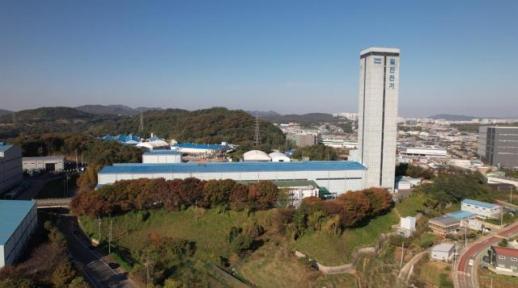 Iljin Electric Signs $621 Million High-Voltage Cable Supply Contract in Malaysia Iljin Electric announced that it has signed a contract to supply approximately $621 million worth of 275kV high-voltage cables for data centers in Malaysia, covering a total length of 54 kilometers. This marks Iljin Electric's fifth contract to supply high-voltage cables to data centers in Malaysia and is the largest order since the company entered the Malaysian cable market. An official from Iljin Electric stated, "We are continuously increasing our overseas orders for high-voltage cables and are working hard to secure more international contracts based on projects in the Southeast Asian market. We can supply both high-voltage transformers and circuit breakers, as well as high-voltage cables, which will contribute to our growth." As Malaysia is actively promoting the attraction of data centers as a national policy, significant long-term demand is expected. The Iljin Electric official added, "We plan to use this large order as a stepping stone to pursue ongoing high-voltage cable contracts for data centers." Additionally, Iljin Electric recently signed a contract worth approximately $1.086 billion with the Singapore Power Authority for high-voltage cable supply in May. The company recorded its highest-ever performance last year, and it is anticipated that the momentum will continue this year due to orders for data center-related products.* This article has been translated by AI. 2026-06-05 10:24:00
 -
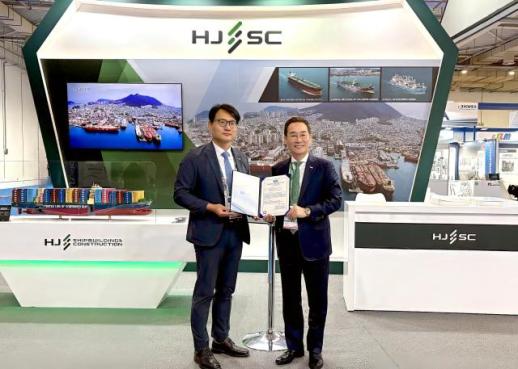 HJ Shipbuilding to Develop 10,000 TEU Biofuel-Powered Container Ship HJ Shipbuilding has received design concept approval from the Korean Register (KR) for a 10,000 TEU biofuel-powered container ship. On June 4, during the Posidonia exhibition held at the Metropolitan Expo Center in Athens, HJ Shipbuilding CEO Yoo Sang-cheol and KR Executive Vice President Cho Byung-sam met to sign the certification agreement. Posidonia is recognized as one of the world's top three maritime and shipbuilding exhibitions, alongside Norway's Nor-Shipping and Germany's SMM in Hamburg. Biofuel for ships refers to a carbon-reducing fuel that blends traditional fossil fuel-based marine oil with a certain percentage of plant and animal oils. With the International Maritime Organization (IMO) tightening carbon emission regulations and the European Union (EU) implementing new environmental regulations, including maritime fuel regulations and the EU Emissions Trading System, the use of biofuels is increasing in major ports worldwide, emerging as an eco-friendly alternative fuel. Interest in biofuels has grown among shipowners attending Posidonia, prompting the shipbuilding industry to proactively secure technology and respond to market demands. To secure relevant technology, HJ Shipbuilding collaborated with KR last year, applying a biofuel propulsion system to the 10,000 TEU container ship it is currently building. The company completed its technology development last month and obtained certification on this day. Yoo Sang-cheol, CEO of HJ Shipbuilding, stated, "The development of biofuel-powered container ship technology is expected to have a positive impact on our sales and order activities in the eco-friendly ship market. Building decarbonized ships is essential for reducing greenhouse gas emissions, and we will secure technological competitiveness to build trust with shipowners." Meanwhile, HJ Shipbuilding reported a more than 347% increase in operating profit in the first quarter compared to the same period last year, indicating significant performance improvement. The company is expected to continue this positive trend as it advances from high-value shipbuilding to biofuel propulsion. 2026-06-05 10:06:00
 -
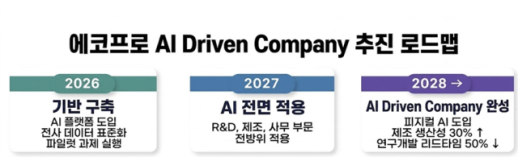 EcoPro Launches Comprehensive AI Initiative Ahead of 30th Anniversary EcoPro has announced its commitment to a company-wide initiative called "AX (AI Transformation)," aiming to integrate artificial intelligence (AI) across all sectors by its 30th anniversary in 2028. On June 4, EcoPro stated that it plans to go beyond using AI as a mere work assistant, applying it comprehensively in manufacturing and research and development (R&D) to drive significant innovation. Notably, the company's Hungarian subsidiary, EcoPro BM, aims to enhance productivity through the introduction of AI-based robotics for operational automation. EcoPro intends to implement a "three-phase roadmap" to become an AI-driven enterprise, leveraging partnerships with leading AI consulting firms. According to the AX three-phase roadmap, EcoPro will establish the foundation for AX this year through company-wide data standardization and pilot projects. Building on this, the company plans to scale up operations next year, with the goal of becoming an AI-driven company by 2028, where AI will facilitate 24/7 operations across all domestic and international subsidiaries. Initially, EcoPro will integrate AI into its R&D sector, aiming to reduce the lead time from R&D to mass production by 50%. Previously, the timeline for product planning to mass production took at least three to five years, but the company plans to cut this duration in half using AI. The introduction of "Physical AI" will also be pursued, with plans to establish autonomous manufacturing plants and laboratories. This implementation is expected to allow robots to take over hazardous tasks, creating a continuous operation and experimentation system that functions 24/7 throughout the year. The production sites will also integrate AI operational systems. The current reliance on workers' experience and intuition will shift to an "AI autonomous control environment" utilizing a manufacturing data platform and machine learning. EcoPro aims to enhance operational efficiency and manufacturing productivity by 30% through the establishment of an "AI autonomous control mother line" in precursor and cathode material calcination lines. AI is expected to analyze and predict defect causes with 95% accuracy and reduce energy consumption by approximately 15-20% through a data-driven predictive maintenance system. Lee Soo-ho, Vice President of EcoPro's AI Innovation Office, stated, "Beyond innovating traditional manufacturing methods, collaboration with AI is now essential. We plan to create an environment where employees can naturally utilize AI as a colleague, thereby improving operational efficiency across the board." Meanwhile, EcoPro BM plans to commence full-scale production at its Debrecen plant in Hungary during the first half of the year. This move aims to directly address the tightening regional regulations, such as the EU Critical Raw Materials Act (CRMA), while strengthening its supply chain and securing new clients among European original equipment manufacturers (OEMs).* This article has been translated by AI. 2026-06-04 17:12:00
 -
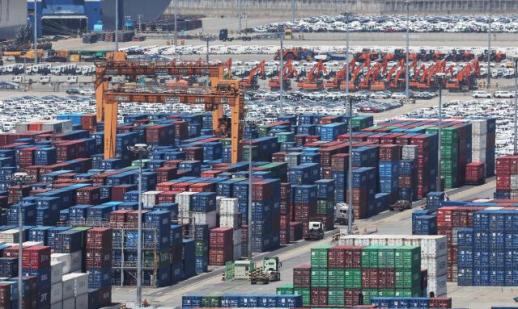 U.S. Tariff Burden on South Korean Companies Drops from 3rd to 6th Place South Korea's ranking in effective tariff rates on exports to the United States has improved since the announcement of the U.S. reciprocal tariff policy in April of last year. In the second quarter of 2025, South Korea ranked third among the top 10 exporting countries to the U.S., but this dropped to sixth place in the first quarter of this year, indicating a reduction in tariff burden. The effective tariff rate is calculated by dividing the tariff amount by the U.S. import value. According to an analysis of customs statistics by the Korea Chamber of Commerce and Industry (KCCI) on June 4, South Korea's exports to the U.S. in the first quarter of this year totaled $36.74 billion, with a tariff amount of $3.2 billion and an effective tariff rate of 8.7%. This rate is significantly lower than China's 26.4%. South Korea ranks sixth among the top 10 exporting countries to the U.S., following India (14.1%), Japan (11.2%), Germany (10.3%), and Vietnam (9.9%). In the first quarter of this year, South Korea's tariff amount on exports to the U.S. was $3.2 billion, placing it seventh among the top 10 exporting countries. The implementation of a 10% general tariff on U.S. imports in April last year and item-specific tariffs on automobiles and parts (25%) and steel and aluminum (50%) peaked in the third quarter. However, following the conclusion of tariff negotiations between South Korea and the U.S. and a reduction in automobile tariffs to 15% in November last year, the burden has decreased. Compared to China, which recorded a tariff amount of $16.58 billion on exports to the U.S., South Korea's performance appears relatively favorable. The effective tariff rate for the automobile sector, which has the highest proportion of tariff amounts among export items, fell significantly from 21.3% in the second quarter of last year to 13.5% in the first quarter of this year. Conversely, the effective tariff rate for steel and steel products, which has the second-highest tariff amount, increased to 42.5% in the first quarter of this year due to the implementation of a 50% item-specific tariff in June last year. In terms of automobile tariffs, South Korea experienced a delay in the application of reductions compared to Germany and Japan. As a result, in the fourth quarter of last year, the gap widened with Germany and Japan, but by the first quarter of this year, South Korea's rate was higher than Japan's (12.5%) but lower than Germany's (14.5%). Regarding steel tariffs, South Korea's low export proportion of raw materials such as pig iron and ferroalloy to the U.S. (only 2%) has resulted in high rates. In contrast, Brazil has a lower effective tariff rate of 20%, attributed to its 52% share of pig iron and ferroalloy in U.S. steel exports, which benefits from lower rates. While it is true that South Korea's tariff burden has eased, uncertainties remain due to the potential for changes in U.S. tariff policy and the still high steel tariff rates. The KCCI stated, "Close monitoring of Section 232 tariff measures related to key export items such as semiconductors is necessary, along with ongoing diplomatic support from the government to resolve tariff uncertainties." It also emphasized the need for policy support to protect domestic production bases and maintain competitiveness in the global market, stating, "Support to enhance our companies' price competitiveness, such as domestic production tax credits and strengthened export financing, should continue, alongside efforts to enhance capabilities through AI transformation in manufacturing over the medium to long term."* This article has been translated by AI. 2026-06-04 17:03:00
 -
 HD Construction Machinery to Supply $23 Million in Bulldozers to Polish Military HD Construction Machinery has signed a major contract to supply bulldozers to the Polish military. According to industry sources, HD Construction Machinery was recently confirmed as the final supplier for the procurement of tracked bulldozers for the Polish 3rd Regional Logistics Base. This marks the company's first significant contract in a European military procurement project, valued at approximately 27 billion won (about $23 million). The order includes 50 units of 15-ton DEVELON bulldozers, with the potential for increased supply based on options. An official from HD Construction Machinery stated, "This contract is significant as it represents our entry into a challenging military procurement market and is a result of launching our bulldozer products in the European market within two years." To secure this order, HD Construction Machinery tailored its production capabilities to meet specific customer requirements, including adjustments to vehicle height, increased travel speed, and military-grade painting. Despite a tight deadline to deliver all units by November, the company established a stable production and supply system to gain the customer's trust. Lim Jeong-woo, the European Regional Director of HD Construction Machinery, remarked, "This contract demonstrates our ability to meet stringent military procurement conditions and showcases our product performance, quality, and supply capability in Europe. We aim to strengthen our competitive edge in various working environments and special-purpose demands, positioning ourselves as a trusted partner not only in construction equipment but also in public, military, and infrastructure recovery markets." In May, HD Construction Machinery signed a memorandum of understanding with the Mykolaiv regional government in Ukraine for cooperation on reconstruction efforts. The company is also expanding its global presence, having recently secured a contract worth 20 billion won for the supply of articulated dump trucks with Rental Group, the largest construction equipment rental company in Northern Europe.* This article has been translated by AI. 2026-06-04 12:09:00
 -
 NVIDIA CEO Jensen Huang to Throw First Pitch for Doosan Bears Jensen Huang, CEO of NVIDIA, will throw the first pitch at a Doosan Bears home game at Jamsil Baseball Stadium in Seoul. In response, Park Jung-won, chairman of Doosan Group, will take the plate for the ceremonial first hit. According to Doosan, on June 7, during the regular season home game between the Doosan Bears and the Kiwoom Heroes, Huang will throw the first pitch while Park will bat. Huang is known for his keen interest in baseball. He will wear a Doosan Bears jersey featuring the number 93, representing the year NVIDIA was founded (1993), as he steps onto the mound to delight Korean baseball fans. Park, who is also the owner of the Doosan Bears, will wear a jersey with the number 96, symbolizing the founding year of Doosan (1896), as he joins Huang in this ceremonial event. Additionally, Huang has garnered attention for his collaborations with companies like Samsung Electronics and SK Hynix on HBM technology, as well as his recent meeting with Samsung Chairman Lee Jae-yong and Hyundai Motor Group Chairman Chung Eui-sun, which has been dubbed the 'Gangbu Meeting.' This gathering is seen as a significant symbol of cooperation in the semiconductor, automotive, robotics, and AI sectors, making Huang's activities a focal point for assessing the potential benefits of AI for Korean companies.* This article has been translated by AI. 2026-06-04 09:03:00
 -
 Samsung Heavy Industries Wins $2.9 Billion Delfin FLNG Contract, Transforming North American LNG Market Samsung Heavy Industries has signaled the start of a new era in floating liquefied natural gas (FLNG) production, moving beyond shipbuilding to lead a transformation in North America's LNG development. On June 2, Samsung Heavy Industries announced that its recent FLNG contract pertains to the first FLNG construction project for the Delfin LNG project in Louisiana, USA. The Delfin FLNG, which Samsung Heavy Industries has secured, marks the first FLNG project in U.S. history, with a contract value of $2.9 billion (4.33 trillion won). The Delfin LNG project breaks away from traditional reliance on large land-based LNG plants, adopting a multiple operational approach that involves deploying several FLNG units of the same specifications. Currently, three FLNG units are planned for order. This method offers advantages such as distributing initial investment burdens and allowing for flexible production adjustments based on market conditions. Industry experts view it as a new LNG production model with competitive advantages over land-based LNG projects. The Delfin FLNG is designed as a hybrid model that combines the economic benefits of nearshore FLNG with stability in offshore environments. The upper plant utilizes a slim structure that receives pre-processed gas from land, reducing construction costs, and is equipped with a living quarters for 120 personnel and a mooring system to ensure stable operations approximately 75 kilometers offshore from Louisiana. Additionally, eco-friendly technologies such as an air-cooled cooling system and a combined power generation system have been implemented. Notably, the FLNG is equipped with self-navigation capabilities to escape hazardous areas during hurricanes, enhancing safety. Samsung Heavy Industries attributes its ability to execute such advanced design and technology to its long-standing expertise in integrated FLNG operations. A company representative stated, "The Delfin project is significant as Samsung Heavy Industries will independently carry out the entire EPC (Engineering, Procurement, and Construction) process for the first time, leading series construction. We aim to drive the 'FLNG production era' by applying optimized designs and solutions proposed proactively by Samsung Heavy Industries to achieve groundbreaking cost reductions and flawless quality." Meanwhile, Samsung Heavy Industries has secured seven out of eleven newly ordered FLNGs globally, including the Prelude, the world's largest FLNG, achieving a 64% market share. Negotiations for subsequent orders related to the Delfin project are also ongoing. Samsung Heavy Industries offers a comprehensive lineup across the LNG value chain, from FLNG (production, liquefaction, and offloading) to LNG carriers and LNG-FSRUs (supply), providing integrated LNG solutions.* This article has been translated by AI. 2026-06-04 08:51:00
 -
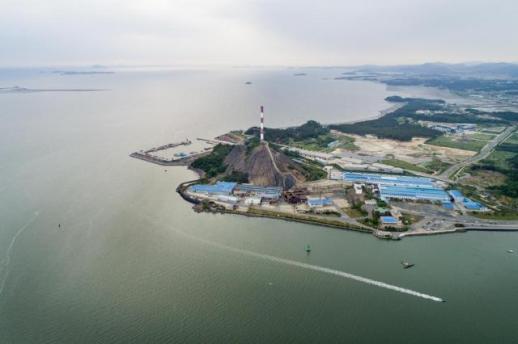 Korean Non-Ferrous Metal Industry Celebrates 90th Anniversary Amid AI Boom The Korean non-ferrous metal industry is set to celebrate its 90th anniversary on June 3. Since the first smelting of copper ore at the Janghang Smelter in Chungcheongnam-do in 1936, the industry has laid the groundwork for industrialization and is now gaining renewed attention due to the growth of artificial intelligence (AI) data centers, electric vehicles, and renewable energy. Once considered a traditional smokestack industry, smelting is re-emerging as a key strategic sector in the era of supply chain security. On June 2, the 19th Non-Ferrous Metals Day celebration took place at the LS MnM Onsan Smelter in Ulsan. Jo In-rae, team leader at LS MnM, received a presidential citation for his contributions to stabilizing the supply chain by improving facilities and optimizing processes, increasing the processing volume of copper concentrate and scrap by 170%. Eighteen individuals were also recognized with government awards for their contributions to the development of the non-ferrous metal industry. Since its inception at the Janghang Smelter on June 3, 1936, the domestic non-ferrous metal industry has supplied essential metals such as copper and zinc for key national industries, including electrical, electronics, automotive, and shipbuilding. It played a crucial role in industrialization until the 1980s, when environmental pollution issues led to its classification as a typical smokestack industry. The Janghang Smelter, which marked the beginning of the domestic non-ferrous metal industry, ceased operations in 1989 amid environmental controversies. However, the smelting industry itself did not come to a halt. The Onsan Smelter, completed in 1979, took over as the center of domestic non-ferrous metal production. Since then, LS MnM, Korea Zinc, and Youngpoong have expanded the domestic supply chain through significant investments in facilities. The status of the smelting industry, once viewed as a typical smokestack sector, is rising again due to the proliferation of AI data centers. The demand for transformers and circuit breakers is surging due to the need to upgrade the U.S. power grid and the expansion of AI data centers, leading to intense competition for copper. Industry experts have referred to copper as the “oil of the AI era.” Copper, known for its high conductivity, is widely used in servers, power supply units, cooling systems, transformers, distribution panels, cables, and communication infrastructure necessary for AI computations. According to S&P Global, global copper demand is expected to reach 28 million tons by 2025 and surge to 42 million tons by 2040, a 50% increase. There are also analyses suggesting a potential annual copper supply shortage of 10 million tons during this period. Copper prices are soaring, reaching approximately $14,490 per ton, a nearly 40% increase from the $10,360 recorded in May of last year. Compared to early this year, when prices were around $13,150 per ton, this represents about a 10% rise. The competition for copper extends beyond pricing to issues of supply chain security. As copper is essential for key national industries such as electric vehicles, semiconductors, defense, and power grids, major countries are seeking stable sources of supply. While the U.S. does not rely heavily on imports of high-purity copper from China, it views the concentration of global smelting and refining capabilities in China as a risk. According to the United Nations Conference on Trade and Development, China accounts for about 60% of global copper ore imports and over 45% of high-purity copper production. The U.S. has already begun treating copper imports as a national security issue. Last year, the White House directed an investigation into the impact of copper imports on U.S. national security, covering raw ore, copper concentrate, refined copper, copper alloys, scrap, and copper derivatives. As the demands of AI data centers, power grids, and defense intersect, copper is increasingly being classified as a strategic national asset rather than just a raw material. However, South Korea is a resource-poor country with almost no copper mines. Most of its copper concentrate is imported from countries like Chile, Peru, and Indonesia for smelting. Nevertheless, South Korea has maintained a presence in the global non-ferrous metal supply chain with world-class smelting technology. Additionally, as the shift away from Chinese supply chains for critical minerals strengthens, South Korean smelting and refining technology is gaining attention. Companies like LS MnM, focused on copper, and Korea Zinc and Youngpoong, centered on zinc, lead, and rare metals, are crucial pillars of the domestic non-ferrous metal supply chain. An LS MnM representative stated, "With the surge in copper demand driven by the expansion of AI data centers and the growth of the electric vehicle and battery markets, securing stable raw materials has become a core competitive advantage for South Korea's future growth industries. We aim to establish a long-term stable copper supply chain through diversified sourcing, investments in metal recycling, and strengthening global partnerships."* This article has been translated by AI. 2026-06-03 09:33:00
 -
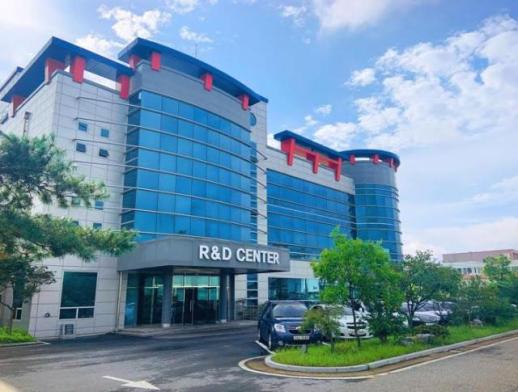 Namsun Aluminum Named GM's Supplier of the Year for 15th Consecutive Year SM Group's manufacturing subsidiary, Namsun Aluminum, has once again been named Supplier of the Year (SOY) by General Motors (GM). According to industry sources on June 2, Namsun Aluminum's automotive division was recognized at GM's 34th Supplier of the Year awards ceremony held recently in Austin, Texas, marking the 15th consecutive year it has received this honor from 2011 to 2025. Namsun Aluminum's CEO, Jeong Soon-won, attended the ceremony to accept the award. The SOY award is given annually by GM to approximately 6,000 global partners based on a comprehensive evaluation of their technology, innovation, supply stability, and sustainability. This year, a total of 103 companies, including 20 from South Korea, received the prestigious award. Namsun Aluminum's key bumper systems and large injection molds supplied to GM Korea were highlighted as factors in its selection. A representative from SM Group stated, "Notably, there have been no issues with the Supplier Parts Quality System (SPPS) in the past year, and we achieved the highest rating of 'BIQS Level 5' in GM's quality evaluation system, which significantly contributed to our assessment." SPPS is a communication tool used by suppliers and customers to resolve product quality issues. Jeong Soon-won commented, "Being named SOY for 15 consecutive years is a recognition of our consistent efforts in enhancing quality, developing new technologies, and ensuring stable supply. Our entire team has proven that we are at a global top level in quality management." He added, "We will not rest on our laurels but will maximize our expertise and business know-how to become a more trusted partner in the global automotive parts market." Meanwhile, Namsun Aluminum, a key subsidiary of SM Group, focuses on its aluminum division, which manufactures window frames and curtain walls, as well as its automotive parts division, which supplies bumpers to GM Korea and others. Recently, it has expanded into eco-friendly and high-value markets, including solar structures and high-performance window systems.* This article has been translated by AI. 2026-06-02 16:57:00