

Journalist

Han Young-hoon
han@ajunews.com
-
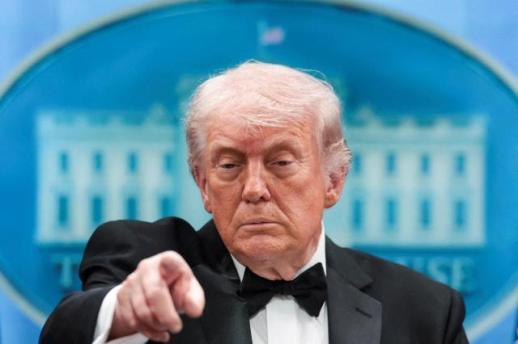 Trump Announces Delay of Military Action Against Iran Amid Negotiations President Donald Trump announced that he will postpone military action against Iran. This decision comes after Iran submitted a revised proposal to the U.S., and key Middle Eastern nations requested additional time for negotiations. On May 18, Trump stated on his social media platform Truth Social, "We will not be attacking Iran tomorrow." He explained that leaders from Qatar, Saudi Arabia, and the United Arab Emirates (UAE) are engaged in "very serious negotiations" with Iran, requesting a delay in military action due to the potential for an agreement to prevent Iran from acquiring nuclear weapons. Trump indicated that he accepted this request, noting that these countries informed him that negotiations with Iran could progress quickly. "I agreed to give them time," he wrote. This announcement followed the delivery of Iran's revised proposal to the U.S. Reuters reported that Pakistan conveyed Iran's proposal, which the Iranian Foreign Ministry confirmed was communicated through Pakistan. The proposal reportedly focuses on ending the conflict and normalizing navigation through the Strait of Hormuz. However, the U.S. does not view Iran's proposal as sufficient for an agreement. Axios cited a senior U.S. official stating that the White House does not consider Iran's revised proposal a "meaningful improvement" and believes it is inadequate for a deal. The U.S. insists that specific concessions are needed regarding Iran's nuclear program and uranium enrichment. In a phone interview with the New York Post, Trump stated that there are currently no concessions on the table for Iran, saying, "Nothing is open right now." Trump also maintained military pressure, instructing Defense Secretary Pete Hegseth and Chairman of the Joint Chiefs of Staff Dan Cain to prepare for a large-scale attack if a satisfactory agreement does not emerge. He had previously intensified pressure on Iran, warning on Truth Social that "the clock is ticking" and that if they do not act quickly, there will be nothing left for them.* This article has been translated by AI. 2026-05-19 06:24:48
 -
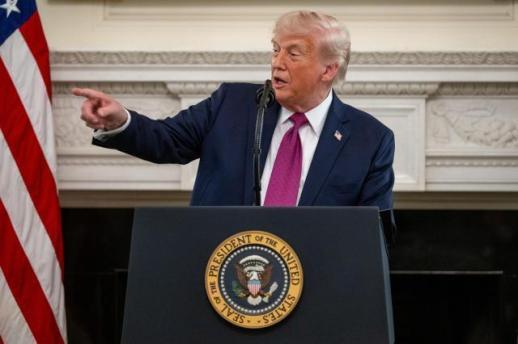 Trump Rejects Iran's Proposal, Signals No Concessions Donald Trump, the President of the United States, expressed strong dissatisfaction with Iran's recent proposal for a ceasefire, indicating that he sees no room for further concessions. In a phone interview with the New York Post on May 18, Trump stated, "Nothing is open right now" regarding potential concessions to Iran. Internal assessments within the U.S. government also reflect a negative outlook. Axios reported, citing a senior U.S. official, that the White House does not view Iran's revised proposal as a "meaningful improvement" and believes it is insufficient for an agreement. The core issue remains Iran's nuclear program. According to Reuters, Iran's recent proposal focuses on ending hostilities and reopening the Strait of Hormuz, suggesting that discussions on its nuclear program and uranium enrichment should be addressed in subsequent negotiations. Trump also mentioned military options, claiming he had postponed an attack on Iran at the request of leaders from Qatar, Saudi Arabia, and the United Arab Emirates. However, he instructed that U.S. forces should be prepared for a large-scale attack if an "acceptable agreement" is not reached. Mediation efforts through Pakistan are ongoing. Iran's Foreign Ministry confirmed that its proposal was conveyed to the U.S. through Pakistan. Sources from Pakistan indicated that "both sides are continually changing their demands" and noted that "time is running out."* This article has been translated by AI. 2026-05-19 06:16:33
 -
 AstraZeneca's New Hypertension Drug Approved in the U.S., Expected to Generate $7 Billion in Annual Revenue AstraZeneca's new hypertension treatment has been approved in the United States. This combination therapy is intended for patients whose blood pressure remains uncontrolled despite taking multiple medications. It is considered a new treatment option as it targets a hormone that raises blood pressure. On May 18, The Wall Street Journal reported that AstraZeneca received approval from the U.S. Food and Drug Administration (FDA) for its hypertension drug, Baxfendy, which was previously known as baxdrostat during development. The approval is aimed at adult hypertension patients. It is not a standalone treatment but is used in conjunction with other blood pressure medications. Late-stage clinical trials confirmed that adding Baxfendy to patients already taking two or more blood pressure medications resulted in a reduction in blood pressure. Baxfendy targets aldosterone, a hormone involved in regulating sodium and fluid levels in the body. When it acts excessively, it can raise blood pressure. Baxfendy works by inhibiting this action to lower blood pressure. AstraZeneca is promoting Baxfendy as a "new approach to treatment." Hypertension affects a large number of patients, and it is not uncommon for individuals to fail to reach their target blood pressure despite using multiple medications. Rud Doever, AstraZeneca's Vice President of BioPharmaceuticals, stated, "We are providing a new treatment option for a condition that has seen limited progress in treatment over the past 20 years." This approval is also significant for AstraZeneca's revenue structure. The company’s key product in the cardiovascular, renal, and metabolic disease sectors, the diabetes drug Farxiga, recently lost patent protection in the U.S. Farxiga has been AstraZeneca's best-selling drug. Baxfendy is seen as a key candidate in the company's strategy to develop new revenue sources following the expiration of Farxiga's patent. Baxfendy was acquired by AstraZeneca when it purchased Syncor Pharma in 2023. The company is expanding its lineup of new drugs in the cardiovascular, renal, and metabolic disease sectors, including Baxfendy and the obesity treatment under development, Elecoglifron. AstraZeneca anticipates that Baxfendy could generate annual sales exceeding $5 billion (approximately 7.4 trillion won). The company aims to achieve $80 billion (approximately 118.4 trillion won) in revenue by 2030, planning to launch 20 new drugs before then.* This article has been translated by AI. 2026-05-18 18:04:59
 -
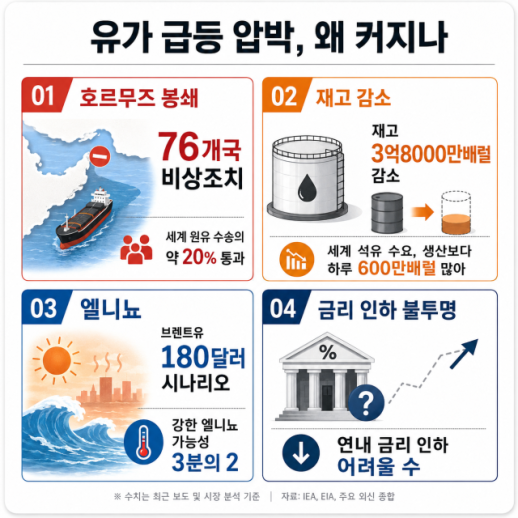 Middle East Conflict and El Niño Could Drive Oil Prices to $180 The ongoing conflict in the Middle East, combined with climate factors, is creating significant energy shocks. With the blockade of the Strait of Hormuz halting oil exports from the Gulf region, global oil inventories are rapidly depleting. The potential for increased demand due to summer cooling and travel, along with a strong El Niño, has led to warnings that international oil prices could rise to $180 per barrel (approximately 260,000 won). According to the Financial Times (FT) on May 17, the International Energy Agency (IEA) estimates that the number of countries implementing emergency measures for fuel security and consumption restraint has risen to 76, up from 55 at the end of March. This increase occurred within just two months. Australia plans to invest $10 billion (about 14.7 trillion won) to expand its fuel and fertilizer reserves, while India is advising its citizens to refrain from gold purchases and international travel to defend its foreign exchange reserves. Countries are responding urgently as energy supplies tighten. The IEA projects that from March to June, global oil demand will exceed production by about 6 million barrels per day. Some analysts estimate the shortfall could reach 8 to 9 million barrels daily. Since the onset of the conflict, global oil inventories have decreased by approximately 380 million barrels, excluding amounts that could not leave the Gulf region. Releasing government reserves has its limits. Currently, more than 2 million barrels of emergency oil are being supplied to the market daily, but many of these release measures are set to end in July. JP Morgan warns that the inventories of OECD member countries could drop to levels that strain oil distribution and refinery operations by early June. The forecast of $180 per barrel arises from these circumstances. Paul Diggle, chief economist at Aberdeen Asset Management, stated, "We are considering a scenario where Brent crude could rise to $180 per barrel (approximately 260,000 won)." He noted that while this is not his base case, it is a serious consideration. Currently, Brent crude is priced above $105 per barrel (about 150,000 won). However, analysts suggest this level may not exert enough price pressure to significantly reduce oil consumption. Morgan Stanley warns that if prices exceed $150 (about 220,000 won), it could lead to actual fuel shortages, supply chain disruptions, and a simultaneous economic recession. A key variable is the reopening of the Strait of Hormuz. Apostolos Tzitzikostas, the European Union's Commissioner for Transport, cautioned at an FT conference that if the Middle East conflict does not resolve within weeks and the Strait remains closed, the possibility of a global recession cannot be ruled out. In this scenario, the volume of oil reaching the market becomes more critical than production levels. El Niño Complicates Matters Adding to the uncertainty is the emergence of El Niño. According to CNN, the National Oceanic and Atmospheric Administration (NOAA) reports that El Niño is forming more rapidly than expected, with a significant likelihood of developing into a strong event this fall or winter. NOAA estimates a two-thirds chance that this El Niño could reach strong or very strong levels at its peak, with a 96% probability of lasting through winter. El Niño is characterized by higher-than-average sea surface temperatures in the tropical Pacific, which can alter global weather patterns. A strong El Niño increases the risks of droughts, heatwaves, and floods in various regions. Heatwaves can lead to higher air conditioning use, increasing power demand, while droughts can worsen conditions for hydropower generation. Increased reliance on oil, gas, and coal to meet energy needs could further pressure overall energy prices. Rising oil prices also pose challenges for monetary policy. Jeffrey Gundlach, CEO of DoubleLine Capital and known as the 'Bond King,' stated that rising oil prices and tariff burdens due to the Middle East conflict could push inflation higher, complicating the Federal Reserve's ability to cut interest rates this year. He suggested that the next Consumer Price Index (CPI) could rise to around 4%, indicating that the Fed's next policy move might be an increase rather than a decrease.* This article has been translated by AI. 2026-05-18 17:36:00
 -
 Netanyahu: Mission to Eliminate Key Hamas Planners Nearly Complete Israeli Prime Minister Benjamin Netanyahu announced that the mission to eliminate the key planners behind Hamas's surprise attack on October 7, 2023, which resulted in over 1,200 deaths, is nearing completion. His remarks followed an Israeli military announcement that a Hamas military commander had been killed in airstrikes in the Gaza Strip. On May 17, during a weekly cabinet meeting, Netanyahu stated, "I promise to eliminate those who designed the massacre and hostage-taking, and we are very close to completing this mission." He referred to the deceased commander, Ezzedin al-Haddad, as a "despicable terrorist." The Israeli military previously reported that al-Haddad was killed in airstrikes on May 15. Since the October 7 attack by Hamas, Israel has continued operations targeting the political and military leadership of the group. Israel has also claimed to have eliminated Yahya Sinwar, identified as a key architect of the October 7 attack, along with Muhammad Deif, a long-time leader of Hamas's military wing. According to AFP, the attack resulted in 1,221 deaths in Israel. Netanyahu also addressed the extent of Israeli military control in the Gaza Strip, stating, "The Israeli military currently controls 60% of the Gaza Strip." This aligns with recent reports indicating that Israeli forces have advanced toward a newly established operational boundary known as the "Orange Line." Israel and Hamas entered a ceasefire, mediated by the United States, on October 10 of the previous year. Under the ceasefire terms, Israeli forces were to withdraw to the so-called "Yellow Line," but even then, over 50% of the Gaza Strip would remain under Israeli control. Netanyahu's statement about 60% control suggests that the operational scope of Israeli forces may have expanded beyond the agreed withdrawal line. Netanyahu emphasized, "We are pressuring Hamas," adding, "Our mission is to ensure that Gaza will never again pose a threat to Israel." The humanitarian toll in the Gaza Strip has also risen significantly. According to the Gaza Health Ministry, which is governed by Hamas, over 72,700 people have died as a result of Israeli military operations since October 2023, with the majority of casualties being civilians. The United Nations considers the Gaza Health Ministry's statistics to be reliable data.* This article has been translated by AI. 2026-05-18 14:39:38
 -
 Air Busan Flight Diverts to Kaohsiung Due to Strong Crosswinds An Air Busan passenger flight en route from Busan to Taipei encountered strong crosswinds while attempting to land at Taoyuan International Airport, leading to two aborted landing attempts. The aircraft subsequently diverted to Kaohsiung Airport. According to local media reports, Air Busan flight BX791 departed Gimhae International Airport in Busan on May 16, intending to land at Taoyuan International Airport. However, during the landing approach, the aircraft experienced significant turbulence due to strong winds and was unable to complete the landing. Footage released by local media showed the plane descending close to the runway, followed by a puff of white smoke before it ascended again. Some reports suggested that the tail of the aircraft may have brushed the runway, but there has been no official confirmation regarding any contact or damage to the aircraft. After two unsuccessful landing attempts, flight BX791 abandoned its landing at Taoyuan and redirected to Kaohsiung Xiaogang Airport, where it landed safely. At the time, strong winds were reported in northern Taiwan. Hwa Shi News noted that gusty winds were observed in the Taoyuan area on the evening of May 16. A current pilot explained on local broadcasts that if landing is deemed difficult, it is standard safety procedure to either ascend again or divert to another airport.* This article has been translated by AI. 2026-05-18 14:15:00
 -
 High Unemployment Rates Persist for U.S. Workers Under 35 with Master's Degrees The employment premium associated with master's degrees in the United States is diminishing. While the number of master's programs has rapidly increased, the quality job opportunities that these degrees were expected to provide have not kept pace. Companies are increasingly prioritizing practical skills over academic qualifications in their hiring processes. According to a report by the Wall Street Journal on May 17, labor market research firm Burning Glass Institute analyzed data from the U.S. Bureau of Labor Statistics (BLS) since 2003 and found that the unemployment rate for master's degree holders under 35 has reached one of its highest levels in the past two decades. In contrast, the unemployment rates for those with doctoral, law, or medical degrees in the same age group remain low. Gad Levanon, chief economist at Burning Glass Institute, attributed the weakening investment return of master's degrees to an oversupply of graduates compared to the available jobs. He noted that while employment trends for advanced degree holders used to move in tandem, a widening gap has emerged between master's and professional degrees. The supply of master's degrees has surged significantly. A report from the Center for Education and the Workforce indicates that the number of master's programs in the U.S. increased by 69% from 2005 to 2021, surpassing 33,500. In the past five years, there has been a rise in programs aimed at retraining for artificial intelligence (AI), including specialized one-year courses in online MBA, data science, and healthcare management. The disparity arises from how degrees function in the job market. Medical and law degrees often lead directly to licensure, while master's degrees serve more as a 'signal' of capability. As the number of master's degree holders increases, the rarity of this signal diminishes. Levanon stated, "A master's degree is no longer a guaranteed pathway to good jobs." In fact, the employment situation for master's degree holders under 35 has worsened compared to the average over the past 20 years. The Wall Street Journal reported that the unemployment rate for this group was only higher during specific periods, such as the COVID-19 pandemic and shortly after the 2008-2009 financial crisis. In the past year, the employment rate for those with associate degrees has been higher than that of master's degree holders. Corporate hiring attitudes are also shifting. A survey from Drexel University's LeBow College of Business found that over 40% of companies reported no plans to hire MBA graduates this year, a significant increase from 26.8% last year. Johnny Taylor Jr., president of the Society for Human Resource Management (SHRM), noted that the rise of AI has led companies to focus more directly on job performance capabilities rather than degrees. However, the utility of a master's degree has not completely vanished. Amir Zelcher, who is enrolled in the MBA program at Texas A&M University, is set to begin a full-time position at Texas Instruments this fall. He credited the school's career preparation program and support for interviews and salary negotiations as beneficial for his job search. The effectiveness of the degree now hinges more on the demand for the major, the school's career support, and actual job skills.* This article has been translated by AI. 2026-05-18 12:53:40
 -
 Israeli Military Reports Shortage of 12,000 Troops Amid Ongoing Conflicts The Israel Defense Forces (IDF) have publicly acknowledged a significant shortage of troops and increasing fatigue among reservists. As the conflict in Gaza and tensions with Iran continue, both the standing army and reserve forces are nearing their limits. On May 17, The Times of Israel reported that the IDF currently lacks approximately 12,000 troops based on standing army standards, with a shortfall of about 7,000 combat soldiers. A senior IDF officer stated, "The security needs are great and urgent, and the fatigue among soldiers is much greater than expected." The IDF warned that the troop shortage could worsen starting next year. Israel reduced the mandatory service period for men from 36 months to 30 months, effective August 2024. The first cohort under this new system is set to be discharged in January 2027. The IDF believes that unless existing laws are amended, the shortage of combat and non-combat personnel could increase by thousands. IDF Chief of Staff Eyal Zamir has repeatedly called for an extension of the mandatory service period back to 36 months. However, the government has yet to approve this request. The IDF also sees a need for effective conscription legislation and adjustments to the duration and methods of reserve call-ups. However, the government's response has not aligned with military needs. The administration is prioritizing the passage of a Haredi conscription bill over extending mandatory service. This bill aims to increase Haredi participation in the military, but the IDF views it as insufficient to address the immediate troop shortage. Although there are about 80,000 eligible Haredi conscripts, actual enlistment numbers are limited, and even if the bill's goals are fully met, the annual increase in Haredi combat soldiers may only reach a few hundred. Actual enlistment figures also fall short of military demands. Approximately 1,850 Haredi soldiers enlisted during the first half of the 2025-2026 conscription period, with projections suggesting over 3,000 for the entire period. While this represents a record high, it still falls short of the IDF's target of 4,800 annually. Moreover, the IDF has indicated an immediate need for 7,000 additional combat troops, highlighting that expanding Haredi enlistment alone will not fill the gap. The burden on reservists is also rapidly increasing. The IDF initially set the reserve duty period for 2026 at 55 days, but many reservists have already served 80 to 100 days due to the ongoing conflict with Iran. Critics point out that the current system relies heavily on emergency call-up orders, which limits its effectiveness in prolonged warfare. A senior IDF officer warned, "If legislative measures are not taken now, the situation will worsen and shake the entire system," adding that there remains a "last legislative opportunity" to address the troop crisis before the upcoming elections.* This article has been translated by AI. 2026-05-18 12:13:16
 -
 Ukraine Launches Large-Scale Drone Attack on Russia, Casualties Reported Near Moscow Ukraine has launched a large-scale drone attack targeting Russian territory, a response following airstrikes by Russia on Kyiv that resulted in the deaths of 24 civilians. The conflict has escalated as both sides engage in long-range strikes, reaching areas near Moscow. According to reports from Reuters and the Associated Press, Ukraine began its drone assaults on various regions, including Moscow and Belgorod, late on the night of May 17. Russian authorities reported that at least four people were killed in the attacks, including three near Moscow and one in Belgorod. More than 12 others were reported injured according to Russian sources. The Russian Defense Ministry claimed to have intercepted 556 drones nationwide. Additionally, separate reports indicated that over 1,000 Ukrainian drones were shot down within a 24-hour period. Moscow Mayor Sergey Sobyanin stated that 81 drones were aimed specifically at Moscow. Damage was reported in the Moscow area, with some drones landing near residential areas and infrastructure. Debris was also found near Sheremetyevo Airport, causing delays and cancellations of some flights. Damage was reported near Moscow's oil facilities, with injuries occurring as a result. Ukraine emphasized that the attacks were a justified response to Russian airstrikes. Ukrainian President Volodymyr Zelensky stated, "Ukraine's response is legitimate as Russia continues its war and attacks on cities." Zelensky had previously warned of a strong response following the deadly airstrikes on Kyiv that killed 24 people the previous week. This attack demonstrates Ukraine's long-range strike capabilities, reaching areas near Moscow. Ukraine has recently increased its attacks on Russian oil and military facilities, aiming to pressure Russia's energy and military infrastructure and raise the costs of the ongoing war. On the same day, Russia continued its drone attacks on Ukraine. The AP reported that Russian strikes on central Ukraine's Dnipropetrovsk region resulted in injuries to eight civilians. 2026-05-18 08:51:00
 -
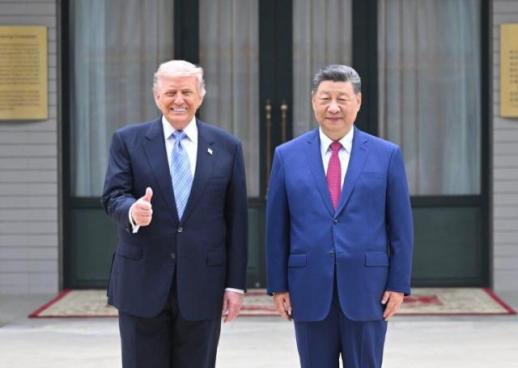 Trump Associates Warn of Potential Chinese Invasion of Taiwan Within Five Years Donald Trump's recent visit to China has heightened concerns within the U.S. administration regarding the risks associated with Taiwan. While the atmosphere of the summit appeared friendly, some of Trump's associates believe that China may consider invading Taiwan within the next five years. According to Axios on May 17, some of Trump's close aides view the most significant outcome of the U.S.-China summit as an increased risk of a Chinese invasion of Taiwan. They also expressed concerns that such an action could disrupt the semiconductor supply chain critical for the artificial intelligence (AI) industry. During his visit to Beijing, Trump reportedly felt satisfied with the ceremonial treatment he received. However, his associates noted the messages conveyed by China during the trip. One aide told Axios that Xi Jinping's attitude suggested, "China is no longer an emerging power but an equal to the United States, and it is trying to establish a new position that Taiwan belongs to China." The aide assessed that the visit signaled a significantly increased likelihood of the Taiwan issue coming to the forefront within the next five years. He added, "The U.S. economy is not prepared for this, and the semiconductor supply chain is far from self-sufficient." The Taiwan issue is also directly linked to the AI competition. Taiwan is a key hub for advanced semiconductor production. If China were to pressure Taiwan or take military action, U.S. companies could face disruptions in the supply of chips necessary for AI operations. The aide emphasized, "There is no more urgent issue for CEOs and the economy as a whole than the semiconductor supply chain." Taiwan has also expressed its vigilance. President Tsai Ing-wen recently stated, "Taiwan will not be sacrificed or used as a bargaining chip," asserting that the future of Taiwan should be determined by its people. He also emphasized that U.S. arms sales to Taiwan are a commitment under the Taiwan Relations Act.* This article has been translated by AI. 2026-05-18 08:04:41