
Journalist

Han Ji-yeon
hanji@ajunews.com
-
 Asiana Airlines to cut int'l flights amid soaring oil prices SEOUL, March 31 (AJP) - Asiana Airlines will cut about a dozen flights on four international routes this spring amid rising oil prices caused by the prolonged conflict in the Middle East. The flagship carrier said on Tuesday it canceled seven flights from Incheon to Changchun, China; three flights to Harbin; and two flights each to Phnom Penh, Cambodia, and Yanji, China for the months of April and May, as jet fuel prices surged sharply. "We will minimize inconvenience for affected customers by offering alternative flights and waiving fees for changes to their trip schedules," Asiana Airlines said. Amid soaring oil prices, domestic airlines are trimming flights to reduce costs, with Asiana becoming the first full-service carrier to follow suit after low-cost carriers made similar cuts. Asiana became the first full-service carrier to follow suit after low-cost airlines made similar cuts, as soaring oil prices push domestic carriers to trim flights to reduce costs. Korean Air, the country's largest flagship carrier, which completed its acquisition of Asiana Airlines in December last year, will also enter emergency mode starting next month. 2026-03-31 15:58:00
 -
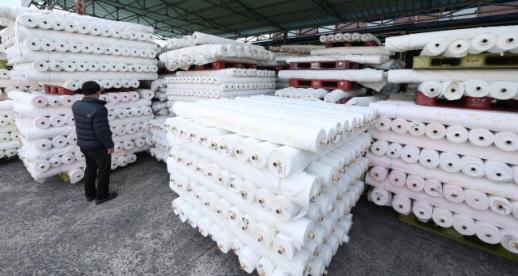 Korean manufacturers turn sharply pessimistic in steepest BSI drop since Covid SEOUL, March 26 (AJP) -South Korean manufacturers turned abruptly pessimistic, with sentiment posting its sharpest drop since the Covid-19 shock in early 2020 as the Middle East crisis spilled into the real economy a month after U.S.-Israeli strikes on Iran. The country's largest business association, Federation of Korean Industries (FKI), said Thursday its Business Survey Index (BSI) outlook for April stood at 85.1, based on a survey of the country’s 600 largest companies by sales. The index dropped 17.6 points from March’s 102.7 — which had marked the first positive reading in 48 months — falling back below the baseline of 100 in just one month. The March actual BSI came in at 92.6. By sector, both manufacturing and nonmanufacturing were in negative territory, at 85.6 and 84.6, respectively, marking the first time in 15 months that both sectors recorded readings in the 80s. Manufacturing sentiment deteriorated sharply, plunging 20.3 points from March’s 105.9 — the steepest drop since April 2020 during the COVID-19 shock. Nonmanufacturing also fell 14.8 points from 99.4. Within manufacturing, eight of 10 subindustries were below the 100 threshold, with only pharmaceuticals and electronic and communications equipment posting positive outlooks. All nonmanufacturing subsectors remained negative. Weakness was most evident in sectors directly exposed to crude supply disruptions. Petroleum refining and chemicals posted a BSI of 80.0, while electricity, gas and water fell to 63.2. Transportation and warehousing stood at 82.6, and nonmetal materials and products — including plastic manufacturing reliant on crude-based inputs — lagged at 69.2. FKI attributed the broad-based decline to heightened uncertainty stemming from the Middle East conflict, including surging global oil prices and rising ocean freight rates. Oil prices have Dubai grade has risen over 150 percent so far this year owing to the conflicts in the Middle East and crippling of the core waterway, the Strait of Hormuz, off the Iranian coastline. All seven major categories in the BSI remained below the 100 mark, including domestic demand (90.8), exports (94.3) and investment (95.4). The funding conditions index, which reflects corporate liquidity, fell to 89.7 — the lowest since June 2023. The profitability index dropped 7.1 points from the previous month to 90.8, signaling mounting cost pressures. FKI said companies are facing growing pressure on financial health, citing concerns over inflation from global supply chain disruptions and a slowdown in the real economy. Lee Sang Ho, head of FKI’s economic division, said rising tensions in the Middle East have heightened concerns over crude supply and dampened business sentiment, calling for swift policy support, including proactive fiscal measures, to prevent external uncertainty from spilling over into the real economy and disrupting corporate activity. 2026-03-26 07:48:02
 -
 Hyundai Motor CEO Jose Munoz: 20 New Models in China, Full Electrified Lineup in Europe by 2027 Hyundai Motor said it will step up its push in global markets this year with an aggressive rollout of new vehicles, while strengthening so-called “physical AI” capabilities in areas such as autonomous driving and robotics to compete in future mobility. Jose Munoz, Hyundai Motor’s CEO, said in a CEO shareholder letter released on the 20th that the company will “aggressively launch global new models tailored to customer expectations.” For China, Munoz said Hyundai will follow a “in China, for China, and for the world” strategy, launching 20 new models over the next five years and targeting annual sales of 500,000 vehicles. In South Korea, he said Hyundai plans to release new versions of the Tucson and Avante this year. In North America, Munoz said Hyundai will introduce extended-range electric vehicles starting in 2027 with a driving range of more than 600 miles (about 965 kilometers) per charge. He also said the company plans to launch its first body-on-frame midsize pickup truck before 2030. In Europe, Munoz said Hyundai will unveil five new models over the next 18 months, including the Ioniq 3, which he said will be shown to the world for the first time at Milan Design Week in April. He added that by 2027 Hyundai will have an electrified model lineup for every vehicle it sells in Europe. For India, Munoz said Hyundai will invest $5 billion through 2030 and launch a total of 26 new models. He said the company will introduce its first locally strategic electric SUV in India by 2027, planned, designed and produced locally. Hyundai also said it will accelerate its physical AI strategy, including autonomous driving and robotics. Munoz said the group’s technology platform, Pleos, will be a key element in speeding up autonomous driving development. He said Hyundai plans to equip Ioniq 5 vehicles produced at Hyundai Motor Group Metaplant America with specifications optimized for autonomous driving and supply them to Google’s Waymo. He also called Boston Dynamics’ Atlas “one of the world’s most advanced humanoid robots,” and said Hyundai aims to develop intelligence that goes beyond building cars to changing how vehicles are made and operated. On the fast-changing international environment, Munoz said the global trade landscape remains uncertain due to tariff pressure, currency swings and geopolitical tensions. He said Hyundai will carry forward the spirit of founder Chung Ju-yung, who expanded the business by turning uncertainty into opportunity. * This article has been translated by AI. 2026-03-20 11:21:56
 -
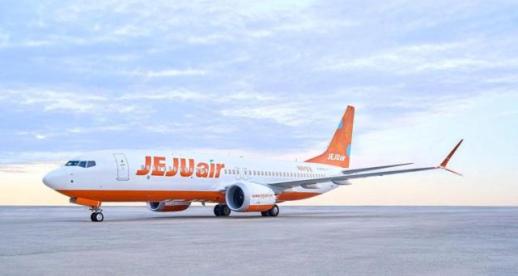 Jeju Air tops 60 million passengers as it marks 17 years of international flights SEOUL, March 20 (AJP) - Short-haul carrier Jeju Air said Friday it has carried over 60 million passengers as it marks the 17th anniversary of launching international routes. Jeju Air became the first South Korean budget carrier to launch international services, with flights between Incheon and Osaka in March 2009. Starting with about 159,000 passengers in its first year, Jeju Air continued to expand, reaching a milestone of serving over 1 million passengers in 2012. By offering more diverse routes to neighboring Japan, China, and Southeast Asian countries in later years, the airline's cumulative international passengers surpassed 10 million in 2016 and topped 50 million in 2024. As of the end of February this year, its cumulative international passengers stood at about 62.86 million, showing an average annual growth of 27.5 percent. Jeju Air currently operates some 58 international routes, with destinations in China, Indonesia, Japan, Laos, Malaysia, Mongolia, the Philippines, Singapore, Thailand, and Viet Nam. Notably, what started as one daily flight between Incheon and Osaka now operates seven times a day, making Jeju Air the most frequent carrier on the route. The number of passengers has grown nearly eightfold, from 73,000 in 2009 to 574,000 in 2025. "We have helped make air travel more accessible and affordable for passengers over the past 17 years," a Jeju Air staffer said, adding that the airline will continue to promote "healthy competition" in South Korea's aviation industry. 2026-03-20 11:19:31
 -
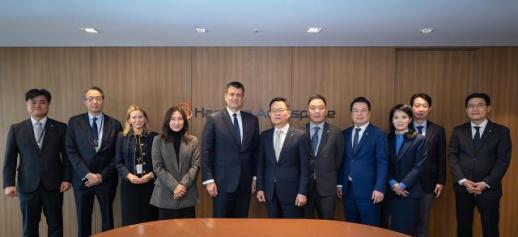 Hanwha Aerospace Hosts IISS Global Security Strategy Roundtable in Seoul Hanwha Aerospace said Thursday it held a “Global Security Strategy Roundtable” with the International Institute for Strategic Studies, a global think tank, to discuss key international issues. The event was held Wednesday at Hanwha Building in Janggyo-dong, Seoul. Attendees included Hanwha Aerospace CEO Son Jae-il and senior executives from Hanwha Systems and Hanwha Ocean, the group’s three defense companies. The IISS delegation included Director-General Bastian Giegerich; Senior Adviser Lee Jung-min; Rami Kim, the institute’s Korea Chair; and Rosamund de Sibel, head of advisory services, Hanwha Aerospace said. It was the first visit by IISS leadership to Hanwha headquarters since the Korea Chair was established at IISS last year, the company said. The two sides exchanged views on the rapidly changing security environment and global defense industry trends. Hanwha executives outlined their global business vision, while IISS shared its research and advisory work and plans for the Korea Chair, the company said. Discussions also covered major security issues including rising defense demand in Europe and the need to strengthen air defense capabilities in the Gulf region, it said. Founded in the United Kingdom in 1958, IISS is a leading defense and security think tank. It hosts the Shangri-La Dialogue, Asia’s largest security forum, and publishes The Military Balance, a widely used annual assessment of global military capabilities. The Korea Chair is a permanent research post jointly sponsored by Hanwha and the Korea Foundation for International Cultural Exchange (KF). Hanwha said it is the first Korea-focused position established at a major European security think tank. The inaugural chair, Dr. Rami Kim, is based at IISS headquarters in London and leads research on advanced technology and defense and security issues, the company said. “Hanwha aims to be a ‘trusted industrial partner’ that grows with partner countries through technology transfer, joint investment and local production, not simply a defense exporter,” Son said. “Strategic cooperation with IISS will be an important foundation for realizing that vision.” * This article has been translated by AI. 2026-03-20 10:27:24
 -
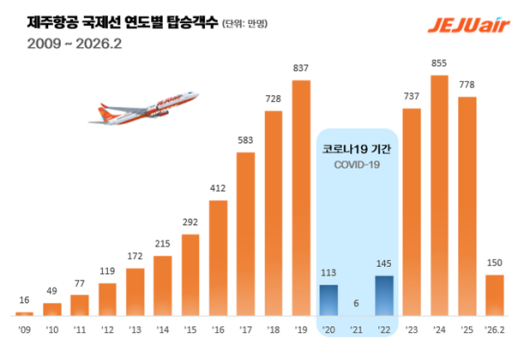 Jeju Air Marks 17 Years of International Flights, Averaging 27.5% Annual Growth Jeju Air said Thursday it has marked the 17th anniversary of its international service, reporting 62.85 million cumulative international passengers and average annual growth of 27.5%. The airline began scheduled international flights on March 20, 2009, launching the Incheon-Osaka route as South Korea’s first low-cost carrier to operate a regular international service. After about 159,000 passengers in its first year, Jeju Air expanded steadily. In 2012, it carried about 1.19 million international passengers, ushering in what it called the “1 million annual international passengers” era. As it added routes to Japan, Southeast Asia and greater China, the airline’s cumulative international passenger total surpassed 10 million in 2016 and topped 50 million in 2024. As of the end of February this year, cumulative international passengers stood at about 62.858 million, maintaining average annual growth of 27.5% since 2009, the company said. Jeju Air also increased its network from seven weekly flights on the Incheon-Osaka route in 2009 to 58 international routes now, serving destinations including Japan, the Philippines, Thailand, Vietnam, Malaysia, Singapore, Indonesia, Laos, Mongolia and greater China. Japan routes carried more than 4 million passengers last year, the company said, its best result on record. Southeast Asia routes also posted their strongest performance since the COVID-19 pandemic, with 360,000 foreign tourists using the services. The Incheon-Osaka route, Jeju Air’s first international service, has grown from one daily flight at launch to seven a day. The company said that is the highest frequency among airlines operating Korea-Japan routes. Passenger traffic on the route rose from about 73,000 in 2009 to about 574,000 in 2025. A Jeju Air official said the carrier has helped shift the market toward consumers and broaden access to air travel over the past 17 years, adding that it aims to strengthen South Korea’s aviation competitiveness through “healthy competition.”* This article has been translated by AI. 2026-03-20 10:12:09
 -
 Mercedes-Benz Korea Expands Airport Vehicle Care Service to Gimpo International Airport Mercedes-Benz Korea said on the 20th it is expanding its premium vehicle storage and care program, “Mercedes-Benz Airport Service,” from Incheon International Airport to Gimpo International Airport for customers traveling by air. Under the program, customers drop off their vehicles at a designated location before departure. The company stores the vehicles in an indoor parking facility and, if requested, provides inspection and care services. Vehicles are returned to customers according to their arrival schedule. The expansion to Gimpo is aimed at easing inconvenience from parking congestion and wait times as airport traffic increases, the company said. The service is offered up to three times during the free service period to customers who bought a new Mercedes-Benz vehicle on or after Nov. 1, 2023. Customers who bought a fully electric vehicle during the same period can use it without a limit on the number of times. Customers must book in advance through the customer contact center and hand over the vehicle at the designated location. Vehicles are stored indoors to avoid exposure to fine dust and heavy rain. By request, customers can also receive maintenance services such as regular inspections and replacement of consumable parts. “Airport Service is a premium vehicle care program that goes beyond simple storage, keeping customers’ vehicles in top condition while they travel,” said Tolsten Schtrein, executive vice president and head of customer service. “We will continue to expand differentiated premium service experiences tailored to customers’ lifestyles.” The service operates year-round from 4 a.m. to midnight. Vehicle cleaning and EV charging are available only at Incheon International Airport. * This article has been translated by AI. 2026-03-20 09:54:16
 -
 Geely Auto Group Tops 206,000 Global Sales in February as Zeekr Surges Geely Auto Group, the parent of Zeekr, said Thursday its global sales totaled 206,160 vehicles in February. That brought worldwide sales for January and February to 476,327 vehicles. Exports in February alone reached 60,879 vehicles, up 138% from a year earlier. New energy vehicles (NEVs) — including Zeekr, Geely and Lynk & Co. — accounted for 117,488 units in February, up 19% from the same month last year. NEV sales for the year to date totaled 241,740 units, a 10% increase from a year earlier. By brand, Zeekr posted the strongest growth. Despite fewer production days due to China’s Lunar New Year holiday, which lasted up to nine days, Zeekr sold 23,867 vehicles worldwide in February, a 70% jump from a year earlier. While many NEV makers reported month-to-month declines, Zeekr’s January-February sales rose 84% from a year earlier to about 47,700 vehicles, the company said. The company attributed the performance to strong sales of Zeekr’s flagship 9X SUV. In China’s domestic market in February, the Zeekr 9X was named the top-selling model in the large SUV segment priced above 100 million won (500,000 yuan). It also marked a fourth straight month as the best-selling vehicle across all models in that price range. A Geely Auto Group official said February is typically a difficult month for Chinese automakers to deliver results, but the group still posted sharp year-on-year growth. The official added that if Zeekr makes an official entry into the South Korean market this year, its growth could accelerate further. * This article has been translated by AI. 2026-03-20 09:24:06
 -
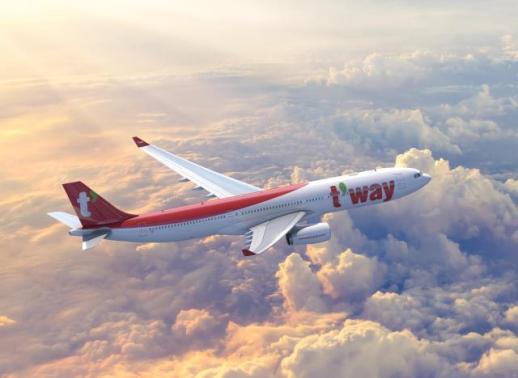 T’way Air Says Incheon-Saga Route Hit 95% Load Factor in Jan.-Feb., Up 12 Points T’way Air said Friday that its Incheon-to-Saga route in Japan, which it operates exclusively, posted a 95% load factor in January and February. That was up 12 percentage points from 83% a year earlier. The airline said bookings for March and April were running at about 87%. The Incheon-Saga service operates four times a week (Monday, Wednesday, Friday and Sunday), departing Incheon International Airport at about 8:10 a.m. and arriving at Saga Airport on Japan’s Kyushu island at about 9:40 a.m. local time. The return flight leaves at about 10:40 a.m. local time and arrives at Incheon at about 12:15 p.m. Flight time is about 1 hour 30 minutes. Saga, in Japan’s Kyushu region, is known for hot springs, natural scenery, and historical and cultural sites. Local specialties include eel, tofu, seafood and sake. Major attractions include Arita’s pottery village, Takeo Onsen, Ureshino Onsen and Keishuen Garden. Saga Prefecture can also be paired with nearby Fukuoka and Kumamoto, allowing travelers to build broader Kyushu itineraries. T’way said interest in the route has risen as more travelers seek quieter, more distinctive destinations. Separately, the airline said it is running a discount event for Saga sightseeing tour buses for T’way passengers through March 31, with details available on its website. “Demand for the Saga route continues to grow as interest in travel to smaller Japanese cities increases,” a T’way official said. “We will continue to provide convenient travel options by diversifying our routes, based on safe operations.” 2026-03-20 09:09:20
 -
 Hyundai Xcient Hydrogen Trucks to Join Uruguay Green Logistics Project Hyundai Motor Co.’s Xcient hydrogen fuel cell truck will be used in a green logistics project in Uruguay. Hyundai said it recently supplied eight Xcient hydrogen fuel cell trucks in Uruguay for the “Kairos Project.” Set to begin full operations in the second half of 2026, the private-sector partnership aims to cut carbon emissions from timber logistics. The project is being carried out in Uruguay by the Kairos consortium. The plan centers on introducing hydrogen trucks into transport and producing green hydrogen directly using solar power to reduce long-term emissions from timber hauling. Hyundai Motor Group said it has completed construction of a 4.8-megawatt solar power plant. It added that electrolysis equipment and a hydrogen refueling station, capable of producing 77 tons of hydrogen a year, are under construction. The project is valued at $40 million (about 60 billion won). Three Uruguayan companies formed a consortium for the effort, and Spain’s largest bank, Santander, is participating as a key investor with support from the World Bank Group’s International Finance Corp. and the U.N. Renewable Energy Innovation Fund, Hyundai said. Under the arrangement, renewable energy company Ventus will handle hydrogen production and operate the refueling station. Timber logistics company Fraylog will oversee overall logistics operations. Fidocar, Hyundai’s sales agent in Uruguay, will manage imports, permits and maintenance for the trucks. The Xcient hydrogen fuel cell truck is a 37.2-ton gross vehicle weight tractor model. It is equipped with a 180-kilowatt hydrogen fuel cell system and a drive motor with a maximum output of 350 kW. With 10 hydrogen tanks, it can store a total of 68 kilograms of hydrogen and travel up to 720 kilometers on a single fill, Hyundai said. Once operations begin, six of the eight trucks will be deployed first for timber transport, with total annual mileage expected to reach about 1 million kilometers. The remaining two trucks will be added later as transport services expand, the company said. Hyundai said the project is significant because it will be the first case of hydrogen fuel cell trucks being operated for commercial purposes in Latin America. A Hyundai official said the company was “very pleased” that the Xcient hydrogen fuel cell truck is expanding its presence in the hydrogen ecosystem to Latin America, following Europe and North America. The official said Hyundai will continue efforts to decarbonize key parts of the transport value chain and pursue a clean, sustainable future. * This article has been translated by AI. 2026-03-20 08:57:20