
Journalist

Han Jiyeon
hanji@ajunews.com
-
 Geely’s Zeekr Targets South Korea Launch in Q3 With 7X Premium Electric SUV Geely Automobile’s premium electric-vehicle brand Zeekr is preparing to enter South Korea in the third quarter, led by the midsize electric SUV 7X. The model has already drawn attention among Korean consumers, who have dubbed it the “Porsche of the continent.” Zeekr is betting on a “premium masstige” approach — offering high-end specifications at roughly half the price of comparable vehicles — to shake up Korea’s upscale EV market. Industry officials said on the 19th that Zeekr Korea is preparing to launch the 7X with customer deliveries targeted for the third quarter. The company had initially planned a May-to-June launch, but said the schedule slipped due to government certification, building a dealer network suitable for a premium brand, strengthening after-sales service and tightening marketing policies. A Zeekr official said the goal is to minimize gaps between the launch, deliveries and the start of services, adding, “We will be that much more fully prepared.” Zeekr says the 7X will arrive as a 2026 facelifted model, a point that has boosted expectations compared with some import brands criticized for selling older models in Korea. The 7X is similar in size to Kia’s Sorento, with a length of 4,825 millimeters and a wheelbase of 2,925 millimeters, but Zeekr says second-row space is significantly larger, allowing an adult man 180 centimeters tall to stretch out his legs. The company highlights a long list of features typically found in luxury vehicles, including a large display, surround-view camera, automated parking, power reclining seats, a power sunshade, a second-row power table and a refrigerator. With a 75 kWh battery, maximum output is about 370 kW and 0-100 kph acceleration is 5.4 seconds; with a 103 kWh battery, output is 585 kW and 0-100 kph is 2.9 seconds. Zeekr says its 900-volt high-voltage architecture can charge from 10% to 80% in 10 minutes, and it expects a certified driving range of 550 to 600 kilometers per charge. Zeekr believes it can compete in Korea by building a stronger service network than Tesla while pursuing a more premium strategy than BYD. While BYD has lowered the entry barrier with EVs priced in the 20 million won range, Zeekr aims to sell a fully optioned premium EV that would typically cost about 100 million won at roughly half that price, using the “Porsche of the continent” concept. Aggressive pricing is also expected. The domestic launch price for the facelifted 7X is projected to be in the 60 million won range. In Europe, including Germany and the Netherlands, it has been priced at 53,000 euros (90.63 million won), while in China it sells for 229,800 yuan (about 49.5 million won). Zeekr plans to align Korea pricing as closely as possible with China because it views Korea as a strategic market. Zeekr’s Korea strategy is being led by CEO Lim Hyun-gi, who previously served as head of Audi Korea. The company expects him to leverage his experience in building dealer networks to strengthen Zeekr Korea’s retail and after-sales operations. Zeekr Korea plans to target consumers in their 30s to 50s with a “3E” strategy centered on premium positioning, eco-friendliness and family appeal. The push is also being closely watched by Hyundai Motor Group and Tesla, the two leading players in Korea’s EV market. According to the Korea Automobile Importers & Distributors Association, Tesla sold 7,868 vehicles last month, including 7,015 Model Y units, making it the top-selling single EV model in the country. Over the same period, Kia sold 14,488 EVs and Hyundai sold 9,956. Chinese EV brands including Xiaomi, Xpeng and Nio are also watching Zeekr’s performance. An industry official said that if more than 150 Chinese EV brands continue to seek entry into Korea, consumers will have more choices, and competition will accelerate not only in low-priced models but also in the premium segment, reshaping the market around quality. * This article has been translated by AI. 2026-03-20 05:03:29
 -
 Mercedes-Benz Korea Names Shirin Emeera as New CEO Mercedes-Benz Korea said March 19 it has appointed Shirin Emeera, head of Mercedes-Benz in Sweden and Denmark, as its new CEO. She will officially begin her term July 1. The company described Emeera as a global leader with more than 20 years of experience at Mercedes-Benz. It said she led the Sweden and Denmark businesses to No. 1 in the premium segment in both markets. She currently oversees dealer model market management and global network development at Mercedes-Benz AG. A Mercedes-Benz official said Emeera is a leader with an entrepreneurial mindset who can drive strategic growth in challenging conditions, adding that the appointment was made to further strengthen the company’s position in South Korea. Emeera said it is meaningful to lead Mercedes-Benz Korea in South Korea, which she called one of the most influential and trend-leading markets in the global auto industry. She said she will work closely with the Korea team and dealer partners to deliver a differentiated customer experience, building on the company’s solid foundation in the market. Meanwhile, current CEO Matthias Geisen was appointed to a promotion effective July 1 as head of marketing and sales for the vans division at Mercedes-Benz AG in Stuttgart, Germany. Since taking the top job at Mercedes-Benz Korea in September 2023, Geisen has been credited with opening the world’s first Seoul Maybach Brand Center and an SUV Experience Center, and with successfully introducing a new sales approach called “Retail of the Future.” Geisen thanked South Korean customers and business partners for their continued trust and support. He said he will support growth in the South Korean market from headquarters, drawing on his experience leading what he called a dynamic and high-standard market.* This article has been translated by AI. 2026-03-19 14:00:21
 -
 AutoInside Relocates and Expands Gwangju Direct Store to Grow Honam Reach AutoHands’ direct-run and certified used-car platform, AutoInside, said on the 19th it has opened an expanded and relocated Gwangju direct store to strengthen its presence in the Honam region. The Gwangju store moved to the second floor of the “M Plus Complex Auto Sales Center” in Seo-gu, Gwangju. The company said the new location, near the Honam Expressway and the Songam, Seochang interchanges, improves access for customers across Honam. With the move, the store secured a larger display area to showcase a wider range of vehicles. It also added more comfortable consultation and lounge space and offers one-stop service covering both vehicle purchases and sales, the company said. To mark the reopening, AutoInside said it will temporarily expand benefits under its trade-in program. Through the end of April, customers who sell their current vehicle to AutoInside and then buy a direct-run or certified used car will receive additional benefits of up to 400,000 won on the purchase price, depending on the vehicle’s condition. “Many consumers considering a vehicle change feel burdened by complicated procedures, so we prepared additional benefits through the trade-in program to help them sell and buy more quickly and conveniently,” an AutoInside official said. AutoInside operates five showrooms nationwide, including the Gwangju store. The company said it runs the full process — from vehicle purchasing and inspection to sales and extended warranties — through a direct management system. AutoInside’s certified used-car program, officially launched in February last year, sells only accident-free vehicles that are less than eight years old with under 100,000 kilometers and that pass a 205-point inspection, the company said. Buyers receive a free warranty for six months from the purchase date or up to 10,000 kilometers, whichever comes first. Kim Seong-jun, CEO of AutoHands, said the expanded relocation is intended to improve convenience for Honam customers and provide more consistent, high-quality service across the buying and selling process. “We will continue to build a used-car purchasing environment customers can trust, based on a thorough direct management system,” he said. * This article has been translated by AI. 2026-03-19 10:39:18
 -
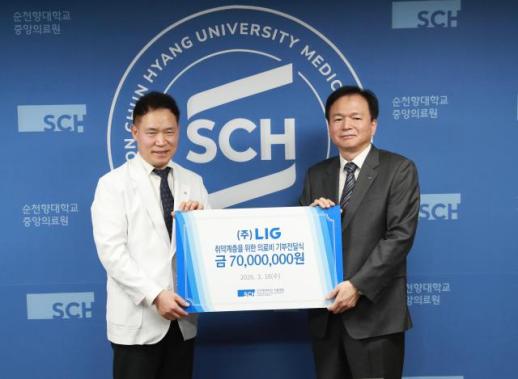 LIG Donates 70 Million Won to Soonchunhyang University Seoul Hospital LIG said it donated 70 million won to Soonchunhyang University Seoul Hospital on March 18 to support medically vulnerable people. The company has run the donation program since 2021, marking its sixth year, and has given a total of 330 million won. LIG said the latest donation will be used to help cover treatment costs for low-income patients who fall through gaps in support. Lee Seong-jin, head of Soonchunhyang University Seoul Hospital, said, "We are grateful for the warm interest and support for medically vulnerable people," adding, "We will do our best to ensure the donation reaches those who truly need it so they can regain their health." Choi Yong-jun, LIG CEO, said he hopes the donation will offer "a small hope" to neighbors suffering from illness, and pledged continued efforts to support medically vulnerable groups. LIG said it also carries out other social contribution activities, including support programs for low-income national merit recipients, sponsorship of the Korea Disabled Football Association, and assistance for young adults preparing for independent living. It said affiliates including LIG Nex1, Innowireless, LIG System and Huseco develop programs reflecting their business characteristics as part of ESG management.* This article has been translated by AI. 2026-03-19 08:30:18
 -
 Hyundai Veteran Han Ji-hyeong Built A2Z Into a Top-11 Autonomous Driving Firm Han Ji-hyeong, CEO of A2Z, is a hands-on engineer who spent more than a decade at Hyundai Motor Co. working on autonomous driving technology. He was an early member of Hyundai’s self-driving effort, beginning research before the technology was widely commercialized, and worked on the autonomous Nexo that President Moon Jae-in rode during the 2018 PyeongChang Winter Olympics. At the time, Hyundai developed autonomous driving through partnerships with outside companies. Han said he believed a fully driverless system with “zero defects” required more independent development. “As I thought about the direction and speed of development, I decided to start a company with colleagues who shared the same view,” he said. He added that A2Z focused on a B2B and B2G market for low-speed, special-purpose vehicles in cities to commercialize existing technology quickly. “Shuttles or special-purpose vehicles that run at about 50 to 60 kilometers per hour are less technically demanding than autonomous passenger cars and can be commercialized in a short time, and that expectation proved right,” he said. A2Z drew global attention in 2024 when it ranked 11th in a “comprehensive assessment of autonomous driving companies’ technology” by market research firm Guidehouse Insights, the only South Korean company on the list. The ranking included Waymo, Baidu, Mobileye of Israel and Nvidia, and A2Z was the only company valued at less than 1 trillion won, according to the article. The company says it has operated 82 autonomous vehicles, the most in South Korea, and logged about 940,000 kilometers of cumulative driving in urban autonomous operations, also a domestic high. Based on that field experience, it has developed services including urban autonomous shuttles, smart logistics solutions and mobility support for transportation-disadvantaged people. Its Level 4 autonomous vehicle, ROii, developed in 2024, is expected to enter full commercialization this year after performance certification tests and approvals. In Singapore, A2Z obtained local autonomous driving license M1, the first South Korean company to do so, and through its joint venture A2G (Autonomous to Global) is pursuing orders tied to the local smart city project “COSMO.” It is also exploring entry into markets including the United Arab Emirates and Japan. A2Z says it is preparing for an era of fully unmanned autonomous driving. Han said fully unmanned vehicles require a different approach from today’s practice of developing software and hardware separately. “Through an integrated platform in which the brain, the body and the infrastructure that moves them are perfectly aligned, we will realize 100% unmanned autonomous driving the fastest and most completely,” he said. 2026-03-19 05:05:37
 -
 A2Z CEO Han Ji-hyeong says fully driverless tech is inevitable, pushes exports to Japan and Middle East "To achieve 100% driverless autonomous driving, we have the full lineup of technologies needed — from software to vehicle hardware, control systems and external infrastructure. Based on that, we will expand exports to Japan, the Middle East and beyond and reach our goal of 30 billion won in annual revenue," Han Ji-hyeong, CEO of Autonomous A2Z, said in an interview on Tuesday at the company’s research center in Anyang. Han said autonomous driving can reshape urban transportation, raise productivity and help address social challenges such as mobility support for underserved groups and population aging. He said fully driverless technology is an "inevitable future" in the AI era and stressed the need for South Korea not to fall behind the United States and China as he seeks overseas markets. A2Z, founded in 2018 by Han and four engineers who previously worked at Hyundai Motor, is one of South Korea’s leading autonomous driving companies. Its name reflects its aim to hold all technologies needed for fully driverless operation. The company develops software for AI perception, sensors and vehicle control, along with vehicle platforms, control centers, controllers and remote-driving systems. Its products include the Level 4 driverless vehicle ROii and the autonomous logistics delivery platform COii. Han said A2Z’s edge is treating autonomous driving as an integrated system rather than a single technology. "Autonomous driving is a massive systems industry where vehicles, software, control centers, remote control and city infrastructure are all connected," he said, adding that a unified platform is essential for practical, fully driverless operation. He pointed to scenarios such as sudden road construction or blocked lanes. In today’s deployments, a safety driver can intervene. In a fully driverless setting, he said, vehicles may be forced to stop because they are configured not to cross a center line under traffic rules. He cited last year’s large-scale power outage in San Francisco, when Waymo robotaxis stopped and contributed to gridlock, as an example of what could become more common. "In those cases, an external intervention structure that can remotely control the vehicle is essential," Han said, adding that A2Z has built a system that allows a control center to manage vehicles in real time. Han said A2Z has also chosen a hybrid approach instead of the AI-driven end-to-end method drawing attention in the industry. In A2Z’s design, AI handles perception and decision-making, while a rules-based system performs final control of vehicle movement. Han said the structure addresses a weakness of end-to-end systems: while flexible in unexpected situations, even "0.01%" of extreme behavior can lead to an accident. He said end-to-end logic supports active judgment in complex road environments, while rules-based control governs actual vehicle actions in emergencies, providing layered safety. A2Z said more than 70% of its employees are developers, with an average age in the 30s and 40s. The company is expanding sales channels in Japan, Singapore and the Middle East. It recently began operating autonomous shuttle buses in Japan and Singapore. In the United Arab Emirates, it has set up a joint venture with AI company Space42 — A2D (Abu Dhabi Autonomous Driving) — and is preparing an autonomous vehicle operations business. Han said Japan is pushing to introduce 10,000 driverless shuttle buses in 100 cities by 2030 to address issues including aging and mobility support, and Dubai is pursuing a national policy to shift 25% of total traffic to driverless autonomous transport by 2030. He said A2Z expects to play a key role. He added that as U.S.-China tensions intensify, South Korean autonomous driving companies are emerging in the UAE and Dubai as alternatives to Chinese firms. A2Z is posting more than double growth each year, Han said. The company’s revenue last year was about 16 billion won, and it is targeting 25 billion to more than 30 billion won this year. It expects 10 billion won in revenue from the Middle East alone within the year. Han said 2028 is expected to mark a shift to 60% overseas revenue and 40% domestic. As Dubai, Abu Dhabi and other Middle Eastern markets clarify their transition plans, he said A2Z expects to generate 110 billion won in revenue locally by around 2035. Han said the company is also pursuing an initial public offering, describing it as a step to validate its technology and business model as well as raise funds. He said A2Z is aiming to become a unicorn — a privately held startup valued at 1 trillion won or more — and warned that a low valuation could dampen investment, putting South Korea at a disadvantage in competition with the United States, China and Israel. He also called autonomous driving a core security technology that requires active national support. Fully driverless technology, he said, brings together AI, urban data, traffic laws and safety rules — reflecting a country’s legal system and culture. Because the industry is still in its early stages and gaps among countries are not yet large, he said now is a critical window to compete for leadership. Han said dependence on another country’s autonomous driving software could lead to dependence across hardware, city infrastructure and related systems. He urged the government to act as an early customer. He added that unlike pure IT startups, autonomous driving startups involve manufacturing, creating spillover effects to second- and third-tier vendors and potentially supporting regional economies and job creation.* This article has been translated by AI. 2026-03-19 05:04:02
 -
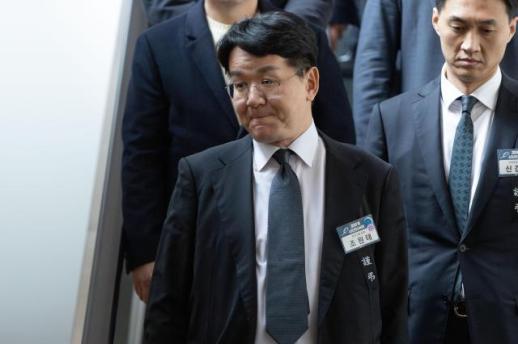 Hanjin Group Chairman Cho Won-tae Earned 14.58 Billion Won in Pay Last Year Cho Won-tae, chairman of Hanjin Group, received 14,578,180,000 won in pay last year from the holding company and major affiliates. According to filings on the Financial Supervisory Service’s electronic disclosure system, Cho was paid a total of 14,578,180,000 won last year from Hanjin KAL (6,176,000,000 won), Korean Air (5,705,000,000 won), Jin Air (1,710,000,000 won) and Asiana Airlines (987,180,000 won). The total was about 43% higher than his 2024 pay. His compensation rose 49% at Hanjin KAL, and increased 12% at Korean Air and 79% at Jin Air over the same period. He began receiving compensation from Asiana Airlines in January, after it was incorporated as a Korean Air subsidiary. Korean Air said it calculated and paid compensation under its director compensation standards, following procedures including prior review by its compensation committee and approval by the board. It said pay levels reflected the scale of the business and the responsibilities and roles after the launch of an integrated Korean Air. Separately, Korean Air said average annual pay per employee last year was 123 million won, up 9% from a year earlier. Average pay at Hanjin KAL also rose 11% to 146 million won over the same period. 2026-03-18 17:36:08
 -
 FL Auto Korea Launches Lincoln Nautilus Hybrid Midsize SUV in South Korea FL Auto Korea said March 18 it will officially launch Lincoln's midsize SUV, the Lincoln Nautilus Hybrid, in South Korea. The Nautilus Hybrid is a new trim of the second-generation model and is being introduced to the South Korean market for the first time. The company said the launch is aimed at strengthening its push into the premium midsize SUV segment while responding to growing demand for eco-friendly vehicles. The hybrid model is designed to further emphasize Lincoln's core brand concept of "Quiet Flight." The Nautilus name comes from a Latin word meaning "exploration," and the vehicle is positioned around an elegant design, smooth driving performance and a spacious interior. The hybrid system pairs a 2.0-liter turbocharged four-cylinder engine with a 99-kilowatt electric motor for a combined 321 horsepower. Under South Korea's certification standards, it is rated at about 11.9 kilometers per liter in combined fuel economy. Exterior details include Lincoln's signature horizontal design cues and modern white Lincoln lettering across the rear. A blue-accented Lincoln emblem in the center of the grille and nameplate badges on the doors are used to distinguish the hybrid model. Inside, the Nautilus Hybrid features a 48-inch panoramic display and an 11.1-inch center-stack touchscreen. It supports wireless Apple CarPlay and Android Auto. Driver-assistance and convenience features include forward collision-avoidance assist, cruise control, lane-centering assist and lane-keeping assist. Lee Yun-dong, CEO of FL Auto Korea, said the 2026 Lincoln Nautilus "more precisely implements Lincoln's 'ultimate sanctuary' through its hybrid system," adding that he hopes more customers will experience the model's differentiated value. The 2026 Lincoln Nautilus Hybrid is priced at 95 million won, including value-added tax and based on a 3.5% individual consumption tax rate.* This article has been translated by AI. 2026-03-18 15:36:20
 -
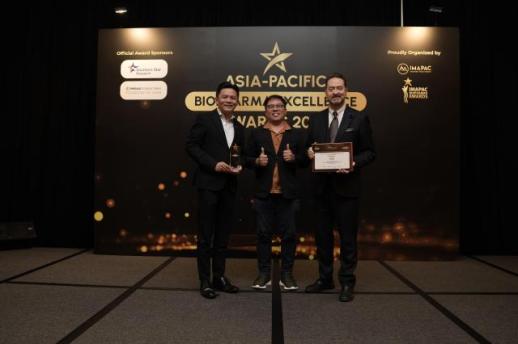 FedEx Wins 2026 Asia-Pacific Biopharma Excellence Award for Last-Mile Logistics Federal Express Corp., known as FedEx, said Tuesday it won the “Best Logistics and Supply Chain Management” award in the “Last-Mile Implementation” category at the Asia-Pacific Biopharma Excellence Awards 2026. The awards are hosted by IMAPAC, an international organization in the pharmaceutical and biotech sector. They recognize companies that have contributed to industry development in Asia across areas including bioprocessing, logistics, supply chain management and clinical research. The Asia healthcare market is expected to expand to about $5 trillion by 2030, accounting for roughly 40% of the global healthcare market. The healthcare cold-chain logistics market is also projected to grow from about $31.9 billion last year to about $42.5 billion by 2031. With temperature control critical in healthcare, the role of logistics partners with integrated capabilities is growing, the company said. “This award is a meaningful achievement that shows healthcare customers trust FedEx,” said Salil Chari, FedEx regional president for Asia Pacific. “As therapies become more specialized and temperature control becomes more important, logistics requirements are also increasing. FedEx will support safe transport based on systematic operational capabilities.” FedEx said it supports stable transport across multiple temperature ranges, including ultra-low freezing below minus 70 degrees Celsius, freezing below minus 20 degrees, refrigerated shipments at 2 to 8 degrees, and controlled room temperature at 15 to 20 degrees. It has built a network of FedEx Life Science Center locations in Gimpo, South Korea; Memphis, Tennessee; Mumbai, India; Singapore; Tokyo; and Veldhoven, Netherlands. The company said it operates more than 130 cold-chain facilities worldwide to maintain temperature control in cross-border, multimodal logistics. It also said 22 FedEx facilities worldwide are part of a network with CEIV Pharma certification for international air transport of pharmaceuticals, positioning FedEx as a key logistics partner for high-value healthcare shipments including biopharmaceuticals, vaccines, and cell and gene therapies. * This article has been translated by AI. 2026-03-18 15:24:29
 -
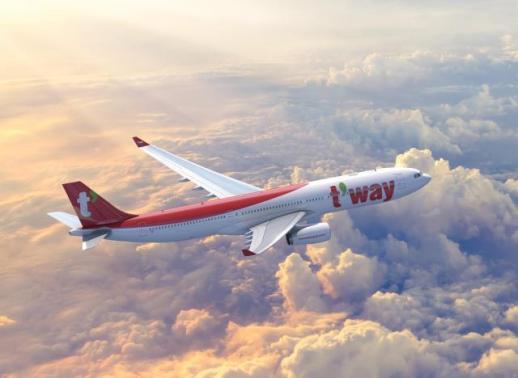 T’way Air Triples April Fuel Surcharges, Up to 213,900 Won One-Way T’way Air said Tuesday it has set fuel surcharges on one-way international tickets departing South Korea and issued in April at 30,800 won to 213,900 won. The fees are about triple this month’s levels of 10,300 won to 67,600 won. Under the new schedule, the shortest routes, including Incheon and Busan to Fukuoka, will carry a 30,800-won surcharge. Midrange routes such as Incheon to Da Nang and Cebu will be charged 87,900 won, while long-haul routes including Incheon to Paris, Rome and Sydney will be charged 213,900 won. T’way said the benchmark for April surcharges — the average Singapore jet fuel price (MOPS) from Feb. 16 to March 15 — was 326.71 cents per gallon, placing it at level 18 out of 33 (320 to 329 cents per gallon) amid the impact of the Middle East war. That is 12 levels higher than this month’s level 6 (200 to 209 cents per gallon), marking the steepest one-month jump since the current surcharge system was introduced in 2016. Korean Air, Asiana Airlines, Jin Air and Eastar Jet have also raised April fuel surcharges by up to about threefold in a month. Jeju Air is expected to announce its April fuel surcharges soon. * This article has been translated by AI. 2026-03-18 13:36:18