

Journalist

Jinkyu, Myung
hisunny20@ajunews.com
-
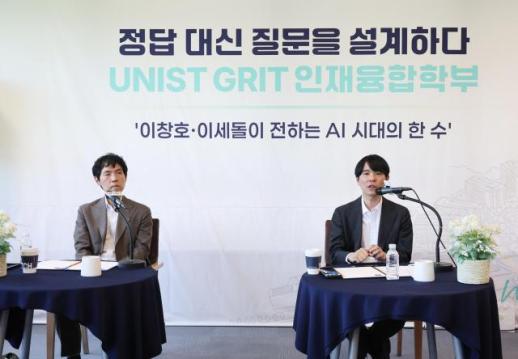 Lee Sedol, Lee Chang-ho warn against overreliance on AI: Humans must make answers their own "AI can show you a good move, but turning that answer into your own is ultimately a human task." As artificial intelligence rapidly expands into areas once considered uniquely human, two of South Korea’s best-known Go players said the skills that will matter most are the ability to ask the right questions and to make independent judgments. Lee Sedol, a distinguished professor at Ulsan National Institute of Science and Technology, and Lee Chang-ho, a top Go titleholder known for his calm style, spoke May 6 at UNIST in Ulsan during a talk concert titled “UNIST Open Stage 1” and at a briefing beforehand. They said AI should not be treated as a simple “answer machine.” Lee Sedol pointed to AlphaGo Zero and said that in an era when AI can evolve beyond human data, cooperation matters as much as use. He said watching AI play moves once taught as taboo made him realize how much people can be trapped by education and convention, adding that those who grasp AI’s message will move ahead. Lee Chang-ho said he initially struggled to accept AI’s unconventional moves, but later saw many as strong ideas that break fixed thinking. Still, he warned against blind trust, saying people should think deeply on their own and ask for help only when they truly need it. He said real synergy comes when a person has established a personal style and then uses AI support. Lee Sedol also described the personal strain AI brought to professional Go. He said studying with AI was so difficult it contributed to his decision to retire earlier, and that thinking about what younger players face weighs on him. Looking back on his 2016 match against AlphaGo, he said he would accept the challenge again but would prepare more thoroughly, adding that he regretted brushing aside expert advice at the time. He also said he was careless after winning Game 4 when he told Demis Hassabis that AI did not seem able to beat humans. Lee said it was a shameful answer to a question that could bring enormous change. On broader social impact, Lee Sedol said the loss of existing jobs during the transition is unavoidable, but that distinctly human value will rise. He said society should guard against a dystopia in which people lose control of their thinking or AI technology is monopolized by a small group in power. Lee Chang-ho said the AI era could make fundamentals even more important. He said a strong base — including humanities literacy and reading — would help people protect themselves from AI-related risks. In the talk that followed, both men framed AI not as a simple matter of winning and losing but as a matter of interpretation. They said that as AI produces more correct answers, what matters is not the answer itself but the ability to understand it and connect it to one’s own judgment. Lee Sedol said what matters more than AI’s strength is what new questions people can ask after seeing its answers, adding that judgment is needed to make choices in unfamiliar situations. Lee Chang-ho said seeing the right answer and understanding the path to it are different, and that even if AI suggests a good move, making it one’s own remains a human responsibility. * This article has been translated by AI. 2026-05-06 16:06:23
 -
 South Korea Seeks Proposals to Expand Open Quantum Testbed for Next-Gen Networks The Ministry of Science and ICT said Tuesday it will seek proposals for an “open quantum testbed upgrade and expansion project” to strengthen next-generation communications infrastructure for the AI and quantum era and accelerate the spread of quantum communications technology. The open quantum testbed is a core demonstration platform aimed at commercializing quantum cryptography communications and expanding related industries. Since 2024, the government has built and operated a quantum cryptography communications network and measurement equipment used to issue test reports along the Seoul-Pangyo-Daejeon corridor. The call for proposals follows the “First Comprehensive Plan to Foster Quantum Science and Technology and the Quantum Industry,” announced in January. The ministry said it aims to expand the testbed from the Seoul-to-Daejeon route to a nationwide scale, while also building infrastructure that includes overseas connections and efforts to secure next-generation technologies. Eligible applicants are consortia that include major telecommunications operators. The support period runs through 2028, for a total of three years. The ministry began a preliminary notice Tuesday and said full project work is expected to start in July. The project will be pursued across three segments: commercial hubs, overseas hubs and future hubs. Commercial hubs will focus on demonstrating quantum cryptography communications services in real network environments and verifying commercialization using low-cost, compact QKD equipment. Overseas hubs will build international links connected to foreign quantum testbeds to verify interoperability of quantum communications technologies between countries and lay the groundwork for global technical cooperation. Future hubs will focus on building test environments for next-generation communications technologies, including satellite and wireless QKD and quantum entanglement. Kim Seong-su, director general for research and development policy at the ministry, said the project will upgrade the demonstration base for quantum cryptography communications and expand its use across a range of industries. He said the ministry will work to ensure quantum technology becomes core infrastructure supporting future industrial innovation. In January, the government said it would move beyond research and development to produce industrialization results under the comprehensive plan. The plan calls for training 10,000 quantum specialists and fostering 2,000 related companies by 2035, and for achieving the world’s No. 1 position in quantum chip manufacturing. To that end, the government is pursuing work centered on three areas — quantum computing, communications and sensors — including development of a full-stack quantum computer, construction of a nationwide quantum cryptography communications network, and commercialization of quantum biosensors. It is also moving ahead with establishing a joint research center in cooperation with U.S. company IonQ. * This article has been translated by AI. 2026-05-06 12:03:00
 -
 SK Telecom Added to Dow Jones Sustainability World Index, Only Korean Telecom Included SK Telecom (SKT) has been added to the 2026 Dow Jones Best-in-Class (DJ BIC) World Index, the company said Tuesday. The index is used by investors as a benchmark after assessing companies’ economic, environmental and social performance. The DJ BIC is a revamped version of the Dow Jones Sustainability Index (DJSI) following a September 2025 overhaul, and is published annually by S&P Global. SKT has been included consistently since its first entry in 2008, except in 2020. The World Index is the top tier, selecting only the top 10% by industry from about 2,500 companies worldwide by market capitalization. SKT was the only South Korean telecom included this year. SKT said the latest inclusion reflects companywide efforts including board-led accountability, supply-chain ESG management, climate response and stronger industrial safety and health measures. An SKT official called it “the result of continuously advancing our sustainability management system.” The company said it strengthened governance, including recording a 100% board attendance rate in 2024, and expanded ESG inspections, training and consulting for partner companies. It also said it is pursuing a “2050 net zero” strategy through its ESG committee, building a carbon management system that includes improving power efficiency and shifting to renewable energy. In safety and health, it said it was named an excellent company for three consecutive years in a shared-growth cooperation program. Eom Jong-hwan, head of SKT’s sustainability management office, said the company will continue to advance ESG management “to fulfill the responsibilities that come with being included in the DJ BIC World Index,” and “continue sustainable growth together with customers.” 2026-05-06 10:48:26
 -
 SK Broadband targets offline ads with B tv On-Ad set-top box signage service SK Broadband is pushing into the offline advertising market with a digital signage service built on IPTV set-top boxes, branded B tv On-Ad (On-Ad). The company is pitching a subscription model priced in the 10,000-won range per month, aiming to lower barriers in a market long dominated by expensive equipment and to tap demand for what it calls space-based marketing. “Digital out-of-home advertising has become part of daily life, but the key now is not simple exposure — it’s how much you raise the value of the time customers stay,” Ryu Jong-in, head of SK Broadband’s channel planning team, said in an interview April 29 at the company’s headquarters in central Seoul. “On-Ad is a service that turns that dwell time into data.” According to the Korea Local Finance Association’s “2025 Outdoor Advertising Statistics,” South Korea’s outdoor advertising market totaled 4.6241 trillion won in 2024, with digital advertising accounting for 1.6634 trillion won. The market, once centered on paper ads and basic video playback, is rapidly shifting toward data-driven models. On-Ad runs on IPTV infrastructure and can be used with a business-to-business set-top box, allowing operations without building separate servers or encoders. “In the past, each store needed computer infrastructure and separate management, but now a single set-top box can centrally manage displays,” Ryu said. He cited the ability to start at about 13,000 won a month without upfront equipment investment of 100,000 to 150,000 won as the service’s biggest differentiator. A key feature is artificial intelligence-based data analysis. Using a webcam, the system analyzes viewing angles and gaze time and includes functions that estimate gender and age group. “We extract statistical values such as the age group of customers looking at the camera — for example, ‘women in their 20s’ — and use them for data analysis,” Ryu said. He added that tailored advertising based on gender and age could become possible. SK Broadband is also considering adding content-optimization tools, including upscaling low-resolution video and automatically adjusting content for special aspect ratios such as 32:9 used in subways and buses, as well as vertical mobile formats. Ryu said development is complete and the company is reviewing applying it to On-Ad. The service has been adopted by a domestic health-and-beauty store chain, which SK Broadband said demonstrated its practicality in retail operations. At Chung-Ang University’s Da Vinci Campus in Anseong, On-Ad was used in a project to digitize department bulletin boards. More recently, the service was installed at Hyundai Motor’s Bluehands repair shops. Ryu said On-Ad has grown by more than twofold each year since launch and that the company is targeting 100% growth this year. Ryu said hospitals and universities are priority areas for expansion. He said the company aims to help hospitals replace paper leaflet point-of-purchase advertising with displays for more efficient operations. SK Broadband is also reviewing generative AI-based content creation. Ryu said the company expects an environment where small business owners can enter prompts to produce ad images or videos and air them immediately, adding that the market structure could change significantly within two to three years. 2026-05-05 18:15:26
 -
 Coupang Play Gains Share With HBO Releases as Rivalry for No. 2 OTT Spot Intensifies In April, the user gap between South Korea’s streaming services Tving and Coupang Play widened again. Mobile Index data released on the 4th showed Tving posted 7,708,645 monthly active users, while Coupang Play had 9,101,593. The difference was about 1.39 million users. Tving’s MAU fell 3.95% from the previous month, while Coupang Play rose 0.61%. Among major platforms, Netflix logged 14,799,836 MAU, down 7.02% from the prior month. Wavve rose 1.27% to 3,897,570. Disney+ had seen its February MAU jump by nearly 1 million due to a compensation program for customers affected by a KT hacking incident, but in April it fell 8.31% to 3,462,195. Coupang Play attributed its MAU increase to exclusive content, including new HBO titles and recently talked-about films. The film “The Man Who Lives With the King” was released exclusively on Coupang Play on April 29 through an individual purchase model. HBO original series “Euphoria Season 3” was also added. Tving, in its third year streaming KBO games, saw users decline in April. While the pro baseball season opening was expected to boost traffic, the platform showed limited gains in new users. Still, activity among existing users increased. A Tving official said, “MAU declined, but average daily active users rose by double digits from the previous month,” adding that repeat visits tied to the KBO League and Tving originals such as “Yumi’s Cells Season 3” and “Heart Signal 5” appeared to have helped increase viewing time. 2026-05-04 14:51:19
 -
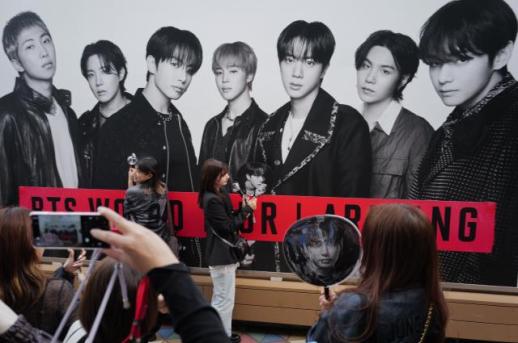 BTS’ ‘ARIRANG’ Holds U.K. Top 100 for Sixth Week; No. 4 on Billboard 200 BTS’ fifth full-length album, ‘ARIRANG,’ has stayed on the U.K. Official Charts Top 100 for a sixth straight week. According to Yonhap and other reports on May 2, ‘ARIRANG’ ranked No. 17 on the Official Albums Chart Top 100, down four spots from the previous week. The title track, ‘SWIM,’ placed No. 41 on the Official Singles Chart Top 100, down seven. The releases also remained on U.S. Billboard charts. ‘SWIM’ fell 10 places to No. 22 on the Hot 100, while ‘ARIRANG’ slipped three spots to No. 4 on the Billboard 200. HYBE said the album reflects BTS’ identity and universal emotions, combining traditional symbols with a modern sensibility to underscore the group’s message. BTS stepped up promotions in March with a large-scale comeback performance at Gwanghwamun Square in Seoul to mark the album’s release. Since April, the group has expanded global activities with the ‘BTS WORLD TOUR ARIRANG,’ including stops in Goyang and other cities. 2026-05-02 14:45:16
 -
 Chinese Diplomats Visit North Korea’s Border Region Near Planned Russia Bridge As North Korea and Russia push ahead with construction of a road bridge over the Tumen River, Chinese diplomats stationed in North Korea visited the North Korea-China-Russia border area to review local conditions. Yonhap News Agency and the Chinese Embassy in North Korea said Wang Chongling, a minister-counselor, led a delegation that visited North Hamgyong province and the city of Rason from April 25 to 30, inspecting five factories and exhibition facilities. The embassy said Wang’s group also visited the Wonjong-ri trading port in Rason for “survey, research and inspection” activities. Wonjong-ri is a key hub for North Korea-China trade and links to the Quanhe trading port in Hunchun, China’s Jilin province. Yonhap reported the trip included Jin Yanguang, China’s consul general in Chongjin, along with Jang Gwang-nam and Rim Gwang-ho, researchers at North Korea’s Foreign Ministry Asia 1 Bureau; Ri Jun-pil, head of Rason’s external affairs bureau; and Kim Song-chol, deputy head of North Hamgyong’s external affairs bureau. The visit came shortly after North Korea and Russia officially set out a completion schedule for the Tumen River road bridge. On April 21, the two countries held a ceremony in the border area to mark the bridge connection and accelerate the project. The bridge project was agreed at a June 2024 summit in Pyongyang between North Korean leader Kim Jong Un and Russian President Vladimir Putin. The two signed a “comprehensive strategic partnership treaty,” which took effect in December that year. The new bridge is designed as a two-lane, two-way structure about 800 to 850 meters long and 10 meters wide. It will be built about 400 to 415 meters downstream from the existing Tumen River rail bridge, built in 1951 and known as the Korea-Russia Friendship Bridge. The project is expected to strengthen overland links between the two countries and improve logistics efficiency.* This article has been translated by AI. 2026-05-02 13:54:17
 -
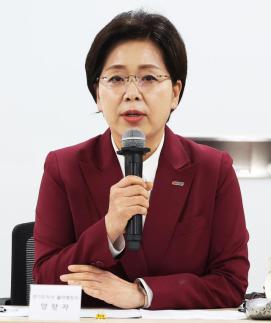 Yang Hyang-ja Picked as People Power Party’s Gyeonggi Governor Candidate Yang Hyang-ja, a top official of the People Power Party, has been selected as the party’s candidate for Gyeonggi governor in the June 3 local elections. According to Yonhap News Agency and the party’s central nomination committee on Friday, Yang secured the nomination based on a combined tally of a two-day vote by party members (50%) and a public opinion poll of the general electorate (50%). In a news conference immediately after the primary result was announced, Yang said she would “end the era of outdated ideology and open an era of future high-tech industries,” adding that she would take on a “bold challenge” toward “a new conservative party and a future Gyeonggi.” She said she would focus “only on the economy and people’s livelihoods, beyond ideology and camps,” and pledged to work with “reasonable residents” rather than “extreme supporters” of the two major parties to turn the race into an “economic election,” shifting it from “an election that asks about the past” to one that “discusses the future.” Yang emphasized that she would run on boosting income for Gyeonggi’s 14 million residents, fostering advanced industries tailored to each of the province’s 31 cities and counties, and expanding high-paying youth jobs with annual salaries of 100 million won. Yang will face Democratic Party candidate Choo Mi-ae in the election. Yang entered politics in 2016 after being recruited as outside talent when Moon Jae-in was serving as leader of the Democratic Party. She drew attention for her background as a high school graduate who became a managing director at Samsung Electronics. That year, she became an ex officio member of the party’s top leadership after defeating Yoo Eun-hye in a race for chair of the party’s national women’s committee. From 2018 to July 2019, she served as head of the National Human Resources Development Institute, a government official post. At Samsung Electronics, she joined in 1985 as a research assistant in a semiconductor memory design lab and was promoted to managing director in 2014, setting a record as the first female executive from a high school graduate background. In politics, she has been active as a semiconductor industry expert. With Yang’s nomination in Gyeonggi, the People Power Party has completed nominations for the 16 provincial and metropolitan governor races, the party said.* This article has been translated by AI. 2026-05-02 11:18:17
 -
 South Korea Gasoline, Diesel Prices Stay Above 2,000 Won a Liter; Seoul at 2,048 South Korean gasoline and diesel prices at gas stations continued to hover in the 2,000-won range on a weekly basis. Data from Yonhap News Agency and the Korea National Oil Corp.’s Opinet system showed that in the fifth week of April (April 26-30), the nationwide average retail price of gasoline rose 4.8 won from the previous week to 2,008.6 won per liter. By region, Seoul posted the highest price at 2,048 won per liter, up 8.7 won from a week earlier. Daegu was the lowest at 1,993.6 won, up 4.7 won. The recent rise in international oil prices was attributed to stalled ceasefire talks between the U.S. Donald Trump administration and Iran. A persistently weak won has added to upward pressure on domestic fuel prices. Domestic fuel prices are influenced not only by global crude prices but also by the exchange rate. In March, Dubai crude jumped 87.9% from the previous month, while the won-dollar exchange rate rose 2.6%, pushing import prices up 16.1% from a month earlier — the highest level in about 28 years since January 1998. A higher exchange rate raises the won-denominated cost of crude, which is traded in dollars. Over the same period, the won-based crude price hit a record since data collection began, while jet fuel and naphtha prices rose 67.1% and 46.1%, respectively. Analysts have warned that the combined rise in oil prices and the exchange rate could spread across broader inflation. With the consumer inflation rate in April 2026 in the mid-to-high 2% range, some forecasts say it could climb to around 3% in May if the high exchange-rate trend persists, potentially weakening households’ real purchasing power and adding to living-cost burdens. 2026-05-02 10:27:16
 -
 South Korea’s Next-Gen Medium Satellite 2 to Launch on SpaceX Falcon 9 After War Delay South Korea’s Next-Generation Medium Satellite 2 is set to head to space from Vandenberg Space Force Base in California aboard SpaceX’s Falcon 9 on May 2 local time. The Korea Aerospace Administration said the satellite is scheduled for launch at 3:59 p.m. May 3 in South Korea (tentative). According to the launch sequence, the Falcon 9 will shut down its first-stage engine 135 seconds after liftoff and ignite the second-stage engine 146 seconds after liftoff. The payload fairing is to separate at 182 seconds. Final separation of the satellite is planned at 3,625 seconds after launch, about 60 minutes 25 seconds. After launch, the satellite is expected to settle into an orbit of about 498 kilometers (309 miles). It will undergo about four months of initial operations before beginning full mission work in the second half of 2026. The Korea Aerospace Research Institute (KARI) will conduct initial after-launch checks (IAC) and in-orbit tests (IOT). Ground stations for early operations will include King Sejong Station in Antarctica, Troll Station, Svalbard in Norway and a station in Daejeon. Next-Generation Medium Satellite 2 is the first mid-size satellite independently developed under the lead of a South Korean industrial company. Korea Aerospace Industries (KAI) joined the design team for Next-Generation Medium Satellite 1 starting in 2015 and received transfers of key technologies, then led development of the second satellite. The project began in January 2018 and proceeded in stages. It passed a system assembly test readiness review meeting (IRR) in June 2020 and completed a pre-shipment review (PSR) in December 2021. The satellite was originally to be launched from Russia, but the launch was halted after the Russia-Ukraine war began in February 2022. In November 2023, South Korea ended the launch contract with the Russian side and selected SpaceX as the replacement provider, signing a new contract. With the schedule delayed, the satellite underwent state-of-health (SOH) tests every six months while stored on the ground. It completed a final integration test in December and finished a second PSR in March. In April, it was transported to the launch site for final preparations. The aerospace administration said the project is significant because the satellite bus and some core payloads were developed with domestic technology. “It verified Korea’s independent space development capabilities and laid the groundwork for follow-on satellites and international competitiveness,” the agency said. The satellite’s mission is to support public needs such as land and resource management and disaster response. It will provide high-resolution imagery used for ground observation, change detection, mapmaking and urban planning, and can support damage assessment and response during disasters such as typhoons, floods and wildfires. Separately, Next-Generation Medium Satellite 3 was launched on Nov. 27 from the Naro Space Center in Goheung, South Jeolla Province, on the fourth flight of South Korea’s Nuri rocket. That launch was the first produced under private-sector leadership and the first nighttime launch, successfully separating one primary payload and 12 secondary satellites. Next-Generation Medium Satellite 3 observes auroras and airglow in high-latitude regions and precisely measures the space magnetic field and plasma environment. Full mission operations began in February. 2026-05-02 10:12:19