

Journalist

Cho Hyeon-mi
hmcho@ajunews.com
-
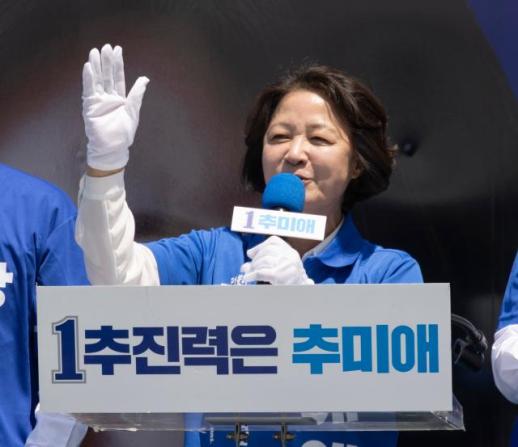 Choo Mi-ae Urges Voters to Support Democratic Progress in Gyeonggi Province Choo Mi-ae, the Democratic Party candidate for Gyeonggi governor, called on voters to support the upcoming election on June 3, urging them to judge the forces that threaten democracy and to pave the way for Gyeonggi's advancement. On June 2, a day before the election, Choo's campaign committee released a statement noting that Gyeonggi's early voting rate stands at 20.96%, which is lower than the national average and ranks among the lowest of the 17 provinces and cities. The campaign team emphasized that there is a clear desire among voters for the success of the Lee Jae-myung administration and for Gyeonggi to achieve greater progress. They expressed urgency, stating, "That passionate sentiment must translate into votes." They also appealed for support for Choo and other ruling party candidates in the main election. The campaign team warned, "Complacency is not an option. If we let our guard down, the forces that threaten democracy will regroup," urging voters to prevent the resurgence of these forces through their ballots. Furthermore, they highlighted that this election is crucial for normalizing South Korea and preventing the revival of insurrectionist forces, while also establishing a competent local government that can transform the lives of residents into tangible achievements under the Lee Jae-myung administration. They reiterated their plea for voters to lend their support once more.* This article has been translated by AI. 2026-06-02 11:03:00
 -
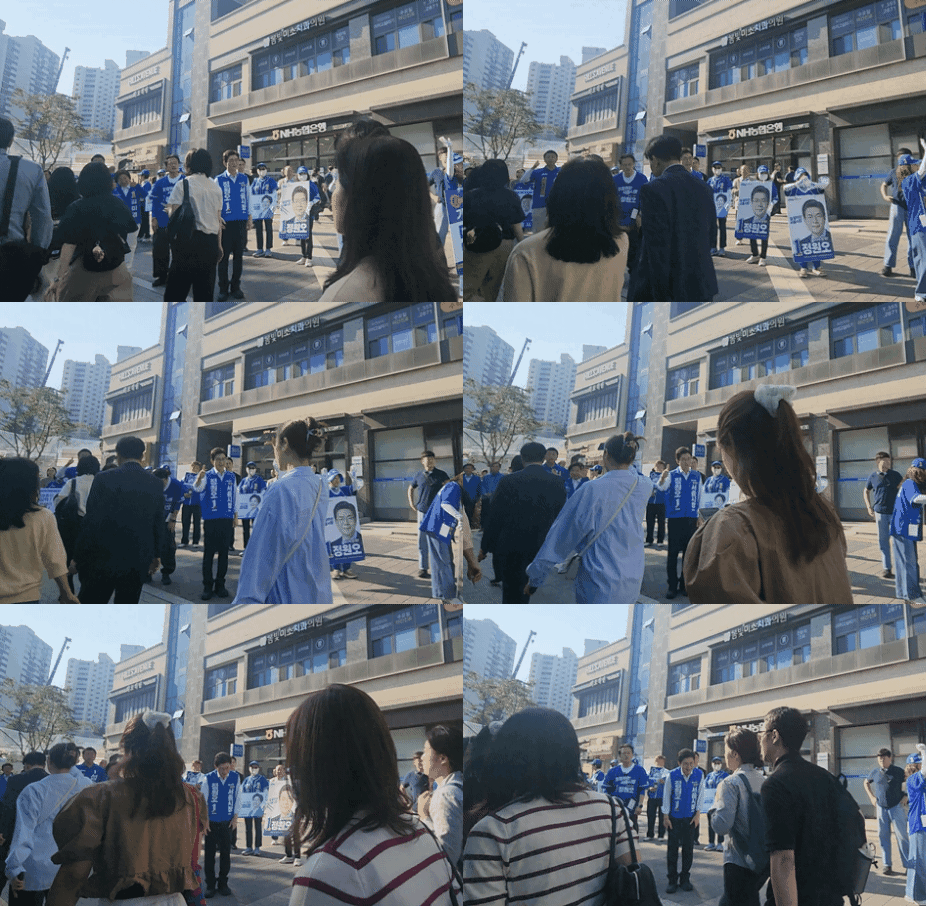 Jung Won-oh Campaigns Across Seoul Ahead of Local Elections Jung Won-oh, the Democratic Party candidate for Seoul mayor, is intensifying his campaign across the city on June 2, just one day before the local elections.According to the Democratic Party's Seoul mayoral election campaign committee, Jung began his final day of campaigning at 6:30 a.m. with a visit to the Gangseo public bus depot. He then encouraged bus and subway workers at the Gimpo Vehicle Depot of Seoul Metro Line 9.His last morning greeting took place at Eunpyeong-gu's Nokbeon Station, where he urged citizens to participate in the upcoming vote. Afterward, he moved to Yonsei University's student union in Seodaemun-gu to have breakfast with students and engage in a walking campaign on campus. Jung held a joint press conference with Democratic Party candidates for district mayors in Seoul, urging last-minute voter participation. He also plans to meet with small business owners and artists in Munrae-dong, Yeongdeungpo-gu, where he announced his candidacy. Following that, he will visit various locations including Yeouido, Gyeongdong Market, Dongmyo Flea Market, Yaksu Market, Yongsan Yongmun Market, the cafe street in Hapjeong-dong, and Gyeongui Line Forest Park to rally support and encourage voting.A major rally will take place at Cheonggye Plaza at 7 p.m., featuring Democratic Party leader Jeong Cheong-rae and key figures from the campaign committee, aiming to consolidate support in the final hours.After the rally at Cheonggye Plaza, Jung will continue campaigning late into the night, visiting the food alley in Nonhyeon-dong, Cheonho Rodeo Street in Gangdong-gu, and Songpa Public Bus Depot to ask citizens for their support and gather feedback.The official campaign's final event will occur at 11:40 p.m. at the Bokjeong Station transfer center in Songpa-gu. At this event, Jung is expected to reflect on his campaign efforts and express his commitment to creating "a completely new Seoul." He will conclude his 13-day official campaign by taking the late-night bus 'N37' to Suseo Station.* This article has been translated by AI. 2026-06-02 09:42:00
 -
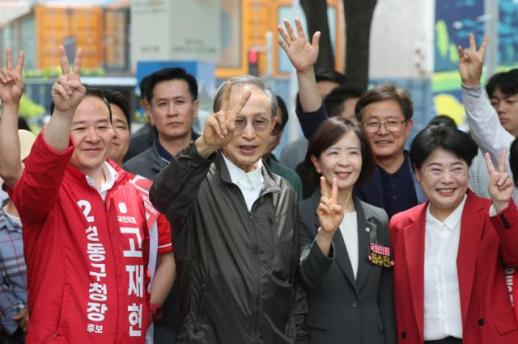 Lee Myung-bak Supports Candidates Ahead of Seoul Mayor Election Former President Lee Myung-bak visited Seoul Forest in Seongdong-gu on June 1, urging citizens to support candidates from the People Power Party ahead of the Seoul mayoral election. On that morning, Lee joined the campaign for People Power Party candidate Ko Jae-hyun, who is running for Seongdong District Mayor, along with Choi Soo-jin, the party’s district committee chair for Jung-gu and Seongdong-gu, and former lawmaker Yoon Hee-sook. Seoul Forest was created during Lee's tenure as mayor in 2005. Reflecting on the challenges he faced, Lee remarked, "Many people opposed the creation of this park (Seoul Forest) politically. The same was true for the restoration of Cheonggyecheon and the bus reform." He added, "Despite the political opposition, we ultimately created a very convenient and beautiful park. Now, no one complains about Seoul Forest." He emphasized the importance of electing capable local leaders, stating, "We need to choose mayors and district heads who can get the job done. Politicians who are all talk do not contribute to regional development." Lee highlighted his achievements during his time as mayor, including the restoration of Cheonggyecheon and the implementation of the central bus lane and transfer discount system, despite the difficult political environment. He urged citizens to vote for candidates who can effectively lead the city. Lee's visit to Seoul Forest is seen as an effort to rally support among his base while countering claims by Jung Won-o, the Democratic Party's candidate for Seoul mayor, who has been emphasizing his accomplishments in Seongdong-gu. Yoon Hee-sook, co-chair of the campaign committee for People Power Party candidate Oh Se-hoon, stated in an MBC radio interview, "Candidate Jung has claimed he will create 20 more Seongsu-dongs, but it was former President Lee who invested in the infrastructure of Seongsu-dong." Meanwhile, Oh Se-hoon, who could not join Lee during the campaign due to scheduling conflicts, visited the Ttukseom area in Seongdong-gu later that afternoon to meet with voters. Born in Seongsu-dong, Oh began his remarks by saying, "'The son of Seongdong,' Oh Se-hoon, is back." He stressed the importance of the upcoming election, calling for overwhelming support to ensure collaboration among district heads, city councilors, and provincial councilors for the development of Seongdong-gu and the continuous progress of Seoul.* This article has been translated by AI. 2026-06-01 20:30:00
 -
 Oh Se-hoon Criticizes Jung Won-o's 'Seoul Discount' Claims Oh Se-hoon, the People Power Party candidate for Seoul mayor, strongly criticized rival Jung Won-o of the Democratic Party on June 1 for his claims regarding a "Seoul Discount," calling them "absurd and unfounded." Oh refuted assertions that his administration has diminished Seoul's competitiveness. Speaking to reporters before a campaign event in Mangwoo-dong, Jung's remarks were labeled as "a strange expression not commonly used like 'Korea Discount.'" He added, "To use such terms and imply that I am the cause is an absurd and unfounded accusation." Oh further claimed that Jung would be responsible for diminishing the city's prestige and competitiveness. He stated, "A Democratic mayor, who has consistently criticized Seoul's branding strategies and urban marketing policies as 'exhibition administration, superficial administration, and unnecessary investment,' would be the catalyst for a Seoul Discount." He emphasized that the potential for a Seoul Discount would increase if an unprepared and inadequate candidate like Jung were to become mayor. Earlier that day, Jung held a press conference in front of Seoul Station, urging voters to end the "Seoul Discount" on June 3. He specifically pointed to Oh's administration as the source of safety negligence, incompetence, and irresponsibility, stating, "I will focus on overcoming these issues to restore Seoul's premium during the remaining campaign period." The two candidates also exchanged barbs over Oh's characterization of Jung as a "puppet of President Lee Jae-myung." Oh claimed that if Jung were elected, he would essentially be a puppet mayor, unable to voice dissent in cabinet meetings. In response, Jung remarked, "Oh has admitted he was a puppet of the Yoon Suk-yeol administration. I have always stood up for citizens and voiced concerns even when serving as a district chief under Mayor Park Won-soon." He criticized Oh for attending only two cabinet meetings during the Lee Jae-myung administration, stating, "To kick away opportunities and then ask for them again is typical behavior of an incompetent and irresponsible person." However, Oh maintained his stance, asserting that voters who have observed Jung's actions would conclude that he would be a compliant puppet mayor focused on aligning with the president. He added, "The weight of a mayor elected by ten million citizens is significantly different from that of a mayor at the end of their term. I will do my best to ensure that the president's flawed real estate policies are directed toward the right path."* This article has been translated by AI. 2026-06-01 16:45:00
 -
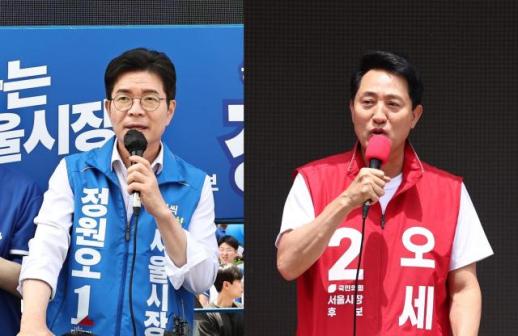 Final Push for Support as Seoul Mayoral Election Approaches With the Seoul mayoral election just two days away, Democratic Party candidate Jung Won-o and People Power Party candidate Oh Se-hoon are intensifying their efforts to rally support. Both candidates packed their schedules with over ten campaign events on June 1, starting early in the morning and continuing late into the evening. Jung began his campaign at dawn in the Cheongnyangni fruit market in Dongdaemun District. He then moved to Seoul Station in Yongsan District to appeal for support from commuters and met with voters in Geumcheon and Dongjak Districts. His campaign concluded in the evening in the Euljiro 3-ga area of Jung District. He also held site visits and discussions. In the morning, Jung visited the Dongui-dong neighborhood in Jongno District to engage with residents. In the afternoon, he listened to opinions from members of Hi-Seoul certified companies and redevelopment associations in Gangnam District, as well as from redevelopment and reconstruction association members in Yongsan District. After greeting commuters at Seoul Station, Jung told reporters, "I believe there will be support from both sides in the final stretch, and I have been campaigning with promises and directions aimed at Seoul's substantial centrist population." He added, "In the remaining two days, I will maintain consistency in that direction and do my best with sincerity and urgency." Oh continued his '88-hour infinite responsibility campaign.' His team announced that from 8 a.m. on May 30 until midnight on June 2, when official campaigning ends, he would conduct non-stop campaigning across Seoul. Oh began his campaign schedule with an interview on Channel A's YouTube broadcast, visiting various neighborhoods in southeastern and northeastern Seoul to meet citizens. After greeting commuters at Gwanghwamun Station, he toured Seongbuk, Gangbuk, Dobong, Nowon, Jungnang, Dongdaemun, Seongdong, Gwangjin, Gangdong, and Gangnam Districts. His final campaign event for the day was held near Seokchon Lake in Songpa District. In the morning, Oh met with reporters near Wolgok Station in Seongbuk District, stating, "I plan to visit all 25 autonomous districts in Seoul over the next two days to meet as many citizens as possible. Today, I will focus on the northeastern and southeastern districts, and tomorrow I will cover the southwestern and northwestern areas without missing any locations." However, both candidates toned down their campaigning in the afternoon due to the aftermath of an explosion at Hanwha Aerospace's Daejeon plant that resulted in five fatalities. Jung canceled some campaign events, and Oh's campaign committee did not hold a scheduled press briefing in the afternoon. Meanwhile, President Lee Jae-myung directed that all available resources be mobilized for rescue and recovery efforts related to the incident. He also called for a thorough investigation into the cause of the accident and the establishment of measures to prevent future occurrences. 2026-06-01 15:39:00
 -
 Seoul Mayor Candidate Oh Se-hoon Criticizes Rival Over 'Kiss' Controversy Oh Se-hoon, the People Power Party candidate for Seoul mayor, criticized his rival Jung Won-o of the Democratic Party over a controversy involving a forced kiss at a campaign event in Yangcheon-gu the previous day. He stated, "Jung did not intervene and just laughed, which shows he lacks the qualities needed for a mayor." Speaking to reporters before a rally near Wolgok Station in Seongbuk-gu on June 1, Oh pointed out, "Based on his immediate judgment in handling the situation, Jung is an unprepared candidate in many ways." Oh specifically condemned Jung for not reacting when Woo Hyung-chan, the Democratic Party's candidate for Yangcheon-gu mayor, urged a child in Jung's arms to "give a kiss." He said, "Jung just smiled. If he had any awareness of the issue, he should have politely intervened, but there was no such intervention at all." He added, "Such behavior will serve as material for citizens to make wise judgments." Oh further remarked, "Although the election period seems short, it is sufficient to reveal all the qualities of a candidate. The kiss controversy also reflects the usual thoughts of the Democratic Party and candidate Jung." Meanwhile, Jung responded to the controversy by stating, "There was an unexpected action from the Yangcheon-gu mayoral candidate yesterday, but our camp addressed the issue on-site." After holding a press conference titled 'An Appeal to the Citizens of Seoul' at Seoul Station in Yongsan-gu on the same day, Jung added, "I feel a deep sense of responsibility to ensure that such issues do not recur."* This article has been translated by AI. 2026-06-01 11:24:00
 -
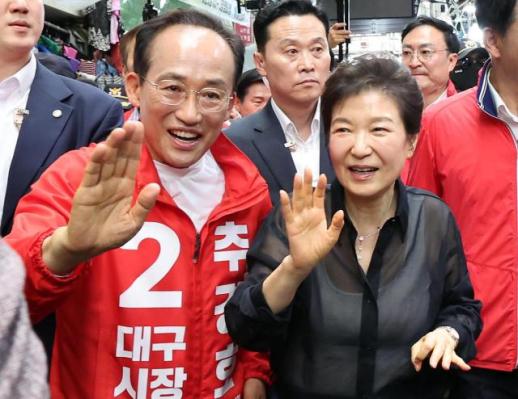 Park Geun-hye Supports Choo Kyung-ho Ahead of Local Elections in Daegu Former President Park Geun-hye visited Seomun Market in Daegu on May 31 to support Choo Kyung-ho, the People Power Party candidate for mayor, just three days before the June 3 local elections. Dressed in a black long-sleeve shirt and jeans, Park arrived at the market around 4 p.m. and greeted Choo and other People Power Party candidates running in Daegu. Supporters gathered at the market welcomed her with applause and waved South Korean flags. Park also exchanged friendly greetings with citizens shopping at the market and urged them to support Choo. After touring the market with Choo for about 20 minutes, Park expressed her gratitude, saying, "Seeing all of you gives me renewed energy, even if I feel a bit tired." She emphasized the significance of Seomun Market, stating, "This market is a symbol of conservatism, and I know that the economy in Daegu is struggling right now." Park expressed her belief that Choo is the right person to revitalize the local economy, highlighting his experience as the head of the Office for Government Policy Coordination under her administration and as the Minister of Economy under the Yoon Suk-yeol administration. "He will do better than anyone else in improving the economy," she asserted. Park urged the crowd, saying, "If you all provide overwhelming support, Choo Kyung-ho will revive the Daegu economy and repay you all. Please believe in him and support him generously." This marks Park's second public appearance in support of Choo, following her visit to Chilseong Market in Daegu on May 23, which was her first campaign event for the local elections. 2026-05-31 18:36:00
 -
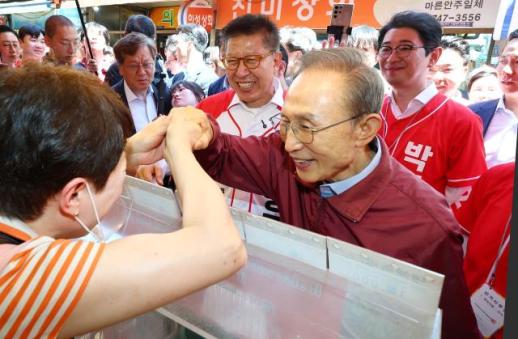 Lee Myung-bak Supports Park Hyung-jun in Busan Mayoral Race Former President Lee Myung-bak visited Busan on May 31 to urge citizens to support Park Hyung-jun, the People Power Party's candidate for mayor. According to Park's campaign committee, Lee's visit was part of a series of endorsements from former conservative presidents, following a visit by former President Park Geun-hye on May 27. Lee attended a worship service with Park at the Suyeongro Church in Haeundae, then moved to a nearby pork soup restaurant where they shared a meal. After dining, they visited the traditional market in Haeundae, meeting with merchants and local shoppers. At the market, Lee stated, "The city needs a mayor who works, not just a politician who speaks." He added, "Even when I was a mayor in Seoul with an opposition party, I chose a working mayor, which led to Seoul's development. The future of Busan depends not on who the president or ministers are, but on who the mayor of Busan is." He emphasized, "We can all see that Park is leading Busan toward a future-oriented development. If he is given another four-year term, we can increase the population, attract young people, and establish Busan as a hub for advanced industries." Lee urged the citizens of Busan to wisely choose Park Hyung-jun, a capable mayor who can finish what he started. In response, Park expressed gratitude for Lee's visit and promised to deliver a victory in return. He noted, "Currently, there is a growing trend of civic unity and conservative consolidation in Busan. I urge all citizens to come together as one, especially with the support of former President Lee. We will stop the current government's reckless actions in Busan and ensure the preservation of democracy and national dignity in South Korea."* This article has been translated by AI. 2026-05-31 17:09:00
 -
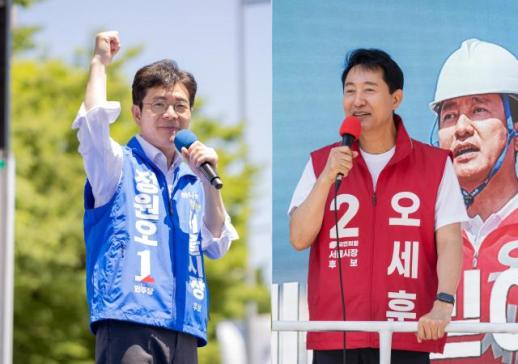 Intense Final Campaign Battle Between Candidates for Seoul Mayor As the June 3 Seoul mayoral election approaches, a fierce exchange of negative campaigning is intensifying between Jung Won-oh of the Democratic Party and Oh Se-hoon of the People Power Party. With polls showing a tight race, both candidates and their parties are ramping up efforts to sway voters in the final days of the campaign. Lee In-young, the head of Jung's campaign committee, held a press conference on May 31 and asserted, "Oh is not free from severe criticism regarding negligence in safety over the past decade, including the Itaewon tragedy and the Seosomun overpass collapse." Kang Jun-hyun, the Democratic Party's chief spokesperson, pointed out Oh's recent remark during a televised debate, where he questioned, "What good does it do for me to go to Samseong Station right now?" Kang interpreted this as an admission of failure in managing safety for Seoul citizens and a blatant declaration of evading responsibility. In response, the opposition has focused on Jung's moral integrity. Jang Dong-hyuk, the People Power Party leader, held a press conference that day, accusing Jung of being a candidate unfit for office due to his association with President Lee Jae-myung and the passage of harmful legislation. Jang further criticized the president for hosting a fish party at Jagalchi Market on the day of the Seosomun overpass collapse, claiming that the president later directed a raid on Seoul City Hall. He also stated, "Jung failed to explain any policies during the TV debate, showing his lack of competence." The level of criticism between the candidates has escalated. Oh Se-hoon labeled Jung as a "puppet of the president" during a press conference at his campaign office, arguing that Jung would not challenge any misguided policies from the president. He emphasized, "What Seoul needs now is not a puppet but a guardian of citizens' rights." In turn, Jung accused Oh of being silent during President Yoon Suk-yeol's oppressive governance, stating, "Claiming he will express his opinions in front of President Lee is nothing short of a declaration of political conflict." The number of legal complaints related to the mayoral election has also surged into double digits. As of May 30, there have been 13 reported cases of complaints and legal actions. Of these, 10 were filed by Jung's campaign and the Democratic Party. Jung's team accused Oh's campaign of manipulating public opinion and filed complaints for obstruction of business and violations of election laws. Oh's camp has denied these allegations. Mutual accusations regarding past violence allegations against Jung have also emerged. The Democratic Party filed complaints against People Power Party lawmakers Joo Jin-woo and Kim Jae-seop for violations of election laws, while the People Power Party countered with accusations of false reporting against Democratic lawmakers Seo Young-kyo and Lee Joo-hee. The escalating conflict in the Seoul mayoral race is attributed to the close competition between the two candidates, with recent polls indicating they are neck-and-neck or tied within the margin of error. 2026-05-31 15:33:00
 -
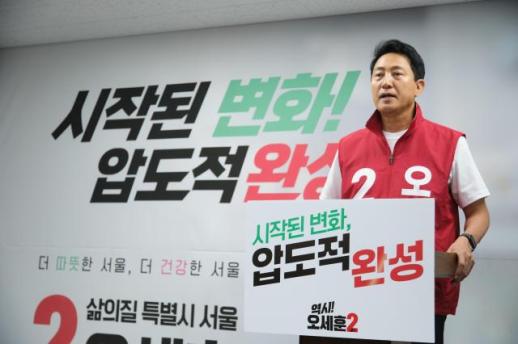 Oh Se-hoon Calls for Housing Regulation Relief from President Oh Se-hoon, the People Power Party's candidate for Seoul mayor, stated on May 31 that he plans to present three urgent housing policy improvements and two proposals for restoring the economy and democracy to the president during the first cabinet meeting after his election. Speaking at a press conference titled 'Five Major Commands from Seoul Citizens' at his campaign office in Jongno-gu, Oh emphasized that if elected, he would immediately fulfill the serious mandate from the citizens. The five major commands from Seoul citizens include: normalizing conditions for redevelopment and reconstruction projects, increasing the supply of private rental housing to address the rental crisis, establishing measures to prevent excessive property taxes, easing regulations in the metropolitan area to boost the local economy, and safeguarding democratic values by preventing the dismissal of charges. Oh pointed out that the only significant new housing supply measure in Seoul is redevelopment, which has become difficult under the current 10-15 policy. He pledged to lift restrictions on relocation loans for redevelopment projects, allow the transfer of membership status in housing cooperatives, and promote the relaxation of floor area ratios for public redevelopment projects. He also addressed the worsening rental crisis under the Lee Jae-myung administration, proposing the easing of regulations on registered rental businesses and corporate private rental projects to ensure the supply of safe and reasonably priced housing. Oh promised to advocate strongly for maintaining the long-term holding tax exemption for single-homeowners and adjusting tax brackets. He stated, "If the exemption for single-homeowners is abolished, it would cause significant losses. Therefore, we must maintain the current exemption and work with the government to find reasonable adjustments to the tax brackets." He emphasized that policies conflicting with the direction of government policy, including the maintenance of the tax exemption, would be unfeasible for Jung Won-oh, the Democratic Party's candidate for Seoul mayor. Oh remarked, "A Democratic mayor in Seoul would be nothing more than a puppet, unable to even mention the urgent and serious five commands from citizens. I believe that Jung, who was chosen as a candidate by the president, will have to act at the level of a nominal appointee." He urged Seoul citizens for strong support, stating, "What we need now is not a puppet but a guardian of citizens' rights." While vowing to speak candidly to the government, Oh addressed concerns about ongoing conflicts with the Lee administration, asserting, "I have never caused extreme conflicts with a president from a different party or engaged in unnecessary showy politics." He added, "Why can't I meet the president separately to discuss matters? I did so when I was elected in 2021, meeting with President Moon Jae-in. If I sincerely explain the market situation and convey the urgent issues, there should be no reason to reject stabilizing the housing market, which would also contribute to government stability." Oh concluded, "I have never backed down from doing what is right, and all the proposals I mentioned today are essential for a necessary future change. I question whether Jung, who is hesitant to speak out against the president, can truly take such actions." 2026-05-31 11:03:00