
Journalist

Hwang Jin Hyun
jinhyun97@ajunews.com
-
 Trump Invokes Defense Production Act to Fund Energy Projects Amid Oil Price Pressure President Donald Trump, facing rising oil-price pressure tied to the Iran war, on Sunday issued measures allowing federal funding for energy-sector projects. Bloomberg News and other outlets reported that Trump released five presidential memorandums invoking the Defense Production Act, targeting U.S. oil production and refining, coal supply chains, natural gas transportation and power-grid infrastructure. The actions allow the Energy Department to direct federal funds to those areas. A White House official told Bloomberg the memorandums would let the administration use tools such as energy purchases and financial support to address delays, funding shortfalls and market barriers affecting industry. The funding is expected to come from a large spending package law passed last year under the Trump administration, according to the report. In the memorandums, Trump cited his declaration of a national energy emergency shortly after taking office, saying ensuring resilient domestic oil production and refining capacity is critical to U.S. defense readiness. He warned that without immediate federal action, U.S. defense capabilities would remain at risk of disruption. He also stressed that securing natural gas and liquefied natural gas is important to U.S. defense and allies’ energy security, adding that insufficient natural gas and LNG export capacity could expose the United States and its partners to danger in a crisis. The Defense Production Act was enacted in 1950 during the Korean War and gives the president authority to intervene to expand private-sector production. It was introduced as federal power to direct industry was strengthened after disruptions in military supplies, the report said. The move was widely interpreted as a response aimed at curbing oil-price increases following Iran’s blockade of the Strait of Hormuz. Trump has also faced pressure to push for an early end to the war as energy prices have surged. Trump has previously used the law for energy policy, including efforts to restart offshore crude production off Southern California. During the 2020 COVID-19 outbreak, he invoked it to expand ventilator production. The previous Joe Biden administration also used the act to boost production of energy technologies such as solar panels and transformers. 2026-04-21 13:39:22
 -
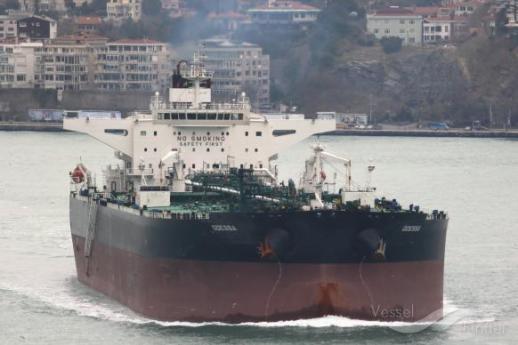 Oil tanker passing through Strait of Hormuz 'heading to discharge its cargo' in South Korea SEOUL, April 20 (AJP) - An oil tanker that passed through the Strait of Hormuz is expected to arrive in South Korean waters as early as next month, Reuters reported on Monday. The Malta-flagged Odessa is "heading to discharge its cargo at South Korean refiner Hyudai Oilbank after passing through the Strait of Hormuz," it said. "The Suezmax tanker, which can carry 1 million barrels of oil, had its AIS tracker switched off and re-appeared on April 17 near the United Arab Emirates' Fujairah port," it added, quoting data from maritime tracking provider Kpler and the London Stock Exchange (LSEG). Another tracking service, VesselFinder, also estimated that the Odessa, which was off the coast of India on Monday morning, is scheduled to arrive at a port in Daesan, South Chungcheong Province on May 8. The vessel, capable of carrying about 1 million barrels of oil, accounts for roughly half of South Korea's daily oil consumption, but it remains unknown what the tanker is carrying. Meanwhile, a South Korean oil tanker that passed through the Red Sea last week after receiving crude at Saudi Arabia's Yanbu port is continuing its voyage. That marked the first instance of transporting approximately 2 million barrels of oil through the Red Sea as an alternative route since the blockade of the strait, prompting the government to consider utilizing the Red Sea route as an alternative for oil shipments. According to industry sources, around five contracts have been signed so far between Saudi Arabia's state-owned oil company Aramco and South Korean refineries, with each tanker expected to carry roughly 2 million barrels of oil. But challenges remain, as a member of the Houthi militia recently mentioned the possibility of blocking the Bab al-Mandab Strait, a critical chokepoint connecting the Red Sea and the Gulf of Aden. 2026-04-20 16:31:13
 -
 Wall Street Ends Mixed After Fed Holds Rates; S&P 500 Briefly Tops 7,000 The three major U.S. stock indexes finished mixed as the Federal Reserve held interest rates steady and investors waited for earnings from major Big Tech companies. Strength in technology and semiconductor shares pushed the S&P 500 above 7,000 for the first time intraday, though it later gave back gains. On Tuesday, the Dow Jones Industrial Average rose 12.19 points, or 0.02%, to 49,015.60. The S&P 500 slipped 0.57 points, or 0.01%, to 6,978.03. The Nasdaq composite gained 40.35 points, or 0.17%, to 23,857.45, extending its winning streak to six sessions. Stocks opened higher on semiconductor strength. The Philadelphia Semiconductor Index climbed more than 2%. Nvidia rose 1.59% after reports that Chinese authorities approved imports of its H200 artificial intelligence chip. Microsoft rose 0.22%, Alphabet added 0.44%, Broadcom gained 0.14% and Tesla edged up 0.13%. Apple fell 0.71%, Amazon dropped 0.68% and Meta Platforms slipped 0.63%. Seagate Technology surged more than 19% after reporting results that beat market expectations. Micron Technology jumped 6.10% as a memory-chip supply shortage persisted. Intel soared 11% on expectations that Nvidia and Apple could shift some orders to reduce reliance on Taiwan Semiconductor Manufacturing Co. Jere Ellerbock, a manager at Argent Capital Management, told CNBC that the story in 2023, 2024 and much of 2025 centered on AI-related semiconductors, with demand “very strong,” while demand from autos, industrial and communications was broadly weak. “But now that’s changing,” he said, adding that demand across semiconductors is now far outpacing supply. The Fed held its benchmark rate at 3.50% to 3.75%, pausing an easing cycle that included three cuts totaling 0.75 percentage points in September, October and December. In a statement, the Fed said available indicators suggest economic activity has been expanding at a solid pace, while job gains remain low, the unemployment rate shows signs of stabilizing, and inflation remains somewhat elevated. After the close, Microsoft, Tesla and Meta reported fourth-quarter results. Microsoft and Meta beat expectations for both revenue and earnings per share. Market reaction was mixed: Microsoft fell more than 5% in after-hours trading, while Meta jumped more than 9%. Tesla beat EPS estimates, and its shares rose more than 3% after hours even as revenue posted its first annual decline on record. CME Group’s FedWatch tool showed fed funds futures pricing in an 88.6% chance the Fed will hold rates steady in March. The Cboe Volatility Index was little changed at 16.35.* This article has been translated by AI. 2026-01-29 08:15:00
 -
 Meta, Tesla Rise After Earnings While Microsoft Slides in After-Hours Trading U.S. megacap tech stocks known as the “Magnificent Seven” got their first earnings results of the season, and the market reaction split sharply. Meta Platforms and Tesla rose in after-hours trading after reporting results, while Microsoft fell. On Tuesday, Microsoft closed up 0.22% on the New York Stock Exchange, Tesla gained 0.13% and Meta slipped 0.63%. After the earnings releases, the moves reversed. As of 7:58 a.m. in South Korea, Meta was up 8.39% after hours and Tesla was up 1.66%, while Microsoft was down 4.70%. Meta’s after-hours surge followed results that beat expectations and a strong revenue outlook. Meta said fourth-quarter (October-December) revenue rose 24% from a year earlier to $59.89 billion, topping the LSEG consensus estimate of $58.59 billion. Earnings per share came to $8.88, above the $8.23 estimate. Advertising revenue, which makes up most of Meta’s sales, rose 24% to $58.137 billion. For the full year, Meta reported revenue of $200.097 billion, up 22%. Meta also reaffirmed an aggressive investment push in artificial intelligence, supported by steady ad revenue. It projected 2026 capital expenditures of $115 billion to $135 billion, above the market estimate of $110.6 billion. CEO Mark Zuckerberg said, “In 2025, we delivered strong business performance,” and added that in 2026 the company aims to advance “personalized superintelligence for people around the world.” He said Meta will unveil its latest AI model in the coming months and will keep releasing new models throughout the year. Microsoft’s results also beat expectations, but after-hours trading reflected concerns about future growth and investment costs. Microsoft said fiscal 2025 second-quarter (October-December 2025) revenue rose 17% from a year earlier to $81.27 billion, above the LSEG estimate of $80.27 billion. EPS was $5.16, well ahead of the $3.92 estimate. Chief Financial Officer Amy Hood said, “Microsoft Cloud revenue exceeded $50 billion this quarter, reflecting strong demand for our portfolio of services,” adding that revenue, operating income and EPS all beat expectations. In its intelligent cloud segment, revenue rose 29% to $32.9 billion, topping the StreetAccount analyst estimate of $32.4 billion. Operating income increased 21% to $38.3 billion, and EPS was $4.14, above the $3.97 estimate. Even so, the stock fell about 5% after hours. The Wall Street Journal reported that investors pointed to data center and other capital spending of $37.5 billion, above market expectations, as a drag on the shares. Tesla also rose after hours after reporting fourth-quarter 2025 revenue of $24.9 billion and EPS of $0.50. Both topped the LSEG Wall Street consensus of $24.79 billion in revenue and $0.45 in EPS. Tesla also said it signed an agreement on Jan. 16 to invest $2 billion in Elon Musk’s AI startup, xAI. “Tesla is building products and services that bring AI to the physical world,” the company said, adding that the xAI investment and term sheet are intended to strengthen Tesla’s ability to develop and deploy AI products and services at scale. Still, Tesla said revenue fell 3% from a year earlier and EPS declined 17%. Full-year revenue totaled $94.8 billion, down 3%, and automotive revenue was $69.5 billion, down 10%. 2026-01-29 08:03:00
 -
 Fed holds key rate at 3.50%-3.75%, says inflation remains elevated The Federal Reserve on Tuesday held its benchmark interest rate at 3.50% to 3.75%. The decision followed the central bank’s first scheduled Federal Open Market Committee meeting of the year, which ran for two days. The Fed had cut rates three straight times — in September, October and December — by 0.25 percentage point each, but paused that easing streak. The move was widely seen as a bid to slow the pace of policy changes as concerns persist that President Donald Trump’s sweeping tariff plans could reignite inflation. In its statement, the Fed said recent indicators suggest economic activity has been expanding at a solid pace. It added that job gains remain low, the unemployment rate shows signs of stabilizing, and inflation “remains somewhat elevated.” Reiterating its goals of maximum employment and 2% inflation, the Fed said uncertainty about the economic outlook remains high and it is watching risks to both sides of its mandate. At a news conference after the decision, Chair Jerome Powell said newly released data and sentiment reflected in the Fed’s Beige Book suggest growth is starting the year on a solid footing. He said the U.S. growth outlook has “clearly improved” since the FOMC meeting in December. On the timing and pace of further rate cuts, Powell reaffirmed the stance he laid out when the Fed cut rates in December, saying the Fed is in a good position to respond to risks between its dual goals. Powell said there was broad support within the committee — including among nonvoting members — to hold rates. He added, “No one sees the next rate adjustment as a rate hike” as a baseline outlook, underscoring that the Fed is not considering an increase at this point. The decision was not unanimous. Of the 12 voting members, 10, including Powell, supported holding rates, while two — Gov. Stephen Miran and Gov. Christopher Waller — dissented in favor of a 0.25-point cut. Miran previously served as White House National Economic Council chair during the Trump administration, and Waller has been mentioned as one of four candidates Trump is considering for the next Fed chair. Their dissent was seen as aligned with Trump’s push for rate cuts. Gov. Michelle Bowman, also cited as a potential Fed chair candidate, voted to hold rates. The decision kept the interest-rate gap between South Korea and the United States at 1.25 percentage points based on the upper end of the U.S. range. South Korea’s benchmark rate is 2.50%. The Bank of Korea on Jan. 15 held its rate at 2.50% for a fifth straight meeting. Asked about the economic impact of tariff policy, Powell said the U.S. economy has held up “quite well” given major changes in trade policy. He cited that tariff levels were softened from initial announcements, there were no foreign retaliatory steps, and much of the tariff increases have not yet been passed on to consumer prices. On the recent surge in gold prices above $5,000 an ounce, Powell said the Fed monitors markets but does not react to specific asset-price moves. “There may be claims that we’ve lost credibility, but that’s not true,” he said. He added that expected inflation shows the Fed’s credibility is “exactly where it should be,” rejecting claims that worries about damage to the Fed’s independence drove the rise in gold. Asked why he issued an unusual statement related to a grand jury subpoena involving him, Powell said, “Please refer to the statement released on the 11th. I won’t add to it or repeat it.” He also said he had nothing to say on whether he complied with the subpoena. Powell also declined to say whether he would continue serving out the remainder of his term as a Fed governor after his chair term ends in May, saying he had nothing to discuss on that matter. Trump, speaking the day before in Iowa during an economic address, said he would announce Powell’s successor “soon” and said that under a new chair, “you’ll see rates come down a lot.”* This article has been translated by AI. 2026-01-29 07:30:00
 -
 Ecuador Protests After ICE Agents Try to Enter Consulate in Minneapolis U.S. Immigration and Customs Enforcement agents tried to enter Ecuador’s consulate in Minneapolis on Monday but left after consulate staff blocked them, according to The Washington Post. Ecuador’s Foreign Ministry said in a statement that it immediately submitted a letter of protest to the U.S. Embassy in Ecuador, demanding steps to ensure such an incident does not happen again at any Ecuadorian consulate in the United States. The ministry said the agents attempted to enter the building at about 11 a.m., but staff stopped them and activated emergency response procedures to ensure the safety of Ecuadorian citizens inside. The U.S. Department of Homeland Security did not provide a separate response to the Post’s request for comment. Video shared online shows ICE agents approaching the entrance as staff rushed to the door and said, “This is the Ecuadorian consulate. You cannot enter.” One agent warned that he would arrest a staff member if touched, but the agents ultimately left after staff repeatedly said they could not come in. Under international law, law enforcement in a host country cannot enter a foreign diplomatic mission without consent from consular or ambassadorial officials. An exception applies when there is an immediate threat to life, such as a fire, in which case consent is presumed. The incident occurred during an ongoing federal immigration enforcement operation in Minneapolis. The Post reported the operation has drawn criticism and legal challenges over its tactics, and that controversy has intensified after federal agents this month fatally shot two U.S. citizens, Rene Good and Alex Pretti. Minneapolis City Council President Elliott Payne said he spoke with Ecuador’s ambassador, who said he believes the ICE agents tried to enter the consulate by mistake. Payne also said ICE agents entered a cafe near the consulate and threatened protesters, saying, “We will come back and arrest all of you.” The cafe is known as a frequent gathering spot for protesters in northeast Minneapolis.* This article has been translated by AI. 2026-01-28 18:00:00
 -
 South Korea’s Black Eagles Get First-Ever Refueling Support at Japan Air Base South Korea’s Air Force aerobatic team, the Black Eagles, received refueling support at a Japan Air Self-Defense Force base. The Yomiuri Shimbun and other outlets reported that the team refueled Tuesday at the JASDF base in Naha, Okinawa. It was the first time the JASDF has provided refueling support to a South Korean Air Force aircraft. The aircraft departed from Wonju Air Base in Gangwon Province and arrived at Naha around 10 a.m., one after another. Pilots also met with JASDF personnel at the base. Masahisa Miyazaki, Japan’s vice defense minister, said, “As the security environment surrounding our country grows more severe, Japan-South Korea defense cooperation is very important,” adding that the Black Eagles’ first stopover carried “great symbolic significance.” The Black Eagles were to depart Okinawa and travel via the Philippines, Vietnam, Thailand, India and Oman, arriving in Saudi Arabia on Feb. 2 to take part in the International Defense Industry Exhibition 2026. Japan had previously agreed to provide refueling support for the Black Eagles as they traveled to the Dubai Airshow in the United Arab Emirates in November, but later refused after raising an issue over the T-50B aircraft conducting routine training near Dokdo. After South Korean Defense Minister Ahn Gyu-back and Japanese Defense Minister Shinjiro Koizumi discussed defense coordination in a phone call on Dec. 26, talks resumed on a Japan stopover. A military attache message was sent Jan. 5 seeking approval for the stopover and airspace transit. The Yomiuri described the refueling in Japan as part of Japan-South Korea defense cooperation and said the Japanese government wants to link cooperation with South Korea to a mutual logistics support agreement, known as an ACSA. It said an ACSA between the Self-Defense Forces and the South Korean military would allow smoother, broader mutual provision of fuel and food and improve operational flexibility. Ahn is scheduled to visit Japan on Wednesday and meet Koizumi on Thursday in Yokosuka, Kanagawa Prefecture.* This article has been translated by AI. 2026-01-28 17:33:54
 -
 Rubio Warns U.S. Could Use Force in Venezuela if Other Options Fail U.S. Secretary of State Marco Rubio plans to warn that the Trump administration could take additional military action if Venezuela’s transitional government fails to meet U.S. expectations. According to The Associated Press, Rubio said in prepared remarks released by the State Department ahead of a Senate Foreign Relations Committee hearing on Venezuela scheduled for Tuesday that the United States is “prepared to use force to secure maximum cooperation if other methods fail.” “I hope it won’t be necessary, but we will never turn away from our responsibility to the American people and our mission in this hemisphere,” he said. Rubio is expected to strongly defend President Donald Trump’s Venezuela-related actions, including an operation to capture Nicolas Maduro and military strikes on drug-smuggling vessels. “There was no war with Venezuela, and we did not occupy any country,” Rubio said in the prepared text. “U.S. forces were not stationed on the ground. This operation was to support law enforcement.” Rubio also suggested Venezuela’s transitional government, led by interim President Delcy Rodriguez, will ultimately comply with Trump’s demands. “Rodriguez knows Maduro’s fate well,” he said. “We believe Rodriguez’s personal interests align with our core objectives.” The AP reported Rubio is expected to cite U.S. core goals as opening Venezuela’s energy sector, giving U.S. companies preferential access to Venezuelan oil production facilities, and using oil revenue to buy U.S.-made products. Rodriguez said earlier that Venezuela and the United States have “established a channel of communication based on mutual respect” and are working with Trump and Rubio to set a practical agenda. After capturing Maduro earlier this month and transferring him to the United States, the United States has been directly leading the sale and management of Venezuelan crude, citing the normalization of Venezuela’s oil industry. It has also sent State Department personnel focused on Venezuela to the country and begun steps toward normalizing relations, including preparations to reopen the U.S. Embassy in Venezuela. Meanwhile, Reuters reported, citing sources, that U.S. officials are working to soon issue a “general license” that would lift some sanctions on Venezuela’s energy sector. The report said partners and customers of Venezuela’s state oil company, PDVSA — including Chevron, Repsol, Italy’s Eni and India’s Reliance Industries — have in recent weeks applied for individual licenses to expand Venezuela’s crude production and exports.* This article has been translated by AI. 2026-01-28 16:57:16