
Journalist

Joonha Yoo
joonhayoo94@ajupres.com
-
 The King's Warden breaks Korean film drought with 10-mln crossing SEOUL, March 07 (AJP) - In the arithmetic of the Korean film industry, there are hits — and then there are “ten-million films.” Crossing the 10-million-admissions threshold in a country of roughly 52 million people bears significance beyond a commercial milestone. It means a film has escaped the gravity of niche audiences and become something closer to a shared national experience. With more than 10 million moviegoers now through theater doors, The King’s Warden has quietly joined that club — becoming the first Korean film to reach the milestone in about two years, after a prolonged blockbuster drought in local cinemas. For director Jang Hang-jun, it marks a breakthrough that took 24 years to arrive. For star Yoo Hae-jin, it represents a different kind of achievement — the fifth time he has been part of a ten-million blockbuster. In an industry increasingly fragmented by streaming platforms and shortened attention cycles, that double milestone says something larger about how Korean audiences still choose their cinema heroes. For much of his career, Jang Hang-jun was known less as a box-office director than as one of Korean television’s most versatile storytellers. He entered the industry in the early 1990s and made his directorial debut with the comedy “Break Out the Lighter” in 2002. The film drew notice for its quirky humor and sharp dialogue but never hinted at blockbuster credentials. The projects that followed — including romantic comedy “Spring Breeze” and sports drama “Battlefield Heroes” — struggled to find audiences. For years afterward, Jang’s filmography thinned. He wrote television dramas such as Sign and The King of Dramas, became a familiar face on talk shows and variety programs, and developed a reputation for quick wit and effortless storytelling. For much of the public, he was better known as the genial television personality — and as the husband of star screenwriter Kim Eun-hee, creator of hit series Signal and Kingdom. The success of The King’s Warden changes that narrative almost overnight. What once looked like a career of diversions now resembles a long apprenticeship in storytelling. Jang’s television instincts — dialogue timing, character warmth and narrative rhythm — became the film’s quiet engine. Critics note that his biggest strength lies not in spectacle but in orchestrating performances. The film’s ensemble — from Yoo Hae-jin’s grounded humor to Yoo Ji-tae’s unexpectedly imposing interpretation of historical power broker Han Myeong-hoe — feels calibrated rather than imposed. In Korean cinema terms, the industry sometimes calls this stage “the director just before becoming a master.” If Jang’s success arrives as a breakthrough, Yoo Hae-jin’s milestone feels more like confirmation. The veteran actor has now appeared in five films that surpassed 10 million admissions, joining a small group of performers who have repeatedly anchored major hits, including The King and the Clown (2005), Veteran (2015), A Taxi Driver (2017), and Exhuma (2024). Few Korean actors have navigated so seamlessly between supporting roles, comic relief and leading performances. He has brought the texture of everyday life into historical epics and genre films alike. In The King’s Warden, Yoo plays village chief Eom Heung-do, the man tasked with guarding the exiled teenage king Danjong. The character is neither hero nor villain — simply a pragmatic villager trying to survive the politics of the Joseon court. Yoo’s performance moves easily between humor and melancholy, embodying the film’s central tone: ordinary humanity in the shadow of history. The film’s success carries broader significance for the industry. In recent years, Korean theaters have struggled to reproduce the blockbuster momentum that once defined the market. Streaming services have fragmented audiences, and mid-budget films often disappear quickly from screens. Against that backdrop, The King’s Warden represents something increasingly rare: a word-of-mouth blockbuster built on emotional trust rather than spectacle. Instead of palace intrigue, the film focuses on a dethroned boy-king living among villagers — a shift that reframes tragedy through intimacy rather than grandeur. The result is a historical drama that families can watch together, bridging generations in a way few modern releases manage. It reminds of the rule of thumb: even in an era dominated by algorithms and streaming platforms, a well-told story can still draw an entire nation to the big screen. 2026-03-07 08:31:18
 -
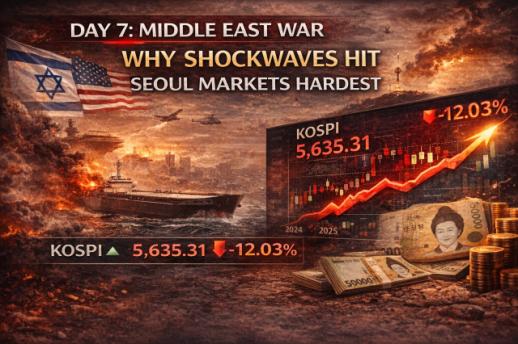 Day 7 Middle East War: Why shockwaves hit Seoul markets hardest As the war triggered by U.S.–Israeli strikes on Iran enters its first week, AJP examines how the conflict began and evolved, the emerging power vacuum in Tehran and its implications for Iran and the Gulf states, and the broader impact on global energy routes, financial markets and the international order. SEOUL, March 06 (AJP) - South Korea’s stock market entered 2026 in a euphoric rally. The benchmark KOSPI surged nearly 50 percent in the first two months of the year, pushing past the 6,300 level after an extraordinary 76 percent gain in 2025, making it one of the world’s strongest equity markets. The mood reversed abruptly when investors returned from a long holiday weekend to the shocking news of U.S.–Israeli strikes on Iran that killed the country’s supreme leader and senior military officials. Within days, the Korean equity market experienced one of the most dramatic swings in its history. The first week of the Middle East war triggered a historic whipsaw in Seoul, sending the KOSPI plunging 12 percent in a single session — the worst crash on record — before rebounding nearly 10 percent the next day as oil prices, the Korean won and foreign investor positioning repriced simultaneously. By the end of the first week of March, the market was still roughly 10 percent lower than before the war began. On Wednesday — the second trading day after the weekend strikes — the KOSPI collapsed 12 percent. The index then surged back the following day in a near mirror-image rebound. The tug-of-war continued through Friday as retail investors and foreign funds battled for control of the market, producing one of the most volatile trading weeks in decades. “This market is not for the faint of heart,” veteran investor Jim Bianco wrote on X. Part of the turbulence reflected timing. Korea’s market had been closed for a three-day holiday from Feb. 28 to March 2, compressing the geopolitical shock into the first two trading sessions of March. But the magnitude of the swings also revealed how quickly risk premiums can be repriced in Korea — a market where oil prices, the currency and foreign investor flows often move together. Hormuz shock ripples across Asia The war’s financial shock spread quickly across Asia, a region heavily dependent on Middle Eastern energy shipments passing through the Strait of Hormuz. Although the strait was not formally closed, Iranian threats against vessels and heightened military tensions effectively slowed shipping traffic and increased the perceived risk of disruption. For global markets, the mere possibility of disruption was enough. Even without a full blockade, the risk feeds into energy costs through multiple channels: higher war-risk insurance premiums, tanker rerouting, delivery delays and rising freight rates. Those costs ultimately raise the landed price of oil and industrial inputs. For Korea, those risks translate directly into market volatility. The country imports about 70.7 percent of its crude oil and roughly 20.4 percent of its liquefied natural gas from the Middle East, leaving it unusually exposed to geopolitical disruptions in the Gulf. When global investors move into risk-off mode, those structural vulnerabilities quickly become an equity story. Energy is priced in dollars. When oil rises while the Korean won weakens, the import bill increases twice — lifting inflation risks and squeezing corporate margins. That dynamic was visible throughout the week. The dollar-won exchange rate climbed from 1,439.8 before the war to 1,480.6 by Thursday, briefly touching 1,506.7, a level widely seen by investors as a psychological stress threshold. Meanwhile Brent crude jumped from $72.48 to $84.31, reaching an intraday high of $86.27. For Korea, oil and foreign exchange tend to reinforce each other. When both move at once, the market typically reprices risk more aggressively than peers with lower energy exposure or weaker FX sensitivity. Foreign selling amplifies the drop Foreign investor flows amplified the volatility. Korea’s equity market has one of the highest foreign participation rates among major markets, meaning global portfolio shifts can move the index rapidly. Foreign investors had already been trimming positions after Korea’s extraordinary rally. Data from the Korea Exchange show foreign investors sold 26.1 trillion won worth of shares in the benchmark market this year as of March 3. The selling was concentrated in the large-cap stocks that had led the rally — particularly Samsung Electronics and SK Hynix, the backbone of the KOSPI. Foreign investors sold 22 trillion won worth of Samsung Electronics shares and 10.5 trillion won of SK Hynix, while also trimming positions in Hyundai Motor and Hyundai Mobis. Retail investors moved aggressively in the opposite direction. Individuals bought 12.8 trillion won of Samsung Electronics and 6.7 trillion won of SK Hynix, absorbing much of the foreign selling pressure. According to Noh Dong-gil, a researcher at Shinhan Securities, foreign investors were not abandoning Korea entirely but were rebalancing their portfolios. “They reduced exposure to semiconductors — the key driver of KOSPI volatility — while adding defensive or policy-related stocks,” he said. “The problem was the scale and speed of the selling, which amplified the market’s decline.” Base case vs. Stress case For strategists, the week’s violent swings reflected a rapid shift between base-case and stress-case geopolitical scenarios. Kim Do-un, a senior analyst at Hana Securities, described the whipsaw as a market briefly pricing in an extreme energy shock. Historically, he said, Middle East crises often create buying opportunities — provided the conflict does not escalate into a prolonged oil shock. “If the conflict doesn’t escalate into an all-out regional war and oil does not move into the $100 to $120 range, then the pullback at these levels can be interpreted as a healthy correction,” Kim said. “What we saw was the market’s center of gravity shifting — at least temporarily — from the base scenario toward the worst-case scenario.” Kim mapped those scenarios into index levels. “If the conflict remains contained within roughly two months and the currency stabilizes, the KOSPI’s lower bound would likely be around 5,600,” he said. “But if Hormuz disruption intensifies, the won breaks above 1,500 again and oil approaches $120, then a move toward 5,000 becomes plausible.” 2026-03-06 16:02:53
 -
 Asian markets ending the first war week muddled SEOUL, March 06 (AJP) - Asian markets finishing the first week of a new war became muddled Friday amid mixed messages from Washington and the battlefields in the Middle East about how long the conflict could continue and how large the impact on the global economy. Overnight, U.S. equities returned to declines as geopolitical risks surrounding the Iran conflict weighed on investor confidence. The Dow Jones Industrial Average fell 1.61 percent to 47,954.74, while the S&P 500 slipped 0.56 percent to 6,830.71. The tech-heavy Nasdaq Composite declined 0.26 percent to 22,748.99. Security concerns around one of the world’s most critical energy shipping routes also weighed on sentiment. Reports of tanker attacks near the Strait of Hormuz heightened fears about the safety of oil shipments through the Gulf, where hundreds of vessels carrying crude oil and liquefied natural gas are reportedly waiting for safe passage. Political uncertainty in Iran added to investor caution. Reports indicated that clerics responsible for selecting the country’s next supreme leader are considering Mojtaba Khamenei, the son of the late Ayatollah Ali Khamenei, as a potential successor, raising questions about the direction of Iran’s leadership following the conflict. Across Asia, markets showed diverging performances. Japan’s Nikkei 225 slipped 0.8 percent to around 54,860, while China’s Shanghai Composite Index edged up 0.6 percent to 4,108.6 as investors selectively bought recently weakened technology shares. In Seoul, the benchmark KOSPI briefly rebounded around 9:23 a.m. before turning lower again from about 9:30 a.m. As of 10:30 a.m., the index was down 2.6 percent at 5,437.1. The tech-heavy KOSDAQ also reversed early gains, falling 0.8 percent to 1,107.3 after touching an intraday high of 1,118.01 at around 10:16 a.m. Trading activity remained brisk, with turnover reaching about 14.3 trillion won ($9.7 billion) on the KOSPI and 7.1 trillion won on the KOSDAQ. Investor flows showed strong retail buying against persistent foreign selling pressure. On the main board, individual investors purchased 1.96 trillion won worth of shares, while institutions and foreigners sold 639.5 billion won and 1.34 trillion won, respectively. On the KOSDAQ, individuals and institutions were net buyers of 82.7 billion won and 93.3 billion won, while foreigners sold 176.7 billion won. Major blue chips traded lower. Samsung Electronics fell 4.9 percent to 182,200 won, while SK Hynix dropped 5.3 percent to 892,000 won. Automakers also declined, with Hyundai Motor down 2.6 percent at 534,000 won and Kia falling 2.5 percent to 162,300 won. Battery maker LG Energy Solution slipped 1.5 percent to 366,000 won, while biotech heavyweight Samsung Biologics declined 2.9 percent to 1.6 million won. Defense-related shares bucked the broader market trend on expectations of sustained global demand amid geopolitical tensions. LIG Nex1 surged 10 percent to 834,000 won, while Hanwha Systems gained 7.2 percent to 161,300 won and Hanwha Aerospace advanced 3.3 percent to 1,428,000 won. The dollar weakened globally, trading at 1,473.30 won. 2026-03-06 11:43:35
 -
 KOSPI stages sharp rebound to lead Asian recovery SEOUL, March 05 (AJP) - Korean stocks led Asia’s rebound Thursday, with the benchmark KOSPI surging nearly 10 percent in a sharp reversal from the previous session’s record plunge, as bargain hunting and program buying drove a broad-based rally in heavyweight shares. The KOSPI closed at 5,583.9, up 490.4 points, or 9.6 percent, after swinging between an intraday low of 5,248.13 and a high of 5,715.3. Turnover reached 44.81 trillion won. The tech-heavy KOSDAQ outperformed, jumping 14.1 percent to 1,116.4. After a stunning flop on the previous two sessions, Korea marched far ahead of regional peers, with the KOSPI’s 9.6 percent gain dwarfing Japan’s Nikkei 225 rise of 1.9 percent and China’s Shanghai Composite advance of 0.6 percent. Buying was driven largely by retail investors on the main board, who snapped up 1.7964 trillion won ($1.23 billion) worth of shares on a net basis. Foreign investors, by contrast, sold 144.5 billion won, while institutions offloaded 1.7187 trillion won. On the KOSDAQ, the pattern flipped, with foreigners and institutions emerging as heavy buyers — purchasing 831.8 billion won and 741.5 billion won, respectively — as retail investors turned net sellers of 1.5528 trillion won. Large-cap leaders anchored the rebound. Samsung Electronics rose 11.3 percent to 191,600 won, while SK hynix gained 11 percent to 941,000 won, keeping semiconductors at the center of the rally. Hyundai Motor climbed 9.4 percent to 548,000 won, while LG Energy Solution added 6.9 percent to 371,500 won. Samsung Biologics jumped 8.6 percent to 1,647,000 won, and Hanwha Aerospace rose 4.4 percent to 1,381,000 won. Despite the strong finish, it was a roller-coaster ride. A buy-side sidecar was triggered shortly after the opening bell on both the KOSPI and KOSDAQ as program buying accelerated. Sidecars temporarily halt program-trading orders when index moves breach preset thresholds, a mechanism aimed at cooling abrupt swings. Elsewhere in the region, investors weighed policy signals out of China after Premier Li Qiang unveiled a 2026 growth target range of 4.5 to 5 percent at the opening of the National People’s Congress, stepping down from the “around 5 percent” goal maintained in recent years. China’s Shanghai Composite ended 0.6 percent higher, while Hong Kong’s Hang Seng rose 0.5 percent. Japan also joined the rebound. The Nikkei 225 gained 1.9 percent, with the index bouncing sharply in early trade as bargain hunting followed three sessions of losses tied to Middle East tensions. The Nikkei briefly climbed into the 56,600 range, recouping much of the previous day’s decline, while roughly 90 percent of stocks on the TSE Prime market traded higher. Semiconductor-linked and financial shares rebounded as well, with Advantest jumping about 7 percent at one point and Mitsubishi UFJ Financial Group rising around 5 percent. The Korean won which hovered near 1,480 came down to 1,460 range amid broad easing in the greenback and oil prices. The dollar was 1,469.40. 2026-03-05 17:54:12
 -
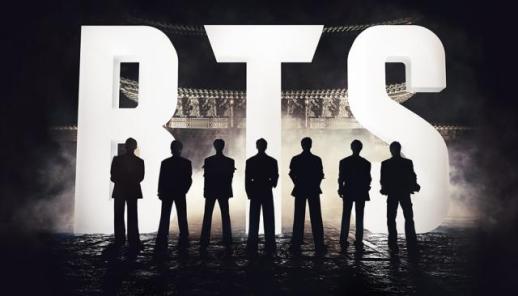 BTS Comeback D-16: BTS teaser sparks global buzz ahead of 'ARIRANG' comeback SEOUL, March 05 (AJP) - BTS ignited massive online buzz Thursday after releasing a teaser for its upcoming comeback performance "BTS THE COMEBACK LIVE : ARIRANG," sending anticipation among global fans soaring ahead of the group’s long-awaited return. The K-pop sensation unveiled the trailer across its major social media platforms, quickly drawing millions of views and reactions from fans worldwide. The video opens with the roar of ARMY, BTS’ global fanbase, echoing from past concerts. The familiar sound sets the tone for what many fans view as a symbolic reunion between the band and its supporters. Scenes of Gyeongbokgung Palace — one of Seoul’s most iconic historic landmarks — appear throughout the teaser, blending traditional Korean imagery with BTS’ modern global identity. At the center of the trailer is a message from leader RM: "We promised our fans that we’d be back." The screen then flashes bold phrases such as "THE WORLD’S BIGGEST BAND IS BACK" and "WITNESS THE HOMECOMING," underscoring the scale and symbolism of the group’s return. The teaser rapidly gained traction online shortly after its release. On YouTube, the video garnered more than 32,000 views, 6,100 likes and 496 comments as of 4:30 p.m. (0730 GMT), seven hours after the initial upload. Engagement was even stronger across social media platforms. The teaser post on X generated about 4.1 million views, 211,000 likes, 141,000 reposts and roughly 8,600 comments. On Instagram, it collected more than 2.03 million likes and over 77,000 comments, highlighting the group’s massive global reach. Fans flooded comment sections with messages celebrating the group’s return, "Not everyone will understand why this feels so emotional. But if you’ve been here for years, you know this isn’t just a trailer. BTS don’t just release music, they release memories, healing, and pieces of our lives. Years later they still give the same feeling, excitement, pride, and little bit of tears," the YouTube comment posted by "Anusha15-1" gained over 4.1 thousand likes in five hours, with many noting that a performance in Seoul’s historic center adds symbolic weight to the comeback. "THE SHOT OF THEM WALKING WITH LIGHTED LAMPS IN THEIR HANDS LOOKED SO COOL!!" said "berryberryblueberryy" on YouTube. A teaser poster released alongside the video shows the silhouettes of all seven members standing before Gwanghwamun, reinforcing the theme of reunion. BTS is expected to release its fifth studio album "ARIRANG" on March 20. The following evening, the group will hold a major comeback performance at Gwanghwamun Square in central Seoul. The concert will be streamed worldwide through Netflix, making it one of the platform’s most high-profile live music broadcasts. The show will be directed by Hamish Hamilton, known for staging global events such as the 2012 London Olympic opening ceremony and the Super Bowl halftime show since 2010. The album’s title track, "SWIM," reflects on moving forward through life’s waves rather than being swept away by them. RM participated in writing the song, adding a personal narrative to the project. For BTS, the teaser signals more than the release of new music. It marks the beginning of a long-awaited reunion with fans around the world. 2026-03-05 16:33:55
 -
 Middle East Crisis: Away from the front lines, Iran and Israel wage a war of words in Seoul SEOUL, March 05 (AJP) - The Iranian and Israeli embassies in Seoul held back-to-back press briefings Thursday, trading starkly opposing narratives over the escalating war in the Middle East as both sides sought to shape international opinion. The unusual diplomatic exchange unfolded within hours of each other in central Seoul, with the Iranian ambassador accusing the United States and Israel of launching an illegal war and the Israeli envoy defending the military campaign as a necessary step to stop Iran’s nuclear and missile programs. The dueling briefings underscored how the widening conflict — sparked by U.S.-Israeli strikes on Iran — is rapidly becoming a global information battle as well as a military confrontation. Iran: “Illegal aggression” and war crimes Speaking at the Iranian Embassy in Yongsan, Ambassador Saeed Koozechi blamed Washington and Israel for triggering the conflict. “The responsibility for the current crisis in West Asia lies with the United States and the Zionist regime of Israel,” Koozechi said. “Today’s war did not originate from Iran’s actions, but from the deliberate decision of the United States and Israel to abandon diplomacy and choose military aggression.” The ambassador said Iran had engaged in negotiations with Washington twice in the past nine months over its nuclear program, arguing that the attacks during ongoing diplomacy demonstrated that the talks were used as a cover for military action. He accused Israel of violating international law and targeting civilians, citing an alleged strike on a girls’ elementary school in the southern Iranian city of Minab. “The attack killed 165 students and seriously injured dozens more. Such acts are clear war crimes and blatant violations of international humanitarian law,” he said. Iran, he added, would continue exercising its right to self-defense under Article 51 of the United Nations Charter until the attacks stop. “The Islamic Republic of Iran will not hesitate to defend itself. Our response is not revenge but legitimate self-defense,” Koozechi said. The ambassador also rejected accusations that Iran is pursuing nuclear weapons, calling them “fabricated claims and disinformation.” “The country possessing nuclear weapons in the region is not Iran but Israel,” he said, noting that Israel is not a signatory to the Nuclear Non-Proliferation Treaty (NPT). Israel: Preventing a nuclear threat Roughly an hour later in a separate venue in central Seoul, Israeli Ambassador Rafael Harpaz offered a sharply different account. According to Harpaz, the military operation was aimed at preventing Iran from completing a nuclear weapons capability and halting the expansion of its ballistic missile arsenal. “Iran was approaching the final stage of nuclear weapon capability,” Harpaz said. “If we did not act now, we might not have another opportunity to prevent it.” He argued that years of diplomatic efforts had failed to stop Iran’s nuclear ambitions. “Iran has been explaining its nuclear program for decades and promising that it is peaceful,” he said. “But each time, the negotiations simply bought them more time to advance their program.” Harpaz also pointed to Iran’s financial support for Hezbollah in Lebanon, estimating that Tehran has provided the group with $2 billion to $3 billion in funding. The ambassador framed the operation as a defensive measure for Israel’s security. “When you imagine a one-ton warhead mounted on a ballistic missile hitting a densely populated Israeli city, the threat becomes very clear,” he said. Dispute over civilian casualties The two ambassadors clashed sharply over allegations that Israeli strikes hit civilian facilities. Iran said attacks on schools and hospitals represented clear violations of international humanitarian law. Israel denied intentionally targeting civilian infrastructure and warned that misinformation was circulating widely. “There is a lot of fake news coming out of Iran,” Harpaz said. “Israel has never intentionally targeted civilian facilities.” He added that Israel operates under a system of free media and urged journalists to verify claims carefully. Competing visions of the conflict The diplomatic clash in Seoul reflected a broader divide over the goals and legitimacy of the war. Iran framed the conflict as an unlawful act of aggression aimed at undermining its sovereignty and destabilizing the region. Israel, by contrast, presented the campaign as a preemptive effort to neutralize a nuclear and missile threat that could endanger its survival. Both ambassadors acknowledged the risk of a prolonged conflict but expressed confidence in their respective positions. “Iran has faced many invasions in its history and will continue to resist aggression,” Koozechi said. Harpaz said Israel believes the military campaign will not become an endless war. “We trust our capabilities and the support of our allies,” he said The rare diplomatic confrontation in Seoul highlighted how the Middle East conflict is being fought not only on battlefields but also in global capitals. 2026-03-05 15:08:39
 -
 Asian markets in second rout while Seoul bourses suffer worst collapse SEOUL, March 04 (AJP) - The spiraling war in the Middle East sent shockwaves across Asian markets Wednesday, triggering a historic collapse on the Seoul bourse. Global energy markets remained volatile as tensions centered on the Strait of Hormuz — a critical artery for global oil shipments — fueled fears of supply disruptions and renewed inflation pressure. The narrow waterway carries roughly one-fifth of the world’s seaborne crude and serves as a key route for energy supplies bound for Asia. U.S. President Donald Trump said Washington was prepared to intervene to protect shipping lanes in the region. “If necessary, the United States Navy will begin escorting tankers through the Strait of Hormuz,” Trump said, adding that the government would also provide political risk insurance for maritime trade to ensure the “free flow of energy to the world.” The war abruptly ended this year’s fastest and steepest rally in Korean equities, sending stocks tumbling for a second consecutive session in one of the sharpest market collapses in decades. The benchmark KOSPI plunged 12.06 percent, or 698.37 points, to close at 5,093.54, after already falling 7.24 percent the previous day. The two-day slide wiped out nearly 19 percent of the index’s value. The index briefly dropped to an intraday low of 5,059.45 before closing near session lows, pushing the market back toward levels seen earlier this year. The scale of the decline was extraordinary by historical standards. The drop surpassed the 12.02 percent plunge recorded on Sept. 12, 2001, in the aftermath of the Sept. 11 attacks, when the KOSPI fell 64.97 points to close at 475.64. The latest selloff therefore ranks among the steepest single-day declines in the history of the Korean stock market. Selling pressure intensified shortly after the open. The index began the session 3.44 percent lower at 5,592.59, before losses rapidly accelerated across the board. According to the Korea Exchange, circuit breakers were triggered as the selloff deepened. Trading was halted on the KOSDAQ at 11:16:33 a.m., followed by the KOSPI at 11:19:12 a.m., after both indices fell more than 8 percent from the previous close. The mechanism halted trading for 20 minutes in an effort to curb panic selling. It marked the seventh circuit breaker in KOSPI history and the eleventh for the KOSDAQ, and the first such halt since Aug. 5, 2024. Trading activity surged as volatility intensified. Turnover on the KOSPI jumped to about 62.6 trillion won ($42.6 billion), sharply higher than 52.8 trillion won the previous day. Losses were widespread across the Korean market, with major exporters and technology firms leading the decline. Samsung Electronics dropped 11.74 percent to 172,200 won, while SK hynix fell 9.58 percent to 848,000 won, extending losses from the previous session. Automakers and industrial stocks also suffered steep declines. Hyundai Motor plunged 15.8 percent, Kia slid 14.04 percent, and LG Energy Solution fell 11.58 percent. Heavy industry and shipbuilding shares were similarly hit, with HD Hyundai Heavy Industries dropping 13.39 percent. Even defense stocks — which had surged a day earlier amid rising geopolitical tensions — reversed sharply. Hanwha Aerospace, Hyundai Rotem, and Hanwha Systems all posted significant losses. The tech-heavy KOSDAQ also recorded a historic decline. The index plunged 14 percent, or 159.26 points, to 978.44, breaking below the psychologically important 1,000 level after opening at 1,112.08. Major growth stocks fell sharply across the board, including EcoPro, Alteogen, EcoPro BM, Samchundang Pharm, and Rainbow Robotics, all posting double-digit losses. Elsewhere in Asia, markets also declined as investors moved away from risk assets, though the scale of losses was far less severe than in Korea. Japan’s Nikkei 225 fell 3.6 percent to 54,245.5, while the broader TOPIX dropped 3.7 percent. In Greater China, declines were more moderate. Hong Kong’s Hang Seng Index fell 2.3 percent, while the Shanghai Composite slipped 1 percent. The comparison underscored the magnitude of Korea’s selloff, which far exceeded declines across other major Asian markets. Currency markets also reflected growing risk aversion. The Korean won traded near crisis-era levels at 1,476.2 per dollar, highlighting investor concerns about capital outflows and rising energy costs. With tensions in the Middle East unresolved and energy markets highly sensitive to developments around the Strait of Hormuz, volatility across global markets is likely to remain elevated. Market watchers note that after surging nearly 50 percent this year as of last week, the KOSPI may still face further downside risks if geopolitical tensions persist. 2026-03-04 17:47:01
 -
 K-pop boy band NOWZ drops first Japanese album SEOUL, March 04 (AJP) - Cube Entertainment's K-pop boy group NOWZ has rolled out its first Japanese album “NOWZ” on Wednesday, targeting the neighboring country's dance music scene. Releasing albums in Japan was considered one of the most important promotion activities for Korean artists in the early 2000s, when K-pop was not as popular. Japan has served for decades as a crucial gateway for K-pop acts seeking to build international audience. Chart performance, arena tours and album sales in the country have often been viewed as key milestones in an artist’s global expansion. The importance of the Japanese market dates back to the expansion of second-generation K-pop artists such as TVXQ, Girls’ Generation and KARA, whose chart success and large-scale tours helped establish Japan as a major overseas base for Korean artists. More recently, the industry has expanded its strategy by launching “localized K-pop” groups designed specifically for the Japanese market. JYP Entertainment’s nine-member girl group NiziU, formed through the audition program Nizi Project in partnership with Sony Music Entertainment Japan, debuted in Japan in December 2020 before expanding activities to Korea with a Korean-language release in October 2023. HYBE Labels Japan, now known as YX Labels. also launched multinational boy group &TEAM in December 2022 following the audition program &AUDITION – The Howling, positioning the group as a Japan-based K-pop act targeting both domestic and global audiences. NOWZ, composed of Hyunbin, Yun, Yeonwoo, Jinhyuk and Siyun, released the EP on global streaming platforms Wednesday alongside a performance video for the track "AMMO (feat. YRD Leo)." NOWZ is a five-member boy group under Cube Entertainment that debuted in April 2024. The group was originally introduced under the name NOWADAYS before rebranding as NOWZ in June 2025. It marks Cube Entertainment’s first new boy group since Pentagon, which debuted in 2016. The performance video for "AMMO (feat. YRD Leo)" features fast-paced visuals including laser effects and glass-shattering sequences synchronized with the group’s choreography. Japanese rapper YRD Leo, who features on the track, also appears in the video. The choreography for "AMMO" was created by Monika of the dance crew PROWDMON. The group previously showcased performance-driven tracks such as "EVERGLOW," "Problem Child" and "HomeRUN." The EP contains five various tracks, including the pre-released original Japanese song AMMO (feat. YRD Leo) as well as Japanese versions of previously released tracks HomeRUN, "GET BUCK," "Untitled World" and "Fly Freely." Following the EP, NOWZ will begin promotional activities in Japan starting March 5, including television appearances, media interviews and fan events. The group will also hold its first fan concert, "Run with me, NOW," in Korea on March 28. 2026-03-04 16:02:46
 -
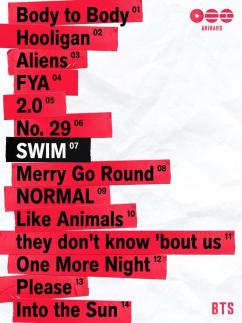 BTS Comeback D-17: 'ARIRANG' tracklist unveiled as heat builds up in countdown SEOUL, March 04 (AJP) - BTS has drummed up anticipation for its long-awaited comeback with the release of the 14-song tracklist for its upcoming album ARIRANG — the group’s first full-member project in nearly four years — due March 20, with fans already preparing to camp out for the closest view of the open-air comeback show the following day. The tracklist was unveiled by HYBE through its official website and social media channels, accompanied by a visual featuring the album’s logo layered over bold red tape-style graphics — an early hint at the intensity of the group’s reunion era. The album contains 14 tracks led by the title song “SWIM,” alongside “Body to Body,” “Hooligan,” “Aliens,” “FYA,” “2.0,” “No. 29,” “Merry Go Round,” “NORMAL,” “Like Animals,” “they don’t know ’bout us,” “One More Night,” “Please,” and “Into the Sun.” HYBE described ARIRANG as BTS’s first full-length album in nearly four years and a project that carries “special significance” in defining the direction of the seven members moving forward. The comeback marks the group’s first full-member release since entering an extended hiatus, raising expectations not only commercially but culturally as well. The title track “SWIM” is described as an upbeat alternative-pop song centered on perseverance and love for life. Rather than resisting life’s turbulent waves, the lyrics express the determination to keep moving forward at one’s own pace. Group leader RM played a major role in the songwriting process. The album took shape largely in Los Angeles last summer, where BTS collaborated with a global roster of producers including Diplo, Ryan Tedder, and Spanish electronic producer El Guincho. The tracklist reveal triggered immediate engagement online. As of 10 a.m. Wednesday, HYBE’s official post uploaded shortly after midnight had drawn roughly 4.7 million views, 13,000 comments, 203,000 reposts and 308,000 likes on X, with numbers continuing to rise. Major pop culture accounts showed similar traction, each generating more than one million views within hours — underscoring the global anticipation surrounding BTS’s return as a full group. The album’s title has also fueled discussion among fans. “Arirang,” widely recognized as Korea’s most iconic folk song, carries strong cultural symbolism. With BTS planning its comeback stage at Gwanghwamun Square, some fans had expected a stronger Korean-language presence within the album. A number of online comments pointed to the contrast between the Korean title and the predominantly English tracklist. Others expressed curiosity about how the cultural symbolism would translate into the music. Still, many fans voiced confidence in the group’s creative direction, noting BTS’s long-standing ability to blend Korean identity with global pop sounds. As the March 21 comeback event approaches, excitement is spilling beyond the internet. Posts circulating on social media suggest that some fans are already considering camping near Gwanghwamun Square to secure better viewing spots for the open-air performance. The anticipated turnout has prompted the Seoul Metropolitan Government to review the event’s safety preparations. City officials said Tuesday that the safety management plan for the “BTS 2026 Comeback Show” had been conditionally approved, with additional measures to be reinforced in coordination with police and fire authorities. ARIRANG will be released globally at 1 p.m. KST on March 20, followed by “BTS Comeback Live: ARIRANG” at Gwanghwamun Square the next day, with the performance streamed worldwide on Netflix. 2026-03-04 14:10:41
 -
 WAIFF D-2: Seoul edition marks global expansion in 2026 SEOUL, March 04 (AJP) - The World AI Film Festival (WAIFF), which debuted in Nice, France on April 11, 2025, will expand globally in 2026, with Seoul emerging as one of its key host cities. Putting emphasis on collaboration between artificial intelligence and human creativity, WAIFF aims to bridge technology, industry and artistic expression. The 2026 circuit will move through China, Korea, Japan and Brazil before culminating in April at the WAIFF Cannes Edition in France. Select award-winning works from the Seoul edition will receive official invitations to screen in Cannes, placing Korean creators before an international audience of filmmakers and industry professionals. Eligibility and Submission Framework WAIFF Seoul 2026 was limited to Korean nationals and residents, excluding employees of WAIFF institutions, partner organizations and their family members. Nominees invited to official events must have no restrictions affecting their entry or stay in Korea, and participants under 19 were required to submit parental consent. Eligible works were required to have been completed after Oct. 1, 2024, with one entry permitted per category. The festival stipulated meaningful integration of artificial intelligence, requiring each project to employ at least three AI tools, including one image-generative system. Submissions were required to include a synopsis, poster and still images, a production journal, a director’s biography or CV, and the video. English subtitles were mandatory, and videos had to meet a minimum technical standard of Full HD resolution at 24 frames per second. Entries that failed to comply with the guidelines or were submitted after the deadline were deemed invalid. Once selected as nominees, works could not be withdrawn. Competition Structure The Seoul edition will feature four categories reflecting different storytelling formats. The AI Short Film section accepts works running between five to ten minutes, with a recommended 16:9 aspect ratio and a declared genre among animation, action, drama or fantasy. The AI Shorts Series category centers on vertical content. Participants must submit a 9:16 series comprising four to six episodes, each 15 to 60 seconds, delivered as a single file with clearly separated segments. The AI Advertisement category invites short-form commercials for fictional products or services, incorporating a product name, logo and narrative concept. The Youth AI Film category consists of participants under 24 as of Feb. 10, 2026, with entries required to run between five to ten minutes. Team submissions are permitted, provided a designated representative is appointed to hold authority over awards and prize matters. The organizers do not intervene in internal disputes among team members. Event Schedule WAIFF Seoul 2026 will kick off on March 6 from 6 p.m. to 7:30 p.m. at Lotte Concert Hall, located on the 8th floor of Lotte World Mall in Seoul. Admission is free. The following day, March 7, the “WAIFF Seoul 2026: Creative Intelligence Forum” will run from 10:00 a.m. to 6:00 p.m. at Lotte Cinema World Tower Seoul. Tickets are priced at 89,000 won ($59.97). 2026-03-04 13:42:46