
Journalist

Joonha Yoo, and Yoo Na-hyun
joonhayoo94@ajupress.com
-
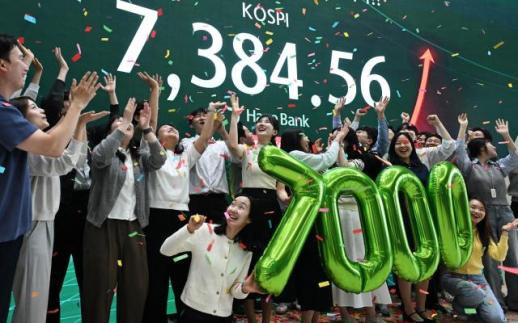 KOSPI shatters 7,300, outpacing Asia as foreign buying floods chip stocks SEOUL, May 06 (AJP) - South Korea’s benchmark KOSPI surged to a fresh record high Wednesday, sharply outperforming regional peers as foreign investors piled into semiconductor heavyweights, while most Asian markets posted more modest gains and Japan remained closed for the Golden Week holiday. The KOSPI jumped 6.5 percent to close at 7,384.56, after moving between an intraday low of 7,093.00 and a high of 7,426.60, briefly breaking above the 7,400 level during the session. The latest advance highlights the extraordinary pace of the rally, with the index surging from 4,949.59 on January 26 to above 7,300 in just over three months, driven largely by concentrated gains in semiconductor heavyweights. Foreign investors purchased 3.13 trillion won ($2.15 billion) worth of shares, while retail and institutional investors sold 572.4 billion won and 2.31 trillion won, respectively, indicating that the rally was overwhelmingly driven by offshore flows. Investor sentiment was underpinned by a strong lead from Wall Street, where the S&P 500 and the Nasdaq Composite closed at record highs, while the Dow Jones Industrial Average rose 0.7 percent. The Philadelphia Semiconductor Index climbed 4.2 percent. Sentiment was further buoyed by easing geopolitical tensions after Marco Rubio said the U.S. military operation against Iran, dubbed “Operation Epic Fury,” had concluded successfully, easing concerns over potential disruptions in the Strait of Hormuz. Oil prices extended declines, with Brent crude falling 1.4 percent to $108.3 per barrel and West Texas Intermediate crude dropping 1.4 percent to $100.8, while the VIX volatility index fell 5 percent to 17.38. The easing risk environment supported the Korean won, which strengthened to 1,454.5 per dollar, down 1 percent from the previous session, extending its recovery toward levels seen before the recent escalation in Middle East tensions. Despite South Korea’s heavy reliance on Gulf energy imports, the KOSPI has remained resilient, reflecting strong global liquidity conditions and concentrated inflows into semiconductor exporters. Sector gains were led by semiconductors and financials, with chip-related stocks and equipment makers jumping 12.1 percent. Life insurers and brokerage firms rose 11.2 percent each, supported by expectations of improved earnings amid surging trading activity. Among large-cap stocks, Samsung Electronics surged 14.4 percent to close at 266,000 won, supported by expectations of a prolonged memory upcycle and reports that Apple is considering the company as a potential foundry partner alongside Intel as part of efforts to diversify supply chains beyond TSMC. SK hynix rose 10.6 percent to 1,601,000 won, while SK Square gained 9.9 percent to 1,089,000 won. LG Energy Solution added 2.12 percent to 482,000 won, and Hyundai Motor rose 2.0 percent to 550,000 won. In contrast, Doosan Enerbility slipped 0.2 percent to 127,000 won, Hanwha Aerospace fell 2.2 percent to 1,433,000 won, while Samsung Biologics edged down 0.3 percent to 1,480,000 won and Samsung Electro-Mechanics declined 0.7 percent to 912,000 won. The KOSDAQ slipped 0.3 percent to close at 1,210.20, after moving between 1,197.01 and 1,220.90. Retail investors bought 610.1 billion won, while foreigners and institutions sold 61.6 billion won and 543.9 billion won, respectively. The divergence reflected continued weakness in biotech shares and fund rotation into large-cap semiconductor stocks on the main board. Among KOSDAQ heavyweights, Ecopro BM rose 6.03 percent to 228,500 won, and Ecopro gained 4.5 percent to 162,800 won, while Rainbow Robotics advanced 2.5 percent to 702,000 won. However, Alteogen fell 2.6 percent to 363,500 won, Samchundang Pharm slipped 0.9 percent to 406,000 won, and Lino Industrial dropped 3.4 percent to 116,700 won. HLB rose 1.3 percent to 61,700 won. Elsewhere in Asia, Hong Kong’s Hang Seng Index rose 1.1 percent to 26,178.8, and China’s Shanghai Composite gained 1.14 percent to 4,158.88, while Japanese markets remained closed for the Golden Week holiday. 2026-05-06 17:11:47
 -
 KOSPI hits record high, approaching the 7,000 mark SEOUL, May 04 (AJP) - Korea’s benchmark KOSPI led gains across Asia on Monday, surging more than five percent to a fresh high as markets in China and Japan remained closed for holidays, while Hong Kong posted comparatively modest gains. The KOSPI closed 5.12 percent higher at a record 6,936.99, after moving between an intraday low of 6,741.63 and a high of 6,937.00. The rally was driven by strong foreign and institutional buying, with foreign investors purchasing 3.00 trillion won ($2.04 billion) worth of shares and institutions adding 1.94 trillion won, while retail investors sold 4.79 trillion won, indicating a market led by offshore and institutional flows. Large-cap technology and semiconductor stocks led the advance, supported by continued optimism over artificial intelligence investment and improving global tech sentiment. SK hynix jumped 12.5 percent to close at 1,447,000 won, after touching an intraday high of 1,450,000 won, while SK Square surged 17.8 percent to 991,000 won. Samsung Electronics rose 5.4 percent to 232,500 won, extending gains across the broader chip sector. Gains also spread to other sectors. LG Energy Solution climbed 2.5 percent to 472,000 won, while Hyundai Motor added 1.5 percent to 539,000 won. In the industrial and defense sector, Hanwha Aerospace rose 3.4 percent to 1,465,000 won and Doosan Enerbility edged up 0.1 percent to 127,200 won, while HD Hyundai Heavy Industries slipped 0.7 percent to 680,000 won. Biotech heavyweight Samsung Biologics rose 1.02 percent to 1,485,000 won. By sector, conglomerates led the gains, rising 11.6 percent, followed by electrical equipment and securities, which both climbed 8.6 percent. Theme-wise, cable-related stocks surged 17 percent, while power equipment and optical communication sectors advanced 11.4 percent and 10.5 percent, respectively. On the junior KOSDAQ, the index rose 1.8 percent to close at 1,213.74, moving between 1,211.39 and 1,222.65 during the session. Foreign investors bought 555.3 billion won worth of shares, while retail investors sold 448.9 billion won, and institutions offloaded 73.6 billion won. Among major stocks, battery and materials names led the gains. EcoPro rose 1.9 percent to close at 155,800 won, while EcoPro BM jumped 4.6 percent to 215,500 won. Biotech stocks were mixed. Alteogen gained 1.2 percent to 373,000 won, while HLB edged up 0.2 percent to 60,900 won and Peptron climbed 2.7 percent to 267,500 won. Samchundang Pharm, however, fell 1.4 percent to 409,500 won. In the robotics and equipment sector, Rainbow Robotics rose 3.2 percent to 685,000 won, while LEENO Industrial added 1.3 percent to 120,800 won. The Korean won strengthened 0.5 percent to 1,467.7 per dollar. Elsewhere in Asia, Hong Kong’s Hang Seng Index rose 1.3 percent to 26,120.0, while Japan’s Nikkei 225 and China’s Shanghai Composite remained closed for holidays. Market sentiment was also supported by developments in the Middle East, as the United States announced a new initiative, dubbed “Project Freedom,” aimed at facilitating the movement of commercial vessels through the Strait of Hormuz. Under the plan, U.S. Central Command said it would deploy guided missile destroyers, more than 100 aircraft and unmanned platforms, and around 15,000 personnel to support maritime operations. However, officials indicated that direct naval escort of commercial ships would not be part of the operation, suggesting a coordination-based approach involving governments, insurers, and shipping firms. The initiative comes amid mounting pressure in global energy markets, with more than 2,000 vessels and approximately 20,000 crew members stranded in and around the Strait of Hormuz, according to the International Maritime Organization. Oil prices remained volatile. Brent crude traded at $108.8 per barrel, up 0.6 percent, while West Texas Intermediate rose 0.5 percent to $102.5. 2026-05-04 17:27:28
 -
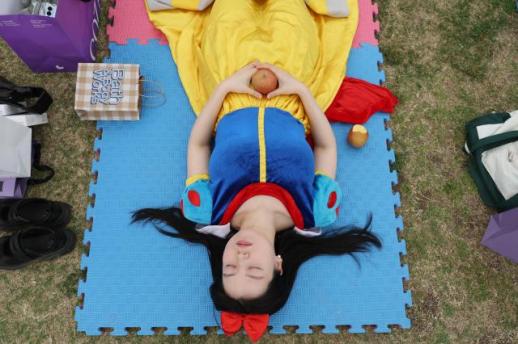 In South Korea, even sleep becomes a public competition SEOUL, May 04 (AJP) - In South Korea, where overwork and sleep deprivation have become almost a national condition, even rest now comes with rules, timers and a scoreboard. At the Han River on Saturday afternoon, 170 contestants arrived armed with plush toys, mosquito-proof determination and creative signs — including one reading, “Don’t wake me up unless you’re a prince” matched in modern-day Sleeping Beauty gown for Seoul’s annual Han River Napping Championship. Since overwork and chronic sleep deprivation come with the journalist’s job, I joined them. The rule was paradoxically simple: fall asleep in public — deeply — while everyone watches. Going to sleep required rituals and performance. A pre-nap yoga session intended to relax participants did the opposite for someone unaccustomed to stretching both muscles and stress. Some contestants clung to oversized stuffed animals like emotional-support teammates. One wore a sleep mask labeled “Offline.” Another built a miniature “sleep zone” complete with neck pillows and warning tape. The challenge was not merely to nap. It was to nap competitively. Lying among 170 strangers in an open public space, the experience of trying to rest became something communal — and for many, strangely unfamiliar. Participants were fitted with heart-rate monitors checked every 30 minutes, while organizers wandered through the crowd armed with feathers and mosquito sound effects to sabotage sleepers. Winners were chosen based on how steadily and deeply their heart rates dropped over time, turning the ancient human act of collapsing from exhaustion into quantified performance art. Then every 30 minutes, the host’s microphone shattered the silence again. From afar, the riverside scene looked peaceful, almost whimsical. Up close, it resembled a wellness survival game show: rest under observation, relaxation under evaluation. Yet for many participants, the event felt less absurd than oddly familiar. “I usually sleep about three to four hours a day,” said Nam Ji-soo, a 30-year-old office worker. “Work doesn’t really stop, and even on weekends, it’s hard to feel fully rested.” University student Park Jun-seok blamed the modern holy trinity of insomnia — social media, short videos and endless notifications. “You lie down to rest, but something always distracts you,” he said. “Social media and YouTube end up being the biggest cause of my lack of sleep.” Their exhaustion reflects a broader national pattern. South Korea ranked near the bottom globally in the IKEA Sleep Report 2025, placing 50th out of 57 surveyed markets with one of the world’s lowest sleep satisfaction levels. Koreans averaged just 6 hours and 27 minutes of sleep per night, among the shortest durations recorded. And even that may be optimistic. A separate 2025 study by the Korean Society of Sleep Research estimated actual average sleep time at only 5 hours and 25 minutes. Another report found Koreans sleep roughly 90 minutes less than the OECD average. Perhaps most revealing is what happens before bed: nearly 70 percent of adults use smartphones until the moment they fall asleep, while more than 60 percent keep their phones beside them overnight. The sleep deficit is coupled with overwork and stress, and experts say the daydreaming or sleeping contests reflects something deeper about modern Korean life. “Sleeping is something we usually do alone, in a private space. But here, it happens in public,” said Kim Jae-hwi, a psychology professor at Chung-Ang University. “Koreans are turning the most private time into a public show.” And perhaps that is what made the scene feel strangely fitting. In a country where productivity rarely powers down and smartphones follow people into bed, even doing nothing now requires an organized event, a heart-rate tracker and an official excuse to rest. For one afternoon at the Han River, sleep stopped being invisible. It became performance, competition — and somehow, entertainment. For me, it was the rarest luxury of all: sanctioned rest disguised as work. 2026-05-04 17:23:28
 -
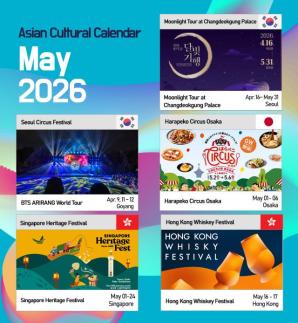 Asian Culture Calendar SEOUL, April 30 (AJP) - South Korea Apr. 8 - May 27 Gyeongbokgung Saenggwabang Apr. 16 - May 31 Moonlight Tour at Changdeokgung Palace May. 2 - 3 Ajou Motor College Festival May. 4 - 5 Seoul Circus Festival May. 5 - 10 Hangang River Festival May. 13 - 24 Suragan Sisik Gonggam May. 16 - 17 Yeon Deung Hoe May. 22 - 25 Hwaseong Boating Festival Japan May. 1 - 6 Harapeko Circus Osaka May. 2 - 3 Nyanko Expo May. 2 - 5 Saku Hot-Air Balloon Festival May. 3 - 4 Hakata Dontaku Festival May Hong Kong May. 16 - 17 Hong Kong Whiskey Festival May. 24 Cheung Chau Bun Festival Singapore May. 1 Mayday SG Festival 2026 May. 1 - 24 Singapore Heritage Festival May. 15 - 30 Singapore International Festival of Arts (SIFA) 2026-05-01 13:33:03
 -
 BTS Busan concert sells out in presale as global tour demand surges SEOUL, April 30 (AJP) - BTS’ upcoming Busan concert has sold out during the fan club presale, highlighting strong demand for the group’s global tour, BigHit Music said Thursday. Tickets for the BTS Busan concert, part of the “BTS World Tour ‘Arirang’ in Busan,” scheduled for June 12 and 13 at Busan Asiad Main Stadium, were fully sold out during the membership presale, which opened on Thursday via NOL Ticket, South Korea's popular online ticket reservation service. Busan Asiad Main Stadium is one of South Korea’s largest concert venues with a capacity of up to around 80,000, including floor seating. The BTS tour has drawn strong demand across major markets, beginning with three sold-out shows in Goyang, northwest of Seoul, that attracted a combined audience of some 132,000 people, before continuing through Japan, North America and Europe. The upcoming Busan concert marks BTS’ return to the venue for the first time in about four years since their October 2022 concert held in support of the city’s World Expo bid. That event drew around 50,000 attendees and reached audiences across 229 countries and regions via live broadcasts. The June 13 Busan concert coincides with the group’s debut anniversary, adding symbolic significance. The venue also hosted BTS’ last full-member performance before their military enlistments. Beyond the concerts, BTS plans to roll out a citywide project titled “BTS The City Arirang” across Busan from June 5 to 21, extending the impact of the BTS Busan concert beyond the stage. The tour’s impact is also evident in global music charts. In Japan, BTS’ 2017 track “Crystal Snow” topped Oricon’s weekly streaming surge chart following renewed attention from a Tokyo Dome performance, despite being nearly nine years old. “MIC Drop” also re-entered the rankings, reflecting increased streaming driven by the tour. The global impact of the BTS tour extends beyond music. In El Paso County, Texas, local authorities declared the group’s concert dates as “BTS Weekend,” while presenting the band with an award recognizing its cultural influence. Local officials in El Paso estimate the concerts could generate roughly $75 million in economic impact, underscoring how BTS concerts are driving tourism and local spending worldwide. 2026-04-30 14:45:36
 -
 KOSPI tests 6,700 milestone amid heavy tug-of-war SEOUL, April 30 (AJP) - South Korea's main index is set to end weekly session at fresh historic high, breaking above the 6,700 mark for the first time as foreign buying fended off local profit-taking. The KOSPI rose 0.4 percent to 6,713.16 as of 11:20 a.m. Thursday, testing above 6,700 mark for the first time. Foreign investors bought 332.7 billion won($224 million), while institutions and retail investors sold 214.9 billion won and 90.4 billion won, respectively. The markets are closed Friday for Labor Day. Samsung Electronics edged down 0.1 percent to 225,750 won, failing to sustain earlier gains despite reporting record first-quarter earnings. The company posted operating profit of 57.23 trillion won, up 756.1 percent from a year earlier with the bulk, 53.7 trillion driven won from chip sales. Revenue jumped rising 69.2 percent to 133.87 trillion won and net profit surged 474.3 percent to 47.22 trillion won. SK hynix rose 0.8 percent to 1,303,000 won, tracking gains in global semiconductor stocks amid sustained demand for AI-driven memory products. LG Electronics jumped 5.8 percent to 143,700 won after reporting first-quarter operating profit of 1.67 trillion won, up 32.9 percent from a year earlier, with revenue rising 4.3 percent to a record 23.73 trillion won, driven by solid performance in home appliances and vehicle components. However, gains were capped as cyclicals and heavy industry shares declined. Hyundai Motor fell 2.9 percent to 540,000 won, while LG Energy Solution dropped 1.6 percent to 465,500 won. Doosan Enerbility slipped 0.8 percent to 128,200 won. Defense and shipbuilding stocks also edged lower, with Hanwha Aerospace down 0.6 percent and HD Hyundai Heavy Industries losing 0.4 percent. Investor sentiment remained cautious amid rising global uncertainties. Brent crude hovered above $110 per barrel on Middle East tensions, raising inflation concerns, while the Federal Reserve maintained a cautious stance on interest rates after holding the target range for the third straight session. The Volatility Index (VIX) rose 5.5 percent to 18.8, signaling a pickup in market uncertainty. Overnight, U.S. stocks closed mixed as investors weighed concerns over OpenAI’s growth outlook against strong earnings momentum from major technology firms. The Dow Jones Industrial Average fell 0.6 percent, while the S&P 500 slipped 0.04 percent and the Nasdaq Composite edged up 0.04 percent. Subsequent earnings reinforced the AI investment narrative. Microsoft reported an 18 percent increase in quarterly revenue to $82.89 billion, with cloud revenue rising 29 percent. Alphabet posted a 22 percent rise in revenue to $109.9 billion, while its cloud division surged 63 percent. Amazon reported a 16.6 percent increase in revenue to $181.5 billion, all exceeding expectations. Supporting sentiment, the Philadelphia Semiconductor Index rose 2.4 percent, indicating that global chip demand remains resilient despite recent volatility in AI-related stocks. The junior KOSDAQ underperformed, falling 1.0 percent to 1,208.1, as foreign and institutional investors sold a combined 249.7 billion won, offsetting buying of 292.3 billion won by retail investors. Among major KOSDAQ stocks, Ecopro fell 2.3 percent to 156,300 won, Alteogen declined 1.5 percent to 374,500 won, and Samchundang Pharm dropped 4.4 percent to 423,500 won. In contrast, Rainbow Robotics rose 1.8 percent to 676,000 won on continued interest in AI-related automation. Regionally, Hong Kong’s Hang Seng Index fell 0.6 percent, while China’s Shanghai Composite rose 0.1 percent. Japan’s Nikkei 225 dropped 1.2 percent as investors locked in gains following recent rallies. The Korean won weakened to 1,485.8 per U.S. dollar amid spike in oil prices. 2026-04-30 11:26:47
 -
 KOSPI rebounds to fresh high, shrugging off AI jitters SEOUL, April 29 (AJP) - Korea’s benchmark KOSPI stood out in Asia on Wednesday, closing at a fresh record high after rebounding from early losses driven by concerns over the sustainability of the artificial intelligence-driven rally. The KOSPI rose 0.8 percent to close at 6,690.90, after hitting a low of 6,596.03 throughout the trading session. The index later reversed course to hit today's high of 6,702.38, highlighting resilient buying momentum despite external headwinds. Institutional investors led the gains, purchasing 478.3 billion won ($323.6 million), worth of shares, as retail investors added 166.9 billion won. Foreign investors, however, sold 607.1 billion won, indicating persistent external selling pressure even as domestic investors absorbed the outflows. The market opened weaker after concerns intensified over the profitability of artificial intelligence investments, following reports that OpenAI had fallen short of internal targets for user growth and revenue. The news weighed on global technology sentiment and pressured semiconductor shares early in the session. Heavyweight chipmakers showed mixed performances. Samsung Electronics rose 1.8 percent to 226,000 won, helping support the broader index, while SK hynix slipped 0.5 percent to 1,293,000 won, reflecting sensitivity to shifts in AI-related sentiment. Gains were led by energy, defense and industrial shares, as investors rotated into sectors benefiting from rising oil prices and escalating geopolitical tensions. Hanwha Aerospace advanced 1.8 percent, while HD Hyundai Heavy Industries climbed 3.5 percent. SK Square gained 2.3 percent and Doosan Enerbility rose 1.1 percent. Oil prices remained elevated amid supply concerns linked to tensions surrounding the Strait of Hormuz, with Brent crude trading above $113 per barrel and West Texas Intermediate holding above $101, reinforcing inflation concerns and supporting energy-related stocks. Investors also remained cautious ahead of the United States Federal Reserve’s policy decision, focusing on its outlook for inflation as rising energy prices add to global cost pressures. The KOSDAQ also closed higher, rising 0.4 percent to 1,220.30 after moving between 1,206.11 and 1,220.94 during the session. On the secondary bourse, retail investors bought 143.2 billion won worth of shares, while foreign and institutional investors sold 19.6 billion won and 83.8 billion won, respectively, reflecting a divergence in investor positioning. Among KOSDAQ stocks, performance was mixed, with gains in select biotech names offset by declines in semiconductor and robotics shares. Alteogen rose 0.9 percent, while Rainbow Robotics fell 0.6 percent and Ecopro BM slipped 0.5 percent. The Korean won weakened to 1,477.9 per dollar, down 4.3 won from the previous session. In other parts of Asia, Hong Kong’s Hang Seng Index rose 1.4 percent to 26,032.7 and China’s Shanghai Composite gained 0.7 percent to 4,107.5, while Japan’s Nikkei 225 fell 1.0 percent to 59,917.5. 2026-04-29 17:41:28
 -
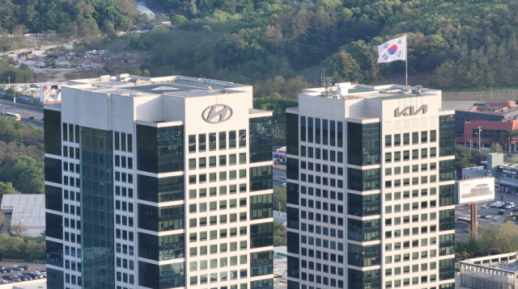 Hyundai flags battery subscription to spark EV boom from high fuel cost SEOUL, April 29 (AJP) - Contrary to the expectation that the Gulf-triggered energy crisis could renew the appetite for "plugging in," EV demand remains subdued. South Korea’s Hyundai Motor Group hopes to make the choice easier through a novel concept: lending battery chargers and subscriptions. Energy costs have climbed sharply amid the prolonged conflict between the United States and Iran. In Korea, gasoline prices rose from 1,819.2 won per liter in the fourth week of March to 2,003.8 won in the fourth week of April—an increase of nearly 200 won in just one month. Despite the pain at the pump, EV sales have not picked up as purchasing power remains constrained by a prolonged economic slowdown in Korea. Hyundai’s EV sales posted an overall decline in March, despite gains in some entry-level models. Ioniq 5 sales fell from 3,222 units in February to 2,382 in March and Ioniq 9 dropped from 1,751 to 1,239. Only the entry-level Casper Electric provided a rare boost, rising from 472 to 1,201 units. Overall, Hyundai's total EV sales declined from 5,445 to 4,822 units. Its sister carmaker, Kia, fared better. EV3 sales increased to 4,303 units, the EV5 surged from 2,524 to 6,884 units, and the PV5 jumped from 3,967 to 8,086 units, lifting Kia's total EV sales from 9,960 to 19,273 units. The broader market trend points to a shift in consumer behavior. Global auto demand fell 7.2 percent year-on-year in the first quarter, reflecting uncertainty tied to geopolitical risks. In this climate, hybrids are gaining traction as a more practical alternative. Hyundai Motor reported that global hybrid (HEV) sales reached 174,000 units in the first quarter—outselling its EVs (59,000 units) by nearly three times. HEV sales rose about 27 percent from a year earlier, with their share of total sales reaching a record 17.8 percent. In the United States, hybrids accounted for a record 24.8 percent of Hyundai’s sales. The gap between EV adoption and hybrid growth highlights ongoing concerns over EV ownership, particularly regarding battery life. “Since you usually keep a car for over 10 years, there is always concern about how long the battery will last,” said Oh Jun-su, a 34-year-old brand designer in Seoul who has driven a Kia EV4 for a year. He noted that EVs lack appeal on the used car market due to the battery factor. Replacement costs are a major hurdle, with industry estimates suggesting a new battery for a Kia EV6 can cost around 25 million won ($17,000). Hyundai is aiming to solve this through a battery subscription model. The conglomerate will begin a pilot program in the first half of the year, starting with Ioniq 5 taxis in the Seoul metropolitan area. The program focuses on corporate fleets whose warranties have expired. Under this model, users pay a monthly fee instead of purchasing the battery and can replace it when performance drops. This approach is supported by a regulatory sandbox that allows vehicles and batteries to be registered separately. In parallel, the company is expanding subscription-based charging. EV charging provider Chaebi has launched a package in partnership with Hyundai, offering discounted rates for monthly fees of 9,900 won or 19,900 won. Together, these efforts suggest automakers are experimenting with new usage models to finally lower the barriers to EV adoption. 2026-04-29 17:36:53
 -
 KOSPI extends rally, hitting new milestone SEOUL, April 28 (AJP) - South Korea's benchmark KOSPI closed Tuesday at a new high after testing a new milestone as the sole winner in Asia. The main bourse added 0.4 percent to finish at 6,641.02 points after climbing as high as 6,712.73, extending its winning streak to a seventh consecutive session. Institutional investors purchased 351.1 billion Korean won (US$270 million) worth of shares, while foreign and retail investors sold 184.5 billion won and 130.3 billion won, respectively, indicating that the rally was increasingly driven by domestic institutional flows as other investors took profits. The rally has been underpinned by sustained global inflows into artificial intelligence (AI)-linked semiconductor stocks, with the country's market capitalization surging more than 45 percent this year to around $4.04 trillion, overtaking the United Kingdom and highlighting its growing prominence in the global AI investment cycle. The gains reflect South Korea's outsized exposure to AI-linked sectors, amplifying its outperformance relative to regional peers. Among major stocks, SK hynix rose 0.6 percent to 1,300,000 won, while Hyundai Motor jumped 5.9 percent to 555,000 won, reflecting a broadening of the AI-driven rally beyond semiconductors as investor interest extended to automakers amid growing expectations for partnerships in autonomous driving and robotics. Samsung Electronics, however, fell 1.1 percent to 222,000 won, signaling profit-taking in index heavyweights following recent gains. In contrast, the junior KOSDAQ fell 0.9 percent to close at 1,215.6, reversing earlier strength as foreign and institutional investors offloaded a combined 786.8 billion won worth of shares. Retail investors bought a net 796.0 billion won, helping to limit losses. The divergence between the two major indexes highlights a shift toward large-cap, AI-linked stocks at the expense of higher-risk stocks. Biotech and high-growth stocks led declines, reflecting continued pressure on high-valuation segments, even as some battery-related shares showed resilience. The South Korean won edged down to 1,474.0 per dollar amid lingering global uncertainty. Elsewhere in Asia, Japan's Nikkei 225 fell 1.1 percent to 59,917.5 after the Bank of Japan held its policy rate at 0.75 percent while signaling the possibility of further tightening. China's Shanghai Composite slipped 0.2 percent and Hong Kong's Hang Seng Index dropped 0.9 percent, as elevated energy prices and geopolitical risks weighed on regional sentiment. Meanwhile, oil prices extended gains, with Brent crude hovering above $110 per barrel amid prolonged disruptions in the Strait of Hormuz. 2026-04-28 17:52:56
 -
 Netflix wins tax battle in Seoul to pay little despite massive revenue in Korea SEOUL, April 28 (AJP) - A South Korean court ruled in favor of Netflix, ordering tax authorities to refund most of the roughly 80 billion won ($58 million) it had imposed on the global streaming giant, in a decision that underscores the limits of taxing cross-border digital services. The Seoul Administrative Court sided with Netflix Services Korea in a lawsuit filed in November 2023 seeking to cancel 76.2 billion won of the total tax assessment following a probe into its income. At issue was whether payments made by the Korean unit to its Netherlands-based affiliate, Netflix International B.V., should be treated as royalty income — subject to domestic taxation — or business income, which is exempt under the South Korea–Netherlands tax treaty if the foreign entity lacks a permanent establishment in Korea. Tax authorities argued the payments were royalties tied to the use of intellectual property. Netflix maintained they were business income derived from services provided overseas. The court ruled that the payments were not compensation for copyrights but service fees related to streaming services, noting that key functions such as content storage and transmission were performed by the overseas entity. It found that the Korean unit mainly handled platform operations, marketing and user management, while operating under a structure in which it retained a fixed margin and remitted the bulk of revenue to its parent — a model consistent with a service arrangement rather than intellectual property licensing. The ruling comes as Netflix continues to expand its presence in Korea’s over-the-top (OTT) market. According to its disclosure last week, Netflix Services Korea posted revenue of 1.05 trillion won last year, up 17 percent from a year earlier, marking its highest level since launching in the country in 2016. Operating profit rose to 20.3 billion won. Netflix’s monthly active users reached 15.6 million in December, up 20 percent on year and nearly double that of second-ranked Coupang Play. Despite strong top-line growth, profitability remains limited. The company’s operating margin has hovered around 2 percent for several years, as more than 80 percent of its local revenue is paid to its headquarters under “membership purchase” costs. Last year, about 8.5 trillion won — roughly 81 percent of domestic revenue — was remitted overseas. As a result, Netflix paid 6.6 billion won in corporate tax in Korea, equivalent to 0.6 percent of revenue, below the 1.1 percent average for foreign firms, according to CEO Score. The tax authority has not yet indicated whether it will appeal the ruling. However, Netflix Korea said "Netflix complies with tax laws and regulations in all countries where it operates and will continue to invest in Korean content and its broader ecosystem while cooperating with local authorities, regardless of the court’s decision." 2026-04-28 16:39:12