


Latest by
-
 Samyang Foods Launches 'Samyang 1963' in Japan, Expanding Beyond Buldak Brand Samyang Foods is introducing its premium ramen, 'Samyang 1963,' to the Japanese market. Following its launch in the United States in August, the company is expanding its overseas sales regions and broadening its product portfolio beyond the Buldak brand. On October 2, Samyang Foods held a product presentation and tasting event for local media in Akasaka, Tokyo, the company announced on October 6. The event was attended by 22 representatives from 18 local media outlets. Hong Beom-jun, head of Samyang Japan, and Miyai Mizuki, marketing director, introduced the brand story and plans for the product's launch in Japan. Samyang 1963 is a premium ramen that modernizes the heritage of Samyang Ramen, which was first launched in South Korea in 1963. It features a return to the Uji frying method after 36 years, enhancing the rich flavor of the noodles. Samyang Foods launched Samyang 1963 in South Korea in November of last year. The product for the Japanese market is designed to appeal to local consumers, incorporating flavors from beef, chicken, garlic, and green onions. Local media attendees experienced the product's spiciness, noodle texture, and broth flavor, showing interest in the development background of the Uji frying method and how it differs from existing ramen, according to the company. Samyang Foods plans to officially launch Samyang 1963 in Japan this month, following its introduction to the U.S. market. After the launch, the company will also conduct marketing activities targeting local consumers. Currently, Samyang Foods exports its products to over 100 countries worldwide, with overseas sales reaching 645.8 billion won in the second quarter of this year, surpassing 600 billion won for the first time. As the share of overseas business in overall performance increases, establishing brands beyond Buldak in international markets is identified as a medium- to long-term goal. Hong stated, "Samyang 1963 embodies the ramen heritage that has continued for over 60 years since the beginning of Samyang Foods. We aim to convey a different taste and brand value of Samyang Foods to Japanese consumers and expand our engagement with local consumers through a variety of products."* This article has been translated by AI. 2026-10-06 15:52:20
 -
North Korea Fortifies Border, South Korea Calls for MDL Verification Talks The South Korean government is demanding accountability and an apology from North Korea for the placement of landmines south of the military demarcation line (MDL), while also stressing the need for dialogue to confirm the MDL standards. With North Korea's fortification of its border increasing the risk of accidental military clashes, officials believe it is no longer feasible to ignore the differences in MDL perceptions between South Korea, North Korea, and the United Nations Command.However, given North Korea's rejection of inter-Korean dialogue and its refusal to recognize the authority of the UN Command, the likelihood of immediate negotiations appears low. As a practical alternative, South Korean military and UN Command officials are considering aligning their standards before presenting them to North Korea, thereby clarifying response protocols and establishing grounds for accountability in the event of future incidents.On October 6, the government coordinated messages and response strategies among its unification, foreign affairs, and defense agencies regarding the MDL standards. Following a proposal for dialogue from Unification Minister Jeong Dong-young, both the Defense Ministry and the Foreign Ministry emphasized the necessity of discussions, indicating that the issue of MDL verification and measurement has emerged as a significant diplomatic and security concern for the entire government.A Unification Ministry official stated that in light of a recent landmine explosion incident in the western front DMZ, “we will closely cooperate with the Defense Ministry and other relevant agencies to review necessary measures based on the military's investigation results.” The official noted that the Defense Ministry had proposed military talks regarding the MDL boundary last November, and Minister Jeong has reiterated the need for dialogue and communication to confirm the boundary.Following Minister Jeong's suggestion on October 2 for North and South Korea to initiate talks to reconfirm and measure the MDL, Defense Minister Kang Shin-cheol stated on October 6 that “the MDL exists as multiple lines recognized by South Korea, North Korea, and the UN Command,” urging North Korea to engage either on-site or at the negotiation table to clarify these discrepancies.Foreign Minister Park Jin also addressed the National Assembly's Foreign Affairs and Unification Committee, agreeing on the necessity for South Korea, North Korea, and the UN Command to jointly manage the MDL coordinates and on-site markers. He emphasized, “It is crucial to establish a unified government position, and we are continuously working towards that goal.”As diplomatic and security agencies align their approach to hold North Korea accountable while preventing escalation of tensions, discussions among relevant agencies regarding follow-up measures to the landmine explosion and the MDL standards are expected to accelerate.The urgency for MDL verification has grown due to the long-standing accumulation of discrepancies in the standards applied on the ground, compounded by North Korea's fortification efforts, which have increased the risk of actual clashes. Since the signing of the armistice agreement in 1953, 1,292 signs have been installed along the MDL, but only about 200 are currently identifiable.The South Korean military utilizes the MDL established by the U.S. National Geospatial-Intelligence Agency (NGA) in 2004. The UN Command applies a line created by connecting over 23,000 coordinates generated approximately every 10 meters through its “MDL Project” in 2016. If North Korea applies a separate standard alongside the boundary established at the time of the armistice, there could effectively be a fourth standard in the field.This year, North Korea has deployed up to 7,000 personnel daily to develop barren land, barbed wire, minefields, and tactical roads. Incidents of North Korean military incursions across the MDL have increased from 17 times last year to over 50 this year, with nine recorded incursions in 2024.The issue of MDL identification is not a recent development. According to the annual military strategy publication “Strategic Digest 2015” jointly released by the U.S. Forces Korea, the ROK-U.S. Combined Forces Command, and the UN Command, many signs were severely damaged in 2015, leading to a “dangerous ambiguity” in accurately determining the MDL's location. The UN Command and U.S. military have recognized the seriousness of this issue for over a decade, yet discrepancies in the standards have persisted without negotiations with the North.Experts assess that the likelihood of North and South Korea jointly surveying the MDL or agreeing on new coordinates in the short term is low, as North Korea has already defined inter-Korean relations as a “hostile two-state” situation and has rejected all government dialogue proposals.While experts suggest that the best approach would be for South Korea, North Korea, and the UN Command to jointly verify the MDL standards, the lack of realism due to North Korea's refusal to engage means that South Korea and the UN Command should first establish a joint baseline to present to North Korea. Earlier this year, the South Korean military formed a separate task force to address the discrepancies in the MDL standards applied by both sides.Park Won-gon, a professor of North Korean studies at Ewha Womans University, stated, “North Korea is independently pursuing fortification of its border while refusing to recognize the line established under the armistice agreement and the authority of the UN Command. Therefore, it is currently the most realistic response to have the South Korean military and the UN Command confirm the boundary and present it to North Korea, as this would provide grounds for accountability in the event of future incidents.”* This article has been translated by AI. 2026-10-06 15:52:20
-
Youth Preparing for Independence to Have Civil Service Exam Fees Waived Starting Next Year Starting next year, young people preparing for independence and those whose protection period has been extended will have their civil service exam fees waived. The Ministry of Personnel Management announced on October 6 that the Cabinet has approved a revision to the civil service appointment examination regulations, which will exempt the exam fees for young individuals who have been under protection in child welfare facilities or foster homes and those who have completed their protection period within the last five years. The civil service exam fees are as follows: 10,000 won for level 5 and above, 7,000 won for levels 6 and 7, and 5,000 won for levels 8 and 9. Previously, the fee waiver applied only to basic livelihood recipients, low-income households, single-parent families, disability pension recipients, and caregivers of two or more minor children. The scope of eligibility has now been expanded. Under the current system, additional acceptance is only allowed if a candidate withdraws from the appointment, has their acceptance canceled, encounters disqualifying circumstances, or resigns on the day of appointment. This has made it difficult to replenish personnel when vacancies arise. The new regulations will also allow for additional candidates to be selected based on departmental staffing needs in cases of military service, pregnancy, or childbirth. Choi Dong-seok, head of the Ministry of Personnel Management, stated, "This improvement aims to alleviate the financial burden on candidates and enhance flexibility in the hiring process. We will continue to work to lower the barriers for young people entering public service and ensure effective hiring practices." * This article has been translated by AI. 2026-10-06 15:48:00
-
Reform Party Appoints Chairs for 12 Local Chapters, Restructures Central Office The Reform Party appointed chairs for 12 of its 16 local chapters on October 6. Additionally, the central office was restructured from a system of one department and six divisions to two departments and six teams. The party announced its plans to enhance the agility of a minor party through the initial organizational restructuring plan presented by the Emergency Committee. The previous six divisions, including the Planning and Coordination Division, General Affairs Division, Organization Division, Public Relations Division, Communications Division, and Policy Division, have been reorganized into two divisions: the Party Affairs Coordination Division and the Strategic Planning Division. The secretariat has been abolished. The Party Affairs Coordination Division now includes the General Affairs Team and the Planning and Organization Team, while the Strategic Planning Division comprises the Communications Team, Policy AI Team, Public Relations Team, and New Media Team. This restructuring follows the submission of collective resignations by the party's office staff union on September 18, which expressed its commitment to the party's reconstruction and reform. The leadership did not accept the resignations and proceeded with the organizational changes. The party also restructured its regional organizations, appointing chairs for 12 of the 16 local chapters. Busan is currently a provisional chapter, and the chapters in Gangwon, Jeonbuk, and Jeju have yet to be established. Among these, five chairs, including Lee Yong-woo in Seoul, Jeong Hee-yun in Gyeonggi, Lee Eun-chang in Chungnam, Ha Heon-hwi in Sejong, and Park Jin-woo in Gwangju and Jeonnam, are set to lead regional organizations in preparation for the general elections. The spokesperson team has appointed Lee Dong-hoon as the chief spokesperson, along with Ko Geum-ran and Cha Ho as spokespersons. Additional deputy spokespersons will be appointed later. Lee Gi-in, the chair of the Emergency Committee, stated, "We will prepare for the general elections and the reconstruction of the party based on the new central office and the 12 local chapter organizations."* This article has been translated by AI. 2026-10-06 15:48:00
-
Oh Se-hoon Criticizes President Lee Jae-myung's Real Estate Claims Oh Se-hoon, the mayor of Seoul, sharply criticized President Lee Jae-myung's comments on real estate, stating, "I feel it's pointless to persuade the president any longer." Oh refuted the government's claims of increased housing permits and construction in Seoul and the surrounding area as a success of its policies, urging the government to acknowledge its failures and change direction in light of the public's housing struggles. On October 6, Oh posted on Facebook titled "The urgency of the people's lives is too great to watch the president's mental victory." He referenced several real estate-related posts made by the president on social media the previous day, criticizing him for appearing to lack the willingness to accept reality. He pointed out, "When housing prices rise, it's blamed on speculative forces; when the side effects of policies are highlighted, it's seen as resistance from vested interests; and when the public cries out in pain, the president dismisses it as backlash that must be endured during the reform process. This narrow-minded perception offers little hope for the future." This statement goes beyond a rebuttal of specific policies, as it questions the president's attitude toward accepting the side effects and criticisms of his policies. The expression "persuasion is pointless" reflects Oh's disappointment that there is little hope for changing direction through policy debate. Oh focused on refuting the president's assertion that the increase in housing permits and construction in Seoul and the surrounding area compared to the previous year is due to the government's "speed strategy." He asked, "What kind of speed strategy has the government implemented? It takes an average of over ten years from the establishment of a cooperative to the start of construction. Does the president have a magic lamp that can produce permits and construction in just one year?" This criticism suggests that attributing the long-term results of Seoul's redevelopment projects to the current government's "speed strategy" distorts the facts. The crux of the criticism lies in the time lag between housing supply results and policy effects. Oh argued that evaluating the increase in permits and construction as a success of any government requires examining when the projects began and the procedures they underwent. He contended that attributing this year's redevelopment project results solely to the current government's short-term policies ignores the restoration process that the city has been undertaking. He likened the situation to the previous administration under Park Won-soon, which uprooted redevelopment projects and laid down herbicides, stating that the results of the city's continuous restoration efforts are now gradually becoming evident. According to Oh, 389 redevelopment projects, totaling 430,000 units, were canceled during Park's tenure. He explained that the city has worked diligently to designate 214 new projects and improve their viability, thereby accelerating the conditions for permits and construction. He noted that approximately 15,000 units of redevelopment projects broke ground last year, with a goal of starting 30,000 units this year. By 2028, the plan is to begin construction on a total of 85,000 units across 85 districts. Oh emphasized, "These results were not achieved overnight. We are steadily rebuilding the collapsed supply base and reaping the fruits of our labor." He added, "It is disheartening to see the president ignore this normalization process and offer a self-serving interpretation of the situation." Oh also criticized the president's perception of real estate policy as being trapped in a political dichotomy of conservative versus progressive. He stated, "This president believes that conservative governments encourage speculation while progressive governments suppress it," labeling this as a baseless binary thinking. He questioned, "What can we expect from a president who cannot step beyond viewing real estate through an ideological lens rather than market principles?" He continued, "According to the president, if conservative governments encourage speculation, housing prices should rise, and if progressive governments suppress it, prices should stabilize. But the reality is the opposite, isn't it?" This highlights the need to distinguish between the justification for policies and their actual outcomes. Just because a policy claims to suppress speculation does not prove its effectiveness; it must be evaluated based on results in housing prices, supply, and the rental market. Oh stated, "Ignoring even the existing facts and merely achieving a mental victory will not change the outcomes of policies. It will only prolong the housing hell that the public is experiencing." He also expressed concern over the president's request for the public to be patient. Quoting the president's statement to wait a little longer with a sense of ease, Oh remarked, "This is not something to say in front of citizens who are struggling to find a place to move amid a rental crisis." At the end of his post, Oh urged the president to honestly acknowledge the failures of the past year in real estate policy and courageously declare a correction of the misguided direction to start anew. He emphasized, "Acknowledging failure is not defeat. Changing one's thinking and policies in the face of the public's suffering is the true courage that a national leader can demonstrate."* This article has been translated by AI. 2026-10-06 15:44:00
-
Lotte Burger Chain Hosts First Running Festival with 2,000 Participants Lotte GRS's Lotte Burger chain attracted 2,000 participants to its inaugural running festival, moving beyond traditional store and product marketing to allow consumers to experience the brand directly through running.Lotte announced on October 6 that the '2026 Ria is Full' event took place on October 4 at the Seoul Children's Grand Park.'Ria is Full' is a non-competitive event focused on enjoying the act of running rather than competing for records. A 5km course shaped like a burger was set up at the park, with participants starting in waves from 7:30 a.m. based on their pre-assessed running preferences.Approximately 2,000 people took part in the event. Tickets were sold exclusively through Lotte's own app, 'Lotte Eats,' and sold out quickly. Lotte's characters 'Teriang' and 'French Fry Man,' along with YouTuber 'Chicken Angel,' also participated as running mates.After completing the run, participants enjoyed brand experience events. A style awards ceremony recognized those with unique running outfits, awarding winners with a 'Lotte Burger One-Year Pass,' along with recreational activities and a lucky draw.Lotte also aimed to reduce single-use items during the event. Reusable cups were used at water stations instead of disposable ones, and a separate return booth was set up. Staff wore upcycled uniforms made from recycled materials, which Lotte GRS unveiled in June.Recently, Lotte affiliates have been expanding experiential marketing through running events. Last month, Lotte Wellfood hosted the 'Excitement Run' with 3,000 participants, while Lotte Department Store and Lotte Mart have also introduced running events to enhance customer engagement.A Lotte GRS representative stated, 'We planned this event to add enjoyable and generous benefits to the healthy culture of running. We will continue to present communication campaigns that share sustainable values with our customers.'* This article has been translated by AI. 2026-10-06 15:40:00
-
Investors Frustrated by 30 Million Won Rule Amid Semiconductor Stock Volatility As semiconductor stocks experience significant volatility, investors trapped in single stock leverage products are increasingly frustrated with the government's 30 million won rule. Critics argue that the government's one-size-fits-all regulation fails to protect existing investors from risk and does not safeguard new investors either. Small investors, lacking cash reserves, are deprived of opportunities to adjust their positions, while those with more cash can enter the market, reinforcing an unequal market structure.According to the securities industry on October 6, small investors are voicing concerns about reverse discrimination stemming from the investment regulations on single stock leverage products introduced by the government in July. Every morning at 9 a.m., around 3,000 participants in a KakaoTalk open chat room for Samsung Electronics and SK Hynix leverage investors share figures like '-80%', '-85%', and '-97%', indicating their investment losses. An SK Hynix leverage investor, identified as A, stated, "The government listed leverage products at semiconductor peaks, and now, with the cash requirement of 30 million won, we can't even make a move without it. With our investment down 75%, being unable to buy more forces small investors to realize their losses."The government's supplementary measures for single stock leverage products (ETFs and ETNs) announced in July included raising the basic deposit requirement from 10 million won to 30 million won and excluding the value of substitute securities like stocks, ETFs (excluding leverage ETFs), and bonds from the calculation of the basic deposit. Starting in November, the trading unit will also increase from one share to 20 shares (tentative). Currently, the single stock leverage product with the largest decline, 'KODEX SK Hynix Single Stock Leverage,' has dropped 74% from its peak, while 'TIGER Samsung Electronics Single Stock Leverage' has fallen by 59.9% based on the closing price on October 2 (11,555 won).Leverage products track daily returns at double the rate, meaning that as stock prices fluctuate, investors face a 'negative compounding effect' that erodes asset value. Investors trapped at high points must actively lower their average purchase price to escape, given the product's structure that becomes less favorable over time. One anonymous investor remarked, "Having started investing in May and already being trapped at a high point, the lack of recognition for substitute securities and the requirement to hold over 30 million won in cash to trade further deprives small investors of the chance to lower their purchase price and exit the product. It’s as if only cash-rich investors can benefit from leverage products, similar to real estate." They added, "Existing investors are already exposed to the risks of these products, yet barriers for new investors are being raised, creating a vicious cycle."Another investor noted, "Existing investors, already hit hard by the product's issues, lack the capacity to buy more, while someone with 30 million won in cash can enter the market without prior investment. This is a paradoxical situation. Existing investors should be allowed to make additional purchases with a portion of their holdings." They criticized the government's blanket monetary regulation as an overly administrative approach that fails to acknowledge the product's introduction failures.Moreover, there are concerns that investors, in their attempts to recover from leverage losses, are turning to unregulated overseas leverage investments or falling prey to illegal investment schemes. According to the Korea Securities Depository, following the implementation of leverage regulations (from July 31 to August 19), domestic investors' trading volume for SOXL (a U.S. semiconductor triple leverage ETF) reached $6.54357 billion (approximately 9.1191 trillion won), accounting for 34.4% of the top 50 overseas stocks. This marks a 3.8 percentage point increase from the pre-regulation figure of 30.6%. In contrast, the trading volume for 16 domestic single stock leverage products plummeted by 90.8% to 1.069 trillion won during the same period. This indicates that the demand for leverage has not disappeared but has shifted to overseas markets.The government acknowledges these concerns but has stated that there are no plans for further review of the security measures for leverage products. A Financial Services Commission official remarked, "The security measures for leverage products are aimed at reducing market volatility and stabilizing the market. Additional security measures for existing investors are not under consideration."* This article has been translated by AI. 2026-10-06 15:40:00
-
KT Wiz Secures KBO Regular Season Title, Individual Awards Still Up for Grabs As the KBO regular season approaches its conclusion, team standings and individual title races are creating a mix of emotions. KT Wiz has clinched the regular season championship, securing a direct path to the Korean Series, while individual records remain competitive, with rankings potentially shifting until the final game.On October 5, KT defeated the Lotte Giants 9-0, while the second-place Samsung Lions lost to the Doosan Bears, ensuring KT's top position regardless of the remaining games. This marks KT's second regular season title in franchise history and their first since 2021. With the championship secured, KT can now focus on managing player stamina in preparation for the Korean Series.In contrast, the race for individual titles remains intense. KIA Tigers' Kim Do-young leads the home run category with 42, closely followed by KT's Sam Hilliard with 41 and LG Twins' Austin Dean with 40. In the hits category, KT's Choi Won-jun and Lotte's Victor Reyes are tied at 199 hits, drawing attention to the possibility of reaching 200.On the pitching side, Doosan's Kwak Bin leads in earned run average, while he and Lotte's Elvin Rodriguez are in a tight competition for strikeouts, with Kwak recording 186. In wins, Choi Min-seok, LG's Lim Chan-kyu, and KT's Ko Young-pyo are all tied with 14 victories.Unlike the team standings, the winners of individual records have yet to be determined. With just a few games left in the regular season, each at-bat and inning could significantly impact the title races, keeping fans engaged in the final stretch.* This article has been translated by AI. 2026-10-06 15:40:00
-
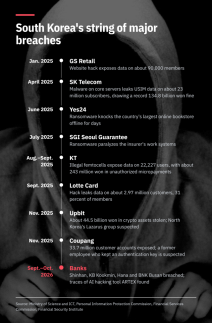 AJP Factbox: South Korea's major hacking incidents since 2025 South Korea has suffered a string of major data breaches since early 2025, from a malware attack that exposed USIM data on about 23 million SK Telecom subscribers to the exposure of 33.7 million Coupang customer accounts. The latest wave hit Shinhan Bank, KB Kookmin Bank, Hana Bank and BNK Busan Bank between late September and early October 2026, and the Financial Security Institute found traces of ARTEX, an open-source AI hacking tool, on servers used in the attack. 2026-10-06 15:36:27
 -
Cosmax Presents 32 Research Findings at IFSCC, Leading in Oral Presentations Cosmetic manufacturer Cosmax announced the presentation of 32 research findings at the International Federation of Societies of Cosmetic Chemists (IFSCC) conference. The number of oral presentations reached 10, doubling from last year and marking the highest number globally. The 'Microbiome Live Bacteria Encapsulation Platform' was selected as one of this year's 'Top 10' applied research studies.Cosmax reported on October 6 that it presented a total of 32 research findings, including 10 oral presentations and 22 poster presentations, at the 36th IFSCC conference held at the Perth Convention and Exhibition Centre in Australia from September 28 to October 1.The IFSCC conference is an academic event where researchers and experts from around the world share their findings and technologies in the cosmetics field. Since its first participation in 2014, Cosmax has cumulatively presented 105 research findings up to this year. The number of oral presentations increased from five last year (including joint research) to 10 this year, the highest number globally.Oral presentations are based on research selected through a rigorous review process by the conference. The IFSCC awards the 'Fundamental Research Award' for studies focused on academic principles and the 'Applied Research Award' for those addressing technological applications.This year, Cosmax's oral presentations covered key areas including basic (skincare and foundational technology) research, makeup, sun care, hair care, and fragrances.In the sun protection category, three studies were presented, including an analysis of the efficacy of inorganic sunscreens through rheology and holography, a D-phase emulsification solution to enhance SPF and user experience for natural emulsifier-based sunscreens, and a cellulose-based multifunctional film for sun protection, color adjustment, and wrinkle improvement.Research utilizing biotechnology was also showcased. The 'Microbiome Live Bacteria Encapsulation Platform' was recognized as one of the 'Top 10' applied research studies this year. Additionally, studies on heat-stable lamellar liquid crystal systems using bio-derived fermented lipids and local clinical research utilizing Antarctic microbiomes were presented.In the hair care sector, Cosmax introduced an AI-based model for predicting hair loss and findings from a global scalp lipid analysis. In makeup, a study on temperature-responsive properties to enhance foundation durability in high-temperature environments was presented, while in fragrances, research on storage-mediated release for scent longevity was discussed.This year, two researchers from the Cosmax China Research and Innovation (R&I) unit also participated in oral presentations. The Cosmax Indonesia R&I center presented six posters covering research in skincare, makeup, and materials.A Cosmax representative stated, "Following last year's achievement as the first in the cosmetics industry to win a grand prize, we have now achieved the highest number of oral presentations globally. We will continue to introduce innovative products that lead the global market based on our technological leadership."Meanwhile, Cosmax operates a total of 10 R&I centers in South Korea, China, the United States, Italy, Indonesia, and Thailand, investing 5% of its annual revenue in research and development. In the second quarter of this year, the company reported consolidated sales of 794.9 billion won and an operating profit of 73.7 billion won, representing increases of 27% and 21%, respectively, compared to the same period last year.* This article has been translated by AI. 2026-10-06 15:36:00