
Journalist

Ryu Yuna
julia37@ajupress.com
-
 Day 7 Middle East War: How Operation Epic Fury was born in the AI age As the war triggered by U.S.–Israeli strikes on Iran enters its first week, AJP examines how the conflict began and evolved, the emerging power vacuum in Tehran and its implications for Iran and the Gulf states, and the broader impact on global energy routes, financial markets and the international order. SEOUL, March 06 (AJP) — Residents of Tehran did not immediately grasp what had happened. Shortly before 10 a.m. local time on Feb. 28, explosions ripped across the Iranian capital as coordinated strikes by U.S. and Israeli forces targeted the country’s military leadership and strategic infrastructure. Air-raid sirens sounded only after the first wave had already struck. Within less than an hour, the opening phase of what Washington called Operation Epic Fury had achieved its primary objective: crippling Iran’s command structure and striking key missile and nuclear facilities. The operation had been authorized by U.S. President Donald Trump the previous afternoon — Feb. 27 at 3:38 p.m. EST — following intelligence assessments that Washington said pointed to accelerating Iranian nuclear development and renewed proxy attacks on Israel. Tehran denies those accusations, and Washington has not publicly presented detailed evidence. The first strikes began at 1:35 a.m. EST (9:05 a.m. Tehran time) as U.S. Central Command bombers and Israeli aircraft hit targets across Tehran and other strategic sites. Reports soon emerged that Supreme Leader Ali Khamenei had been killed in a bunker strike roughly ten minutes later. The campaign widened almost immediately. Iran responded at 4:05 a.m. EST with Operation True Promise IV, launching more than 170 missiles and hundreds of drones toward Israel and U.S. military installations across the Gulf. Interceptions prevented large-scale damage in many areas, but the attack reverberated across the region. Missiles and drones struck or were intercepted near Bahrain’s Fifth Fleet headquarters, Qatar’s Al Udeid air base and Kuwait’s Al Salem base. Dubai International Airport temporarily suspended operations after debris fell near flight corridors. The first day alone signaled that the conflict would not remain contained. A week of rapid escalation Over the following days, the war expanded across multiple fronts. By March 1, U.S. and Israeli forces had intensified strikes on Iranian command centers, missile bases and nuclear facilities. Iranian retaliation extended to ports and energy infrastructure across the Gulf, including shipping hubs in the United Arab Emirates and Oman. Hezbollah joined the confrontation with rocket barrages from Lebanon, while U.S. forces targeted militia infrastructure across the region. On March 2, American B-2 bombers reportedly struck the headquarters of Iran’s Islamic Revolutionary Guard Corps, while Iranian missiles targeted U.S. diplomatic facilities in Kuwait and bases in Qatar. The escalation continued through the week. Strikes damaged or destroyed several Iranian nuclear facilities and naval assets, including warships in the Persian Gulf. By the end of the first week, more than 1,000 people were reported killed in Iran, while missile exchanges and proxy attacks continued across the region. Shipping lanes near the Strait of Hormuz, through which roughly 20 percent of the world’s oil trade passes, were also threatened by mines and naval activity. With no ceasefire in sight, the conflict had already expanded beyond a limited strike into a regional war. Echoes of Iraq — but a different war The opening of the conflict immediately drew comparisons to the 2003 U.S. invasion of Iraq, which was also justified partly on fears of weapons of mass destruction. Following the Sept. 11 attacks, the administration of President George W. Bush adopted a doctrine of preemptive strikes against states suspected of developing WMD or supporting terrorism. The Iraq war later became controversial after such weapons were never found. The current campaign against Iran has been framed differently — as an effort to contain Tehran’s nuclear program and ballistic missile capabilities before they mature into a direct strategic threat. Yet analysts say the motivations behind Operation Epic Fury are likely more complex. Many see a convergence of political opportunity, regional rivalry and strategic calculation. “Having completed or even ongoing military operations would benefit Trump politically,” said Annette Freyberg-Inan, a professor at the University of Amsterdam. “Trump likes to present himself as a global strongman and peacemaker who fixes problems,” she said. For Israel, she added, the confrontation offered “an opportunity to punish and perhaps even remove the Iranian regime while improving Israeli security with U.S. backing.” Domestic political pressures may also have played a role. “Netanyahu’s political survival relies heavily on war, and Iran has always been the primary target,” said Robert Huish, a professor at Dalhousie University. A moment of perceived weakness Iran’s internal turmoil may also have shaped the timing of the operation. In January, large anti-government protests erupted across several Iranian cities before being suppressed by security forces. According to Dov Levin, a professor at the University of Hong Kong, those events may have signaled vulnerability to Washington. “The protests created what could be seen as a ‘blood in the water’ moment,” Levin said. “They may have convinced U.S. decision-makers that Iran was in a particularly weak position and could potentially be coerced into concessions or even defeated quickly in a conflict.” Others believe strategic concerns over nuclear proliferation were decisive. Lee Haneol , a professor of political science and diplomacy at Pusan National University, said Washington and Jerusalem may have concluded that delaying action risked allowing Iran to cross a nuclear threshold. “In that sense, the operation may have been less about democratizing Iran and more about preventing the emergence of another nuclear-armed state similar to North Korea,” Lee said. Warfare in the AI age Beyond geopolitics, the conflict has also revealed how rapidly modern warfare is being reshaped by advanced technologies. The opening strikes showcased AI-assisted intelligence analysis, precision-guided weapons and integrated missile-defense networks capable of identifying and destroying targets within minutes. But experts caution that artificial intelligence remains a complex tool in military decision-making. Hans Liwång, a researcher at the Swedish Defence University, said many widely known AI systems — including large language models — are poorly suited to battlefield analysis. “A particular challenge with AI-based systems is that they are opaque and their reasoning can be difficult to explain,” he said. “Such systems on their own may create bad advice in very convincing language.” Military-grade AI therefore relies on specialized data and tightly controlled operational systems developed within defense agencies or contractors. Still, technology is rapidly changing the battlefield. Yang Woo-jin, a senior researcher at the Security Management Institute, said the first week of the war demonstrated how advanced weapons systems and real-time intelligence networks are increasingly integrated into combat operations. “Israel operates layered missile-defense systems such as Arrow-2, Arrow-3 and Iron Dome, with interception rates estimated at around 90 percent,” Yang said. “The United States maintains a technological advantage in precision-strike platforms and battlefield intelligence.” But the future of warfare may depend less on raw firepower than on speed. “In technology-driven conflicts, the key factor is often who can detect threats faster, make decisions more quickly and allocate resources more efficiently,” Yang said. Iran, he noted, may attempt to counter that advantage through asymmetric strategies, including drone swarms, proxy militias and underground missile systems. As the conflict enters its second week, the implications are expanding far beyond Iran and Israel. Energy markets, shipping routes and financial markets are already reacting to disruptions near the Strait of Hormuz, the world’s most critical oil chokepoint. But the deeper significance may lie elsewhere. The war is unfolding at a moment when AI, drones and precision weapons are transforming how conflicts begin, escalate and spread. Operation Epic Fury may therefore be remembered not only for how it began — but for what it revealed about the next generation of warfare. 2026-03-06 14:53:56
 -
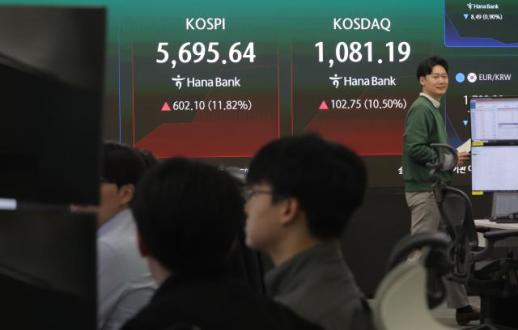 South Korean stocks roar back, up 12% on opening bell SEOUL, March 5 (AJP) – An epic rebound followed an epic downfall for South Korean shares as they opened Thursday 12 percent, instantly erasing the largest-ever collapse of the same scale a day earlier. As of 9:23 a.m., the benchmark KOSPI soared 11.5 percent to 5,684.53, while the tech-heavy KOSDAQ climbed 11.45 percent to 1,090.52. After two consecutive sessions that triggered sell-side sidecars, the opposite sidecar — on the buy side — was activated shortly after the opening bell. Retail and foreign investors piled in in full force, bargain-hunting after the main bourse shed nearly 20 percent over the previous two sessions. Individuals were net buyers of 277.9 billion won ($206 million), while foreigners purchased a net 600.5 billion won. Their buying centered on heavyweight stocks that had become sharply cheaper during the two-day rout. Samsung Electronics surged 13.59 percent to 195,600 won, while SK hynix jumped 15.19 percent to 978,000 won, extending strong gains among semiconductor bellwethers. Automakers also advanced sharply. Hyundai Motor climbed 14.57 percent to 574,000 won, while affiliate Hyundai Mobis rose 9.77 percent to 438,000 won and Kia gained 9.76 percent to 172,000 won. Battery and defense stocks joined the rebound. LG Energy Solution added 8.06 percent to 375,500 won, while Hanwha Aerospace edged up 2.95 percent to 1,362,000 won. Financial shares also rallied, with KB Financial Group rising 10.09 percent to 151,600 won, Shinhan Financial Group gaining 7.66 percent to 95,600 won, and Samsung Life Insurance climbing 8.61 percent to 214,500 won. Market breadth underscored the strength of the rebound. On the main KOSPI board, gainers overwhelmed losers 899 to 20. On the KOSDAQ, 1,660 stocks advanced versus just 59 decliners. The Korean won also strengthened on renewed foreign inflows, with the dollar slipping 2.80 won from overnight to trade at 1,460.70 won. 2026-03-05 09:39:48
 -
 Cheongung-II's maker survives worst-ever rout in Seoul as it debuts on Iranian borders SEOUL, March 04 (AJP) - The bombshell from the 2026 Middle East conflict has flown to Seoul and crashed the party in a big way — sending the benchmark KOSPI plunging a record 12 percent and the KOSDAQ 14 percent. One stock, however, defied the sweeping rout: LIG Nex1, the maker of the Cheongung-II. The sudden spotlight came after the missile defense system reportedly saw its first real combat use intercepting Iranian missiles over the Gulf, a development that instantly thrust South Korea’s defense technology into the center of a widening regional war. The geopolitical shock triggered both panic and dark humor in Seoul’s retail trading circles. A viral meme circulating among Korean day traders shows Kim Seung-youn and his son Kim Dong-kwan beckoning investors to board a flight amid the spiraling Middle East war, captioned: “No time to explain — just get in.” Behind the jokes lies a stark reality: defense companies are increasingly under the spotlight as geopolitical tensions intensify globally, from the Russia–Ukraine War to rising instability in the Middle East following joint strikes by the United States and Israel on Iran. Korean missile shield tested in real combat The Middle East escalation provided an unexpected proving ground. Iran’s retaliatory missile and drone attacks on Gulf states hosting U.S. military assets reportedly triggered interceptions by the Cheongung-II system deployed in the United Arab Emirates, marking what analysts view as the first known combat use of a Korean-exported missile defense system. The UAE integrates Cheongung-II into a multilayered defense network alongside the Patriot missile system and Israel’s Arrow missile defense system. According to UAE defense data, 161 out of 174 Iranian ballistic missiles were intercepted, along with all eight cruise missiles and 645 out of 689 drones — an interception rate exceeding 90 percent across categories. Cheongung-II reportedly delivered comparable performance within the network. Often described as a Korean counterpart to Patriot, the system uses a hit-to-kill interceptor capable of destroying targets by direct impact. Its missiles travel at roughly five times the speed of sound and can intercept aircraft and ballistic missiles at altitudes of around 15–20 kilometers. Analysts say battlefield validation could significantly strengthen confidence in the system globally. “While defense stocks may fluctuate in the short term due to geopolitical developments, the industry’s fundamentals point to a structurally upward trajectory,” said Choi Jung-hwan, a defense analyst at Daishin Securities. “The fact that Cheongung-II has now gained operational experience in an actual conflict could strengthen trust in the system.” The Gulf conflict highlights a broader transformation in modern warfare, where missile barrages and drone swarms increasingly dominate the battlefield. “Missile defense is ultimately a probability game,” Choi said. “Ballistic missiles follow predictable trajectories, but drones are far harder to track and intercept.” He added that the economics of drone warfare also challenge traditional air defense strategies. “Drones are relatively cheap, while the systems designed to intercept them are expensive. In prolonged conflicts, that imbalance can weigh heavily on defenders.” The dynamic is expected to accelerate demand for counter-drone systems and next-generation air defenses — sectors where South Korea is rapidly expanding capabilities. Investors pile into defense names The battlefield headlines quickly translated into investor enthusiasm. Shares of LIG Nex1 surged nearly 30 percent Tuesday after reports of Cheongung-II’s operational use. Other defense contractors also rallied sharply. Hanwha Aerospace jumped about 20 percent to close at 1,432,000 won, while Hanwha Systems climbed more than 29 percent to 146,700 won. Both stocks retreated the following day as profit-taking set in, with Hanwha Aerospace slipping 7.6 percent and Hanwha Systems dropping about 21 percent. LIG Nex1 which soared around 20 percent during the broad retreat managed to end Wednesday up 1.8 percent at 673,000 won. Ryu Youn-seung, professor of defense industrial security at Myongji University, said the Middle East conflict could ultimately boost global demand for missile defense systems. “With Iran and Israel exchanging missile attacks, many countries may seek to strengthen their air defense capabilities,” he said. “The Cheongung-II’s performance could serve as a valuable opportunity for South Korea’s defense industry to gain greater recognition in global arms markets.” Korea’s defense exports have expanded rapidly since the Ukraine war reshaped global arms demand. According to the Stockholm International Peace Research Institute, South Korea ranked 10th among global arms exporters between 2019 and 2023, accounting for roughly 2 percent of global exports. The country’s competitive pricing and rapid delivery timelines have helped drive major deals, including Poland’s $12 billion purchase of Korean tanks, artillery and fighter jets in 2022. Analysts say the industry’s next phase will broaden beyond land systems such as tanks and artillery to include platforms like the KF 21 Boramae and advanced missile defense systems. “Defense is a long-cycle industry operating on timelines of a decade or more,” Choi said. “Korea’s strong manufacturing base — from steel to chemicals — gives it a structural advantage that is difficult for competitors to replicate.” If Cheongung-II’s combat debut proves successful, analysts say it could accelerate South Korea’s rise as a major supplier in the global defense market — not only as a cost-efficient exporter, but increasingly as a credible security partner. 2026-03-04 17:14:03
 -
 Asian markets tank; Seoul plunges more than 8% as won hovers near crisis-era levels SEOUL, March 04 (AJP) - Asian markets tumbled Wednesday as escalating tensions in the Middle East rattled investors, with Seoul stocks plunging more than 8 percent and the Korean won sliding to near crisis-era levels. A pledge by the United States to provide security escorts and insurance guarantees for tankers navigating the Strait of Hormuz did little to reassure investors. Markets across the region remain highly sensitive to the waterway, through which a large share of Middle Eastern oil exports must pass. South Korea’s benchmark KOSPI and the tech-heavy KOSDAQ both plunged more than 8 percent. In just two sessions since the outbreak of war, the KOSPI has lost more than 15 percent, triggering the sidecar trading curb for two consecutive days. Overnight, U.S. equities also closed lower as geopolitical risks in the Middle East continued to weigh on sentiment. The Dow Jones Industrial Average fell 0.83 percent, while the S&P 500 and Nasdaq Composite declined 0.94 percent and 1.02 percent, respectively. Investor anxiety intensified after Iran moved to block the Strait of Hormuz, sending oil prices sharply higher for a second straight day and raising fresh concerns over global inflation. On the Seoul bourse, individual and institutional investors were net buyers of 539.6 billion won ($364.6 million) and 403.3 billion won, respectively, while foreigners offloaded a net 996.1 billion won worth of shares. Major sectors — including chips, autos, batteries and biopharmaceuticals — fell sharply. Refinery stocks, which had surged a day earlier on expectations of higher refining margins, also retreated. SK Innovation dropped 9.55 percent to 118,400 won, while GS Holdings fell 4.40 percent to 67,400 won. Defense stocks showed mixed performance amid lingering geopolitical demand. Hanwha Aerospace slid 9.15 percent to 1,301,000 won and Hyundai Rotem fell more than 10 percent to 222,000 won. LIG Nex1 bucked the trend, rising 10.89 percent to 733,000 won on expectations of stronger demand for its Cheongung-II air defense system, while Hanwha Systems gained 3.41 percent to 151,700 won. Among heavyweight stocks, Samsung Electronics fell 2.56 percent to 190,100 won and SK Hynix declined 2.88 percent to 912,000 won. Hyundai Motor dropped 4.12 percent to 570,500 won, while affiliate Kia slid 4.99 percent to 173,200 won. LG Energy Solution declined 3.94 percent to 377,500 won and Samsung Biologics retreated 3.93 percent to 1,615,000 won. Financial stocks also moved lower. KB Financial Group fell 4.63 percent to 146,400 won, Shinhan Financial Group slipped 4.65 percent and Mirae Asset Securities declined 5.56 percent to 62,900 won. Entertainment stocks traded mixed, with HYBE down 4.73 percent and JYP Entertainment falling 5.22 percent, while YG Entertainment edged up 1.18 percent. The Korean won opened 12.9 won weaker at 1,479.0 per dollar and briefly climbed to 1,482.20 before easing to 1,471.0 after the Bank of Korea said it would closely monitor excessive volatility and respond if necessary in coordination with the government. The currency later weakened again to around 1,481.90 as of 10:43 a.m. 2026-03-04 11:32:17
 -
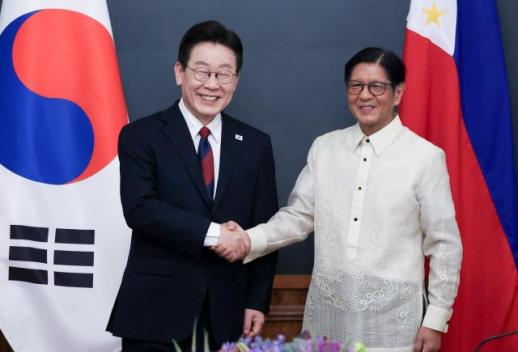 South Korea, Philippines agree to expand cooperation in emerging sectors SEOUL, March 4 (AJP) - South Korea has agreed to expand bilateral cooperation with the Philippines in emerging sectors for future growth, such as artificial intelligence (AI), shipbuilding, and nuclear energy, as part of the two countries' strategic partnership. During a summit between South Korean President Lee Jae Myung and Philippine President Ferdinand Romualdez Marcos Jr. in Manila on Tuesday, the two countries signed about a dozen memorandums of understanding (MOUs) to strengthen cooperation. In a joint statement after the summit, Lee stressed that the partnership would build on existing cooperation in trade, defense, and infrastructure, while expanding into new growth sectors. "We agreed to further strengthen cooperation based on the strategic partnership between the two countries," Lee said. Defense was a key area of cooperation, with South Korea's Defense Acquisition Program Administration signing a revised agreement with the Philippines on defense-related procurement. The agreement covers a broader range of areas, expanding the number of South Korean firms eligible for contracts to modernize the Philippines' military and strengthening financial support. The two leaders also discussed cooperation in nuclear energy, with Lee pointing out that South Korea is reviewing whether the Philippines' decades-long idled power plant in Bataan can be restarted. Lee also emphasized cooperation in shipbuilding, as South Korea and the Philippines rank second and fourth globally in terms of shipbuilding capacity, saying it "holds immense potential." Marcos welcomed Lee's initiative for bilateral cooperation, saying that the two nations continue to strengthen their partnership based on mutual trust, as the Philippines was South Korea's first Southeast Asian country to establish diplomatic relations, marking the 77th anniversary of bilateral ties this year. The two leaders also discussed regional security issues and expressed hope for swift stability in the Middle East after last Saturday's U.S.-led airstrikes on Iran. On Wednesday, Lee is scheduled to visit a Korean War memorial cemetery in Manila, where he will pay tribute to Filipino veterans, before attending other events with South Korean nationals residing there. He then returns home later in the day. 2026-03-04 10:26:46
 -
 Middle East turmoil pounds Korean stocks and won for second session SEOUL, March 04 (AJP) - South Korean shares extended their downward spiral in the aftermath of the Middle East crisis, losing more than 5 percent at the opening bell Wednesday following Tuesday’s rout. South Korea’s benchmark KOSPI tumbled 6.09 percent to 5,444.51 on panicky retail selling after a 7.24 percent plunge in the previous session. The retreat later eased to around 3 percent by about 9:20 a.m., as foreign and local institutional investors moved to scoop up large-cap stocks that had fallen more than 10 percent. A similar pattern played out on the secondary bourse. The KOSDAQ’s earlier 6 percent drop moderated to about 2.6 percent, also on buying by foreign and domestic institutions. Defense stocks were the sole winners among large-cap names. LIG Nex1 soared 25 percent after surging by the daily limit of 30 percent on Tuesday, amid speculation that the Cheongung-II missile defense system — also known as M-SAM — could see deployment in the Middle East to help defend airspace around Iran. Among heavyweights, Samsung Electronics fell about 7.89 percent, while SK hynix dropped 5.96 percent. Hyundai Motor declined 8.40 percent, and affiliate Kia retreated 8.72 percent in early trading. The dollar — which briefly touched the crisis-level 1,500 won in the overnight offshore market — eased to 1,476.20 won. 2026-03-04 09:35:12
 -
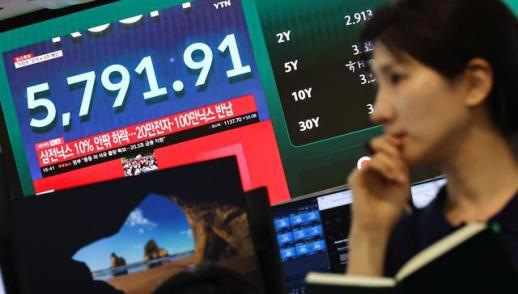
 Middle East Crisis: Is Seoul's market binge over — or will it survive? SEOUL, March 03 (AJP) — Is the two-year bull run in Seoul finally running out of steam, or will the market once again absorb an oil shock and move on? Tuesday’s verdict was brutal. The KOSPI plunged 7.24 percent to 5,791.91, while the tech-heavy KOSDAQ fell 4.62 percent to 1,137.70 — one of the sharpest single-day routs in recent memory. History offers some comfort. In six major Middle East military crises since 2000, the KOSPI was positive one month after each event. The initial reaction varied — often violent — but the pattern was consistent: unless energy supply was materially disrupted, the shock faded. This time, however, investors are not entirely convinced. Hur Joon-young, professor of economics at Sogang University, warned that markets may be underestimating the political dynamics inside Iran. “In previous confrontations, tensions rose but stopped short of prolonged direct war,” Hur said. “If internal pressures within Iran intensify, the conflict could extend beyond the two- to four-week window currently assumed.” He also noted a recurring military lesson: air power alone rarely delivers decisive outcomes. If limited strikes evolve into broader engagement, uncertainty — particularly around energy flows — could persist longer than markets expect. Political calculations in Washington and Jerusalem add another layer of unpredictability. Domestic pressures on leadership could increase escalation risk rather than contain it. In short: the question is not whether there is conflict, but how long it lasts. Markets do not price war; they price oil. The U.S. Energy Information Administration estimates roughly 20.9 million barrels per day transit the Strait of Hormuz — about one-fifth of global petroleum liquids consumption and nearly one-third of seaborne oil trade. History reinforces the point. During the 1990–1991 Gulf War, Brent crude surged toward $40 before easing as supply fears receded. The market reaction depended less on combat itself and more on the durability of supply disruption. If Hormuz flows remain intact, volatility may prove temporary. If they do not, inflation expectations could quickly reprice. The equity response is already bifurcated. Refiners and energy names have rallied on margin expectations. Over the past three months, S-Oil has surged 41.57 percent and SK Innovation 9.71 percent. Defense stocks are in full repricing mode. Hanwha Aerospace jumped nearly 20 percent Tuesday alone, with LIG Nex1 and Hanwha Systems up roughly 30 percent. Brokers cite potential replenishment demand for missile systems in the Gulf, including the Cheongung interceptor and Chunmoo rocket platform. The structural defense bid predates this crisis. Over three months, Hanwha Systems is up 145 percent, Korea Aerospace Industries 75 percent, and Hanwha Aerospace 38 percent. Airlines and travel stocks, by contrast, now face the familiar double hit of fuel costs and demand risk. This is not indiscriminate panic. It is rotation. The counterargument to the selloff is simple: earnings momentum remains intact. Daishin Securities recently lifted its year-end KOSPI target to 7,500 from 5,800, applying forward EPS of 728 and a 12-month PER of 10.32 — broadly in line with post-2021 averages. Forward EPS estimates have already climbed from 555 at end-January to around 610, a 10 percent upward revision. Further sector upgrades could add nearly 14 percent to profits, with semiconductors accounting for the bulk. Kiwoom Securities notes the KOSPI trades just above 10 times forward earnings, with February exports up 29 percent year-on-year, led by chips. If earnings continue to rise, geopolitics may prove noise rather than regime change. The real macro risk lies in second-round effects. If oil prices stay elevated long enough to reignite inflation, expectations for global rate cuts will recede. That would pressure valuation multiples just as earnings optimism peaks. Bond markets are already flashing caution. Short-term yields have risen faster than long-term rates, reflecting inflation sensitivity and diminishing expectations for Bank of Korea easing. A sustained move higher in U.S. Treasury yields would tighten global liquidity — the one variable equities struggle to ignore. Kiwoom’s base case assumes stabilization within a week, even with partial oil disruptions. But sensitivity rises sharply if Hormuz flows are impaired for any sustained period. Markets have historically absorbed geopolitical crises. The S&P 500, for instance, often fell on the first day of Middle East conflicts but recovered within weeks if energy supply remained stable. 2026-03-03 17:31:41
 -
 Asian markets stay low, KOSPI down nearly 3% but defense stocks fly SEOUL, March 3 (AJP) — Asian markets remained lower Tuesday as the region is expected to bear the collateral damage from the closure of the Strait of Hormuz responsible for 70 to 90 percent of fuel imports from the Middle East. The Seoul bourse was heavily volatile, with the KOSPI swinging between 6,180 and 6,040.60 amid a tug-of-war between retail buying and foreign selling. As of 11:10 a.m., the benchmark index was down 2.89 percent at 6,063.39. On the secondary bourse, the tone diverged. Foreign and institutional investors kept buying while retailers took profits, helping the KOSDAQ edge up 0.31 percent to 1,195.15. Heavyweight chipmakers retreated but remained above the psychological milestones they broke last week. Samsung Electronics fell 2.31 percent to 211,500 won, while SK hynix declined 2.26 percent to 1,037,000 won. Japan’s Nikkei 225 slid 1.27 percent to 57,320.94 in morning trade. Hong Kong’s Hang Seng Index managed a modest 0.45 percent gain, though broader sentiment remained fragile. While losers overwhelmed gainers on the KOSPI by 749 to 160, defense stocks stood out as clear beneficiaries of heightened geopolitical risk. Hanwha Systems surged 23.68 percent to 140,200 won, and Hanwha Aerospace jumped 13 percent to 1,353,000 won. LIG Nex1 soared 28.59 percent, while Hyundai Rotem gained 9.11 percent and Poongsan advanced 10.09 percent, reflecting expectations of widening battles and an accelerating arms race. The Korean won weakened sharply to 1,465.30 per dollar, around 2 percent off from Friday’s close of 1,438.4, highlighting capital outflow pressures. Safe-haven demand lifted gold 1.40 percent to $5,385.91. Bitcoin initially tumbled after the announcement but later rebounded 3.59 percent to $68,934, underscoring volatile risk sentiment. Battery makers came under pressure, with LG Energy Solution down 2.93 percent and Samsung SDI slipping 2.90 percent. Automakers were among the sharpest decliners. Hyundai Motor Company fell 3.71 percent to 649,000 won, while Kia Corporation dropped 5.55 percent to 194,100 won. Financials were mostly lower. KB Financial Group fell 1.95 percent, Shinhan Financial Group edged down 0.10 percent, and Mirae Asset Securities declined 1.94 percent. Industrial and shipbuilding shares were mixed. HD Hyundai Heavy Industries gained 1.66 percent and Hanwha Ocean rose 3.47 percent, while Doosan Enerbility slipped 1.41 percent. Biopharma heavyweights also retreated, with Samsung Biologics down 2.81 percent and Celltrion losing 1.47 percent. Steelmaker POSCO Holdings dropped 3.27 percent. Entertainment stocks were weaker, with HYBE down 3.61 percent, JYP Entertainment falling 1.72 percent and YG Entertainment declining 3.65 percent. 2026-03-03 11:30:17
 -
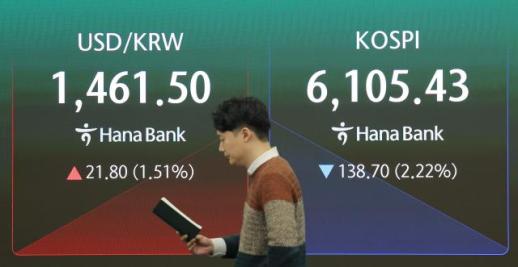 Middle East Crisis: Seoul stocks and currency open 2% lower on fuel jitters SEOUL, March 3 (AJP) — South Korean markets, returning from a long weekend, opened sharply lower Tuesday as investors moved to price in rapidly escalating tensions in the Middle East following U.S.-Israeli strikes on Iran and the growing risk of prolonged disruption to energy supplies. The benchmark KOSPI fell 2.60 percent at the open to 6,081.92, while the tech-heavy KOSDAQ dropped 2.57 percent to 1,162.17. The disruption of the Strait of Hormuz — which handles roughly 20 percent of global seaborne oil shipments — has reignited supply concerns across global energy markets. For Asia’s import-dependent economies, the chokepoint represents a critical vulnerability. Although OPEC+ — including Saudi Arabia, the United Arab Emirates and Russia — agreed to increase output by 206,000 barrels per day starting next month, the planned hike amounts to just 0.2 percent of the roughly 100 million barrels produced globally each day, limiting its capacity to offset potential supply losses should the conflict widen. Oil prices remained volatile. Brent crude for May delivery traded at $77.74 per barrel as of 12:55 a.m. BST, little changed from the previous session. U.S. West Texas Intermediate for April delivery stood at $70.82 per barrel as of 6:56 p.m. EST, down $0.40, or 0.56 percent. Still, traders are increasingly pricing in geopolitical risk premiums. Escalating uncertainty surrounding Iran has fueled speculation that crude could surge above $100 per barrel — a level that would amplify inflationary pressure and weigh on global growth. Seoul sought to calm markets. The government said Sunday that South Korea holds sufficient crude oil and LNG stockpiles to last 208 days, pledging close monitoring of financial and energy markets. U.S. President Donald Trump said the war could last “four weeks,” as Iran launched retaliatory strikes across the region in what analysts describe as the most serious security challenge in the Persian Gulf in decades. The Korean won weakened sharply, falling about 2.5 percent from its Feb. 26 high, reflecting a broader risk-off shift across emerging Asian currencies. 2026-03-03 09:28:19
 -
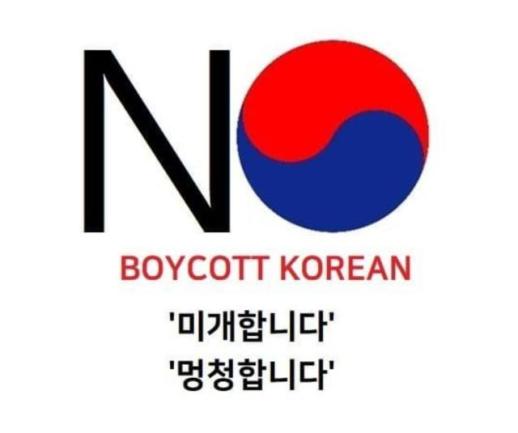 K-wave at a high tide; ripples of dissent surface in ASEAN SEOUL, February 27 (AJP) - At a moment when the Korean Wave appears once again near its global crest — with artists climbing international charts and anticipation building ahead of BTS’s March 21 return at Gwanghwamun — a quieter, less comfortable current has begun to surface in one of Hallyu’s most enduring strongholds: Southeast Asia. On Monday, an X user posted a terse declaration of disillusionment. “I used to really like Korea. But what happened yesterday was too much. I’m no longer interested in this country. I even canceled my ticket and hotel for next month,” the user wrote, adding the hashtag #SEAbling. The post offered no elaboration or any ties to the upcoming BTS event. Attached was a stark image: a South Korean flag laid on the ground, stepped on by sneakers. The image traveled quickly. The word did, too. “SEAbling” — a portmanteau of “SEA” (Southeast Asia) and “sibling” — has surfaced across regional online communities in recent weeks, signaling solidarity among some Southeast Asian netizens who say they are pushing back against what they perceive as condescension or disrespect from Korean fans and internet users. In some corners, calls for boycotts of Korean brands and cultural content have followed. Whether this marks the beginning of a sustained backlash, however, remains an open question. The spark, according to regional media reports including Singapore’s The Straits Times, appears to have been an incident at a January 31 concert by South Korean band DAY6 in Kuala Lumpur. A Korean fan was stopped by venue staff for allegedly attempting to use a prohibited telephoto camera. Video of the confrontation circulated widely online. What began as a dispute over concert rules quickly escalated. Social media exchanges between Korean and Southeast Asian users grew heated. Some Korean users reportedly posted mocking comments about Southeast Asian fans’ appearance, culture and economic standing. In response, Southeast Asian users pointed to South Korea’s low birth rate, suicide statistics and cosmetic surgery culture. The exchange revealed less about the initial incident than about accumulated sensitivities. The question, then, is whether “SEAbling” reflects a passing digital flare-up — or a deeper undercurrent. Kim Hyung-jun, professor of cultural anthropology at Kangwon National University, cautions against viewing the controversy in isolation. “Before 2010, anti-Hallyu sentiment was not particularly visible,” he said. “But as Hallyu succeeded on a larger scale, it became inevitable that some would feel uncomfortable about its rise. Based on related data, roughly 20 percent may hold such sentiments.” The Ministry of Culture, Sports and Tourism’s 2024 Overseas Hallyu Survey reported that 68.8 percent of respondents in major Southeast Asian markets held favorable views of Korean cultural content. The numbers suggest continued dominance rather than decline. Yet dominance carries its own tensions. Kim argues that those voicing dissatisfaction are not typically core Hallyu consumers. “They are often on the periphery, observing the phenomenon rather than actively participating in it,” he said. “But they are not marginal. In some countries, these voices are more visible among university-educated and white-collar professionals who interpret Hallyu through a nationalist lens.” In Indonesia, for example, Kim notes that some former enthusiasts have publicly distanced themselves from Korean culture, framing their disengagement almost as a personal reckoning. “They post reflections that resemble confessions,” he said. “Others respond in solidarity — almost like narratives of recovery. Compared to the past, such sentiments are expressed more clearly and confidently.” In this sense, the backlash may be less about music or television than about hierarchy — cultural, economic and symbolic. The hashtag “SEAbling” suggests a unified Southeast Asian front. Kim, however, doubts that the sentiment will evolve into a sustained regional movement. “In the past, such feelings remained largely within national boundaries,” he said. “Now, digital platforms allow sentiments that exist in varying degrees across Southeast Asia to appear simultaneous. That creates the impression of cross-border solidarity.” But a cohesive regional identity strong enough to sustain coordinated backlash remains, in his view, still forming — if at all. Historically, anti-Hallyu episodes have surfaced periodically in different countries, often fading as quickly as they appear. “For now, these emotions may reflect envy,” Kim added carefully. “But they should not be dismissed. Complacency would be a mistake.” Hyun Si-nae, professor at the Institute for Korean Studies at Inha University, situates the controversy within a broader Asian context. “The term may be new, but discrimination toward Southeast Asians has long been an underlying issue,” she said. “What changed this time is that the issue was named — and amplified.” Hyun suggests the debate reveals anxieties over perceived cultural hierarchy within Asia itself. “In parts of Southeast Asia, there has historically been resentment toward larger regional powers, including China, over political and economic dominance,” she noted. “After the pandemic, the ‘Milk Tea Alliance’ demonstrated that online solidarity across borders is possible. What we are seeing now is not entirely unprecedented.” In her reading, “SEAbling” is less an anti-Korean crusade than a symptom of unresolved regional asymmetries — economic gaps, labor migration patterns, racial perceptions and the uneasy pride of rising cultural exporters. “At its core, this reflects a gap in mutual understanding,” she said. “Like many collective backlashes, its shape will continue to change.” The Korean Wave, by most measurable standards, remains formidable. Southeast Asia continues to be one of its most enthusiastic markets. BTS’s return alone underscores the scale of global anticipation. Whether “SEAbling” fades as another fleeting hashtag or signals a more sustained recalibration of regional sentiment will depend less on fandom than on something more enduring: how Korea navigates its growing cultural power — and how it listens when that power is questioned. 2026-02-27 17:31:06