

Journalist

Kim Hee-su
khs@ajuapress.com
-
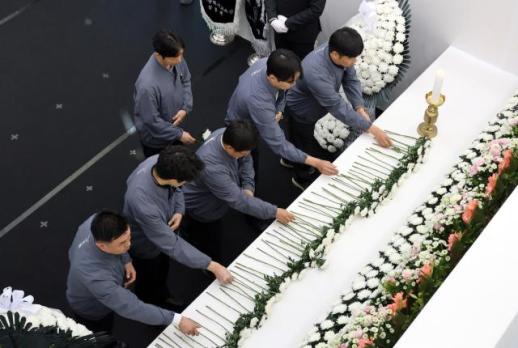 Mourners pay respects to Hanwha Aerospace workers killed in Daejeon blast SEOUL, June 05 (AJP) - Funeral altars were set up at Yuseong District Office in Daejeon on Friday for the five workers killed in an explosion at Hanwha Aerospace’s Daejeon plant four days earlier. The victims had been working in a cleaning room in Building 56 of the company’s Daejeon plant when an explosion of unknown cause occurred on Monday. Funeral arrangements were delayed as the bodies were severely damaged in the blast, complicating the identification process. Authorities completed the process on Wednesday, two days after the accident, while additional time was needed for consultations with bereaved families. Mourners continued to visit throughout the day as Hanwha Aerospace employees, many wearing work uniforms, gathered to pay their respects and offer condolences to the victims’ families. Among those paying their respects were Hanwha Vice Chairman Yeo Seung-joo and Defense Acquisition Program Administration Minister Lee Yong-cheol. Yeo and Lee repeatedly bowed before the grieving father of one victim in his 20s. Speaking to reporters afterward, Lee said the accident had occurred in an area that had not been designated as subject to safety inspections. “We will closely examine gaps in safety management and shortcomings at the facility level, and come up with measures to prevent even unforeseen accidents,” Lee said. One of the five victims will be moved to another region on Saturday for funeral services in his hometown. The remaining four funerals will be held in Daejeon, with funeral processions scheduled for Sunday. 2026-06-05 16:03:28
 -
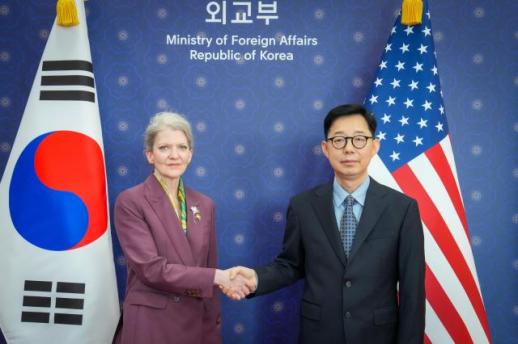 S. Korea, US to track progress in nuclear submarine, enrichment talks SEOUL, June 05 (AJP) - South Korea and the U.S. have agreed to track progress in follow-up talks on Seoul’s push for nuclear-powered submarines, uranium enrichment and spent fuel reprocessing, Seoul's Foreign Ministry said Thursday. The agreement came after government delegations from the two countries held a meeting at the Foreign Ministry in Seoul from Tuesday to Wednesday to begin implementing security-related commitments included in a joint fact sheet issued after last year’s summit between the two leaders. A Foreign Ministry official said the two sides agreed on a process to review progress at certain points and identify issues that require further discussion. “When the time comes, the two sides will review and evaluate the progress made up to that point,” the official told reporters. “They will then identify areas that need more discussion and reflect them in the next round of negotiations.” The move appears to reflect Seoul’s push to make as much progress as possible before political uncertainty grows in Washington, where the ruling Republican Party faces the possibility of losing control of Congress in the November midterm elections. Park described the launch meeting as successful and said U.S. Under Secretary of State for Political Affairs Allison Hooker, who led the U.S. delegation, had expressed the same view. In a post on X on Wednesday, Hooker called her trip to Seoul “a brief but very productive visit,” saying the two sides’ initial discussions on U.S.-ROK nuclear cooperation were “a success” and had set the stage for “continued technical conversations.” Hooker also wrote that in meetings with South Korean officials, she emphasized the need for the two allies to stay aligned on issues ranging from freedom of navigation in the Strait of Hormuz to strengthening critical supply chains and responding to regional threats. Asked whether the U.S. side raised South Korea’s possible participation in efforts related to the Strait of Hormuz or its role in countering China in the Indo-Pacific, Park said such issues were not discussed during the security negotiations. He added that Foreign Minister Cho Hyun and Hooker had broadly discussed issues related to the Korean Peninsula and the Middle East during a breakfast meeting. But he said specific matters, such as South Korea’s participation in a U.S.-led maritime security initiative, were not discussed in detail. 2026-06-05 15:40:09
 -
 Michelle Steel's nomination as US ambassador to S. Korea clears Senate panel SEOUL, June 05 (AJP) - Michelle Steel, U.S. President Donald Trump’s nominee for ambassador to South Korea, has cleared a key Senate committee, leaving only a final confirmation vote before the full Senate. The Senate Committee on Foreign Relations voted 14-8 on Thursday to advance Steel’s nomination, moving her one step closer to taking up the post in Seoul. If confirmed by the Senate, Steel will receive her formal appointment from Trump before assuming the ambassadorial post. Steel was nominated on April 13, and her Senate confirmation hearing was held on May 20. The process has moved relatively quickly, compared with cases in which nominees have waited months for confirmation hearings after being tapped by the president. At her confirmation hearing, Steel emphasized the need for a strong trilateral alliance among South Korea, the U.S. and Japan. Her use of the word “alliance” drew attention, as relations among the three countries are more commonly described as cooperation or coordination, unlike the formal alliances between Seoul and Washington and between Washington and Tokyo. If confirmed, Steel would become the second Korean American to serve as U.S. ambassador to South Korea, following Sung Kim, who served in Seoul from 2011 to 2014. Steel, a Republican, served in the U.S. House of Representatives for four years from 2021 before narrowly losing her reelection bid in November 2024. The ambassadorial post in Seoul has remained vacant since Philip Goldberg, who was appointed under the Biden administration, left the post in January last year. 2026-06-05 10:27:17
 -
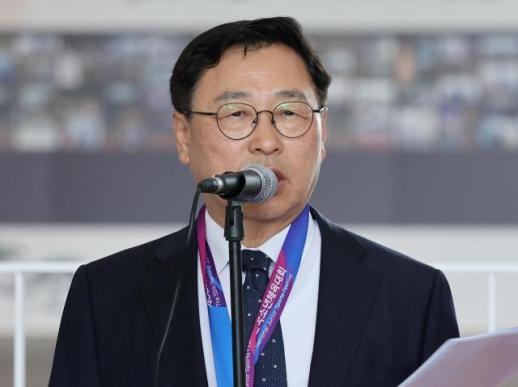 Seoul's progressive education chief wins second term SEOUL, June 4 (AJP) - Jung Keun-sik won a second term as Seoul's education chief in the June 3 local elections, extending progressive control over the capital's education office. His victory gives progressive education leaders four more years in Seoul, South Korea's education hub. It is also expected to add momentum to their key policies, including absolute grading for the college entrance exam and school records. As of 4:40 p.m. Thursday, with 99.92 percent of ballots counted, Jung had 30.32 percent of the vote, or 1,505,509 votes. Conservative candidate Cho Jeon-hyeok came second with 23.48 percent, or 1,166,086 votes. Jung led Cho by 339,423 votes, or 6.84 percentage points. Yoon Ho-sang ranked third with 14.58 percent, or 723,954 votes. Han Man-joong came fourth with 9.42 percent, or 468,177 votes. The count has not been completed because protesters blocked officials from moving a ballot box at a polling station in Jamsil 7-dong, Songpa District, after a shortage of ballot papers. Still, Jung secured victory late Wednesday night. Jung won with just over 30 percent of the vote, the lowest winning share in a Seoul education superintendent race since direct elections began. The previous record was 34.34 percent, set by former superintendent Kwak No-hyun in 2010. Eight candidates ran in this year's race, the largest number since Seoul first directly elected an education superintendent in 2008. They included three progressives, four conservatives and one centrist. Progressive candidates also won in 10 regions nationwide, including Seoul, Gyeonggi Province and Incheon. Jung, a former sociology professor at Seoul National University, first became Seoul education superintendent in an October 2014 by-election, defeating Cho. He served for one year and six months. This year, he campaigned on policy continuity. He especially stressed support for basic academic skills. His main pledges included free early childhood education for children aged 3 to 5, public transportation support for students, free school field trips, support for basic academic skills and stronger protection of teachers' rights. Jung returned to work at the Seoul Metropolitan Office of Education on Thursday morning after his suspension from duty ended. "There are many difficult tasks ahead, including students' mental health, protection of teachers' rights, AI-based future education and narrowing education gaps," Jung said. "I believe we need to strengthen cooperation among the Seoul education office, the Seoul Metropolitan Government and the central government." 2026-06-04 17:34:27
 -
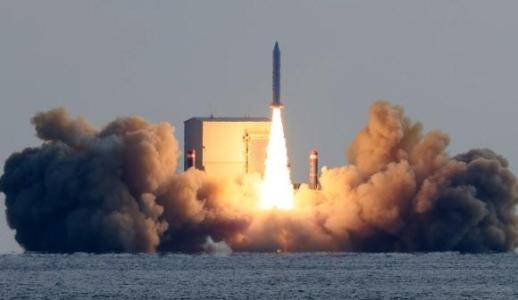 Explosion at Hanwha Aerospace plant casts doubt on planned satellite launch SEOUL, June 4 (AJP) - The planned launch of a satellite-carrying solid-fuel rocket off Jeju remains uncertain following an explosion at Hanwha Aerospace's plant in Daejeon that left seven people dead or injured. The Ministry of Employment and Labor raided Hanwha Aerospace’s headquarters in Seoul and its Daejeon plant on Thursday in connection with the fatal explosion. The Ministry of Employment and Labor raided Hanwha Aerospace's headquarters in Seoul and its Daejeon plant on Thursday following the fatal explosion. Hanwha Aerospace said it would suspend production lines at its domestic sites for two days from Thursday to conduct safety inspections and training, saying "safety comes before production." The measure applies to nine sites nationwide, including plants in Daejeon, Boeun in North Chungcheong Province and Yeosu in South Jeolla Province, which produce propellants and charges, as well as its Changwon plants in South Gyeongsang Province, which manufacture K9 self-propelled howitzers, armored vehicles and aircraft engines. R&D campuses in Daejeon, Pangyo and Asan are also included. Hanwha Aerospace has a total of 11 domestic business sites. The Daejeon plant, where the explosion occurred, is known as a key site that produces defense and space-related products, including propellants. Hanwha Aerospace had been working with the Agency for Defense Development to conduct the fourth launch of a solid-fuel space rocket from waters near the Jeju naval base on May 30, but the launch was postponed due to bad weather. However, Hanwha Aerospace has said it is difficult to directly link the accident to the launch schedule, as the project is led by the military and government agencies. "It is difficult to link the two because rockets and weapons are matters involving the military and the government," a Hanwha official told AJP by phone. "For details, you would need to check with DAPA, the military or other state agencies." The official also said the report linking the accident directly to the launch schedule appeared to be "highly speculative," adding, "It is not accurate to make that connection." The Defense Ministry's spokesperson's office also said the delay was so far understood to be related to weather conditions and that no confirmed link had been made to the accident. "As of now, there has been no discussion related to that," an official at the ministry's spokesperson told AJP by phone. "So far, it has been about the weather." The official added that "various conditions" could still be considered, but said no new launch date had been fixed. The Agency for Defense Development succeeded in the third test launch of South Korea's indigenous solid-fuel rocket from waters off Jungmun, Jeju, in December 2023 to verify its capability to place a small satellite into orbit. The upcoming launch would be the fourth test. Hanwha Aerospace is responsible for the launch vehicle, Hanwha Systems for the reconnaissance satellite and Hanwha Ocean for the offshore launch platform. The accident has also raised questions about why an explosion occurred in a process the company had not considered highly dangerous. During a joint briefing on the day of the accident, a Hanwha Aerospace official said, "The process involved in today's accident had not been recognized as highly dangerous." The explosion reportedly occurred in a cleaning room in Building 56, where tools used in the production of solid propellant for rocket launch vehicles were washed with water and detergent. A chemistry expert said fine aluminum particles used in propellants are vulnerable to static electricity, making explosions possible when residues are removed or handled with various materials. However, the expert said the risk of an explosion may have been considered significantly lower because the accident occurred in a room where water was used for cleaning. Choi Gi-il, a professor of military studies at Sangji University, said the explosion may have been caused by sparks generated by friction, external impact or other minor factors during the cleaning of equipment contaminated with explosives. "There is a high possibility that sparks occurred during the cleaning of tools or mixing containers contaminated with explosives, due to friction, external impact or other small factors, leading to a chain explosion," Choi said. This is not the first fatal explosion at Hanwha Aerospace's Daejeon plant. In May 2018, an explosion at the same site killed five workers. In February 2019, another explosion and fire occurred in a propellant separation room in Building 70, killing three workers. The previous accidents also prompted criticism over the company's safety management. After the 2018 accident, the Labor Ministry found 486 violations during an inspection in the field of occupational safety and health, with 126 cases referred for legal action. At the time, the Daejeon plant's process safety management, or PSM, rating was downgraded to M-, the lowest level. The latest accident could therefore go beyond a single process failure and raise broader questions over whether safety management has been properly carried out at defense and space facilities that handle high-risk materials, especially given the limited transparency surrounding defense contractors. 2026-06-04 16:30:37
 -
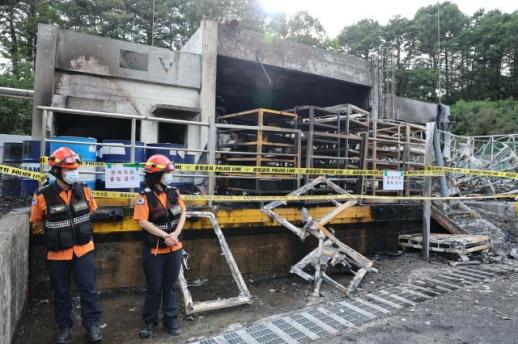 Hanwha Aerospace halts operations at 9 sites for safety inspections SEOUL, June 04 (AJP) - Hanwha Aerospace said Thursday it has suspended operations at nine domestic sites for two days to conduct safety inspections and employee training, following a deadly explosion at its plant in Daejeon. The company said it halted production lines from June 4 to 5, except for some essential processes, under the supervision of each site manager and safety officer. The affected sites include plants in Daejeon, Boeun in North Chungcheong Province and Yeosu in South Jeolla Province, which produce and handle propellants and charges. The shutdown also applies to its Changwon plants in South Gyeongsang Province, which manufacture K-9 self-propelled howitzers, armored vehicles and aircraft engines, as well as R&D campuses in Daejeon, Pangyo and Asan. It marks the first time Hanwha Aerospace has simultaneously suspended operations at multiple sites since the launch of its integrated entity in 2023, following the merger of Hanwha Aerospace, Hanwha Defense and Hanwha Corp.’s defense division. The company said the decision was made because securing a safe workplace environment takes priority over potential production disruptions, as part of efforts to prevent risks similar to the accident at the Daejeon plant. During the inspections, Hanwha Aerospace will review risks related to fires, explosions, serious accidents, unsafe facilities and working conditions, risk assessments and past accident cases. The company will also reexamine machinery, work environments and structures, while checking whether corrective measures and recurrence prevention steps from risk assessments over the past three years have been properly implemented. Hanwha Aerospace said it has also begun reviewing the expansion of unmanned automation for processes related to the production and handling of propellants. Special safety training for employees will also be conducted during the two-day period. Each site will provide training on similar accident cases at home and abroad, workers’ right to stop work in the event of imminent danger and emergency response plans. Hanwha Group said its petrochemical affiliates, including Hanwha Corp., Hanwha Solutions, Hanwha TotalEnergies, Hanwha Impact and YNCC, will also form CEO-led inspection teams by June 10 to review workplace safety, production processes and environmental management at their domestic and overseas sites. 2026-06-04 11:17:15
 -
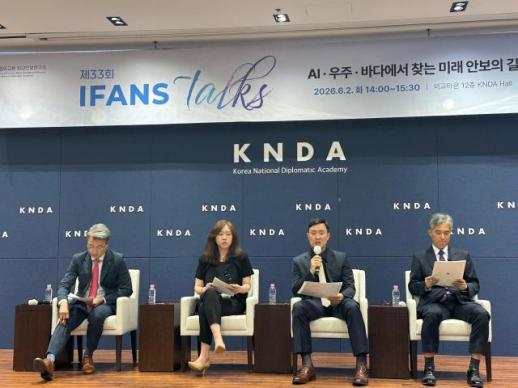 Future warfare makes diplomacy harder, but more vital, experts say SEOUL, June 02 (AJP) - As artificial intelligence, space assets, and maritime competition reshape the nature of warfare, diplomacy is not becoming obsolete but is becoming more important in preventing conflicts from escalating and setting rules for emerging military technologies, security experts said Tuesday. The remarks came during the 33rd Institute of Foreign Affairs and National Security (IFANS) Talks, a public lecture hosted by IFANS under the Korea National Diplomatic Academy, at the Korea National Diplomatic Academy, at the (KNDA) Hall in southern Seoul. Held under the theme “Finding the path to future security through AI, space and the sea,” the event brought together Sohn Han-byeol, a professor at Korea National Defense University, Um Jung-sik, a professor at the Korea Air Force Academy, and Ban Kil-joo, a professor at IFANS. During a Q&A session, the speakers addressed whether the rapid development of military technologies could weaken the role of diplomacy. Sohn said diplomacy will become more difficult, and more important, as advanced technologies lower the threshold for the use of force. “The role of diplomacy is not shrinking. It is becoming more difficult, and because it is becoming more difficult, it is becoming more important,” Sohn said. He said military technologies may allow states to strike faster and more precisely, but they cannot resolve the political causes of conflict. “Military victory and political termination are different,” he said. “Diplomacy is what fills that gap.” Sohn also said diplomacy in the AI era should focus on creating norms for new technologies, including autonomous weapons, AI-assisted targeting and drone attacks. “The empty space of norms is not the realm of the military or technology, but of diplomacy,” he said. He said South Korea could contribute to space cooperation with the United States by strengthening space domain awareness in Northeast Asia, where ground-based monitoring assets remain limited. “The United States is a global space power, but compared with other regions, ground-based space systems in Northeast Asia are relatively insufficient,” Um said. “South Korea can play a sufficient role in the alliance in ground-based space domain awareness.” Um also stressed that South Korea needs to recognize space as an independent operational domain. “Public satellites and commercial satellites floating in space are assets that our military must protect,” he said. “Who protects our commercial satellites?” Ban said maritime security is increasingly linked to energy security, food security, gray-zone competition and the rules-based order. He said South Korea must distinguish between China’s gray-zone activities and North Korea’s military threats when shaping maritime security responses. “China’s and North Korea’s threats are not on the same line,” Ban said. “Their nature and categories must be separated.” Ban said gray-zone threats at sea are not only a bilateral security issue but also a challenge to the rules-based maritime order. “Gray-zone threats weaken the rules-based order and the maritime rules-based order,” he said. “They need to be expanded to and handled by the international community.” Turning to the broader question of diplomacy, Ban said modern warfare does not signal the end of diplomacy. “I see this not as an era of the end of diplomacy, but as an era in which diplomacy must work harder,” Ban said, adding that defense capabilities and diplomacy should reinforce each other. “Diplomacy and deterrence have mutual synergy,” he said. “A virtuous cycle is possible.” Ban stressed that diplomacy is needed both during war and in peacetime. “Diplomacy is conducted even during war,” he said. “In the end, the end of a fight is diplomacy.” The discussion underscored a shared view among the speakers: as war expands into AI, space and the sea, diplomacy is not losing relevance. Instead, it is moving into more complex domains where rules remain unsettled, escalation risks are higher and national security depends on norms, partnerships and public awareness as much as on military power. 2026-06-02 17:56:45
 -
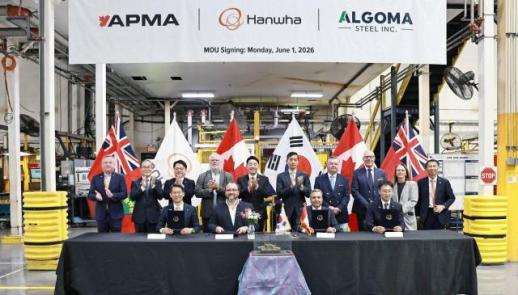 South Korea makes final all-out push for Canada's submarine bid SEOUL, June 2 (AJP) - South Korea is stepping up efforts to win Canada's next-generation submarine procurement project, as Ottawa is expected to select its preferred bidder by the end of June for a deal estimated to be worth US$40 billion. The final race for the Canadian Patrol Submarine Project, or CPSP, has increasingly narrowed into a competition between South Korea's "One Team" bid led by Hanwha Ocean and HD Hyundai Heavy Industries, and Germany's Thyssenkrupp Marine Systems, or TKMS, a long-established player in the diesel-electric submarine market. South Korea's push gained momentum this week as presidential chief of staff Kang Hoon-sik attended a business roundtable in Toronto, where companies from the two countries signed three memorandums of understanding in satellite communications, launch sites and defense vehicles. The business event came as Germany and Norway moved to counter Hanwha Ocean's key selling point — faster delivery — by offering to delay some of their own submarine deliveries to make room for Canada. German Defense Minister Boris Pistorius said TKMS could deliver four submarines to Canada by 2036 if it wins the bid, according to an interview with Canada's CBC News on the sidelines of CANSEC 2026, Canada's largest defense exhibition held in Ottawa last week. "They say they can, and I have only had good experiences with them, so I trust them," Pistorius told CBC News. "They promise only what they can actually achieve." TKMS has proposed its Type 212CD submarine, a model jointly developed by Germany and Norway. But the submarine remains in the design stage and has yet to enter operational service, raising questions over whether the German side could meet Canada's urgent delivery timeline. Hanwha Ocean, by contrast, has emphasized from the early stages of the competition that it can deliver four KSS-III submarines to Canada by 2035. That date is crucial for Ottawa, as the Royal Canadian Navy aims to retire all four of its aging Victoria-class submarines by 2035. Only one of the four is currently believed to be available for operations, making replacement an urgent priority. Pistorius said Germany and Norway, both existing customers of the Type 212CD, had agreed to delay one submarine each from their own orders to allow Canada to receive earlier deliveries. The remaining two vessels, he said, could be produced at an accelerated pace by TKMS. Marte Gerhardsen, state secretary at Norway's Ministry of Defense, also said bringing Canada into the program would strengthen the overall submarine fleet, even if Norway has to wait longer for one of its submarines. "We do not think of the submarine fleet as a Norwegian fleet, a German fleet and a Canadian fleet," Gerhardsen told CBC News. "We think of it as a common fleet." Germany has also offered a broader economic package tied to the submarine bid, including investments in military and non-military projects in Canada, according to CBC News. The proposals reportedly cover carbon capture, LNG exports, torpedo production and hypersonic missile development. South Korea has also pledged similar industrial cooperation if it wins the contract, but Germany is seeking to differentiate its proposal by stressing that many of its projects could begin within two years. Canadian Prime Minister Mark Carney and Defense Procurement Minister Stephen Fuhr have said both Germany's Type 212CD and Korea's KSS-III meet the Royal Canadian Navy's requirements, with a decision expected by the end of June. Carney said last week that the decision goes beyond military requirements. "It is certainly about economic impact, the broader economic benefits," Carney told reporters. Hanwha is seeking to frame its submarine bid as part of a wider defense and industrial partnership with Canada. Representatives from Algoma Steel, Hanwha and Ontario-based auto parts makers recently signed an agreement at a Martinrea International facility near Toronto. Under the plan, Algoma would supply steel to a Canadian consortium if Hanwha wins the submarine contract. Algoma joins Hanwha and the Automotive Parts Manufacturers' Association, which agreed recently to jointly develop and manufacture fighting vehicles for the Canadian Armed Forces and allies. In a separate pact, Hanwha has also agreed to invest in Algoma. The proposed Canadian joint venture would be 51 percent Canadian-owned and use domestic steel and workers, with Hanwha providing expertise, technology and experience, as well as investment. "They are not just interested in supplying submarines to Canada," Martinrea chairman Rob Wildeboer said. "They want to do much more in working with industry in Ontario and Canada to develop defense capabilities." Korea also used CANSEC 2026 as a final opportunity to promote its submarine bid. Hanwha Ocean put its proposed KSS-III Batch-II model at the center of its campaign, stressing that Korea already operates a proven submarine platform. The Korean Navy's 3,000-ton Dosan Ahn Chang-ho submarine has also played a supporting role. After completing a 14,000-kilometer voyage across the Pacific, the submarine arrived at the Esquimalt naval base in Victoria, British Columbia on May 23. The strategy has drawn attention in Canada, with local media quoting one Canadian naval official as comparing the experience of boarding the Korean submarine to switching from a 1999 Honda Civic to a new Tesla. With the final decision approaching, the competition is increasingly becoming not only a submarine procurement race, but also a test of which country can offer Canada a broader strategic and industrial partnership. 2026-06-02 17:26:28
 -
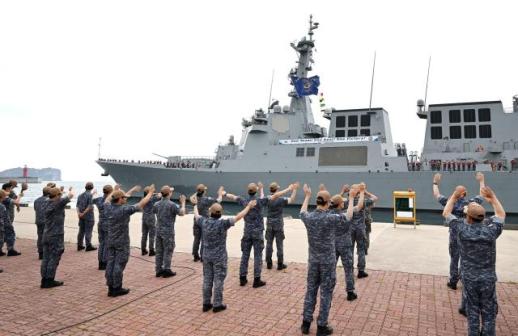 Korean Navy to join RIMPAC, take first command role in multinational maritime exercise SEOUL, June 02 (AJP) - South Korea’s Navy said Monday its Aegis destroyer Jeongjo the Great will depart for the Rim of the Pacific exercise (RIMPAC), marking the first time the service will assume a major command role in the U.S.-led multinational maritime drill. The 8,200-ton destroyer left Jeju Naval Base on Monday and will join the exercise, which will take place in waters off Hawaii from late June through July, according to the Navy. It will be the first RIMPAC participation for the Jeongjo the Great, which was commissioned in December 2024. The 3,000-ton submarine Dosan Ahn Chang-ho and the P-8A maritime patrol aircraft will also take part in the exercise for the first time. The Dosan Ahn Chang-ho, along with the frigate Daejeon, will move to Hawaii after completing a combined cooperation exercise with Canada. The landing ship Cheonjabong is also set to head to Hawaii after conducting a search and rescue exercise, or SAREX, with Japan’s Aegis destroyer Kongo in international waters southeast of Jeju on June 7. RIMPAC is a biennial multinational naval exercise hosted by the U.S. 3rd Fleet to enhance participating countries’ ability to protect sea lines of communication, respond jointly to maritime threats and improve interoperability and operational capabilities among allied and partner forces. This year marks the 30th edition of the exercise. South Korea first joined RIMPAC in 1990 and will be participating for the 19th time this year. During this year’s exercise, the South Korean military will serve for the first time as the Combined Force Maritime Component Commander, or CFMCC. South Korea will become the fourth country to take on the role and the first Asian country to do so. The Navy said the exercise is expected to provide an opportunity to strengthen South Korea’s military capabilities ahead of the planned transfer of wartime operational control from Washington to Seoul. Rear Adm. Kim In-ho, commander of the Republic of Korea Navy’s Maritime Task Flotilla and the officer who will serve as the CFMCC, said the assignment marks a shift in South Korea’s role from a participating country to a command nation. “Taking on the command role for the first time means we have moved beyond being a participating country and have advanced to the position of a command nation,” Kim said. 2026-06-02 10:48:20
 -
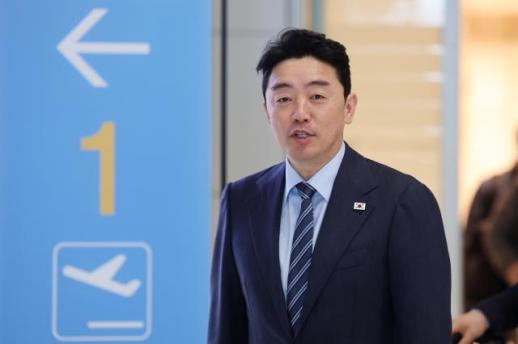 Korea, Canada deepen advanced industry ties with MOUs in defense, space sectors SEOUL, June 02 (AJP) - South Korea and Canada discussed ways to expand cooperation in advanced industries, with companies from the two countries signing three memorandums of understanding in the defense and space sectors, Seoul's industry ministry said Monday. The Korea-Canada Advanced Industry Cooperation Business Roundtable was held at the Park Hyatt Toronto hotel, organized by the Korea Trade-Investment Promotion Agency, or KOTRA, according to the Ministry of Trade, Industry and Resource. The event brought together about 50 government officials and business leaders from both countries in key sectors such as defense, space and hydrogen. Attendees included Presidential Chief of Staff Kang Hoon-sik, Vice Industry Minister Moon Shin-hak, Defense Acquisition Program Administration Minister Lee Yong-cheol and Stephen Lecce, Ontario's minister of energy and mines. The roundtable was designed to discuss concrete cooperation projects between Korean and Canadian companies in promising future industries, including defense, space and hydrogen, while exploring possible government support measures. During the event, Hanwha presented ways to expand cooperation between the two countries in the defense and space sectors, while Hyundai Motor introduced potential cooperation in the hydrogen sector, including hydrogen projects in Canada. “If Canada’s abundant resources and advanced technologies are combined with Korea’s world-class manufacturing capabilities, the two countries will be able to lead the global market in advanced industries,” Kang said. He also stressed that industrial cooperation between the two countries should go beyond simple purchasing and supply arrangements and develop into an ecosystem that connects technology, security and talent. As part of the visit, the special delegation for strategic economic cooperation also visited Martinrea, one of the key parties involved in an MOU signed in April between Hanwha and Canada’s Automotive Parts Manufacturers’ Association. The ministry said the event led to three MOUs between Korean and Canadian companies in satellite communications, launch sites and defense vehicles. Kang left for Canada on Sunday as President Lee Jae Myung’s special envoy for strategic economic cooperation, accompanied by officials from the industry and foreign ministries, as well as companies and organizations in energy, resources, supply chains and advanced industries. During the trip, Kang and other officials are also expected to support Korean companies seeking to win Canada’s submarine procurement project. 2026-06-02 10:03:14