

Against those odds — and the rising cost burden — Seoul is moving to rethink its energy routes. A presidential envoy mission to Kazakhstan, Oman and Saudi Arabia is beginning to signal where those alternatives may lie.
Presidential Chief of Staff Kang Hoon-sik led a joint government-corporate delegation to the three countries this week, aiming to secure long-term crude oil and naphtha supplies in what is increasingly being viewed as a postwar energy order.
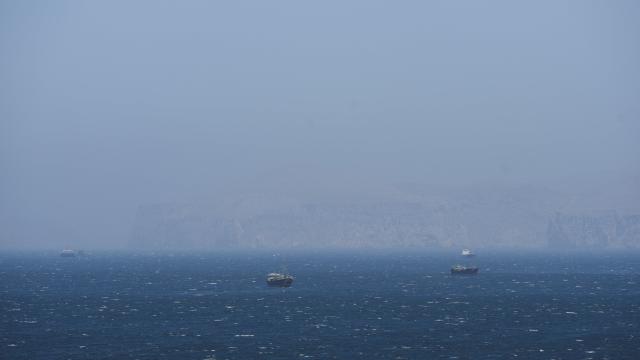
Shipping data underscores the scale of disruption. Vessel activity in the Strait of Hormuz showed only a marginal uptick this week, with just four bulk carriers transiting between midnight and 8 p.m. UTC on Wednesday, according to MarineTraffic.
Before the conflict erupted in late February, more than 100 ships passed through the strait daily. Traffic has since collapsed by more than 80 percent in the immediate aftermath of the attacks, according to Lloyd’s List Intelligence.
Even under the ceasefire framework, flows remain tightly controlled. A senior Iranian source said fewer than 15 vessels per day would be allowed to transit, with all movements subject to prior approval and strict protocols.
“All vessels transiting the Strait of Hormuz should, until further notice, use alternative routes designated by the IRGC Navy,” the force said, warning ships to avoid potential contact with naval mines.
The new routing system effectively redraws the map. Traffic is being pushed closer to Iran’s Larak Island — home to military facilities — while previously used channels are now labeled “danger zones.”
Nearly 2,000 vessels remain stranded near the chokepoint, including 26 South Korea-linked ships and seven Korean oil tankers.
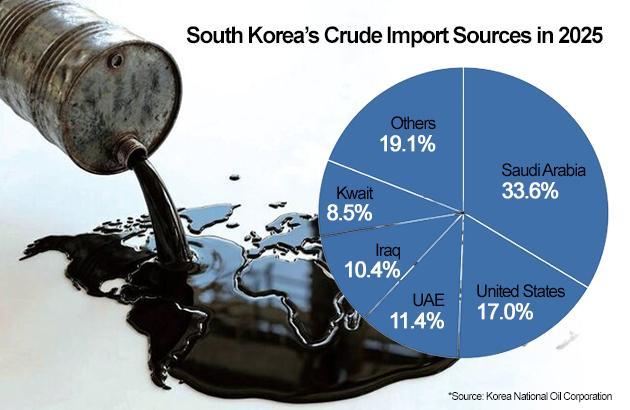
South Korea’s energy dependence leaves little room for disruption. In 2025, crude imports were led by Saudi Arabia (33.6 percent), followed by the United States (17 percent), the United Arab Emirates (11.4 percent), Iraq (10.4 percent) and Kuwait (8.5 percent).
Seoul has already moved to secure emergency volumes, including 24 million barrels from the UAE late last month — equivalent to just over eight days of consumption.
But the buffer is thin.
“We need about 2.8 million barrels per day. Even if Kazakhstan provides supplies, it would likely be less than 2 million barrels. It’s not easy to rely on that alone,” said Yoo Seung-hoon, professor at Seoul National University of Science and Technology.
“The 24 million barrels secured from the UAE would last less than 10 days — about eight days. That’s not a huge amount. We need to secure supplies from Oman and other producers to sustain operations.”
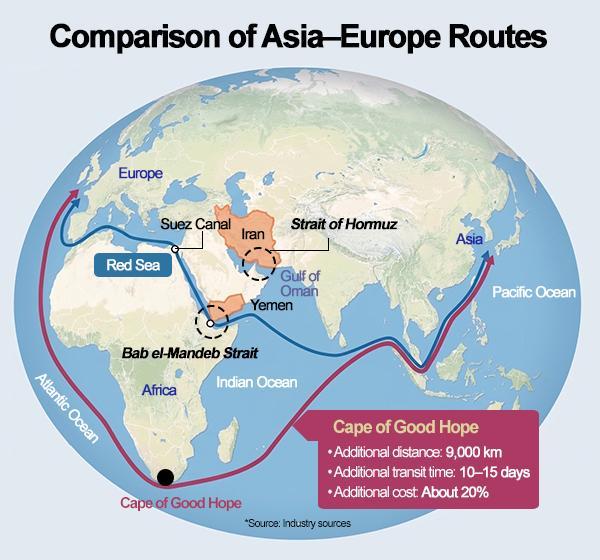
Oman is emerging as a key strategic option. Unlike most Gulf exporters, it can ship crude directly through the Arabian Sea without passing through Hormuz.
Its main export terminals — including Duqm and Sohar — sit outside the strait, offering rare insulation from chokepoint risk.
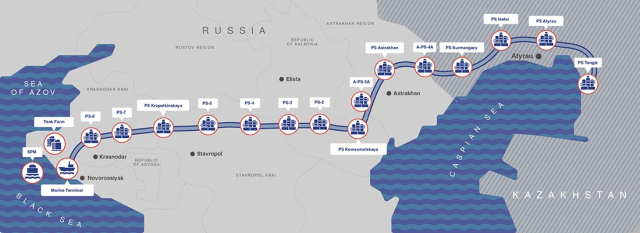
Kazakhstan, while landlocked, presents a different kind of workaround. Its extensive pipeline network connects inland fields to export terminals on the Caspian and Black Seas, allowing crude to reach global markets without touching Hormuz.
Since Houthi attacks in the Red Sea in 2023, such longer routes have already become more common despite higher costs and extended delivery times.
In emergencies, safety is beginning to outweigh efficiency.
GS Caltex has already tested the route, importing 80,000 tons of Kazakhstan’s CPC crude this week. The cargo, loaded via pipeline and shipped from Russia’s Novorossiysk port, arrived at the company’s Yeosu terminal.
“We load the crude from pipeline shipments in Russia and transport it by tanker,” a GS Caltex official said.

Copyright ⓒ Aju Press All rights reserved.
