
Journalist

Heesu Kim
khs@ajunews.com
-
 Hanwha expands Middle East footprint with debut of AI-integrated defense systems SEOUL, February 05 (AJP) - Hanwha is set to showcase next-generation, AI-enabled weapon systems on the global stage for the first time, signaling a major push into the Middle Eastern defense market and a deepening strategic partnership with Saudi Arabia. Hanwha aims to demonstrate South Korea’s defense competitiveness at the World Defense Show 2026 (WDS), to be held in Riyadh from Feb. 8 to 12. Hanwha Aerospace, Hanwha Systems and Hanwha Ocean announced Wednesday that they will jointly operate their largest-ever integrated exhibition booth at WDS, spanning 677 square meters, including an outdoor display area. Held biennially, the Saudi defense exhibition marks its third edition this year, with 773 companies from 76 countries expected to participate. At the center of Hanwha’s exhibition is the debut of its AI-enabled loitering precision-guided weapon (L-PGW), presented as a core capability for future warfare. Developed by Hanwha Aerospace, the L-PGW autonomously conducts reconnaissance, target identification and engagement using artificial intelligence. It integrates satellite data links to transmit battlefield information, before deploying and launching a self-destructing drone to strike designated targets. The system is being unveiled for the first time in a market long dominated by major U.S. and European defense contractors. The company will debut its multi-mission radar (MMR), which is designed to counter low-altitude aerial threats such as drones in coordination with ground-based weapon systems. It will also present AI-powered combat management systems, four-face fixed AESA multi-function radars, unmanned platforms and a stealth-designed “Smart Battleship,” reflecting the growing emphasis on networked and autonomous warfare. Beyond individual platforms, Hanwha is emphasizing a comprehensive, localization-focused cooperation model aligned with Saudi Vision 2030 goals. The K9A1 self-propelled howitzer on display has been customized specifically for Saudi requirements and is equipped with a 1,000-horsepower diesel engine produced by Korea’s STX Engine. Also featured is the Tigon wheeled armored vehicle, optimized for desert terrain. In the maritime domain, Hanwha Ocean will highlight its “Naval solutions” portfolio, spanning submarines, surface vessels and unmanned maritime systems. Exhibits include the 3,000-ton Jangbogo-III Batch-II submarine, launched in October last year. A key element of the presentation is Hanwha’s customized submarine base solution, offered as a comprehensive package covering design, construction, equipment, training and operations. The approach reflects a shift away from arms sales toward defense industrialization models focused on localization and long-term operational autonomy. "We are committed to making tangible contributions to Saudi Arabia’s defense capabilities and to further strengthening our strategic partnership,” a Hanwha official said. 2026-02-05 10:29:09
 -
 Seoul, Washington likely to set 2028 target for wartime command handover SEOUL, February 04 (AJP) - South Korea and the U.S. are expected to set 2028 as the target year for the transfer of wartime operational control (OPCON) at their annual Security Consultative Meeting (SCM) in Washington this October, reflecting growing confidence in Seoul’s ability to lead combined defense operations. According to government sources on Wednesday, the allies are considering 2028 as the most realistic timeline, aiming to complete the handover during the respective terms of South Korean President Lee Jae Myung and U.S. President Donald Trump. Ahead of the SCM, the two sides plan to complete verification of Full Operational Capability (FOC), the second stage in the three-step OPCON transition process, and seek formal approval from their defense chiefs. The transition consists of three phases: Initial Operational Capability (IOC), Full Operational Capability (FOC) and Full Mission Capability (FMC). Having completed the FOC evaluation, the allies are now in the final verification stage, with only confirmation of the future Combined Forces Command reportedly remaining. Once the FOC results are approved, the defense ministers are expected to announce a target year for the transfer. With Trump’s current term ending in January 2029, 2028 is viewed as the most viable option. Following the announcement, the allies will move to the final FMC phase, during which the precise timing of the handover will be determined. While FOC involves extensive quantitative assessments, FMC relies more on qualitative judgments, making political leadership a decisive factor. Lee has repeatedly expressed his determination to complete the OPCON transfer during his term. Trump, who has consistently urged allies to shoulder greater security responsibilities, is also regarded as supportive of the transition. Under the 2026 National Defense Strategy released last month, Washington emphasized that South Korea should, as much as possible, take primary responsibility for countering North Korea’s conventional threats. The document describes South Korea as a country with high defense spending, a strong defense industry and a conscription-based military, capable of defending itself with “critical but more limited” U.S. support. If FMC verification begins in 2027 as expected, the long-delayed OPCON transfer—often described as a two-decade-old task for the alliance—could be realized in 2028. Operational control refers to the authority to command designated forces to carry out specific missions within a defined time and space. Currently, South Korea’s Joint Chiefs of Staff chairman exercises peacetime control, while wartime control rests with the commander of the Combined Forces Command, a U.S. four-star general. After the transfer, a South Korean four-star general will assume wartime command. The process gained momentum in 2005, when the Roh Moo-hyun administration formally proposed the transfer. In 2014, under the Park Geun-hye administration, Seoul and Washington agreed to pursue a conditions-based transition without a fixed timetable. Under that agreement, the transfer depends on three conditions: South Korea’s ability to lead combined operations, the alliance’s capacity to counter North Korea’s nuclear and missile threats, and a security environment conducive to a stable transition. To support verification this year, the allies plan to proceed with the Freedom Shield exercise, scheduled for March 9–19, with a crisis management drill from March 3–6. Freedom Shield is a command post exercise designed to rehearse combined operational plans through simulations of a full-scale conflict on the Korean Peninsula. It covers scenarios ranging from defensive and counteroffensive operations to securing weapons of mass destruction. Pyongyang has repeatedly condemned the drills as “war rehearsals,” and retaliatory provocations, including missile launches, cannot be ruled out during the exercise period. Against this backdrop, observers say Seoul is likely to adopt a low-key approach, as it did during last year’s Ulchi Freedom Shield exercise, by issuing conciliatory messages in advance. At last year’s opening ceremony, Lee stressed the importance of inter-Korean relations, and the joint statement notably avoided references to “North Korea,” “threat” and “provocation.” 2026-02-04 16:13:04
 -
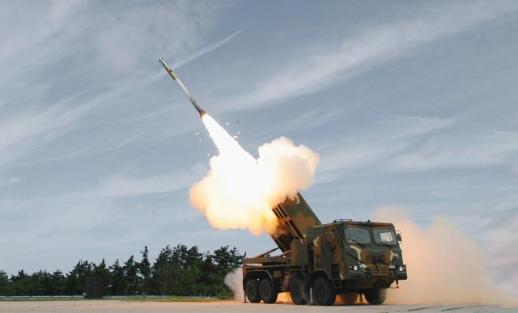 Why Korean rockets are finding buyers on Russia's European doorstep SEOUL, February 02 (AJP) - Norway’s decision to select South Korea’s Chunmoo multiple launch rocket system (MLRS) for its Long Range Precision Fire System (LRPFS) program reflects a broader recalibration under way among European and NATO militaries bordering Russia — one shaped less by brand loyalty than by timelines, industrial resilience and operational flexibility. The contract, signed by the Norwegian Defence Materiel Agency with Hanwha Aerospace, covers 16 Chunmoo launchers, precision-guided munitions, training and logistics support, and is valued at roughly 19 billion Norwegian kroner ($2 billion). Deliveries are set to begin in 2028. For Oslo, the decisive factor was speed. Since Russia’s full-scale invasion of Ukraine, demand for the U.S.-made HIMARS has surged across NATO and allied states, stretching production capacity and pushing delivery schedules years into the future. By contrast, Chunmoo was offered with a clearer delivery timeline and a phased induction plan, allowing Norway to address what it sees as a growing vulnerability in long-range land fires along its northern flank. “Hanwha’s Chunmoo system was the only offer that met all of the requirements in the competition,” the Norwegian government said in its procurement statement. A Hanwha Aerospace official, speaking on background, was more direct. “There is a substantial backlog for HIMARS, with deliveries delayed even for priority customers such as Poland,” the official said. “Norway’s assessment came down to delivery certainty and overall affordability relative to capability.” That calculation extended beyond sticker price. While Norway evaluated proposals from HIMARS and the German-French EURO PULS, Chunmoo was pitched as a turnkey solution — combining multiple rocket types, training, sustainment and future industrial participation under a single framework. Norwegian planners are understood to have placed particular weight on system integration with national command-and-control networks and the possibility of European-based ammunition production. Chunmoo versus HIMARS: flexibility against standardisation The fundamental distinction between Chunmoo and HIMARS lies in design philosophy. HIMARS is optimised around the U.S.-standard 227mm MLRS rocket family, along with ATACMS and the newer PrSM-class tactical missiles. Chunmoo, by contrast, was conceived from the outset as a multi-calibre modular launcher. A single K239 platform can fire 239mm unguided rockets, 239mm precision-guided munitions, or 600mm-class tactical ballistic missiles. In performance terms, the systems are comparable at shorter ranges. HIMARS firing GMLRS munitions reaches about 80 kilometres with a circular error probability (CEP) of under 10 metres. Chunmoo’s CGR-080 guided rockets achieve a similar 80-kilometre reach with a CEP of roughly 15 metres. Where Chunmoo differentiates itself is payload versatility. The same launcher can be configured for area suppression, precision strikes, or deep fires out to nearly 290 kilometres using CTM-series missiles. In effect, it allows a user to consolidate what would otherwise require multiple weapons systems into a single platform — an approach that appeals to militaries facing both budget constraints and manpower limits. Relearning the value of long-range fires Norway’s choice must also be read against its post–Cold War force posture. For decades, Oslo prioritised expeditionary operations and allied airpower, scaling back heavy land forces and allowing medium- and long-range ground fires to atrophy. That strategy left a conspicuous gap once Russia’s war in Ukraine underscored the enduring value of land-based precision strike — particularly in contested environments where air superiority cannot be assumed. In the High North, geography compounds the problem. Vast distances, limited infrastructure and extreme weather complicate air operations, making organic long-range fires a central element of deterrence rather than a niche capability. The LRPFS program is designed to restore that capability as a standing feature of Norway’s Army and to reinforce NATO’s ability to secure sea lanes and reinforcement routes in the Arctic. From Poland to Norway: toward a European ‘K-rocket belt’ Norway’s decision follows a much larger breakthrough for Chunmoo in Poland, which has effectively served as the system’s European test case. In October 2022, Warsaw signed a contract for 288 Chunmoo launchers under its Homar-K program, with deployments beginning in 2023. In late 2025, Poland deepened the partnership with a $4 billion deal to locally produce CGR-080 guided rockets. Those production lines, Polish and Norwegian officials say, will supply not only Poland but other European users, including Norway. The arrangement links Korean system design with Polish manufacturing and Nordic end users — a supply chain that reduces dependence on U.S. production capacity while anchoring key components inside Europe. The trajectory recalls the earlier spread of South Korea’s K9 Thunder howitzer, now in service across Poland, Norway, Finland and the Baltic states. In much of Northern and Eastern Europe, K9 has become the backbone of tube artillery. Chunmoo is positioning itself as its long-range counterpart — extending that firepower deeper into an adversary’s rear. While HIMARS remains the benchmark for NATO-standard long-range fires, Chunmoo’s appeal lies in its pragmatism. It offers faster delivery, greater configurability and a clearer path to local industrial participation — attributes increasingly prized by European states confronting a long-term Russian threat, strained defence supply chains and tighter fiscal limits. The choice also speaks to a broader unease in the High North. Alongside Russia’s militarisation of the Arctic, renewed U.S. attention to Greenland — including Donald Trump’s past and revived suggestions that Washington should assert greater control over the island — has reminded Nordic governments that even allies can become strategic variables. 2026-02-02 16:52:12
 -
 South Korea, Japan agree to resume naval search and rescue drills after nine-year hiatus SEOUL, January 30 (AJP) - South Korea and Japan agreed on Friday to resume bilateral naval search and rescue exercises for the first time in nine years and to institutionalize annual defense ministers’ talks, as the two countries seek to restore military cooperation based on mutual trust. South Korean Defense Minister Ahn Gyu-back and Japanese Defense Minister Shinjiro Koizumi agreed on the importance of advancing defense cooperation following their meeting at the headquarters of the Japan Maritime Self-Defense Force in Yokosuka, Kanagawa. “The two sides agreed to resume a humanitarian search and rescue exercise between the Republic of Korea Navy and the Japan Maritime Self-Defense Force,” according to a joint statement released after their talks. The Korea–Japan SAREX program began in 1999 and had been held biennially until it was suspended after the 10th exercise in 2017. Bilateral defense cooperation stalled amid diplomatic and military tensions in 2018, including a controversy over the use of Japan’s Rising Sun flag, the naval ensign of its Maritime Self-Defense Force during an international fleet review held in Jeju, and a separate dispute involving alleged radar targeting and low-altitude flight between a South Korean naval vessel and a Japanese patrol aircraft. The two sides had initially sought to resume the drills in November last year, but the plan fell through after Japan declined to provide aerial refueling support for South Korea’s Air Force aerobatic team, the Black Eagles, citing the team’s training flights near the Dokdo islets. The decision led to a broader suspension of defense exchanges at the time. Following a phone call between Ahn and Koizumi on Dec. 26 last year, Japan agreed to provide refueling support for the Black Eagles, helping pave the way for the resumption of bilateral defense engagement. The ministers also shared the view that closer cooperation is necessary to maintain peace and stability in the region amid a deteriorating security environment. They reaffirmed their commitment to the complete denuclearization of the Korean Peninsula and to continuing trilateral cooperation among South Korea, the U.S. and Japan. 2026-01-30 17:45:56
 -
 South Korea vs. North Korea: Why a war scenario defies conventional logic SEOUL, January 30 (AJP) - The two Koreas are de facto still at war, separated by the world’s most heavily fortified border. That reality has locked both states into an unusually intense and enduring investment in defense. South Korea has sought leverage through an alliance with the world’s dominant military power, the United States. North Korea, unable to fully rely even on like-minded partners such as China and Russia, has instead pursued deterrence through nuclear armament. Pyongyang’s deepening military cooperation with Moscow during the Ukraine war has heightened concerns. North Korea has supplied artillery shells, missiles and even personnel in exchange for billions of dollars in economic benefits, access to Russian military technology and participation in joint operations. This cooperation is widely believed to be giving North Korean forces valuable real-world exposure to drones, electronic warfare and modern battlefield integration — experience that could gradually sharpen its asymmetric capabilities despite a persistent conventional gap. Thanks to its economic scale and manufacturing base, South Korea holds an unrivaled advantage over the North in purely conventional terms. The 2026 Military Strength Ranking released by U.S.-based Global Firepower (GFP) placed South Korea fifth out of 145 countries, while North Korea ranked 31st. Yet modern warfare is no longer defined by conventional force alone. Cyber operations, drones, artificial intelligence and information warfare — as seen in recent conflicts from Ukraine to the Middle East and Latin America — complicate any linear comparison of military power. Ground forces: modern armor vs. massed firepower On land, the balance is often framed as South Korea’s K2 tanks, K9 self-propelled howitzers and K239 rocket artillery versus North Korea’s larger but aging inventory of tanks, guns and long-range artillery. South Korea fields roughly 2,500 tanks, including substantial numbers of modern K1A2 and K2 main battle tanks equipped with advanced optics, digital fire control systems and composite armor. Across the Demilitarized Zone, North Korea is estimated to possess more than 4,000 tanks on paper, including indigenous Pokpung-ho variants derived from Soviet-era T-62 technology, alongside legacy platforms such as the T-34/85, T-54/55 and the Chonma family. “Most of North Korea’s tanks are obsolete,” said Choi Seung-woo, director at the Seoul Defense Forum Center for Nuclear Strategy. “When you put together accounts from senior and military defectors, many say they rarely trained with real tracked armored vehicles. That doesn’t mean we should underestimate them — but fuel shortages are severe enough that even fighter pilots reportedly fly only infrequently.” Artillery remains one domain where Pyongyang has long pursued both psychological and military leverage. Long-range systems such as 170-millimeter Koksan guns and 240-millimeter multiple rocket launchers — some of which have appeared on the Ukraine battlefield — are positioned within range of the Seoul metropolitan area. Many of these systems are dug into hardened positions and could unleash intense opening salvos. Studies suggest North Korea could fire tens of thousands of rounds toward Seoul in the initial phase of a conflict. Sustaining that tempo, however, would quickly run into logistical limits and survivability problems, as many systems are towed or mounted on aging vehicles vulnerable to counter-battery fire. Air power: stealth dominance vs. an aging fleet In the air, the disparity is even starker. South Korea operates a layered mix of fifth- and fourth-generation aircraft, led by F-35A stealth fighters, supported by F-15K Slam Eagles for deep strike missions and large numbers of KF-16s as multirole workhorses. The domestically developed KF-21 is scheduled to enter service from March, further widening the gap. North Korea, by contrast, relies largely on legacy Soviet- and Chinese-designed aircraft, including small numbers of MiG-29s and larger fleets of MiG-23s, MiG-21s and Su-25 attack jets. While these platforms can still pose localized threats — particularly under the cover of dense surface-to-air missile networks — they lack the sensor fusion, survivability and stealth characteristics of South Korea’s modern fleet. “North Korea has large quantities of conventional weapons and manpower, but most of its equipment is outdated, and only a small fraction qualifies as genuinely high-tech,” said Jung Kyeong-woon, a research fellow at the Korea Association of Military Studies. He noted that South Korea fields a smaller but far more capable force, reinforced by U.S. intelligence, surveillance and high-end strike support. Naval strength: expeditionary navy vs. coastal threat At sea, the Republic of Korea Navy has invested heavily in blue-water capabilities. Its KDX-III Sejong the Great-class Aegis destroyers function as floating command centers and area air-defense hubs, while successive batches of FFX frigates provide flexible anti-submarine, anti-air and anti-ship capabilities. Below the surface, Type-214 submarines with air-independent propulsion and the newer 3,000-ton KSS-III class give Seoul the ability to deploy cruise missiles and submarine-launched ballistic missiles — capabilities demonstrated through successful tests since 2021. North Korea’s navy, by comparison, remains focused on coastal defense, relying on small surface combatants, patrol craft and a large fleet of aging diesel-electric submarines. Still, leader Kim Jong-un has pushed “naval nuclearization” as a strategic priority, emphasizing SLBM-capable submarines, nuclear-powered vessels and missile-armed surface ships. As part of this effort, Pyongyang unveiled the 5,000-ton destroyer Choe Hyon-ho, reportedly equipped with phased-array radar and vertical launch cells. While North Korea has promoted it as an indigenous “Aegis-class” destroyer, its actual combat effectiveness remains unproven. The asymmetric edge: why nuclear weapons reshape the balance Viewed purely through a conventional lens, South Korea has pulled decisively ahead across land, air and sea, even if North Korea still fields greater numbers of tanks and artillery on paper. The true balance on the peninsula, however, turns on a fundamentally different category of force: nuclear weapons and other asymmetric tools whose effects are global and psychological rather than regional and tactical. North Korea underscored this reality with the successful test of the Hwasong-19 in October 2024. With an estimated range exceeding 15,000 kilometers, the missile can theoretically strike anywhere in the continental U.S. — a capability that transforms the strategic calculus in ways no conventional comparison can capture. “Nuclear missiles carry international political weight,” Jung said. “Their impact extends geographically to a global range and psychologically far beyond anything conventional weapons can achieve. Conventional forces remain largely confined to regional military effects.” North Korea is expected to seek integration of nuclear and conventional forces in wartime, but the consequences of nuclear use depend entirely on timing, scale and intent — variables that defy precise modeling. For this reason, analysts generally avoid collapsing nuclear and conventional power into a single numerical score. In the Korean context, war cannot be understood through conventional metrics alone. The peninsula’s balance of power is shaped less by tanks or aircraft counts than by deterrence, escalation dynamics and the shadow cast by weapons that make any conflict inherently global. 2026-01-30 12:02:04
 -
 South Korea ranks fifth in military power — but the list tells only half the story SEOUL, January 29 (AJP) - South Korea, as U.S. President Donald Trump often puts it, is fully capable in conventional warfare — and its global ranking largely backs that claim. Strip away nuclear weapons, and North Korea is no match. According to the 2026 Military Strength Ranking released by U.S.-based Global Firepower (GFP), South Korea placed fifth out of 145 countries, behind only the U.S., Russia, China and India. North Korea ranked 31st. GFP aggregates more than 60 indicators — ranging from the size of military units and defense spending to logistics and geography — into a composite index of conventional military power. Rather than spotlighting a single “wonder weapon,” the ranking aims to measure how much usable force a country can generate and sustain in a major conflict. The U.S. tops the list with a Power Index (PwrIndx) score of 0.0741, where a theoretical score of 0.0000 represents “perfect” capability. South Korea’s score of 0.1642 places it fifth overall. Modernization beyond today’s arsenal Beyond its current inventory, Seoul is pushing ahead with a series of flagship modernization programs designed to anchor its conventional edge into the 2030s and beyond. These include the Korean Next-Generation Destroyer (KDDX) program, which will deliver large, stealthy destroyers equipped with domestically developed radars and missiles; the homegrown KF-21 Boramae fighter, scheduled to enter service from 2026; a multibillion-dollar upgrade of the F-15K fleet; and the AKJCCS project to rebuild the Korea-U.S. joint command-and-control system with AI-enabled decision-support tools. Still, South Korea’s day-to-day military strength rests on a set of core platforms on land, at sea and in the air — the systems that translate budgets and plans into tangible combat power. Ground forces: tanks and big guns On the ground, South Korea relies on modern tanks and heavy artillery to support large conscript and reserve forces. Together, they allow the Army to hold defensive lines in rugged terrain and, if required, mount large-scale counterattacks. At the center of its armored units is the K2 Black Panther, a domestically built main battle tank roughly the size of a city bus, combining heavy armor, a powerful gun and advanced sensors that enable accurate fire on the move. Artillery provides the other half of the Army’s heavy punch. K9 self-propelled howitzers can rapidly move into position, fire on distant targets and relocate before counterfire arrives, while towed artillery remains largely assigned to fixed defenses and rear areas. Multiple-launch rocket systems such as Chunmoo add wide-area and long-range strike capability, creating a dense, layered wall of fire when combined with tanks and guns. Air power: a three-layer fighter fleet In the air, South Korea fields a three-tier fighter structure: stealth aircraft at the top, multirole fighters in the middle and upgraded workhorses at the base. At the high end is the F-35A, a fifth-generation stealth fighter designed to evade radar, gather intelligence and strike high-value targets while acting as a flying sensor hub for other forces. Below it, the F-15K — often described as a “missile truck in the sky” — carries heavy payloads for air-to-air combat and long-range strike missions. The KF-16, the Air Force’s most numerous fighter, handles routine patrols, interceptions and precision strikes. Ongoing upgrades to its radar and avionics are allowing older airframes to perform closer to modern standards. Over the next decade, the KF-21 will slot between the stealthy F-35A and upgraded fourth-generation fighters, further reinforcing South Korea’s qualitative edge. Naval power: big ships and silent submarines At sea, South Korea pairs large surface combatants with quiet submarines to protect its coastlines and sea lanes and to deter regional threats. The KDX-III Sejong the Great-class destroyers, each roughly the length of a football field and displacing more than 8,500 tons, are equipped with powerful Aegis radars and more than 120 vertical launch cells. They can track multiple targets simultaneously, intercept incoming missiles and aircraft, and serve as floating command centers for fleet operations. Newer FFG-III Chungnam-class frigates, displacing about 3,600 tons, add a stealthier, more versatile layer. Their four-sided integrated sensor masts provide 360-degree coverage, while modern anti-air and anti-submarine weapons make them well suited for routine patrols, submarine hunting and convoy protection closer to home. Below the surface, 214-class submarines and the larger 3,000-ton KSS-III Dosan Ahn Changho-class boats can remain submerged for extended periods, quietly tracking enemy vessels or positioning to launch torpedoes, cruise missiles and even ballistic missiles. Seoul continues to upgrade these high-end platforms while retiring older vessels to steadily raise overall fleet quality. A conventional ranking — with clear limits GFP’s ranking places North Korea in the low 30s for conventional strength, up several spots from last year. But the index is not designed to fully capture nuclear weapons, long-range missiles, cyber operations or special forces. South Korea’s fifth-place ranking therefore reflects its non-nuclear conventional capacity rather than the full balance of power on the peninsula. “Those rankings provide a useful snapshot of conventional forces, but they focus primarily on quantifiable metrics like the number of tanks and do not fully capture asymmetric factors such as nuclear weapons, cyber capabilities, or how a real war would unfold,” said Chun In-bum, a retired South Korean Army lieutenant general. Experts note that such indices, by design, focus on conventional capabilities and leave out the nuclear and strategic factors that would shape any real conflict on and around the Korean Peninsula. For Seoul, any serious assessment of security must account not only for North Korea’s nuclear and missile forces, but also for the strategic weapons fielded by neighboring powers — including China, Japan and the U.S. 2026-01-29 10:32:26
 -
 U.S.-first defense strategy pushes Korea toward higher spending and deeper capacity SEOUL, January 27 (AJP) - The main takeaway for South Korea in the U.S. 2026 National Defense Strategy (NDS) is blunt: North Korea is increasingly Seoul’s primary responsibility, and that maturity comes with higher defense spending and deeper manufacturing capacity. While the strategy describes North Korea’s expanding nuclear forces as a “clear and present danger” to the U.S. homeland and its regional allies, it also makes explicit that responsibility for conventional deterrence on the Korean Peninsula should increasingly rest with South Korea. Seoul is portrayed as a country with high defense spending, a robust defense industrial base and a mandatory conscription system — in short, fully capable of defending itself against North Korea, with U.S. forces providing “critical but more limited” support. This approach reflects the broader U.S.-first logic underpinning the NDS. Washington signals that it will prioritize resources for homeland defense and deterrence of China in the Indo-Pacific, while other security challenges are to be managed under a framework in which allies and partners assume “primary responsibility.” According to Jung Kyeong-woon, a research fellow at the Korea Association of Military Studies, the document draws a clear line between U.S. and South Korean roles. “The U.S. direction is to maintain nuclear deterrence, while placing primary responsibility for conventional deterrence on South Korea,” Jung said. “For decades, the South Korean military has relied heavily on U.S. forces. As a result, imbalances in certain capability areas have accumulated and are now quite serious.” He pointed in particular to high-cost, technologically demanding domains. “ISR, C4I systems, missile defense, cyber and electronic warfare all require enormous resources and advanced technology,” Jung said. “If South Korea is expected to shoulder most of the conventional deterrence burden, structural reinforcement in these areas will be unavoidable.” A higher and more durable defense spending floor The strategic shift is reinforced by a new burden-sharing benchmark embedded in the NDS. The document incorporates the concept agreed at the 2025 NATO Hague Summit — defense and security spending equivalent to 5 percent of GDP, including at least 3.5 percent for core defense outlays — as a guideline for U.S. allies and partners. This direction is already reflected in South Korea’s fiscal plans. Seoul has set its 2026 defense budget at around 66 trillion won ($45.6 billion), an increase of roughly 7.5 to 8.2 percent from the previous year, marking the fastest growth rate in nearly seven years. New resources are being concentrated on strengthening the three-axis deterrence framework — Kill Chain, Korea Air and Missile Defense (KAMD), and Korea Massive Punishment and Retaliation (KMPR) — while expanding precision-guided munitions stockpiles and accelerating investment in manned-unmanned teaming, artificial intelligence-enabled systems, drones, and space and cyber capabilities. With Washington pressing allies toward a 3.5-percent-of-GDP benchmark for direct defense spending, Seoul faces mounting pressure over the medium to long term to further raise the defense share of its national budget. The government has already announced a long-term objective of lifting defense spending to around 3.5 percent of GDP by 2035, suggesting close alignment with the NDS’s burden-sharing framework. These pressures are expected to reshape not only South Korea’s military posture, but also the structure of its defense industry. Implications for Korea’s defense industry The NDS reframes deterrence as a system of “allied and partner production,” placing renewed emphasis on industrial capacity. Within this framework, South Korea is positioned as both a model ally and the primary security provider on the Peninsula — expected to strengthen its own forces while supplying equipment and capabilities to regional partners. South Korea’s defense industry has already entered a phase of structural expansion. Between 2020 and 2024, the country rose to become the world’s tenth-largest arms exporter, driven by large-scale package deals for K2 main battle tanks, K9 self-propelled howitzers and Chunmoo multiple rocket launchers. By the end of 2024, the combined order backlog of major Korean defense firms was approaching 100 trillion won, with overseas contracts accounting for a growing share. However, experts caution that growing demand does not automatically translate into durable, long-term gains. “With the increase in global conflicts, the Trump administration’s assertive use of military power and the shifting of responsibilities to allies, demand for weapons systems will certainly grow,” Jung said. “Korean platforms such as the K2, K9, Chunmoo and Cheongung-II have demonstrated strong performance, cost competitiveness and delivery speed, making further exports likely.” At the same time, competition is intensifying. “The United States and Europe are fully aware of these shifts and will not simply surrender the benefits,” Jung said. “It remains unclear whether Korea’s defense exports will become fully institutionalized and structurally sustainable. In many cases, cooperation and competition will coexist.” Washington is already moving aggressively to rebuild its own industrial base. Between 2024 and 2026, the U.S. Army is investing several billion dollars to expand ammunition plants, aiming to raise 155mm artillery shell production to around 100,000 rounds per month — or more than 1 million rounds annually — by 2026. Speaking at the Association of the U.S. Army (AUSA) annual meeting on Oct. 13 last year, Maj. Gen. John Reim, the Army’s Joint Program Executive Officer for Armaments and Ammunition, described the effort as historic. “We haven’t seen this level of investment — about $5.5 billion since 2022 — since World War II,” he said. Europe is following a similar trajectory. The European Union’s Act in Support of Ammunition Production (ASAP) and related initiatives are channeling hundreds of millions of euros into new artillery and missile production lines, as NATO members race to rebuild domestic capacity rather than rely on foreign suppliers. Before Russia’s full-scale invasion of Ukraine, EU countries produced an estimated 250,000 to 300,000 artillery shells annually. ASAP funding is designed to lift output to around 2 million rounds a year — a six- to eightfold increase over prewar levels. Washington’s recent decision to back Seoul’s pursuit of nuclear-powered submarines — marking the first serious move to extend such cooperation beyond the AUKUS partnership — further underscores South Korea’s elevation as a frontline maritime and industrial partner, even though the 2026 NDS stops short of detailing the SSN program. 2026-01-27 16:22:50
 -
 EXCLUSIVE: Korea–India summit under discussion - India's envoy to Seoul SEOUL, January 22 (AJP) - India may be the next state-visit destination for South Korean President Lee Jae Myung, as Seoul looks to build on its back-to-back trips to China and Japan in 2026 by turning a "Special Strategic Partnership" — long cited but not fully realized for more than a decade — into a concrete industrial alliance with the world's most populous country, growing at a pace of more than 7 percent, across shipbuilding, semiconductors, artificial intelligence and renewable energy, according to India's ambassador to South Korea. "I think it is the Korean side's turn to visit. So we would like to have President Lee visit India at early mutual convenience," Ambassador Gourangalal Das told AJP in his first interview with a Korean media outlet. Das said he was optimistic about an "early visit," and when asked whether the summit could take place within the year, replied, "hopefully sooner than that," while declining to provide further details. Working-level discussions are already under way for what he described as "intense exchanges" between the two sides. Das, who formally began his duties after presenting credentials in December, said preparations for outcome-oriented high-level meetings have effectively become his priority. Key pillars under discussion include cooperation in shipbuilding, AI, semiconductors and energy, he said. "Our prime minister has already met President Lee twice, but those were on the sidelines of multilateral events," Das noted. "We hope that very soon we will also have bilateral exchanges at high levels. There have already been several ministerial-level visits as well." Shipbuilding at the top of India's industrial agenda Das framed shipbuilding as the clearest area where India's policy push and Korea's industrial strengths intersect most directly. On the economic front, he said New Delhi has placed shipbuilding near the top of its industrial priorities and recently launched what he described as "a very attractive incentive package." "There is a huge demand for ships in India," Das said. "Korea brings a lot more value in terms of technology and competence, and it is a good, trusted partner." India is backing that ambition with one of its most comprehensive industrial policy drives in decades. In its Union Budget announced last year the government unveiled a multi-layered shipbuilding strategy combining large-scale financing, cost support and cluster-based industrial development, aligned with its long-term road maps — Maritime India Vision 2030 and Amrit Kaal Vision 2047 — which aim to place India among the world’s top 10 shipbuilding nations by 2030 and the top five by 2047. A cornerstone of the initiative is the Maritime Development Fund (MDF), planned with a corpus of Rs 25,000 crore (about $3 billion). The government will contribute 49 percent, with the remainder expected from ports and private investors. The fund is designed to provide long-term, lower-cost financing for shipbuilding and ship repair — a structural bottleneck that Indian yards have long cited. Alongside this, New Delhi is revamping the Shipbuilding Financial Assistance Policy (SBFAP) to offset cost disadvantages faced by domestic yards, including mechanisms such as credit notes linked to shipbreaking at Indian facilities. Large vessels above a certain size are also being reclassified as infrastructure assets, unlocking easier access to financing and signaling a shift in how shipbuilding is positioned within India’s industrial ecosystem. India is also accelerating the development of integrated shipbuilding clusters. Eight maritime clusters — five new and three expanded — are planned across coastal states including Andhra Pradesh, Gujarat and Odisha, combining shipyards with equipment manufacturing, logistics, training and ancillary services to raise productivity and meet global quality standards. "We would like Korean companies to avail of these incentives and opportunities and come out in a big way," Das said. He added that India is already in discussions with all three major Korean shipbuilders — HD Korea Shipbuilding & Offshore Engineering (HD KSOE), Hanwha Ocean and Samsung Heavy Industries (SHI) — ranging from vessel orders to the possibility of hosting a Korean shipyard in India. Korean firms have begun laying groundwork. HD Hyundai Heavy Industries has signed memorandums of understanding with state-owned Cochin Shipyard for technology transfer and joint bidding, and with BEML for crane business cooperation, as it expands shipbuilding and offshore partnerships in India. For Korean shipbuilders facing intensified price competition from China, India offers both an additional manufacturing base and access to a fast-growing market. Indian policymakers, for their part, see foreign partnerships and technology transfer as essential to lifting productivity and moving into higher-value segments. Chips, AI and energy: "the next big potential" Semiconductors form another core pillar. While India's chip ecosystem is still "building," Das stressed that the industry requires "a huge number of ecosystem players," opening space not only for large Korean conglomerates but also for small and medium-sized firms. "Even if not the big semiconductor giants, we see a lot of potential for small and medium-sized Korean players to help make that ecosystem grow," he said, calling semiconductors a high priority for the Indian government. Das repeatedly emphasized the complementarity between the two economies. "Compute capacity can be fully harnessed only if you have data and application potential," he said. "India has all of that. This is a good field for us to work together, and it could become the next big potential in India–Korea relations." High-level exchanges, he noted, typically bring a mass-scale business delegation, and India hopes to use the momentum to broaden cooperation beyond a narrow set of industries. "I do not want to limit my answer to just one or two industries," Das said. "Both our countries are focusing on AI and the different aspects of AI." India is preparing to host the fourth AI Impact Summit next month, following earlier editions in Bletchley Park, Seoul and Paris. Das has argued publicly that India wants AI to deliver "economic growth through social inclusion, rather than social polarization." Asked about Korea's interest in developing a domestic, OpenAI-style model and whether Indian talent could come to Korea, Das linked the issue to India’s sovereign AI initiative. "India is a very diverse country," he said. "We want AI systems that reflect the essence of India, including its diversity, rather than making society very uniform and homogeneous." India's model, he said, is being developed as multimodal, supporting audio and visual interfaces and multiple Indian languages, to reach not only elite engineers but also the roughly 300 million people who still lack easy access to digital tools. Entertainment, students — and the 'paradox' of people-to-people ties Das also pointed to K-content and entertainment as an area of untapped cooperation, noting that both countries bring complementary strengths. On people-to-people ties, he highlighted what he called a "paradox" in Korea–India relations. "Despite Korea being so good in so many areas, there are only about 3,000 Indian students in the country," he said. "Indian students and researchers want to experience life as global citizens." Das said clearer post-study work pathways, broader access to skill-based employment, and stronger incentives for Korean-language learning would be critical to changing that equation. Strategic autonomy, Act East — and why Korea matters On geopolitics, Das stressed India's long-standing commitment to strategic autonomy, including amid fluctuations in U.S. politics. "We don't want to create our foreign policy based on individuals," Das said when asked about frictions with Washington under the Trump administration. "We have, of course, very strong and resilient relations with the United States." "I don't want you to be too focused on headline news," he added. "Irrespective of what might happen on a particular day or what gets people's attention, our relationship with the U.S. remains very strong and very comprehensive." Das said India's foreign policy has consistently prioritized independence. "We have always followed a very independent foreign policy which believes in maintaining our strategic autonomy," he said. "We have not formed any alliance with any country. We try to build good relations with all countries, and whenever differences arise, our approach has always been to deal with them bilaterally, without the intervention of others." Positioning Korea firmly within India's regional strategy, Das underscored the importance of East Asia to India's long-term growth outlook. "We look at the East Asia region as very critical to our own growth prospects," he said. "That is why for the past decade or so we have been promoting the Act East policy — of which Korea is very much at the center." India and Korea, he noted, share interests across maritime security, defense, space cooperation and regional stability, and he described Korea as a core partner in translating India's Act East policy into concrete economic and industrial outcomes. Against that backdrop, Das said the recent momentum in high-level exchanges would offer a chance to expand trade and investment — which he argued remain far below potential — and to push bilateral ties beyond a narrow set of projects into a more durable industrial and strategic partnership. 2026-01-22 08:51:28
 -
 'I-CON City an experiment in creativity and growth — not urban development': Kessler SEOUL, January 21 (AJP) - The ambitious experiment of blending high technology, research, entertainment and community life — while mixing American and Korean cultural elements — is made possible by one decisive factor: location. Cheongna, a 10-minute drive from South Korea’s main gateway at Incheon International Airport, provides the foundation for the $1.4 billion I-CON City project, according to the American developer behind the plan. “This is not just about housing. It’s not just about retirement, a museum or entertainment,” Richard C. Kessler, chairman and founder of U.S. hospitality firm The Kessler Collection, told AJP on Wednesday after signing a memorandum of understanding with the Incheon Metropolitan Government and Korea Land and Housing Corp. (LH). “It’s about all of those things coming together to create something you don’t find everywhere,” he said, describing I-CON City not as a conventional real estate development but as an evolving experiment that blends culture, research, entertainment and community. Founded in 1984, The Kessler Collection operates art-driven boutique hotels in cities such as Savannah and Orlando, with 11 properties across the U.S. After 55 years in real estate, Kessler said, the logic was simple. “Location, location, location,” he said. “This site has all three.” I-CON City, short for Incheon Contents City, also reflects the ambition to create a truly “iconic” destination in the capital region. “Creativity gives energy to everything,” the hotelier said. Officially named the Cheongna Culture and Tourism Complex, the project is being developed jointly by Incheon City, The Kessler Collection and LH, with completion targeted for 2031. The development will integrate cultural, tourism, business and residential functions, according to the city. “That’s really critical to what we are trying to build here,” Kessler said, citing the group’s experience with adaptive reuse projects such as the Plant Riverside District in Savannah, Georgia. There, a former power plant was transformed into a major tourist destination by preserving industrial elements such as generators and smokestacks, creating a space where history and cultural arts coexist. At the heart of I-CON City is the diversity of function. Rather than focusing on a single purpose such as housing or tourism, Kessler said the project aligns with Incheon’s broader push to develop a “K-Con Land” across Cheongna, Yeongjong Island — home to Incheon International Airport — and Songdo, linking multiple interests into one organically growing urban space. A large-scale park will anchor the development, occupying roughly 15 to 20 percent of the site. Kessler described Durumi Park as the “heart” of I-CON City, where research facilities, residential areas and entertainment venues intersect. “That park is the heartbeat of the entire project,” he said. “It’s where culture, technology, people and ideas come together — a place that can continue to evolve over time.” The name Durumi Park carries historical significance. Cheongna was once a natural wetland where red-crowned cranes — a protected natural monument in Korea — migrated and wintered before large-scale urban development reshaped the area. Although land reclamation eliminated much of the original habitat, the crane remains a powerful symbol of Cheongna’s ecological heritage. Nearby, the Starfield Cheongna complex — combining a domed stadium with large-scale retail and leisure facilities — is under construction and scheduled for completion in 2027. Kessler emphasized that I-CON City is designed to attract an international audience, particularly from across Asia. Research-oriented office space, a 5,000-seat entertainment complex and an outdoor amphitheater are intended to draw visitors well beyond the local community. “This is not a local show,” he said. “It’s something people will travel to experience.” Another distinctive feature is the project’s approach to senior housing. Rather than viewing retirement as withdrawal, Kessler said the development aims to attract experienced professionals and global talent who can actively contribute to research, cultural programming and community life. “There’s a lot of wisdom in that group,” he said. “And that wisdom can add real depth to this project.” Storytelling will also play a central role. Drawing on the Kessler Collection’s experience with themed hotels and curated cultural spaces in the U.S., Kessler said I-CON City will highlight narratives unique to Korea — including K-pop, shipbuilding, advanced manufacturing and the country’s modern history. “K-pop is one story the world still doesn’t fully understand,” he said. “There are many others — technology, shipbuilding, creativity — that Korea can tell in a very compelling way.” One centerpiece is a planned concert hall featuring hologram performances by past and present stars on a rotating basis. For fans, the show would not depend on comeback tours or overseas schedules — it would, in theory, always be on. Ultimately, Kessler said, the goal is for I-CON City to serve as a model for future developments — flexible, adaptive and open-ended. “This is an experiment,” he said. “But it’s the kind of experiment that can uncover opportunities developers may not have seen before.” 2026-01-21 17:48:53
 -
 Incheon signs MOU with U.S. Kessler Collection for I-CON City project in Cheongna SEOUL, January 21 (AJP) - Incheon City on Wednesday signed a memorandum of understanding with U.S. hospitality company The Kessler Collection and Korea Land and Housing Corporation (LH) to jointly pursue a $1.4 billion culture and tourism complex in Cheongna International City. The agreement was signed at Incheon City Hall by Incheon Mayor Yoo Jeong-bok, Richard C. Kessler, chairman and founder of The Kessler Collection, and Kang Oh-soon, head of LH’s Regional Balanced Development Headquarters. The project, dubbed the Cheongna Culture and Tourism Complex, or I-CON City, is planned on a 260,000-square-meter site in Cheongna-dong, Seo-gu, Incheon. The development will integrate cultural, tourism, business and residential functions, according to the city. Planned facilities include hotels, resorts and condominiums, as well as museums, a content tower, VFX studios, a K-pop arena, officetels, senior housing and public parks. The project will involve strategic investors including The Kessler Collection, Daol Asset Management, Cheongna Icon City, which is to be established, and Galaxy Corporation. SK Securities will participate as a financial investor, while Posco E&C will take part as the construction company. The total project cost is estimated at 1.9867 trillion won ($1,353 million), with an initial investment of 633.1 billion won planned for 2027 and 2028, according to the city. The Kessler Collection and Daol Asset Management will each invest 30 billion won, holding 30 percent stakes apiece. Kessler Korea and SK Securities will each contribute 12.5 percent stakes, while Posco E&C will invest for a 10 percent stake and Galaxy Corporation for a 5 percent stake. With support from the Incheon Free Economic Zone (IFEZ), the IFEZ Authority will provide administrative support, including assistance with approvals and foreign investment-related procedures, in accordance with relevant laws and regulations. Founded in 1984, The Kessler Collection is a U.S. hospitality firm headquartered in Orlando, Florida, specializing in the development and operation of hotels, resorts and restaurants. The company operates a portfolio of boutique hotels and resorts across major U.S. cities. “I-Con City not just stands for Incheon Contents, but also reflects our vision to create an iconic landmark in the Korean gateway,’” Kessler said. “It is going to be quite an interesting experiment of intermingling of technology, culture, and creativity... one that I think will uncover opportunities that developers may not have identified in the past.” Mayor Yoo echoed the sentiment, saying, “The Kessler Collection’s investment in Cheongna International City will serve as an important catalyst for building Incheon’s cultural and arts ecosystem,” adding that the city will continue to closely coordinate with relevant agencies and companies to advance the project steadily. 2026-01-21 14:51:56