
Journalist

Kim Hee-su, Han Jun-gu
khs@ajunews.com
-
 Stray Kids to headline new music festival 'STRAYCITY' in Latin America SEOUL, May 23 (AJP) - K-pop boy band Stray Kids will headline "STRAYCITY," a new music festival set to debut in Latin America this September, Live Nation and JYP Entertainment said Saturday. The festival will be held in three cities: Bogota, Colombia, on Sept. 9; Buenos Aires, Argentina, on Sept. 14; and Mexico City on Sept. 25. Stray Kids will headline all three editions. The lineup also includes JYP Entertainment’s seven-member rookie boy group NEXZ and local artists Andrés Obregón, RENEE, BAD MILK, Kei Linch, K4OS and Cocho, with supporting acts to vary by city. The festival name draws from "Stray," part of the group’s name, and is planned as a recurring international event anchored by Stray Kids’ global fanbase. Stray Kids officially debuted in March 2018 following a 2017 JYP Entertainment reality program. The eight-member group is known for producing much of its own music through 3RACHA, an in-house production unit consisting of Bang Chan, Changbin and Han. The festival follows Stray Kids’ recent world tour "dominATE," which spanned 56 shows across 35 regions. As part of the tour, the group held eight stadium concerts across five Latin American cities in 2025, with stops in Santiago, Rio de Janeiro, São Paulo, Lima and Mexico City. Stray Kids has also expanded its presence on the global festival circuit, with headline performances at Lollapalooza Paris, I-Days in Italy, British Summer Time Hyde Park in London and Lollapalooza Chicago. The group is set to headline The Governors Ball Music Festival in New York on June 6, followed by Rock in Rio in Brazil on Sept. 11. 2026-05-23 14:25:39
 -
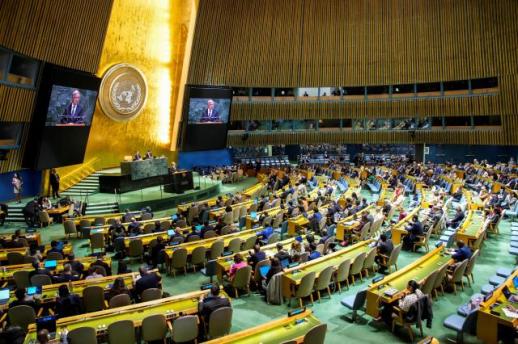 NPT talks collapse again over nuclear disputes involving N. Korea, Iran SEOUL, May 23 (AJP) - The 11th Review Conference of the Treaty on the Non-Proliferation of Nuclear Weapons (NPT) ended Friday without adopting a consensus document, as member states failed to narrow differences over North Korea, Iran and nuclear disarmament. The four-week conference, held at the U.N. headquarters in New York, had been expected to produce a final document on strengthening the NPT regime. But negotiations broke down over regional nuclear threats and how to implement disarmament commitments. It was the third straight failure after similar breakdowns in 2015 and 2022, raising concerns about the credibility of the NPT system. The latest meeting had been expected to face difficulties from the outset, as it opened amid heightened international tensions, including the U.S.-Iran war. Vietnamese Ambassador to the U.N. Do Hung Viet, who chaired the conference, announced late Friday that member states had failed to reach consensus on the final document. He later told a news conference that “no one blocked consensus,” but said “a very important reason” for the failure was a provision in the final draft stating that Iran “can never seek, develop or acquire any nuclear weapons.” Negotiators worked until the final hours, preparing a fourth revised draft and distributing it to delegations early Saturday, but still failed to bridge differences. References to North Korea’s nuclear program were removed entirely during the revision process. Kim Sang-jin, South Korea’s deputy permanent representative to the U.N., expressed deep regret that the document failed to include even a brief message on North Korea. “It should have been clearly stated that North Korea can never have the status of a nuclear-weapon state under the NPT regime,” Kim said. Viet explained that references to specific regional issues, including North Korea and Iran, had to be removed to secure space for the NPT’s three main pillars — disarmament, nonproliferation and the peaceful use of nuclear energy. Attempts to include stronger language on nuclear-weapon states’ disarmament obligations also faced resistance, while a call for follow-up talks on the expired U.S.-Russia New Strategic Arms Reduction Treaty was left out of the final draft. Izumi Nakamitsu, the U.N. high representative for disarmament affairs, criticized nuclear-weapon states for demanding nonproliferation commitments from non-nuclear states while failing to meet their own disarmament obligations. The failure to reach consensus for a third consecutive review cycle is “a serious lesson that the entire international community must take to heart,” she said. 2026-05-23 14:10:17
 -
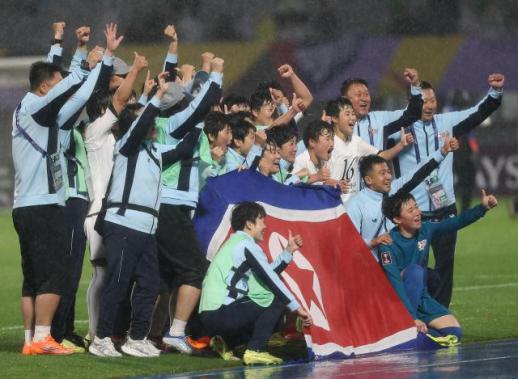 North Korean football club's South visit unlikely to thaw inter-Korean ties: report SEOUL, May 23 (AJP) - North Korean women’s football club Naegohyang FC’s recent visit to South Korea is unlikely to lead to a broader thaw in inter-Korean relations, a South Korean state-run think tank said Friday. A recent report by the Institute for National Security Strategy said the visit should be viewed not as a signal of reconciliation but as “a limited form of contact between two states through an international sporting event,” according to researcher Kim Bo-mi. Naegohyang FC arrived in South Korea on May 17 to participate in the Asian Football Confederation Women’s Champions League. The North Korean side defeated Suwon FC Women 2-1 in the semifinals on May 20 and is set to face Japan’s Tokyo Verdy in the final at 2 p.m. Saturday in Suwon. The visit marked the first trip by a North Korean sports team to South Korea since 2018, drawing attention amid prolonged tensions between the two Koreas. But Kim said the behavior of the North Korean delegation and Pyongyang’s state media coverage suggested the North was intentionally avoiding any narrative of inter-Korean reconciliation or ethnic unity. “North Korea made clear that it views South Korea not as a partner for exchange and cooperation, but as a separate state encountered in an international competition,” Kim wrote. During the tournament, North Korean players and officials also appeared cautious about attaching political meaning to the visit, repeatedly emphasizing that they were focused “only on football.” Kim said it remains unlikely that the visit will trigger rapid improvements in inter-Korean ties or revive large-scale sports exchanges such as unified Korean teams, which were pursued during periods of relatively friendly relations in the past. “For the time being, inter-Korean relations are likely to show a complex pattern in which military tensions and limited exchanges coexist,” she said. Kim urged Seoul to recognize North Korea’s participation in limited exchanges under international norms and develop policies that reflect the changing nature of inter-Korean relations. 2026-05-23 10:50:51
 -
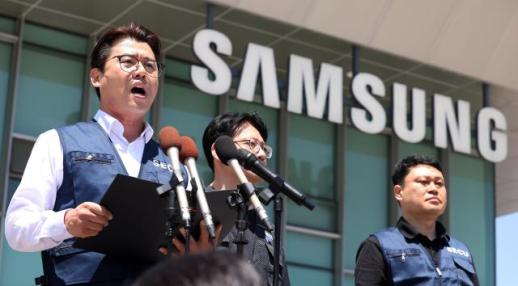 Samsung labor vote on wage deal tops 80% on second day amid bonus split SEOUL, May 23 (AJP) - Samsung Electronics union members voted for a second day on a tentative 2026 wage deal, with turnout exceeding 80 percent. According to industry sources, as of 6:40 p.m. Saturday, 46,185 of 57,290 eligible voters at the SGUU, Samsung Electronics’ largest union, had cast ballots, bringing turnout to 80.62 percent. At the National Samsung Electronics Union (NSEU), the second-largest union, 6,502 of 8,187 eligible voters had participated as of the same time, recording turnout of 79.42 percent. The combined turnout for the two unions stood at 80.47 percent. The agreement is expected to pass, but a widening bonus gap between business divisions has fueled a rejection campaign among DX employees, who work on smartphones, home appliances and TVs. Voting began at 2:12 p.m. Friday and will run until 10 a.m. May 27. The deal will be finalized if more than half of eligible union members take part and a majority of those voting approve it. If support falls short of a majority, the agreement will be rejected and labor and management will have to return to the negotiating table. The tentative deal, reached May 20, includes an average wage increase of 6.2 percent, a new housing loan program of up to 500 million won ($390,000) and a special bonus for semiconductor employees funded by 10.5 percent of the division’s business performance. Under the agreement, employees in the Device Solutions (DS) division could receive between about 210 million won and 600 million won in bonuses before tax, based on an annual salary of 100 million won. Including the new semiconductor special bonus and the existing Overall Performance Incentive (OPI), employees in the memory business could receive up to 600 million won, while those in non-memory units such as System LSI and foundry could receive about 210 million won. By contrast, DX employees are expected to receive only around 6 million won worth of treasury shares as a bonus, as the division is widely expected to miss out on OPI due to weak earnings this year. The union with the largest membership is the Samsung Electronics branch of the Samsung Group United Union (SGUU), with 70,850 members, followed by the National Samsung Electronics Union (NSEU) with 19,053 members and the Samsung Electronics Labor Union 'Donghaeng' with 12,298 members. The total membership stands at 102,298, including overlapping members. By division, DS has about 77,300 employees, outnumbering DX’s roughly 51,700. Among union members eligible to vote, 57,290 belong to the SGUU and 8,176 to the NSEU, a structure seen as favorable to passage. But opposition is growing among DX employees, as the expected bonus gap between divisions could reach nearly tenfold. Lee Ho-seok, head of the Suwon branch of the National Samsung Electronics Union, held a press conference with Donghaeng outside Samsung Electronics’ Suwon campus in Gyeonggi Province and said DX employees had officially launched a campaign to reject the deal. “We will do our best to ensure the deal is rejected by joining forces not only with DX employees but also with semiconductor employees outside the memory business,” Lee said. On May 21, DX employees joined the NSEU and Donghaeng in large numbers. Donghaeng’s membership jumped from around 2,600 to about 12,300 as of Friday morning, while the NSEU’s membership rose by roughly 3,000 from about 16,000 on May 20 to about 19,000 the following day. The SGUU told Donghaeng on Saturday that Donghaeng members would be excluded from the vote because the tentative deal was signed on May 20 after Donghaeng had left the joint bargaining group. It said eligible voters would be limited to SGUU and NSEU members listed as of 2 p.m. May 21. Donghaeng criticized the move as a reversal intended to help pass the deal, saying the SGUU had previously told unions by email that it would respect all unions’ voting rights. Donghaeng said it would proceed with its own vote regardless of the SGUU’s decision to exclude its members. Choi Seung-ho, head of the SGUU, said that if the deal is rejected, he would delegate the remaining 2026 negotiations to other union leaders and hold a vote of confidence on his leadership. If that happens, Samsung Electronics could once again face the possibility of a strike. 2026-05-23 09:48:43
 -
 From timid boy to war hero: India's wartime doctor honored in Korea SEOUL, May 21 (AJP) - At the unveiling of a new memorial near the heavily fortified border with North Korea, Kalpana Prasad, an Indian woman in her 40s and the grand-niece of Lt. Col. A.G. Rangaraj, recalled how her older family members spoke about their brother, who had served on the frontline during the Korean War. “His siblings rushed to tell their mother, but she refused to believe it because she still remembered him as a shy boy who was afraid to walk alone in the dark,” she said. “But somehow, that timid boy ended up jumping out of airplanes.” The timid boy was Lt. Col. A.G. Rangaraj, an army doctor who led an Indian medical unit during the 1950-53 war. Rangaraj and fellow veterans were posthumously honored at a ceremony on Thursday at Imjingak in Paju, north of Seoul, where officials unveiled a memorial recognizing India’s contribution as part of events marking the 76th anniversary of the outbreak of the conflict. The ceremony was attended by visiting Indian Defense Minister Rajnath Singh, who was hosted by Patriots and Veterans Affairs Minister Kwon Oh-eul. The two sides signed a memorandum of understanding on international veterans affairs cooperation aimed at strengthening exchanges in honoring and remembering those who served. One of six countries that provided non-combat support to South Korea during the conflict, India’s contribution came largely in the form of medical and humanitarian aid. The country’s 60th Parachute Field Ambulance, one of the largest medical units sent by a supporting nation, deployed 627 medical personnel. One of the unit’s best-known operations came during Operation Tomahawk on March 21, 1951, near Munsan, north of Seoul, when members attached to the U.S. Army’s 187th Airborne Regimental Combat Team parachuted into enemy territory as part of a combat airborne operation. Amid intense frontline fighting, they established medical facilities and treated wounded soldiers. Led by Rangaraj, the Indian unit treated 200,000 patients and performed 2,500 surgeries. For South Korea, the new memorial carries symbolic weight not only because of India’s wartime role, but also because of its location. Just south of the Demilitarized Zone, Imjingak has long served as a site of remembrance for the war and hope for peace on the still-divided peninsula. The presence of Rangaraj’s family added a personal dimension to Thursday’s ceremony, turning the memorial from a diplomatic event into a reminder of the individual lives behind wartime history. Rangaraj, who completed his medical degree in 1941 before joining the army, became India’s first paratrooper doctor. He was honored in Seoul as the Ministry of Patriots and Veterans Affairs’ Korean War Hero of the Month in March this year. “It is an honor for all of us to know that he has been nominated as a Korean War hero by the government of the Republic of Korea,” Prasad said. In addition to the medical unit, India also played a major postwar role through the Neutral Nations Repatriation Commission. A 5,230-strong Custodian Force of India helped carry out the peaceful repatriation of some 2,000 prisoners. The memorial features busts of Rangaraj and another Indian figure closely associated with the Korean War, Gen. K.S. Thimayya, who chaired the U.N. Neutral Nations Repatriation Commission at the time of the armistice. The memory of the unit’s Korean War service remains alive in Agra, the northern Indian city that is home to the Taj Mahal. The city also hosts the 50th Independent Parachute Brigade, one of the Indian Army’s elite airborne formations, under which the 60th Parachute Field Ambulance continues its medical support mission. During AJP’s visit to the brigade in March, Col. Jagneet Gill, the current commanding officer of the 60th Parachute Field Ambulance, said the unit’s deployment to Korea remains an important part of its identity. “The 60th Parachute Field Ambulance is a key medical support unit under the Indian Army’s 50th Independent Parachute Brigade, and we supported wounded people during the Korean War,” Gill said. “It was really nice to have the chance to visit South Korea last November at the invitation of the Korean government.” Decades later, the legacy of the Korean War continues to resonate in the hearts of both nations. 2026-05-21 18:05:00
 -
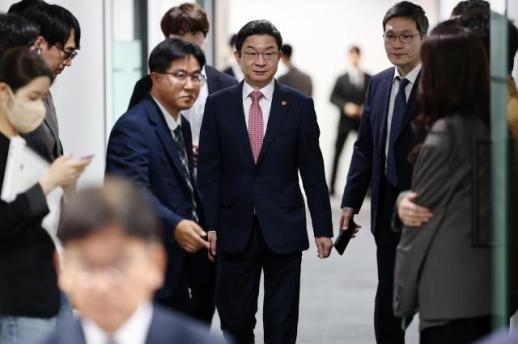 FSC to offer low-rate insurance for 10 Korean ships near Hormuz SEOUL, May 21 (AJP) - Financial Services Commission Chairman Lee Eok-won said Thursday the government will provide low-rate marine insurance for 10 vessels operated by small and midsized Korean shipping companies currently waiting near the Strait of Hormuz. Lee made the remarks during a meeting with shipping companies, policy lenders and insurers in Seoul, the fourth in a series of industry-finance meetings aimed at supporting sectors hit by the Middle East conflict. “The high and prolonged waves triggered by the Middle East war are increasing the management burden on shipping companies through higher operating costs, including fuel expenses, and opportunity costs from route restrictions,” Lee said. He said smaller shipping firms could face difficulties securing insurance for their vessels’ safe return, as marine insurance for large and special risks depends heavily on overseas reinsurers. Under the support plan, 10 domestic nonlife insurers will jointly underwrite war-risk insurance for the vessels without relying on overseas reinsurance. The participating insurers include Hyundai Marine & Fire Insurance, Samsung Fire & Marine Insurance, Meritz Fire & Marine Insurance, KB Insurance and Hanwha General Insurance. The coverage is expected to total about 300 billion won ($200 million) based on the value of the vessels subject to the insurance. The FSC said the insurance will be offered at the lowest rate available among domestic shipping companies, including large carriers. If a lower rate is later applied to another Korean vessel after the contracts are signed, the same rate will be applied retroactively through measures such as premium refunds. The support measure takes effect immediately. Lee also said the FSC will review, in consultation with relevant ministries, ways to establish a standing reinsurance program to expand coverage to major vessels with significant impact on the national economy. Regarding Namu, a midsized bulk carrier operated by HMM that caught fire after an external attack, Lee urged insurers to swiftly proceed with related procedures so that reasonable compensation can be provided. 2026-05-21 17:26:20
 -
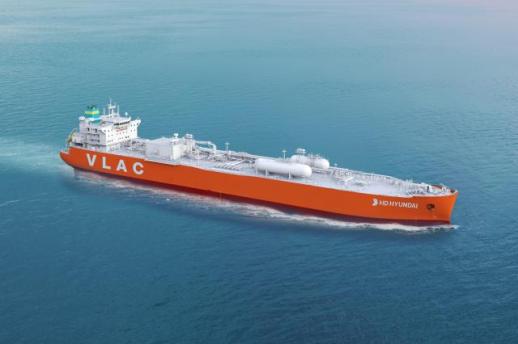 HD Korea Shipbuilding wins $1.2 bln order for 6 ammonia carriers SEOUL, May 21 (AJP) - HD Korea Shipbuilding & Offshore Engineering said Thursday it has signed a contract with a European shipowner to build six very large ammonia carriers. The deal is worth 1.08 trillion won ($1.2 billion), the intermediate shipbuilding holding company of HD Hyundai said in a regulatory filing. The vessels will be built by HD Hyundai Samho and delivered by the second half of 2029. With the latest order, HD Korea Shipbuilding has secured orders for 104 vessels worth $12.54 billion so far this year, achieving 53.8 percent of its annual target of $23.31 billion. By vessel type, the company has won orders for 16 liquefied natural gas carriers, 26 container ships, 26 liquefied petroleum gas and ammonia carriers, seven crude oil carriers, 26 product carriers, two pure car and truck carriers and one other vessel. The order comes as HD Hyundai is also expanding its presence in next-generation energy sectors beyond shipbuilding. The company and Hyundai Engineering & Construction said Thursday they were selected as preferred bidders to manufacture and supply key equipment for TerraPower’s fourth-generation Natrium reactor, a sodium-cooled fast reactor being developed by the U.S. SMR company founded by Bill Gates. HD Hyundai Heavy Industries signed a basic agreement with TerraPower on the reactor supply, while Hyundai E&C plans to discuss participation in engineering, procurement and construction work for follow-up commercial units. 2026-05-21 17:12:13
 -
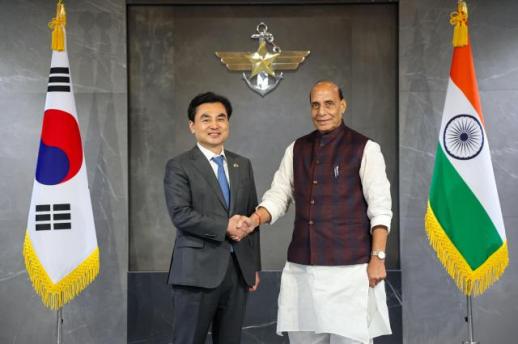 Korea, India discuss expanding arms cooperation in first defense talks in 7 years SEOUL, May 20 (AJP) - South Korean Defense Minister Ahn Gyu-back discussed ways to expand defense and defense industry cooperation with his Indian counterpart Rajnath Singh in Seoul on Wednesday, the Defense Ministry said. During the meeting at the ministry’s headquarters in Seoul, the two ministers agreed to further broaden cooperation in defense and arms industry fields, building on the “joint strategic vision” adopted at last month’s summit between the leaders of the two countries. On defense industry cooperation, the two sides positively assessed past achievements, including exports of K9 self-propelled howitzers to India, and agreed to continue expanding cooperation. The two countries also signed agreements to support more practical cooperation in areas such as cybersecurity, U.N. peacekeeping operations and exchanges between their national defense universities. Ahn explained South Korea’s consistent efforts to restore inter-Korean trust and resume dialogue with North Korea for peaceful coexistence on the Korean Peninsula, while asking for India’s continued support. The meeting was arranged after Ahn invited Singh to South Korea during the 12th ASEAN Defense Ministers’ Meeting-Plus last year. It marked the first visit by an Indian defense minister to South Korea since 2019. Separately, Lee Yong-cheol, head of the Defense Acquisition Program Administration, met Singh to discuss defense industry cooperation and held the Korea-India Defense Forum. “The K9 self-propelled howitzer is a representative success story of Korea-India defense industry cooperation,” Lee said, expressing hope that the two countries would continue expanding cooperation not only in ongoing projects but also across a broader range of weapons systems. The two sides also discussed the launch of the Korea-India Defense Innovation Platform, or KIND-X, aimed at accelerating defense cooperation in emerging technologies such as artificial intelligence and unmanned aerial vehicles. Hanwha Aerospace and Hanwha Systems each signed memorandums of understanding with Larsen & Toubro, India’s leading defense company, in the presence of Lee and Singh. 2026-05-20 18:13:02
 -
 S. Korea pushes nuclear submarine plan, but fuel supply remains key hurdle SEOUL, May 20 (AJP) - South Korea’s long-running ambition to deploy nuclear-powered submarines has gained fresh momentum as Seoul and Washington move to implement security agreements reached at their latest summit, though securing nuclear fuel remains the project’s biggest obstacle. The challenge facing the program is no longer simply whether South Korea can build or acquire nuclear-powered submarines, but how it would fuel them. According to data submitted by the Ministry of National Defense on Wednesday, the Navy recently filed a formal request with the Joint Chiefs of Staff for the acquisition of Korean nuclear-powered submarines. The request marks the first step in South Korea’s weapons acquisition process, under which the military formally outlines operational requirements, deployment concepts, the number of units needed and the projected timeline for a new weapons system. The Navy confirmed it had “made a formal request related to the construction of nuclear-powered submarines,” but declined to disclose details. The Joint Chiefs of Staff is reviewing the proposal and is expected to make a decision as early as this month through a formal meeting. Diplomatic coordination between Seoul and Washington is also accelerating. A senior U.S. delegation led by the under secretary of state for political affairs is expected to visit South Korea within weeks as the allies activate a bilateral working group formed after last year’s summit agreements. The nuclear-powered submarine project has long been a strategic objective for South Korea’s military, dating back to the administration of former President Kim Young-sam. The initiative has repeatedly advanced and stalled under successive governments. During a summit held on the sidelines of the Asia-Pacific Economic Cooperation summit last October, U.S. President Donald Trump and President Lee Jae Myung reportedly reached broad agreements on trade and security cooperation, including deeper discussions on strategic naval capabilities. Military authorities have reportedly considered acquiring at least four nuclear-powered submarines with a displacement of 5,000 tons or more after the mid-2030s, though the size and number of vessels may have changed during internal reviews. The central issue, however, remains nuclear fuel. During a visit to Seoul in April, Rafael Grossi said South Korea would require a separate safeguards arrangement with the International Atomic Energy Agency if it proceeds with nuclear-powered submarines. Grossi noted that nuclear material used in such vessels is “not continuously accessible to inspectors” because of the operational nature of submarine reactors. Because nuclear-powered submarines rely on onboard reactors, securing enriched uranium or other nuclear fuel is essential. If South Korea seeks to produce such fuel domestically or obtain related materials or technology from the United States, separate bilateral negotiations and institutional arrangements would likely be required. Reuters reported last December that South Korea’s push for nuclear-powered submarines could mark the end of “decades of U.S. resistance,” while also warning that the move could trigger an underwater arms race in Asia. The U.S. think tank Pacific Forum has also noted that the South Korea-U.S. nuclear cooperation agreement is focused primarily on civilian nuclear energy. Any transfer of naval nuclear fuel or related technologies could require revisions to the agreement, potentially sparking political debate in Washington. Suh Kune-yull, a professor of nuclear engineering at Seoul National University, said nuclear-powered submarines do not necessarily require highly enriched uranium. “When we talk about enrichment, people usually think of highly enriched uranium with more than 20 percent uranium-235, but nuclear-powered submarines do not necessarily have to use that level of fuel,” Suh said. “It is technically possible to use low-enriched uranium of around 5 percent, similar to the fuel used in nuclear power plants, and France and China are known to operate nuclear-powered submarines based on low-enriched uranium,” he added. The government is pushing to unveil a basic development plan for Korean nuclear-powered submarines by the end of this month. The blueprint is expected to outline Seoul’s principles on acquiring such vessels, construction plans and its stance on nuclear nonproliferation. But whether the initiative evolves beyond a political declaration into a practical roadmap may ultimately depend on how clearly Seoul addresses the question of nuclear fuel supply. 2026-05-20 17:44:42
 -
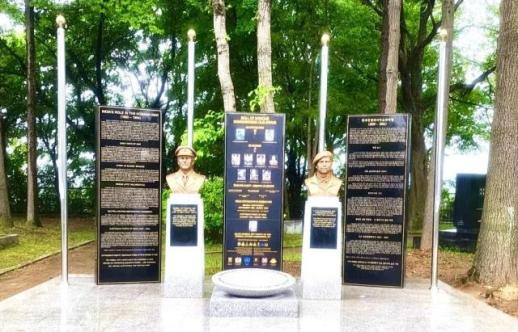 Korea, India to sign MOU on honoring Korean War veterans SEOUL, May 20 (AJP) - South Korea and India will work together on international veterans affairs projects to honor Indian veterans who served in the 1950-53 Korean War as part of a medical support unit, Seoul’s Veterans Affairs Ministry said Wednesday. Minister of Patriots and Veterans Affairs Kwon Oh-eul and visiting Indian Defense Minister Rajnath Singh will sign a memorandum of understanding on bilateral cooperation in international veterans affairs at the Indian Korean War Memorial in Imjingak, Paju, Gyeonggi Province, on Thursday. Under the MOU, the two countries will cooperate in collecting historical records related to India’s participation in the war, honoring veterans, promoting exchanges for veterans’ descendants and future generations, and carrying out academic, educational and cultural projects to shed light on the significance of India’s contribution. After signing the agreement, the two ministers will also attend an unveiling ceremony for the first memorial in South Korea dedicated to Indian Korean War veterans, built by India’s Defense Ministry. The memorial includes busts of Lt. Col. A.G. Rangaraj, who commanded a field hospital during the Korean War, and Gen. K.S. Thimayya, who served as chairman of the Neutral Nations Repatriation Commission after the armistice agreement. Rangaraj was selected by Seoul’s Veterans Affairs Ministry as the Korean War Hero of the Month in March. During the unveiling ceremony, Kwon will present a plaque recognizing the honor to Rangaraj’s descendant, Kalpana Prasad. When the Korean War broke out, India, then a neutral country, dispatched the largest medical contingent among countries that sent medical support, in line with a U.N. resolution on civilian relief. India’s 60th Parachute Field Ambulance arrived in Busan in 1950 and treated many soldiers and patients near the front lines while moving alongside combat units. 2026-05-20 15:45:58