
Journalist

Kim Hee-su
khs@ajupres.com
-
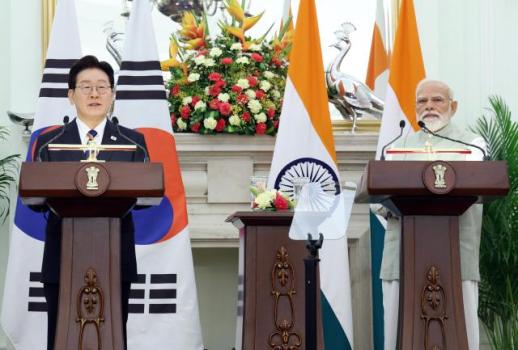 Lee, Indian PM Modi agree to upgrade CEPA, target $50 bln trade SEOUL, April 20 (AJP) - President Lee Jae Myung and Indian Prime Minister Narendra Modi agreed Monday to continue negotiations to upgrade their bilateral trade pact with the aim to double two-way trade to $50 billion by 2030. At a summit held during Lee’s state visit to India, the two leaders announced they would resume talks on upgrading the Comprehensive Economic Partnership Agreement (CEPA) in May, seeking to modernize the framework in response to evolving supply chain and trade conditions. “We agreed to speed up the negotiations to upgrade our CEPA to create more favorable trade and investment conditions and better respond to the changing trade environment,” Lee said during a joint press statement. Modi also emphasized strengthening economic cooperation. “We have set a target to take bilateral trade to $50 billion by 2030,” Modi said, adding that the two sides would work to upgrade the trade agreement and expand economic ties. The leaders agreed to broaden cooperation across strategic sectors including shipbuilding, finance, artificial intelligence and defense, while also strengthening cultural and people-to-people exchanges. “We have agreed to expand cooperation in strategic industries such as shipbuilding, finance, AI and defense, and promote cultural and people-to-people exchanges,” Lee said. As part of efforts to institutionalize economic cooperation, the two countries agreed to establish an “Industrial Cooperation Committee,” their first ministerial-level platform dedicated to economic collaboration. Lee said the body would help strengthen cooperation not only in trade and investment but also in strategic areas such as critical minerals, nuclear energy and clean energy. The two sides also signed a memorandum of understanding on port cooperation, establishing a framework that covers port infrastructure development and personnel exchanges. “In the field of shipbuilding, we aim to bring together the outstanding technology of Korean businesses and the policy support of India’s central and local governments so that Korean companies can seek new opportunities in the Indian market,” Lee said. “In the field of finance, cooperation between financial authorities will serve as a foundation for Korean financial institutions to enter India,” he added. The two countries will expand cultural cooperation, including the establishment of a “Korea Center” in Mumbai, which is expected to serve as a hub where K-pop and Bollywood intersect. The leaders also exchanged views on regional and global issues, including the situation in the Middle East and on the Korean Peninsula. “We agreed that restoring stability and peace in the Middle East is crucial to global security and the economy,” Lee said. He also briefed Modi on Seoul’s efforts to build peace on the Korean Peninsula and expressed hope that India would continue to play a constructive role in the region. 2026-04-20 18:32:07
 -
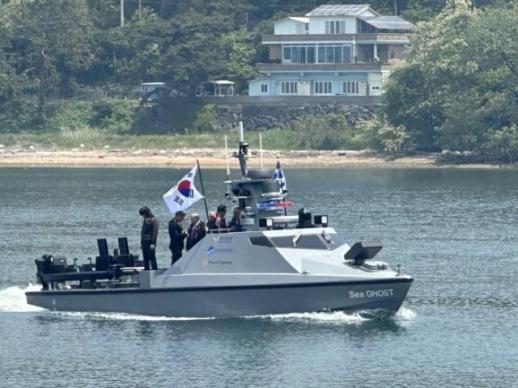 Seoul pushes fleet of war robots but who's in charge over them unclear SEOUL, April 20 (AJP) - Unmanned systems are rapidly reshaping modern warfare, from the battlefields of Ukraine to the Gulf, and South Korea is accelerating its push toward autonomous combat capabilities under its “Army Tiger 4.0” modernization drive. The initiative reflects a broader shift across the military, as the Army, Navy and Air Force each move to build their own unmanned fleets. But a central question remains unresolved: who commands this expanding ecosystem of robots across land, sea and air. Under Army Tiger 4.0, the future battlefield envisions “non-bleeding” robots moving first, with human soldiers positioned one step back. Unmanned ground vehicles (UGVs) and drones are designed to scout, transport supplies and even fight on the front line. A multipurpose UGV — with Hanwha Aerospace and Hyundai Rotem competing for selection as early as June — is a key pillar of the plan. Progress so far had been limited. In a 2023 study, defense scholars Kim Dong-beom and Kim Ho-sung said autonomous efforts were still at the “demonstration and limited experimentation” stage and that “widespread fielding across multiple echelons has yet to be achieved.” They added that turning Army Tiger 4.0 into routine practice “will require long-term force restructuring, sustained investment and iterative validation through exercises,” rather than one-off trials. Structural issues compound the challenge. Jung Yeon-bong of the Institute for National Security Strategy pointed to “the absence of a real control tower,” as well as a continued reliance on “platform-by-platform procurement” and service-centric development. A separate study by Baek Seoung-jin and Bae Hack-young of the Korea Association of Defense Industry Studies found that systems are still being developed in “separate stovepipes,” leaving doctrine and training “several steps behind the speed of technological change.” Navy: toward a “ghost fleet” At sea, the Navy is pursuing a similar transformation through its “Sea GHOST” program — a hybrid force combining crewed warships with unmanned surface vessels (USVs), underwater drones and aerial systems. These systems are designed to take on high-risk missions such as mine clearance, surveillance and tracking enemy vessels. The long-term vision includes a “mothership” capable of controlling multiple unmanned platforms and eventually a dedicated unmanned command. Development, however, remains fragmented. Different programs use incompatible software and data systems, making it difficult to operate them as a unified fleet — a recurring problem across services. Companies including LIG Nex1, Hanwha Systems and HD Hyundai Heavy Industries are racing to develop combat-ready USVs, with deployment targeted in the 2030s. Air Force: manned fighters with unmanned wingmen In the air, the South Korean Air Force is placing unmanned systems at the core of future combat operations. The concept pairs manned jets such as the KF-21 Boramae with “loyal wingmen” — unmanned aircraft that can perform reconnaissance, electronic warfare and strike support. The government is developing a “Korean-style MUM-T” architecture to enable this integration, targeting an open framework by 2028. But the gap between concept and deployment remains significant. Researchers at the Korea Research Institute for Defense Technology Planning and Advancement said current programs are still “in the phase of technology verification and concept demonstration.” They warned that large-scale exercises combining manned and unmanned aircraft under realistic electronic-warfare conditions “have been very limited so far.” A further constraint is operational: without secure communications networks — including beyond-5G links and low-Earth-orbit satellite relays — “AI-driven MUM-T and CJADC2 cannot function as intended in real war,” one defense expert said. Across all domains, the same problem emerges — fragmentation. Experts say South Korea lacks a unified command structure to coordinate unmanned systems development across the services. The result is parallel programs rather than an integrated force. The experience of the Drone Operations Command underscores the issue. Established in 2023, it faced criticism for overlapping roles and limited effectiveness, leading to restructuring in early 2026 rather than expansion. Some analysts argue that South Korea needs a smaller, joint unmanned task force capable of rapid experimentation — closer to models seen in Ukraine and the United States, where frontline units quickly adapt and scale technologies based on battlefield feedback. 2026-04-20 17:45:15
 -
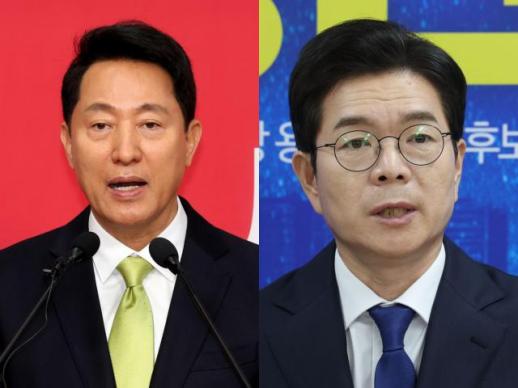 Seoul Mayor Oh to face DPK's Chung in June mayoral race SEOUL, April 18 (AJP) - Seoul Mayor Oh Se-hoon has been confirmed as the main opposition People Power Party’s candidate in the June 3 local elections, facing Chung Won-o of the ruling Democratic Party of Korea. The PPP’s nomination committee announced Saturday that Oh won the party’s primary, defeating Rep. Park Soo-min and former lawmaker Yoon Hee-sook. If elected, he would secure a third consecutive term since returning to office in 2021 and a fifth overall term as mayor. Oh said he would “solemnly accept” the mandate to safeguard Seoul and restore balance in the country, adding, “If I am elected, I will take it as a call to rebuild the opposition,” he said, vowing to push for political reform. Born in 1961, Oh entered politics by winning a parliamentary seat in Seoul’s Gangnam district in 2000. He later became Seoul mayor in 2006 and was re-elected in 2010, but resigned in 2011 after staking his position on a citywide vote over whether to provide free school lunches to all students or only to low‑income children. He returned in 2021 through a by-election and won another term in 2022. His rival, Chung, is a three-term district mayor who has been publicly praised by President Lee Jae Myung, earning him the nickname “Lee’s pick.” After Oh was chosen as the PPP’s candidate, Chung wrote on his social media account that he hoped the upcoming election would be “a fair competition based on policies and competence” in addressing citizens’ livelihoods and the future of Seoul. A poll released Friday by Gallup Korea showed a sharp divide in party support, with the DPK at 48 percent and the PPP at 19 percent. In the same survey of 1,000 adults conducted from April 14 to 16, 45 percent of respondents said they wanted more ruling party candidates to win the June 3 elections, while 28 percent preferred opposition candidates. 2026-04-18 16:45:27
 -
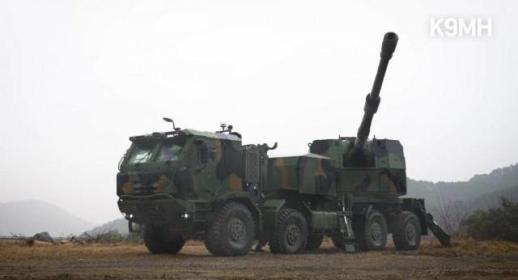 Hanwha's new K9 wheeled howitzer draws global attention after viral test video SEOUL, April 18 (AJP) - A test video of Hanwha Aerospace’s new wheeled self-propelled howitzer, the K9MH, has spread widely on social media, drawing attention to its performance. The U.S. Army is pursuing a major program to replace its current 155mm M777 towed howitzers with wheeled self-propelled systems. Hanwha’s U.S. unit, Hanwha Defense USA, said last month it had proposed the K9MH for the program. The company is also reviewing plans to produce the system in Alabama if selected, and is reportedly planning to invest about $1.3 billion to build an ammunition plant in Arkansas. The K9MH is based on Hanwha’s flagship K9 self-propelled howitzer platform. It mounts a fully automated K9 turret on an 8×8 chassis from Tatra Trucks, a widely used solution for wheeled artillery, reducing the crew to three. Compared with the tracked K9, it is seen as offering lower maintenance costs and greater strategic mobility. Although not from official sources, footage filmed at a test site in Changwon, South Korea, has circulated on overseas social media, showing live-fire exercises of the K9MH. The video includes ammunition loading and firing sequences, demonstrating a dual-feed system that transports projectiles and propellant charges via separate conveyors. The system showed a firing cycle of about 7.5 seconds, delivering nine rounds per minute. Ukrainian defense outlet Defense Express said the K9MH’s performance is comparable to Sweden’s Archer artillery system, one of the leading automated wheeled howitzers, which typically fires eight to nine rounds per minute with a loading cycle of around eight to nine seconds. It added that the K9MH could outperform Germany’s RCH 155 in terms of reload speed. However, the outlet noted that the Archer retains an advantage in deployment speed. The Archer takes about 23 seconds to fire its first round after stopping and 34 seconds to leave position, compared with roughly 20 seconds and 50 seconds, respectively, for the K9MH. The U.S. Army is expected to select candidates for the next phase of the program in July, with a final decision scheduled for the fourth quarter of 2027. Other contenders include Rheinmetall’s RCH 155, Elbit America’s Sigma, and BAE Systems’ Archer. 2026-04-18 15:19:07
 -
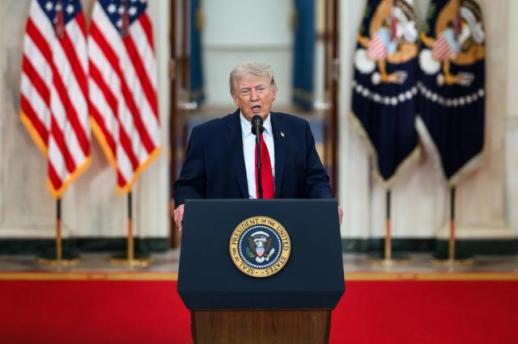 Trump warns of no ceasefire extension as U.S.-Iran talks set for April 20 SEOUL, April 18 (AJP) - U.S. President Donald Trump on Friday warned that the United States may not extend the ceasefire with Iran if no agreement is reached by April 22, stepping up pressure on Tehran. “Maybe I won’t extend it, but the blockade is going to remain. So you have a blockade, and unfortunately we’ll have to start dropping bombs again,” he said aboard Air Force One while returning to Washington from Phoenix, Arizona. The United States and Iran agreed to a two-week ceasefire proposal put forward by Pakistan on April 7, setting April 21 as the initial deadline for reaching a broader agreement. It remains unclear whether Trump’s reference to April 22 reflects an extension of the deadline or a misstatement. A second round of ceasefire talks between the United States and Iran is likely to be held on April 20 in Islamabad, Pakistan, U.S. officials said. Iranian officials also told CNN that their delegation is expected to arrive in Islamabad on April 19, with negotiations likely to take place the following day. Iran has also raised expectations for a deal by announcing that it would fully allow commercial shipping through the Strait of Hormuz following ceasefire declarations between Israel and Lebanon. However, major differences remain over key issues, including uranium enrichment and Iran’s nuclear program. The first round of talks collapsed after the two sides failed to narrow differences on enrichment. U.S. media reported that Washington had softened its earlier demand for a complete ban on uranium enrichment, instead proposing a 20-year suspension. Iran reportedly countered with a five-year proposal, preventing a breakthrough. Trump earlier said Iran had “agreed to everything,” including not possessing nuclear weapons, and would hand over what he described as “nuclear dust” buried underground following U.S. strikes involving B-2 bombers last June. But Iranian Foreign Ministry spokesperson Esmaeil Baghaei rejected the claim in an interview with state-run IRIB, saying Iran’s enriched uranium “will not be transferred anywhere.” 2026-04-18 13:09:59
 -
 Health authorities say current vaccines remain effective amid concerns over new COVID-19 variant SEOUL, April 18 (AJP) - The Korea Disease Control and Prevention Agency (KDCA) said Saturday that current COVID-19 vaccines remain effective against a new variant, urging the public not to overreact. The agency cited an assessment by the World Health Organization regarding the BA3.2 variant, noting that currently approved COVID-19 vaccines are “expected to continue providing protection against severe disease,” and adding that there is “no data indicating increased severity” associated with the variant. According to the KDCA, BA3 — a sublineage of the Omicron variant — briefly appeared in early 2022 before disappearing. Its subvariant, BA3.2, was first identified in South Africa in November 2024. The agency said that although the BA3.2 variant could contribute to a rise in cases domestically, it is continuing to closely monitor the situation. The COVID-19 positivity rate at local clinics rose to 6.3 percent in the 15th week (April 5–11), up from 4.7 percent a week earlier. During the same period, the BA3.2 variant accounted for 23.1 percent of cases, making it the third most prevalent strain. As of last month, PQ2 and NB1.8.1 led with 34.6 percent each, followed by BA3.2 at 23.1 percent and XFG at 3.8 percent. A KDCA official said, “The WHO has assessed that the BA3.2 variant does not significantly change disease severity, and current vaccines remain effective. Excessive concern is unnecessary at this stage.” The official, however, urged high-risk groups, including those aged 65 and older and immunocompromised individuals, to get vaccinated, with vaccinations available through June 30. 2026-04-18 10:36:17
 -
 President Lee signals South Korea role in safeguarding Hormuz shipping lanes SEOUL, April 18 (AJP) - President Lee Jae Myung on Friday said South Korea would make a “substantive contribution” to efforts to safeguard navigation in the Strait of Hormuz. Lee made the remarks during an international summit on maritime security in the strait, where leaders discussed coordinated efforts to restore safe passage through one of the world’s most critical energy chokepoints. According to the presidential office, Lee emphasized that disruptions in the strait — a vital artery for global supply chains — have shaken energy, financial, industrial and food security worldwide. He also raised concerns over the safety and well-being of seafarers, including South Korean nationals, who remain stranded amid ongoing instability. “South Korea is a key stakeholder, importing about 70 percent of its crude oil through the Strait of Hormuz,” Lee said, adding that Seoul would make “a substantive contribution” to ensuring freedom of navigation. Lee further said the government would actively explore ways to expand diplomatic and military cooperation in response to evolving conditions. The summit, attended by representatives from 49 countries, lasted about 90 minutes. While China and Japan also took part, they were represented by non-head-of-state officials. Among leaders participating virtually, Lee was the first to speak and delivered remarks lasting approximately four minutes and 40 seconds, slightly exceeding the allotted three-minute speaking time. Lee’s remarks come amid growing discussions over a potential multinational maritime mission, led by the United Kingdom and France, being prepared as a postwar, strictly defensive effort to safeguard shipping and restore freedom of navigation in the Strait of Hormuz. At a joint press conference, French President Emmanuel Macron said recent developments were “encouraging” for the transport of gas, fertilizers and other goods, while cautioning that risks remain. British Prime Minister Keir Starmer said, “More than a dozen countries have already offered to contribute assets” to help safeguard navigation in the strait. Momentum for international involvement may be building, as Iran earlier in the day announced it would fully reopen the waterway, raising expectations for progress in ceasefire negotiations. U.S. President Donald Trump welcomed the announcement, writing “THANK YOU!” on his social media platform Truth Social. However, he added that the naval blockade would remain “in full force and effect” until a deal with Iran is “100% complete.” 2026-04-18 09:35:10
 -
 South Korea eyes role in Europe-led Hormuz security push after Gulf war SEOUL, April 16 (AJP) -South Korea is moving to join Europe-led multinational talks aimed at restoring safe passage through the Strait of Hormuz once the Gulf conflict subsides, signaling a cautious but deliberate step toward postwar maritime security operations. The presidential office said Thursday that President Lee Jae Myung is “positively” considering participation in a video summit set for Friday, bringing together 70 to 80 countries and international organizations with stakes in the strategic waterway, which carries roughly one-fifth of global energy shipments. “It is in our interest to work with like-minded states to ensure the free and safe reopening of the Strait of Hormuz,” a senior official said. The meeting, led by the United Kingdom and France, is expected to focus on postwar plans to restore freedom of navigation in the chokepoint. Defense Minister Ahn Gyu-back told a parliamentary hearing earlier this week that London and Paris are spearheading discussions on forming a multinational maritime force, adding that Seoul has already signaled its willingness to take part. “As a responsible member of the international community, we are preparing step-by-step plans,” Ahn said, noting that a four-phase strategy has been drawn up in coordination with the Joint Chiefs of Staff and the Defense Ministry. Military officials say options under review range from dispatching personnel to a multinational command structure to providing remote or logistical support without a direct deployment to the strait. French President Emmanuel Macron said Tuesday the initiative would take the form of an international security mission excluding parties directly involved in the conflict — namely the United States, Israel and Iran. The European-led framework aims to ensure safe navigation through the strait even after active fighting subsides, though officials cautioned that restoring full maritime operations could take time. Germany, historically cautious about overseas deployments, is also likely to participate, according to a senior official. Its involvement would broaden the scope of the mission, given Berlin’s financial resources and key military capabilities. Seoul has already taken part in online consultations led by the UK and France. Joint Chiefs of Staff Chair Jin Young-seung joined videoconference discussions on March 26 and again on Wednesday, alongside parallel vice foreign minister-level talks. With limited allied support to reopen the chokepoint — where traffic has dwindled under tight Iranian control — Washington has moved unilaterally. U.S. forces began a “reverse blockade” on Iranian activities over the water corridor since earlier this week. President Donald Trump said on Truth Social that the United States had begun “clearing out” the strait “as a favor” to countries including China, Japan, South Korea, France and Germany, while criticizing them for failing to act. Despite a ceasefire, uncertainty persists over when the strait can fully reopen. A report by The New York Times said Iran has been unable to locate or remove naval mines it previously deployed, complicating efforts to resume maritime traffic. Citing U.S. officials, the report added that Tehran may not have recorded the precise locations of all the mines, some of which were designed to drift with ocean currents. While Iran has released maps indicating safe routes, those corridors are considered limited. Analysts say South Korea could be assigned mine-clearing duties if it joins the mission. “Possible roles would likely include mine removal, securing the strait and escorting oil tankers,” said Jeong Kyung-woon, a researcher at the Korea Association of Military Studies. He added that even the formation of a multinational naval force could itself serve as pressure on Iran by narrowing its strategic options. Ahn emphasized that any deployment would only take place after the war ends. Experts urged caution. “While South Korea is allied with the United States, it is important to avoid being drawn into a conflict that is not directly our own,” said Choi Gi-il, a professor of military studies at Sangji University. Separately, top naval commanders from South Korea, the United States and Japan held talks in Seoul on Wednesday — the first such trilateral meeting since 2022 — fueling speculation that Washington may seek broader allied support for Hormuz-related operations. 2026-04-16 15:33:22
 -
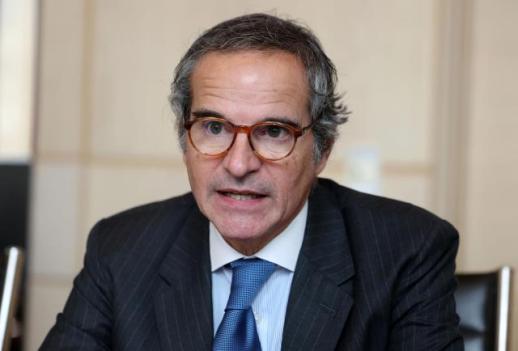 IAEA urges safeguard on Korea's nuclear submarine plan, verification on Iran SEOUL, April 15 (AJP) - South Korea must enter into a special safeguards arrangement with the International Atomic Energy Agency (IAEA) if it proceeds with nuclear-powered submarines to ensure that nuclear material is not diverted from propulsion use, its director general said Wednesday. “The use of nuclear technology to power submarines has a number of very important technical implications,” IAEA Director General Rafael Grossi said at a press briefing in Seoul, describing the visit as a “kickoff” for discussions with Seoul on its naval nuclear propulsion plans. As a signatory to the Nuclear Non-Proliferation Treaty (NPT), South Korea is subject to IAEA safeguards. However, Grossi noted that nuclear-powered submarines pose a unique challenge because fuel loaded into vessels on long missions falls outside routine inspections. “Because of the nature of these vessels, the nuclear material is not continuously accessible to inspectors,” he said, warning that large quantities of enriched uranium — potentially even highly enriched uranium — could remain outside direct oversight for extended periods. To address this, Grossi stressed the need for a tailored verification system between the IAEA and South Korea to ensure that nuclear material is not diverted for military purposes beyond propulsion. “We need technically sound arrangements so we can verify that the material remains where it is and is used only for propulsion,” he said, adding that such frameworks are being developed with countries including Australia and Brazil. He emphasized that “ironclad guarantees” are essential to ensure the program does not contribute to nuclear proliferation, noting that the process would involve coordination across government, military and shipbuilding sectors. Grossi also cautioned that developing nuclear-powered submarines is a long-term undertaking, likely to take many years, involving extensive research, construction and testing phases. On Iran, Grossi said the country has already mastered uranium enrichment technology and currently possesses roughly 440 kilograms of uranium enriched up to 60 percent, with most of the stockpile located at known sites such as Isfahan. He described any potential suspension of enrichment as a “political decision,” noting that the duration of a moratorium — whether five, 10 or 20 years — carries little technical difference but reflects levels of political trust. More importantly, he stressed that any nuclear agreement must include rigorous verification. “Without verification, any agreement is just a piece of paper,” Grossi said. “We must be able to check every gram of nuclear material and how it is used.” Turning to North Korea, Grossi said the IAEA has observed a continued expansion of nuclear activities, including operations at Nyongbyon and other facilities, despite the absence of inspectors since 2009. Recent assessments indicate a “significant increase” in Pyongyang’s nuclear capabilities, with estimates suggesting the country may have material sufficient for dozens of nuclear warheads. While there is no clear evidence of Russian military nuclear assistance, he said current cooperation between Moscow and Pyongyang appears limited to civilian nuclear projects. Grossi reiterated that pursuing nuclear weapons does not enhance national security, warning instead that it risks triggering a broader arms race. “Moving toward nuclear weapons would not give any country greater security,” he said. “It would encourage others to follow, leading to dangerous escalation.” Grossi also addressed his candidacy for the next United Nations secretary-general, highlighting what he described as a deepening crisis of confidence in the global body. “The world is going through a very difficult period marked by polarization and multiple conflicts,” he said, calling the upcoming leadership transition a critical moment to restore trust in multilateral institutions 2026-04-15 15:44:43
 -
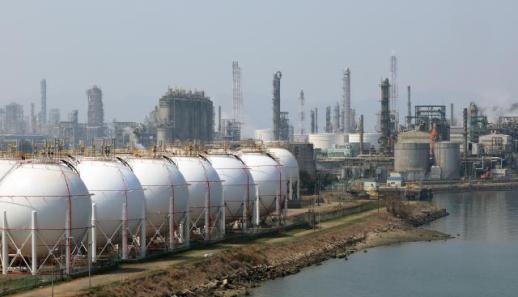 Korean refiners activate 'Plan B' as Hormuz risks complicate crude diversification SEOUL, April 14 (AJP) - South Korea’s refiners are activating contingency plans to diversify crude imports from North America as tensions around the Strait of Hormuz escalate, though analysts warn that hidden costs could limit the effectiveness of such moves. At first glance, alternative sourcing appears feasible. But industry officials say higher freight rates, refinery compatibility issues, and premiums on substitute crude could significantly raise costs. According to the Korea Petroleum Association and the Korea International Trade Association, the Middle East accounted for 70.7 percent of South Korea’s crude oil imports last year, followed by the Americas at 22.8 percent and the Asia-Pacific region at 4.3 percent — underscoring the country’s structural reliance on the region now at the center of geopolitical risk. Crude oil is far from uniform. It varies by density — light versus heavy — and sulfur content — sweet versus sour. Middle Eastern grades such as Dubai and Saudi crude are typically heavier and more sulfur-rich, while U.S. West Texas Intermediate (WTI) and shale output tend to be lighter and sweeter. Korean refiners have long optimized their facilities to process heavier Middle Eastern crude, making any abrupt pivot toward lighter alternatives far more complex than headline diversification suggests. With the country importing roughly 3 million barrels per day, largely via maritime routes, refiners are now reviewing alternative sourcing scenarios spanning North America, Australia and UAE benchmarks such as Dubai and Murban. Technically, these sources offer sufficient variation in quality to allow blending and substitution. The economics however are not straightforward. Compared with the Middle East–East Asia route via the Strait of Hormuz, shipments from the United States can take nearly twice as long, raising overall transport costs even when freight rates themselves appear favorable. Freight dynamics are already tightening. Daily charter rates for Very Large Crude Carriers (VLCCs) from the Middle East have surged to $150,000–$170,000 — the highest in six years — and analysts warn that diversified sourcing could further strain vessel availability and push up costs across routes. Refinery efficiency poses another constraint. Facilities calibrated for heavier Middle Eastern crude risk lower yields and compressed margins if forced to process lighter North American or Australian grades. “Switching crude types affects not only purchase prices but also refining conditions, catalyst use and maintenance cycles,” an oil industry official said. “In the short term, diversification may effectively mean paying an insurance premium.” Still, some refiners have moved faster than others to hedge against concentration risk. SK Innovation, long known for its aggressive diversification strategy, has expanded its North American exposure through the Trans Mountain Expansion (TMX) pipeline in Canada, which began full operations in mid-2024. By securing stable volumes of Canadian crude alongside frequent spot purchases of U.S. WTI, the company has materially reduced its reliance on Middle Eastern supply. At the GS Caltex complex in Yeosu — the world’s fourth-largest single refinery with a capacity of 800,000 barrels per day — diversification efforts are also visible. Last week, the company imported roughly 1 million barrels of Kazakhstan’s Caspian Pipeline Consortium (CPC) crude via the tanker Nantucket from the Russian port of Novorossiysk, equivalent to fueling about one million passenger vehicles. By contrast, S-Oil remains among the most exposed to Middle Eastern supply due to its long-term contracts with Saudi Aramco, its largest shareholder. While such arrangements provide stability, they also constrain flexibility. The company is expected to maintain core Saudi and UAE supply while gradually increasing imports of lighter grades and condensates linked to its Shaheen Project, a major petrochemical expansion underway in Ulsan. HD Hyundai Oilbank continues to lead in diversification, with Middle Eastern dependence at roughly 40 percent as of 2025 — the lowest in the industry. The company has broadened its sourcing footprint to include South American producers such as Guyana and Brazil, while incorporating North Sea grades from Europe. It was also the first Korean refiner to introduce Canadian crude, underscoring a long-standing strategy of supply flexibility. “In the medium to long term, demand for petroleum is expected to decline. For example, gasoline demand will likely fall as electric and hydrogen vehicles become more widespread. Refiners are already moving beyond oil and looking to diversify their business portfolios,” an official from the Korea Petroleum Association said. “If refiners need to modify their facilities to diversify crude supply beyond Middle Eastern sources, government-level support will also be necessary,” the official added. 2026-04-14 17:58:39