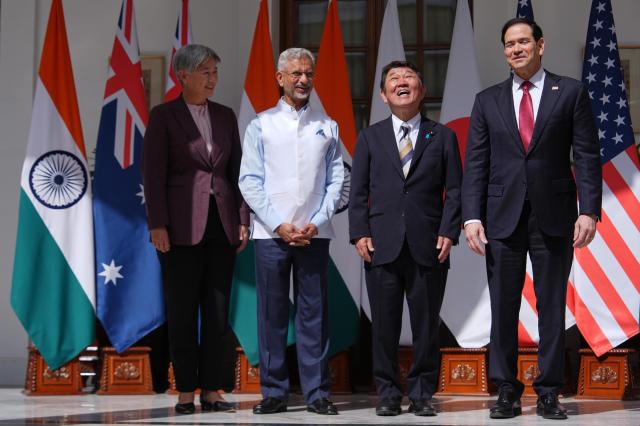
The four nations — known collectively as the Quad — announced the "Indo-Pacific Maritime Surveillance Collaboration" during a foreign ministers' meeting in New Delhi, according to a statement released by the U.S. State Department.
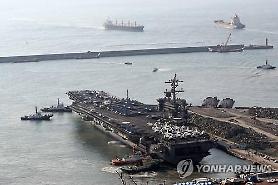
The initiative will initially focus on the Indian Ocean, including maritime routes linked to the Persian Gulf and the Red Sea, where Iran and its regional proxies have threatened freedom of navigation amid ongoing regional tensions.
In a joint statement, the Quad countries said they were united by "a common vision for a free and open Indo-Pacific, underpinned by robust economic and energy systems."
"Recognizing shifts in the global energy landscape and escalating geopolitical complexities, we are accelerating collaboration to ensure energy stability and security," the statement said.
The four countries emphasized the need to protect shipping routes and maintain uninterrupted trade flows, warning that disruptions to oil, gas and petrochemical markets disproportionately affect Indo-Pacific economies.
"We reiterate the importance of ensuring unimpeded freedom of navigation and uninterrupted flow of global commerce, including in the Strait of Hormuz, and opposing any restrictive measures hampering the flow of commercial vessels," the statement said.
The Quad members also pledged to strengthen maritime coordination by expanding the group's existing Indo-Pacific Maritime Domain Awareness initiative into the Indian Ocean and developing a shared "Common Operating Picture" for maritime operations.
India will host a maritime monitoring mission involving coast guards from participating countries to coordinate responses to illegal maritime activities, while Australia will host counterterrorism tabletop exercises next month focusing on state-sponsored terrorism threats and unmanned aerial vehicles.
The announcement appeared to signal the Quad nations' readiness to coordinate efforts to safeguard shipping routes if Iran seeks to tighten control over the Strait of Hormuz following the recent conflict in the Middle East.
They also underscored broader concerns over China's expanding military presence and territorial claims in the East and South China seas.
They added resilient supply chains and stable energy markets were essential to regional security. "We reaffirm the importance of resilient and diversified supply chains, including energy products and other downstream commodities," the statement said.
The four countries also announced plans to establish a "Quad Fuel Security Forum" aimed at coordinating high-level discussions on energy security and emergency response cooperation.
"To this end, the United States, Australia, India, and Japan will work to identify areas of cooperation for the Quad Initiative on Indo-Pacific Energy Security in technology, management, policy, international market analysis, and emergency response exercises," the statement said.
U.S. Secretary of State Marco Rubio attended the meeting alongside Japanese Foreign Minister Toshimitsu Motegi, Australian Foreign Minister Penny Wong and Indian External Affairs Minister Subrahmanyam Jaishankar.
The Quad was formed in 2004 as a strategic partnership aimed at countering China's growing influence in the Indo-Pacific region. The grouping was elevated to the leaders' level in 2021 under then-U.S. President Joe Biden.
Copyright ⓒ Aju Press All rights reserved.