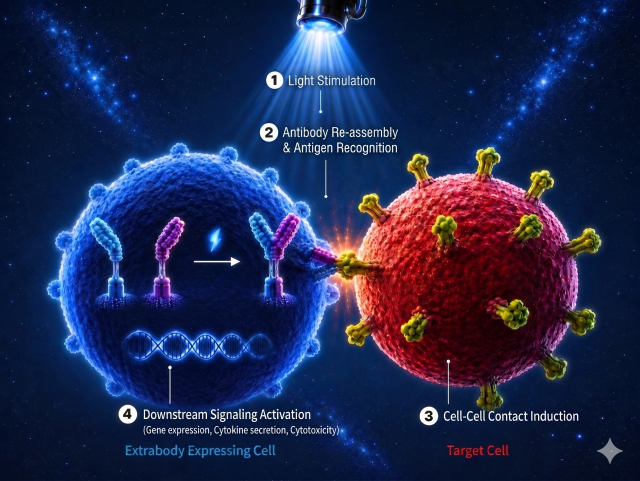
SEOUL, May 27 (AJP) - Researchers at the Korea Advanced Institute of Science and Technology (KAIST) in South Korea have developed an antibody platform that allows immune cells to target and attack cancer cells only when activated by specific light or chemical signals, KAIST said Wednesday.
Current cellular therapies, such as CAR-T treatments, can cause severe side effects because engineered immune cells begin attacking immediately upon recognizing cancer, sometimes damaging healthy tissue in the process. The new platform, named Extrabody, addresses this by splitting an antibody into two inactive fragments. These pieces only recombine and bind to tumor targets when exposed to external triggers.
The research team confirmed the system works against common cancer proteins, including EGFR and HER2. By integrating this light-activated switch into existing immune therapy models, they created a double-lock safety mechanism. The immune cells only activate and release chemicals to kill the target when both the cancer protein and the light stimulus are present at the exact same time.
This precision prevents immune cells from accidentally attacking healthy cells outside the intended treatment area. The study was led by Professor Heo Won-do from the biological sciences department, alongside co-first authors Dr. Kwon Yu-ri and Dr. Yoo Da-seul-i. The findings were published online in Cell Chemical Biology on May 7, 2026.
"This research is a new platform technology that can precisely control cell target recognition at the desired time and location using external stimuli," Heo said. "It can be utilized as a core foundational technology to improve the safety and precision of next-generation immunotherapy and cell-based treatment technologies in the future."
(Reference Information)
Journal/Source: Cell Chemical Biology
Title: An extracellular, optogenetic antibody platform for stimulus-gated antigen recognition and modulation of cell behavior
Link/DOI: https://doi.org/10.1016/j.chembiol.2026.04.006
Copyright ⓒ Aju Press All rights reserved.