
Journalist

Kim ok Hyun
okbest70@ajunews.com
-
 South Jeolla Province to Revamp Seedling Production for Climate-Resilient Forests South Jeolla Province said it held a meeting April 21 at its Forest Research Institute in Naju to discuss a structural overhaul of how it develops forest resources, including tree species selection and seedling production, in response to climate change. The meeting was aimed at preparing for shifting forest growing conditions, rising forest disasters and changes in forest-creation patterns linked to climate change. Eighteen people attended, including officials from the province and its cities and counties, forest research institutions and seedling producers. Participants focused on expanding climate-adapted species, meeting demand for large-tree plantings, and improving the seedling production and supply system. The province said it plans to move away from conifer-centered forest creation by expanding climate-adapted species such as warm-temperate broadleaf trees and nectar-producing trees, and by introducing tailored species suited to local climate conditions. It said the goal is to build forests more resilient to disasters such as wildfires while strengthening ecological stability and public benefits. The Forest Research Institute presented recommendations for key warm-temperate broadleaf and nectar-producing species based on matching species to suitable sites. The province said it plans to secure seed sources for species including inamu, aweenamu and odongnamu within this year and then build out a full-scale seedling production system. The province said nectar-producing trees are a key resource for protecting both the beekeeping industry and forest ecosystems because they provide food not only for honeybees but also for a range of forest insects. It said it will actively secure major nectar-producing species. It also said demand is rising for large-tree plantings to secure carbon absorption earlier, improve scenery and support species conversion as part of efforts to control pine wilt disease. To address supply-demand imbalances, the province said it will improve seedling-age standards and diversify specifications. For seedling production, which the province called critical to long-term forest planning, it said it will build a systematic supply system based on mid- to long-term supply-and-demand forecasts. It also plans to gradually establish an integrated forest resource management system linking seedling production, forest creation and follow-up management to improve policy effectiveness. Kang Sin-hui, head of the province’s Forest Resources Division, said rapid changes in forest conditions driven by climate change require a fundamental shift in forest-creation methods and nursery policy. “Based on field input and scientific data, we will actively push sustainable forest resource development and strengthen the competitiveness of the forestry sector,” Kang said. * This article has been translated by AI. 2026-04-21 16:12:47
 -
 Cho Kuk Innovation Party’s Park Hong-ryul launches Mokpo mayoral bid, vows local political reform Park Hong-ryul, a preliminary candidate for Mokpo mayor from the Cho Kuk Innovation Party, held a news conference on 21 and formally confirmed his entry into the June 3 local elections, pledging to serve as a “steppingstone for reform in local politics.” In a statement, Park said citizens and party members had backed him to face the Democratic Party candidate in the general election. He thanked voters for choosing him, saying he would stand up to what he called the Democratic Party’s heavy-handed politics in Mokpo and help open an era of local government led by citizens. Park also urged primary rival Park Yong-an to join forces, calling for unity to break what he described as the Democratic Party’s stronghold. He said local politics in Yeongnam and Honam had been dominated by the Democratic Party and the People Power Party, arguing the system should move toward a genuine multiparty structure that reflects public opinion. Park said he would win the election, make Mokpo a base for political innovation and restore the city’s standing as a leading center of Honam politics. Park said his party and the Democratic Party share some goals, including prosecutorial reform, but criticized the Democratic Party for, in his words, repaying Honam residents’ support with “lineups” tied to nominations. “It is time for alert citizens to discipline monopolistic political power,” he said. Park pointed to his experience in city administration as an advantage. He said that during his time in office in the 6th and 8th elected administrations, Mokpo boosted tourism competitiveness by installing a marine cable car. He also said the city restarted the long-delayed Imseong District development project through an agreement with the Korea Land and Housing Corp., and improved the monopoly structure of city bus routes, resolving wage arrears and service suspensions. As a key pledge for the 9th elected administration, Park proposed building a Mokpo-style renewable energy convergence national industrial complex on 550,000 pyeong around Gohado, attracting 100 companies and creating 10,000 jobs. Park said he would make Mokpo “a happy city from cradle to old age” and a city with abundant jobs for young people. He asked for support, saying he would overcome what he called the Democratic Party’s high barrier and open a new era for Mokpo. The news conference was seen as signaling potential shifts in the local political landscape ahead of the June 3 elections and was expected to affect the Mokpo mayoral race.* This article has been translated by AI. 2026-04-21 16:10:19
 -
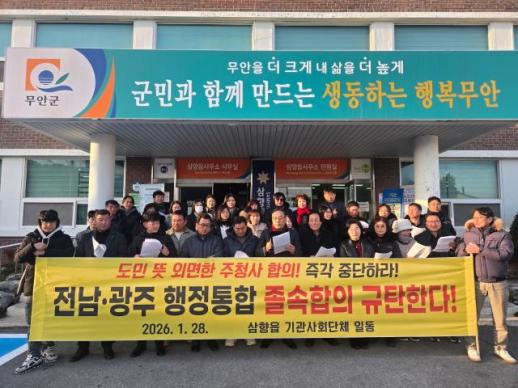 Dispute Grows Over Proposed South Jeolla-Gwangju Administrative Merger Controversy over a proposed administrative merger between South Jeolla Province and the city of Gwangju is spreading across the region. The Samhyang-eup Council of Local Institutions and Social Groups in Muan County said the recent merger agreement between the provincial government and Gwangju was “a rushed deal” that “gave up South Jeolla’s interests.” In a statement released Jan. 28, the council criticized an announcement that South Jeolla Gov. Kim Young Rok and Gwangju Mayor Kang Ki Jung agreed to name the merged local government “Jeonnam-Gwangju Special City,” with the abbreviated name “Gwangju Special City,” and to operate offices across the eastern region, Muan and Gwangju without designating a main headquarters. The council said the decision “betrays residents’ common sense and expectations.” The council said the move reversed a tentative agreement reached just a day earlier, on Jan. 25, at a “Gwangju-South Jeolla administrative merger meeting” to place the main headquarters at the South Jeolla Provincial Government building in Muan. It called the reversal an act that undermined the merger’s stated principles of coexistence and balanced development. It also argued that deciding such a major issue through a meeting among a few local leaders, without sufficient discussion with residents, city and provincial councils, amounted to an abuse of authority that ignored democratic process. It said opinions from South Jeolla’s 22 cities and counties and their residents were excluded. The council said Muan is already the administrative center of South Jeolla because the provincial government is located there, and that it can best ensure continuity and efficiency in regional administration. It added that the Namak and Oryong new towns have grown into a major living area where housing, commerce and education functions are concentrated. If the merger proceeds without a confirmed main headquarters, the council warned, it could lead to the collapse of existing commercial districts, threaten small businesses, deepen economic stagnation and accelerate population decline. It said the issue is directly tied to the future of Samhyang-eup and the wider Muan area. Saying it cannot accept a merger without a main headquarters, the council urged officials to immediately confirm the South Jeolla Provincial Government building as the main headquarters of the proposed “Jeonnam-Gwangju Special City.” It also called for disclosure of a clear administrative center and division of authority, rather than vague language about “balanced operation,” and urged the government and National Assembly to specify in merger legislation that the provincial government building will serve as the core of the integrated regional administration. The council said it will continue to take action to protect South Jeolla’s interests and residents’ pride. * This article has been translated by AI. 2026-01-29 08:57:23