

Journalist

Kim Ki-eung
qortjgus0602@ajunews.com
-
 LG CNS Partners with KEPCO to Innovate Next-Generation Power Systems LG CNS announced on May 11 that it has secured a consulting project for the "Next-Generation Sales and Distribution System Information Strategy Plan (ISP)" for the Korea Electric Power Corporation (KEPCO). The sales and distribution system encompasses the "sales" area, which handles the entire customer service process, including electricity billing and collections for approximately 25 million customers, and the "distribution" area, which manages power facility operations, including design and construction. This system is a core operational tool utilized in real-time by about 22,000 KEPCO employees, responsible for ensuring both the quality of customer service and the stability of power supply. LG CNS was selected as the project partner based on its extensive experience in large-scale next-generation system implementations across various sectors, including public, telecommunications, and finance, as well as its expertise in developing over 100 ISPs in the past three years. An ISP serves as a long-term IT blueprint that comprehensively designs improvement tasks and construction strategies for information systems in line with an organization’s future business direction. It acts as a roadmap for determining which digital systems to build and in what order. Through this project, LG CNS plans to completely overhaul the operational framework of the sales and distribution system and design an intelligent work system based on artificial intelligence (AI) and data. For instance, in the process of checking customer electricity usage and billing, the variety of power measurement devices used at different sites and the differing formats of collected data have led to a significant amount of manual work in the verification process. To improve this work environment, LG CNS aims to propose automation platform solutions to reduce manual and repetitive tasks and identify areas where AI can be effectively applied, presenting concrete implementation plans. KEPCO is advancing its transformation into a "global energy solutions company" by focusing on its "Sales and Distribution System Office," which oversees core systems such as sales and distribution. Recently, it has revamped its public electricity service mobile app, KEPCO ON, and accelerated digital transformation by applying AI to field operations to enhance employee efficiency. 2026-05-11 10:03:22
 -
 AI Server Demand Shifts Semiconductor Supply, Sparking Optimization Race in Gaming Industry As investment in artificial intelligence (AI) servers expands, the semiconductor supply is increasingly focused on server applications, leading to rising prices for consoles and gaming PCs. The gaming industry is shifting its focus from competing on high specifications to ensuring stable performance across a variety of environments, in response to users' longer device replacement cycles. According to industry sources, Nintendo will raise the prices of its console, the Nintendo Switch, starting May 25. The price of the Nintendo Switch OLED model will increase by 50,000 won, from 415,000 won to 465,000 won. The standard Nintendo Switch will rise from 360,000 won to 410,000 won, while the Nintendo Switch Lite will go up from 249,800 won to 279,800 won. Earlier, Sony Interactive Entertainment Korea (SIEK) announced a price increase for the PlayStation 5 (PS5). The base model will see a nearly 27% increase, from 748,000 won to 948,000 won. The higher-end PS5 Pro, which features enhanced GPU performance, AI-based upscaling, and high-resolution graphics processing, will rise from 1,118,000 won to 1,298,000 won, approximately a 16% increase. Microsoft is also gradually raising prices for its Xbox Series X and S consoles. The Series X has increased by about $200 in some countries compared to last year, while the more affordable Series S has seen a price rise of over 30%. In South Korea, the price has reached the upper 300,000 won range. This trend is rooted in the semiconductor supply structure, which has shifted to prioritize AI servers. As the era of 'agentic AI'—which can perform tasks and support decision-making—gains momentum, major global tech companies are ramping up investments in AI data centers. Consequently, leading semiconductor firms like NVIDIA, AMD, and Intel are increasing their production of server chips, while consumer supply is becoming more limited. Industry experts believe that this situation is unlikely to resolve quickly, suggesting that the burden of gaming hardware prices for consumers may persist over the long term. They particularly note the changing device replacement cycles. Traditionally, console replacement cycles were estimated at around five to six years, but with recent price hikes, more users may opt to keep their existing hardware for longer periods. As a result, game developers are finding it increasingly important to provide stable performance across a range of specifications rather than focusing solely on high-end PC environments. Recent major releases have faced user complaints regarding optimization issues, frame drops, and bugs shortly after launch, highlighting that performance stability is becoming a key evaluation factor alongside gameplay quality. For instance, Pearl Abyss is continuing its optimization efforts for the game "Crimson Desert," released in March, ensuring that it does not rely solely on the latest high-end hardware. The company is actively working on stabilization across different platforms, including consoles and PCs, while refining graphics options and improving frame rates. An industry insider stated, "In the past, the competition was centered around graphic quality, but moving forward, how reliably games run on limited hardware environments is likely to become a core competitive advantage. The restructuring of the semiconductor market around AI servers is influencing game development directions as well."* This article has been translated by AI. 2026-05-11 07:48:25
 -
 Upstage Acquires Daum, Aiming for AI-Driven Platform Synergy Upstage's acquisition of the portal Daum has sparked significant interest in South Korea's artificial intelligence (AI) sector. This marks the first instance of a generative AI company securing a large consumer interface after primarily focusing on business-to-business (B2B) growth. Upstage plans to integrate its proprietary large language model (LLM) SOLAR with Daum's search and content data to create an "AI composite platform." The goal is to transform Daum into a next-generation AI portal that understands user intent and context, moving beyond simple search services. The envisioned future differs from traditional portal operations. Instead of merely listing links in response to search queries, the AI will analyze context and intent to summarize, recommend, and generate necessary information, resembling a "context AI service." An Upstage representative stated, "By combining Daum's vast data and traffic with Upstage's AI technology, we will create a new type of AI platform." Once a leading portal, Daum's current search market share is below 5%, having fallen behind Naver and Google. Its presence has diminished due to mobile transitions and intensified search competition, leading to a loss of younger users. Industry experts note that "it is challenging to rebound through traditional portal competition alone," suggesting that innovation driven by AI services is crucial for finding a breakthrough, which underpins this major deal. Daum has recently revamped its services to attract users, introducing an AI-based real-time issue service in March. Unlike the previous method of simply aggregating search volumes for "real-time search terms," the new service analyzes search logs and news articles with AI to provide trending keywords every ten minutes. Upstage is expected to enhance search accuracy and personalized recommendations by integrating its SOLAR model. Upstage's strength lies in its proprietary AI model, SOLAR, which has gained recognition for its performance in Korean language processing and document comprehension, expanding its applications in the corporate sector. Previously, Upstage's business structure focused on B2B in finance, law, and manufacturing. Daum, with its extensive user data, represents a significant internet platform. The combination of these entities is seen as more than just a platform acquisition; it represents the merging of "AI model + large user data + service platform." Portals are rapidly evolving around AI. Naver has launched a beta service called "AI Tab," integrating its search with places and shopping, while expanding AI agent capabilities. Google is also accelerating its integration of generative AI, Gemini, across its search and web browser, shifting the search paradigm from user exploration to AI-curated information delivery. There are also expectations for synergies with government projects. Upstage participates as a lead contractor in the Ministry of Science and ICT's "Independent AI Foundation Model" initiative. The development of Korean AI technology in this context could provide users with seamless access to AI services in their daily lives through the Daum platform. Industry analysts emphasize the significance of a domestic AI company securing a large consumer platform based on its own model, stating, "The synergy created when long-accumulated portal data combines with a proprietary foundation model will be a key point of observation for the domestic AI ecosystem." However, challenges remain. The AI search market is already dominated by global tech giants, and user behavior regarding portals is changing rapidly. An industry insider remarked, "Ultimately, the key is not just the AI technology itself but how innovatively it can be utilized," highlighting the importance of whether Upstage can build a domestic AI portal model through Daum.* This article has been translated by AI. 2026-05-07 23:53:00
 -
 Netmarble Reports 6.8% Increase in Q1 Operating Profit, Eyes Growth with New Releases Netmarble reported increases in both revenue and operating profit for the first quarter of this year, driven by new game releases. The company plans to continue its growth trajectory with five major new titles set to launch in the second half of the year. On May 7, Netmarble announced its consolidated revenue for Q1 reached 651.7 billion won, with an operating profit of 53.1 billion won, marking increases of 4.5% and 6.8%, respectively, compared to the same period last year. The growth was attributed to the successful launch of new games like 'Stone Age: Grow' and 'The Seven Deadly Sins: Origins,' although their contributions were limited as they were released at the end of March. Netmarble's net profit also rose due to gains from the sale of its stake in HYBE. The company anticipates that revenue growth will accelerate in Q2 as new game sales begin to reflect more fully. Internationally, Netmarble's Q1 overseas revenue reached 512.2 billion won, accounting for 79% of total sales. North America led with 41%, followed by South Korea at 21%, Europe at 13%, Southeast Asia at 12%, Japan at 7%, and other regions at 6%. Marketing expenses surged to 168.2 billion won, a 47.3% increase year-on-year, reflecting heightened promotional activities for new titles. Conversely, personnel costs decreased due to staff reductions, and commission fees fell as the share of revenue from proprietary intellectual property games increased. Looking ahead, Netmarble expects to see the full impact of new releases starting in Q2. The company will launch the PC version of 'Game of Thrones: King's Road' in Asia on May 14, followed by the mobile version on May 21, and a new MMORPG titled 'Soul: Enchant' in June. In the second half of the year, Netmarble plans to maintain an aggressive release strategy, introducing five new titles sequentially, including 'Solo Leveling: Karma,' 'Shangri-La Frontier: Seven Strongest Species,' 'Project Octopus,' 'Evilbane,' and 'Project Aegis.' Kim Byung-kyu, CEO of Netmarble, stated, "The first quarter saw limited revenue contributions from major new releases due to their late launch, but we achieved growth in both revenue and operating profit compared to last year, indicating stable business fundamentals. With a diversified portfolio where 79% of revenue comes from international markets, we expect significant growth and improved profitability starting in Q2 as new game sales take effect."* This article has been translated by AI. 2026-05-07 22:00:35
 -
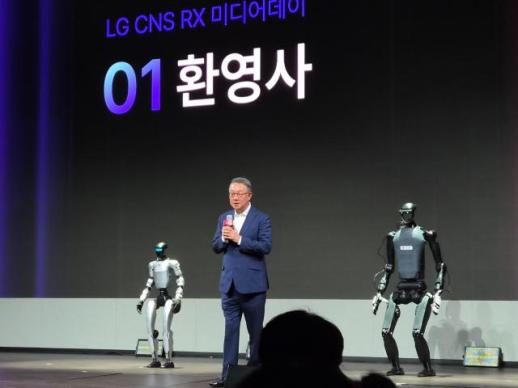 LG CNS Unveils RX Platform for Autonomous, Collaborative Robots A dancing robot opened LG CNS’ showcase, greeting Chief Technology Officer Park Sang-yeop. Another robot handed a microphone to CEO Hyun Shin-gyun to begin the event. In a logistics demo area, robots moved and worked together without human control. A humanoid robot picked up a plastic bag and passed it toward a box on a conveyor belt. A quadruped robot carried the box, and a wheeled robot and an autonomous mobile robot, or AMR, placed it on a designated shelf. LG CNS described the scene as a preview of what it called an era of self-moving robots. LG CNS on May 7 held a “Robot Transformation (RX) Media Day” at its Magok headquarters in Seoul and unveiled its RX platform, “Physical Works.” It also introduced two core platforms: the robot training platform “Physical Works Forge” and the integrated operations platform “Physical Works Baton.” The company said the center of the robot industry is shifting from hardware to real-world deployment. It said the key is building a system that trains robots using on-site data and then operates and upgrades them reliably, rather than simply installing robots. LG CNS defined RX for industrial sites as an end-to-end service covering the full process — from introducing intelligent robots to training and operations — and said it is moving to expand in the market. “LG CNS does not manufacture robot hardware directly, but we source the most suitable robots for each site, train them with data, and operate and manage them so they can perform real work,” Hyun said. “A company’s competitiveness depends on how quickly it can apply robots in the field and turn that into results.” He added that while the robot industry has developed around hardware, the priority is now making robots perform tasks well, validating them on site and operating them stably — “the essence of RX” as LG CNS defines it. Physical Works Forge is a robot training platform that collects and learns from industrial-site data to prepare robots for deployment, LG CNS said. It supports the full process from data collection to simulation and on-site application, and can cut deployment time from several months to about one to two months, the company said. Securing high-quality on-site data quickly and training robots with it is a core capability, it added. Physical Works Baton is designed to integrate control and monitoring of different robots from different manufacturers within a single system. It assigns tasks and manages operations in real time across biped, quadruped, wheeled and AMR robots. Its name refers to a conductor’s baton, reflecting its role in orchestrating multiple robots, the company said. LG CNS said that applying the system to an environment operating about 100 robots could raise productivity by about 15% and cut operating costs by up to 18%. Lee Jun-ho, head of LG CNS’ Smart Logistics & City Business Division, said earlier smart-factory automation largely repeated preset motions, while physical AI-based RX enables robots to recognize situations and carry out tasks autonomously. He said the industry is rapidly shifting from showcase demonstrations to delivering results in real manufacturing and logistics sites. Lee said the biggest barrier to deployment is what he called the “PoC swamp,” referring to proof-of-concept projects that do not progress. He added that if companies can quickly collect and train on high-quality data, the pace of field deployment will accelerate. LG CNS said it is conducting robot PoCs with more than 20 customers in South Korea and overseas. In the Busan Smart City National Pilot City project, it said it is using Physical Works Baton to integrate monitoring of four types of robots: patrol, barista, luggage-carrying and cleaning robots. The company said it plans to expand its RX business based on robot forms optimized for industrial sites and industry-specific robot foundation models, or RFMs.* This article has been translated by AI. 2026-05-07 14:00:23
 -
 Socar to Launch 150 Billion Won Self-Driving Unit; Krafton to Invest 65 Billion Won Socar said it is pushing to set up a self-driving-focused subsidiary with planned investment of 150 billion won, a level it described as among the largest in South Korea’s autonomous driving services sector. Video game company Krafton will join the project as a strategic investor. Socar said Thursday the new company is expected to be established in May. Socar CEO Park Jae-wook, who has led the company’s autonomous driving initiatives, will also serve as CEO of the new unit and oversee the business directly, it said. As part of the partnership, Krafton will make a 65 billion won strategic investment in Socar through a third-party allotment paid-in capital increase, Socar said. Krafton will become a major shareholder of Socar and will also make a separate investment in the new subsidiary as a core investor, the company said. Socar said it plans to participate in forming the new unit by contributing cash and data assets, pending board approval. Socar said the project is being viewed as an unprecedented private-sector collaboration aimed at accelerating commercialization of autonomous driving services in South Korea, as well as one of the largest investments of its kind. The company said it will concentrate 15 years of accumulated autonomous driving data and mobility platform operating capabilities into the new unit. It said that through its “Future Mobility TF,” launched earlier this year, it built a centralized data pipeline that collects real-time driving data based on its car-sharing fleet of about 25,000 vehicles, totaling about 1.1 million kilometers of real-world driving per day. Socar said it has also secured a range of edge-case data, including about 220,000 accident records, and processed the data — including anonymization, time synchronization and tag labeling — into a format that can be used immediately for AI training. It said the work is helping speed efforts to commercialize autonomous driving services. Socar said the new unit will pursue a phased commercialization strategy, starting with Level 2 car-sharing services and later expanding into fully autonomous, consumer-facing services such as Level 4 ride-hailing. It said it will work to internalize technology while validating it in real-world services, build independent technical and operational capabilities, and pursue partnerships to compete in both domestic and global markets. “Our goal goes beyond simply developing autonomous driving technology — it is to commercialize it successfully and fundamentally change how users move and their quality of life,” Park said. “Based on the data and operational know-how Socar has built over 15 years, we will create a new standard for the future mobility market.” An industry official said Socar is effectively the only company with large-scale real-world driving data accumulated by everyday users. “This kind of data is a unique competitive advantage that cannot be built in a short period of time,” the official said. * This article has been translated by AI. 2026-04-30 16:49:52
 -
 Kakao Games Bets on New Releases to Rebound, Expanding Globally to PC and Consoles Kakao Games said it is preparing to shift back to growth by rolling out multiple new titles, with a strategy centered on expanding beyond mobile into PC and console games and a broader global push. The company said on the 30th it will sequentially launch major new games through next year to diversify its business structure and expand overall scale. It plans to strengthen mid- to long-term competitiveness by adding large global-targeted projects and expanding into new genres. In the third quarter, Lionheart Studio is set to release the MMORPG “Odin Q,” a follow-up that expands the “Odin: Valhalla Rising” universe. The game features Unreal Engine 5 graphics and a seamless open world, and is expected to become a next-generation flagship title on the back of the original “Odin’s” steady performance. Around the same time, Supercat is also targeting a release for “Project OQ,” which uses 2.5D pixel art and a distinct setting to offer a different experience from traditional MMORPGs. The company said testing has shown a high level of polish. Kakao Games is also strengthening its PC and console lineup for overseas markets. XLGAMES’ “ArcheAge Chronicle” is scheduled for a global test in June, highlighting console-grade combat presentation and an IP-based world. “Chrono Odyssey,” an AAA action RPG, is targeting release in the first quarter of next year, combining an open world with a time-manipulation system. The company is expanding into additional genres as well. “Dungeon Arise,” an action RPG that blends strategy and progression elements, is scheduled for release in the second quarter and will support both mobile and PC. “God Save Birmingham,” an open-world survival game set in the medieval era, is in development with a fourth-quarter release target. “Project C,” a subculture-based collectible RPG, is also planned to target global fans. Kakao Games said it will continue stable operations for existing live-service titles. Major MMORPGs including “Odin,” “Ares” and “ArcheAge War” have maintained user metrics through regular updates, it said. “Uma Musume Pretty Derby” has also built a loyal fan base through stable service. “Path of Exile 2” is expected to rebound with a major expansion update in May. A Kakao Games official said the company will release a range of new titles with a high level of quality while keeping existing services stable. The official said Kakao Games will strengthen its growth foundation by expanding globally and diversifying genres.* This article has been translated by AI. 2026-04-30 15:04:01
 -
 Naver Q1 revenue jumps 16.3% on commerce and AI growth; operating profit up 7.2% Naver posted double-digit first-quarter revenue growth on expanding commerce and artificial intelligence-driven businesses, and said it will move to strengthen its commerce competitiveness in the second half, including introducing membership-based unlimited free shipping. Naver said Wednesday that first-quarter consolidated revenue rose to 3.2411 trillion won and operating profit to 541.8 billion won. Revenue increased 16.3% from a year earlier and operating profit rose 7.2%. The company said results were driven by growth in core businesses through AI integration and an expansion of its consumer-to-consumer, or C2C, operations. It said it maintained profitability despite infrastructure investment to bolster AI capabilities. Naver also reorganized its business structure, shifting from five areas — search platform, commerce, fintech, content and enterprise — to three pillars: Naver Platform, Financial Platform and Global Challenge. Revenue by segment was 1.8398 trillion won for Naver Platform, 459.7 billion won for Financial Platform and 941.6 billion won for Global Challenge. Naver Platform revenue rose 14.7% from a year earlier. Advertising revenue grew 9.3%, which the company attributed to its AI-based targeting enhancement solution, “AdBoost,” adding that AI accounted for more than half of advertising revenue growth. Service revenue climbed on commerce, rising 35.6% from a year earlier, led by Naver Plus Store, membership and N Delivery, the company said. Naver Plus Store’s app has become a key transaction channel, CEO Choi Soo-yeon said on an earnings conference call. “Transaction volume on the Naver Plus Store app rose 28% from the previous quarter, outpacing overall growth,” Choi said, adding that the purchase conversion rate also increased meaningfully. She said time spent in the app has more than doubled since its launch, and that its purchase conversion rate is 84% higher than on the web. Naver said it is accelerating efforts to improve delivery competitiveness. “We will push to convert key products to N Delivery and expand direct fulfillment contracts,” Choi said. “In the second half, we plan to introduce unlimited free shipping linked to membership.” Financial Platform revenue rose 18.9% from a year earlier to 459.7 billion won. Naver Pay payment volume in the first quarter totaled 24.2 trillion won, up 23.4% from a year earlier. Naver said it plans to strengthen its online-to-offline competitiveness by linking offline payment data with place data, centered on “Npay Connect.” Global Challenge revenue rose 18.4% from a year earlier to 941.6 billion won, driven by growth in its C2C business. C2C revenue — including Poshmark, Kream, Soda and Wallapop — jumped 57.7% from a year earlier, the company said. The enterprise business also grew 18.8% on expansion of AI and digital twin operations. “Naver is a platform that holds search, commerce and payment infrastructure in a single flow,” Choi said. “Through our action-oriented AI strategy, we will strengthen both user experience and monetization while expanding global business opportunities.” * This article has been translated by AI. 2026-04-30 14:21:51
 -
 CJ ENM Unveils AI-Assisted Feature Film, Says Costs and Time Cut Up to Sevenfold “Watching a shot that wouldn’t come together for days get solved at once with AI made me realize how important technology is in content production.” Jung Chang-ik, head of CJ ENM’s AI Studio team, made the remarks April 30 at the “CJ ENM 2026 AI Culture Talk” event at CGV Yongsan I’Park Mall in Seoul. CJ ENM used the event to debut “Apartment (The House),” a hybrid feature film combining AI and live-action footage, and said it signals a shift in how films are made. The film was completed on a total budget of about 500 million won. CJ ENM estimated that producing it through conventional methods would have cost at least five times more. Filming was completed in just four days. The company said the project was an “efficiency experiment” aimed at cutting both cost and time while maintaining quality. CJ ENM said the key approach was to use AI to create all backgrounds and visual effects, while keeping the actors’ performances live. Actors were filmed against a green screen, then combined with AI tools for image generation, retouching and video generation. Google’s generative AI solutions, including Imagen, Nano Banana and Veo, were applied across the production pipeline. Jung said the team maximized efficiency by shooting indoors without moving to locations. He said backgrounds were simulated in detail during preproduction so actors could perform as if they were seeing the real environment on set. CJ ENM also discussed technical limits. Jung said combining different AI solutions can produce uneven color and detail, making digital color grading in postproduction more important. “Each AI output has different color characteristics, so standardizing them is essential,” he said. “The technology has advanced, but the production process still needs refinement.” CJ ENM said it does not see AI as a replacement for actors. The company said authentic acting is difficult for AI to substitute, and that a hybrid model — preserving performance while using AI for backgrounds and effects — is the most practical approach for now. Actor Kim Shin-yong said being able to see AI backgrounds and effects on set helped him stay immersed. He said it was easier to act than in traditional chroma-key shoots. Kim added that AI should be a tool that creates more opportunities to produce content, rather than replacing actors. Baek Hyun-jung, head of content innovation at CJ ENM, said efficiency gains vary by genre and directing style, but that films could see five- to sevenfold cost efficiency. She said the challenge is to use AI not simply to lower budgets, but to raise quality. Baek also highlighted a strategic partnership with Google, saying the company has foundation models strong in realistic depiction. She said CJ ENM is expanding cooperation to move beyond basic generative AI toward “narrative AI,” where storytelling and direction are central. Ahn Sung-min, director of customer engineering at Google Cloud, said AI is a tool to realize creators’ intent, not to replace creativity. He said production quality was improved by precisely analyzing video elements and generating results with consistency. Looking ahead, CJ ENM said the distinction between AI films and conventional films will gradually fade. As computer graphics once expanded the industry, the company said AI will broaden production scale and expressive range. CJ ENM said it expects AI use in film production to expand in earnest starting in the second half of the year. A CJ ENM official said the goal is to apply AI across planning, production, distribution and marketing to strengthen global competitiveness, while advancing the technology and building an industry ecosystem in parallel. 2026-04-30 13:45:21
 -
 Naver Cloud CEO named co-chair of South Korea’s K-AI Partnership Kim You-won, CEO of Naver Cloud, has been appointed co-chair of the government-led K-AI Partnership, taking a leading role in building South Korea’s AI cooperation ecosystem and supporting global expansion. Naver Cloud said Tuesday it was selected as a co-chair organization of the K-AI Partnership alongside the Korea Association of AI and Software Industry (KOSA). Launched under the leadership of the Ministry of Science and ICT, the K-AI Partnership is described as the country’s first integrated public-private cooperation body bringing together industry, academia and research. It was formed to pool national capabilities for AI transformation and to support joint overseas expansion by large companies and small and midsize firms amid intensifying global competition in AI. Unlike groups focused mainly on academic exchange, it aims for an execution-driven structure that moves from identifying on-the-ground industry demand to business matching and generating export results. Cho Joon-hee, KOSA chairman, and Kim will serve as co-chairs. The partnership is designed to combine association leadership with private-sector participation, covering the broader industry while operating on practical technological competitiveness, the company said. Naver Cloud said it has demonstrated its capabilities through major national AI projects and has worked as a bridge between the public and private sectors while pursuing shared growth with small businesses and startups. Based on that experience, the company said it will support the partnership’s business model design and technical cooperation. It also plans to help strengthen AI competitiveness by combining large companies’ infrastructure with startups’ innovative technologies, and to serve as a field-focused channel for policy improvements by reflecting participating companies’ views. “AI is a field that is difficult to complete with the capabilities of individual companies alone, and the scale of cooperation directly translates into competitiveness,” Kim said. “A true AI ecosystem will be built when the infrastructure and technological strength of large companies, the execution power of small businesses and startups, and the research capabilities of industry, academia and research institutes come together.” * This article has been translated by AI. 2026-04-29 14:45:16