
Journalist

Park Boram
ram07@ajunews.com
-
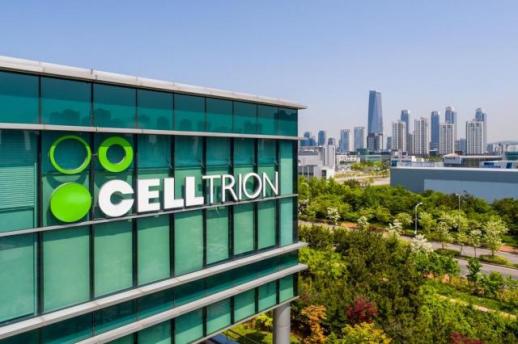 Celltrion Starts Patient Dosing for Three ADC Cancer Drug Candidates Celltrion begins patient dosing for all three ADC cancer drug candidates Celltrion said April 23 that all three of its antibody-drug conjugate (ADC)-based cancer drug candidates have entered the patient-dosing stage. The candidates now being dosed are CT‑P70, CT‑P71 and CT‑P73. All three received U.S. Food and Drug Administration approval last year for investigational new drug (IND) applications for Phase 1 trials, the company said. Patient dosing for CT‑P70 and CT‑P71 began in the second half of last year, and CT‑P73 dosing began in the first quarter of this year. Celltrion said preclinical studies confirmed the candidates’ mechanisms of action and safety. In Phase 1, it plans to evaluate dose-by-dose safety and pharmacokinetic characteristics. The company is also developing a multispecific antibody candidate, CT‑P72. It is currently recruiting patients and could begin dosing the first patient as early as next month. Korea Pharmaceutical and Bio-Pharma Association adds hands-on training on U.S. life sciences patents The Korea Pharmaceutical and Bio-Pharma Association said April 23 it will launch a practical training course on responding to U.S. life sciences patent issues on June 12 at the association’s fourth-floor auditorium. The association said the program is designed to strengthen companies’ ability to manage U.S. patent risks that can arise during global expansion, including technology licensing, partnering and overseas clinical trials. It cited cases in which negotiations collapsed after businesses moved forward without freedom-to-operate (FTO) analysis, or deals were delayed during due diligence because of intellectual property issues. The course will have three sessions: the reality of U.S. life sciences patent disputes and core FTO concepts and practical considerations; U.S. patent avoidance strategies and global dispute trends; and global IP strategy and commercialization preparation at the research and development stage. The lecture will be led by attorney Nam In-young, a New York and California-licensed lawyer and U.S. patent litigation specialist, the association said. The program is aimed at R&D and IP staff, business development and corporate planning personnel, and executives and decision-makers at life sciences companies considering or pursuing entry into the U.S. market. Enrollment will be capped at 50 participants. Handok holds plogging cleanup campaign in Busan with employees Handok said April 23 that it held an environmental cleanup “plogging” volunteer event with employees on April 22 around Busan Citizens Park. The company said the campaign, titled “Pick up for me, pick up for Earth,” was organized with the Busan Volunteer Center to mark Earth Day on April 22. It also aimed to spruce up the area ahead of the 20th National Para Student Sports Games and the 55th National Youth Sports Games. About 30 Handok employees, including sales staff working in Busan, took part, the company said. It plans to continue individual plogging through May 24 using the Busan Volunteer Bank application. Chong Kun Dang Gochon Foundation names three artists for 2026 program, expands support The Chong Kun Dang Gochon Foundation said April 23 it selected three artists — Kim Myeong-chan, Park Geurim and Yeom Ji-hee — as this year’s artists and held a certificate presentation ceremony April 22 at Chong Kun Dang’s headquarters in Chungjeong-ro, Seoul. The foundation said the artists were recognized for experimentation and growth potential within contemporary painting. The selections were made through a closed review by a panel of art experts. Each artist will receive 10 million won a year in creation grants for three years, and in the final year will be given an opportunity to present results through a curated exhibition, the foundation said. The “Chong Kun Dang Gochon Art Award” is a cultural and arts social contribution program launched at the suggestion of Chairman Lee Jang-han to support emerging artists with growth potential. Since 2012, it has been run with Chong Kun Dang Holdings, the Korea Mecenat Association and Art Space Huga, and has discovered and supported a total of 45 artists, the foundation said.* This article has been translated by AI. 2026-04-23 18:10:18
 -
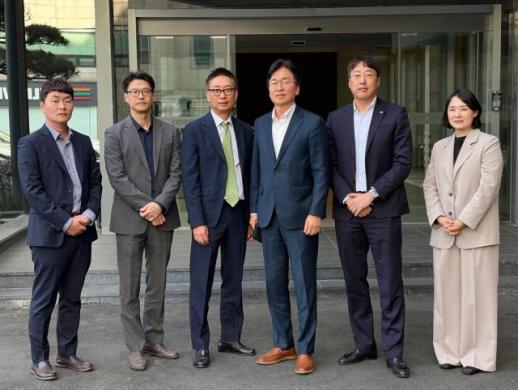 Korea Pharmaceutical and Bio-Pharma Association Names Moon Jong-hoon PR Committee Chair The Public Relations Committee under the Korea Pharmaceutical and Bio-Pharma Association held its regular general meeting on April 22 at the association’s office in Bangbae-dong, Seocho-gu, Seoul, and completed the election of a new chair and the formation of its executive team, the association said April 23. The committee is a consultative body of public relations and external communications professionals from pharmaceutical and biotechnology companies. Moon Jong-hoon, a director at Chong Kun Dang, was elected chair. Park Jae-hyeon, an executive director at Jeil Pharmaceutical, and Yoo Jeong-jae, a head at JW Pharmaceutical, were chosen as vice chairs. The secretariat will be led by Lee Jeong-seok, a director at SillaJen, and Jeon Ha-na, a team leader at Hugel. Jeong Chan-ung, deputy head of the association, will serve as both secretary-general and auditor. The chair and other executive members will serve two-year terms. The meeting also approved the 2025 financial settlement and the 2026 business plan as originally proposed. Moon said he felt a “heavy sense of responsibility” in taking the post at what he called an important turning point for the pharmaceutical and biotechnology industry, and pledged to strengthen communication among member companies and expand information exchanges between the association and the media.* This article has been translated by AI. 2026-04-23 17:48:16
 -
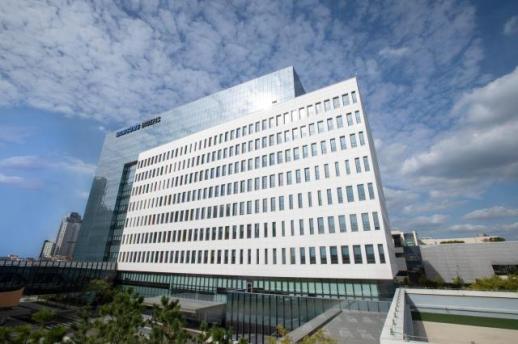 Samsung Bioepis Q1 Operating Profit Rises 13% to 144 Billion Won Samsung Bioepis said April 23 that it posted first-quarter revenue of 454.9 billion won and operating profit of 144.0 billion won. Revenue rose 14% from a year earlier and operating profit increased 13%. The company said the results meet its early-year sales guidance calling for growth of more than 10% from the previous year. It cited expanded global biosimilar sales and a broader new-product portfolio as key drivers. Samsung Bioepis said sales were supported by existing products including SB4, an Enbrel biosimilar marking its 10th year on the European market, as well as the impact of new product launches in the United States. In Europe, the company directly sells four products. For SB15, an Eylea biosimilar, it said it has been discussing potential launch timing with the originator developer, targeting Europe this month and the United States in January next year. In the United States, Samsung Bioepis said it signed a private-label supply agreement in October last year with CVS Caremark, one of the country’s three major pharmacy benefit managers, for SB16, a Prolia biosimilar, and launched it on the market. The company is also pursuing new-drug development. It recently began a global Phase 1 clinical trial of an antibody-drug conjugate candidate, and said additional pipelines being co-developed with China’s Frontline are in the preclinical stage. Separately, Samsung Epis Holdings reported consolidated revenue of 453.9 billion won and operating profit of 90.5 billion won. It returned to an operating profit in the first quarter after reporting consolidated revenue of 251.7 billion won and an operating loss of 63.6 billion won in November and December last year. The company said noncash accounting consolidation adjustments, including amortization of purchase price allocation development costs, were reflected in the results.* This article has been translated by AI. 2026-04-23 17:04:52
 -
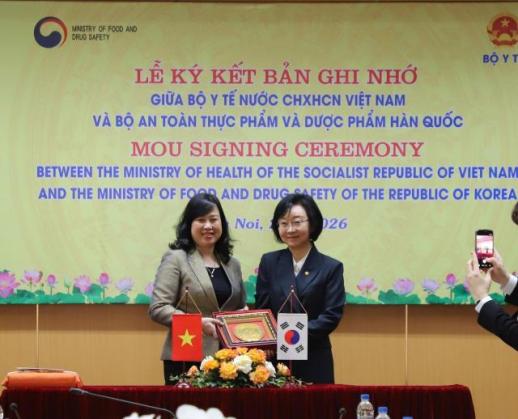 South Korea, Vietnam Sign MOU to Expand Food and Drug Regulatory Cooperation South Korea’s Ministry of Food and Drug Safety said April 23 it signed a memorandum of understanding with Vietnam’s Ministry of Health on April 22 (local time) to strengthen cooperation on the safety of food, pharmaceuticals, cosmetics and medical devices. The signing took place with President Lee Jae-myung and Vietnam’s Party chief and state president, To Lam, in attendance, the ministry said. The MOU calls for exchanging information on laws, approvals, technology and supply chains, and for cooperation in emerging areas such as artificial intelligence, digital technology and biohealth. It also includes steps to promote access to medical products and regulatory trust, and to hold high-level meetings. MFDS Commissioner Oh Yu-kyoung met with Vietnamese Health Minister Dao Hong Lan and discussed the importance of safety cooperation and specific ways to work together, the ministry said. The MFDS introduced South Korea’s food management systems, including HACCP and its SAFE-i 24 electronic import safety review platform. It also asked Vietnam to designate South Korea as a reference country to speed approvals of Korean pharmaceuticals recognized through the World Health Organization’s listing of the country as a stringent regulatory authority. If South Korea is recognized as a reference country, the MFDS said, access could expand to Vietnam’s imported drug market worth about $4.3 billion (about 6.4 trillion won), with an expected annual increase of about 100 billion won in exports of Korean pharmaceuticals. “This MOU will further maximize the outcomes of Korea-Vietnam summit diplomacy through cooperation in safety regulation for food and pharmaceuticals,” Oh said. “We will continue to actively support our companies’ overseas expansion based on regulatory cooperation.”* This article has been translated by AI. 2026-04-23 14:34:32
 -
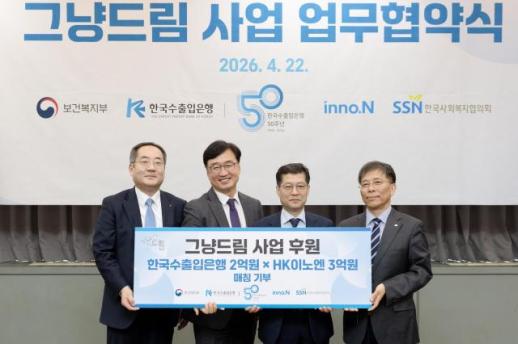 HK inno.N Joins “Just Dream” Program to Support Vulnerable Households HK inno.N said Wednesday it will join “Just Dream,” a government-backed program that provides food and daily necessities to vulnerable households, run with the Export-Import Bank of Korea. Just Dream is a support initiative the Ministry of Health and Welfare has been piloting since December last year. Anyone facing livelihood hardship can receive assistance with food and essential goods. HK inno.N signed a four-party agreement Tuesday at the Korea National Council on Social Welfare in Seoul’s Mapo district with the ministry, the Export-Import Bank of Korea and the council. Attendees included Kim Gi-ho, executive director of HK inno.N’s Strategic Support Office; Eun Seong-ho, director-general for Population and Social Service Policy at the Ministry of Health and Welfare; Shin Yu-geun, executive vice president of the Export-Import Bank of Korea’s Management Planning Group; and Cho Nam-kwon, secretary general of the council. The partnership will use a matching-donation structure to create joint funding. HK inno.N will provide about 120,000 bottles of its “Saessakbori” beverage, valued at 300 million won, and the Export-Import Bank of Korea will donate 200 million won, for total support worth 500 million won.* This article has been translated by AI. 2026-04-23 14:31:44
 -
 Dong-A Pharm, Hanmi and Others Mark Earth Day, Awards and Product Verification Efforts Dong-A Pharm’s Tempo runs eco-friendly giving campaign for Earth Day Dong-A Pharm’s feminine care brand Tempo said April 22 it teamed with global coworking operator JustCo to run an eco-friendly giving campaign for Earth Day. The campaign ran through April 22 for the tenant community at six JustCo locations in Seoul. Tempo said it designed the event to help people practice resource circulation in everyday life, focusing on working women and promoting consumption that considers the environment and ethics. Participants who donated unused items received Tempo’s vegan-certified “Natural Cotton Tampon Light.” Tempo said the product uses an applicator that is 2 millimeters slimmer than earlier versions and is made with 100% organic cotton for the absorbent core, cover and removal string. It has also received certification from The Vegan Society in the U.K. Hanmi Pharmaceutical’s Rolontis wins IR52 Jang Young-sil Award Hanmi Pharmaceutical said April 22 that its neutropenia treatment Rolontis, marketed in the United States as Rolvedon, has won the IR52 Jang Young-sil Award. The award ceremony was held April 14 at the Peace & Park Convention in Seoul’s Yongsan district. Choi In-young, head of Hanmi Pharmaceutical’s R&D Center, and executives Bae Seong-min and Kim Dae-jin, among researchers involved in developing Rolontis, attended and received a certificate and trophy. Rolontis is a long-acting biologic used to prevent and treat severe neutropenia in patients undergoing chemotherapy. Hanmi said it applied its “Lapscovery” platform technology to extend the drug’s effect and dosing interval. Based on those results, the drug was newly listed in the 2022 NCCN guidelines as an option for preventing and treating neutropenia, about 20 years after a new option was added, the company said. “Our focus was on helping patients continue chemotherapy through to the end,” Choi said. “Building on Hanmi’s philosophy, we will further advance our R&D capabilities and devote ourselves to developing innovative new drugs.” PharmaResearch releases video guide to verify authentic Rejuran products PharmaResearch said April 22 it released a “Rejuran Authenticity Verification Guide” video with Rejuran global ambassador Kim Se-jeong to help consumers check whether a product is genuine before a procedure. The company said that as the medical aesthetics market expands, consumer confusion has grown due to similar products, increasing the need for clear verification steps. The video outlines a three-step process: confirming the phrase “DOT® DNA Optimizing Technology” on the product box, checking information by scanning a QR code, and using an NFC tag for authentication. PharmaResearch said the guide is intended to help consumers directly confirm procedure steps and product information. Kwangdong Pharmaceutical holds in-house used-goods market for Earth Day Kwangdong Pharmaceutical said April 22 it held an in-house used-goods trading event, the “KD Goodcycling Treasure Market,” to mark Earth Day. KD Goodcycling is an ESG campaign aimed at reducing waste and spreading a culture of resource circulation, now in its fourth year. The company said the Treasure Market was the first program in this year’s campaign, with employees buying and selling secondhand household items. About 450 items were submitted, including household goods, small appliances and childcare products, the company said, about a 50% increase from a year earlier. Unsold items will be donated to social welfare organizations. “Through various eco-friendly campaigns that are easy to practice in daily life, we will fulfill our social responsibility for a sustainable future,” a company official said.* This article has been translated by AI. 2026-04-22 18:17:13
 -
 Topical Prescription Treatments Offer New Option for Hyperhidrosis Management Hyperhidrosis can be hard to hide in daily life. When excessive sweating occurs in the armpits, clothes can become soaked and concerns about odor can cause some people to withdraw socially. Even with significant day-to-day discomfort, many patients find it difficult to stick with treatment. Hospital-based procedures or oral medications can feel burdensome, depending on the individual. Recently, a new option has drawn attention: prescription topical treatments that patients apply directly to areas that sweat heavily. The approach is seen as a way to reduce the burden of ongoing care and meet growing demand for simpler symptom management. The treatment works by suppressing nerve signals that trigger sweat production. Because it can be used during everyday routines, it may help patients continue treatment more consistently. Hyperhidrosis has often been dismissed as a personal trait, but as treatment choices expand, it is increasingly viewed as a condition that can be managed in daily life. Shin Jeong-won, a professor of dermatology at Seoul National University Bundang Hospital, said hyperhidrosis can significantly disrupt daily life, but many people delay care because of the burden of treatment. “Topical treatment is relatively easy to use and may help patients stay on therapy,” Shin said. 2026-04-21 18:12:51
 -
 Yuyu Pharma Launches Prune-Based Probiotic Powder Sticks Yuyu Pharma said Tuesday it has launched “Janganehwaje Prunebiotics,” a probiotic product in powder stick form. The product combines prunes with four types of bifidobacteria and contains 100 million CFU of probiotics per stick, the company said. It is designed to be taken once a day, one stick at a time. Yuyu Pharma said it also includes six additional ingredients intended to support beneficial bacteria growth, including fructooligosaccharides, chicory dietary fiber and butyric acid bacteria. The company said it uses a synbiotic design that combines probiotics and prebiotics, and that the powder-stick format can be an option for consumers who have difficulty taking tablets or capsules. Woo Seung-pyo, head of Yuyu Pharma’s e-commerce division, said the product applies “easy-cut” packaging technology and offers a convenient way to help manage gut health.* This article has been translated by AI. 2026-04-21 17:40:38
 -
 LG Chem Launches Eutropin EcoPen 48 Growth Hormone Injector to Ease Self-Injection LG Chem said Tuesday it has launched Eutropin EcoPen 48, a replaceable-cartridge injector set for its Eutropin growth hormone, along with the dedicated injection solution, Eutropin Cartridge Injection 48IU. Unlike an all-in-one product, the EcoPen is designed for repeated use by swapping in a dedicated cartridge. Working with Switzerland-based Ypsomed, LG Chem applied a spring-driven, semi-automatic injection system to reduce the force needed to press by hand and make self-injection easier, the company said. The company also used metal materials to improve durability and added functions to set doses based on remaining volume and to check remaining volume in real time. The product uses a 48IU cartridge. LG Chem said it is the highest-capacity growth hormone product launched in South Korea, a feature intended to reduce replacement frequency and improve convenience. Kim Seong-ho, head of LG Chem's Specialty-Care business division, said the company has conducted an observational study of Eutropin in Korean children since 2012. "We will systematically build real-world data and present optimal treatment options," he said.* This article has been translated by AI. 2026-04-21 17:37:51
 -
 Severance University Hospital reaches 50,000 robotic surgeries, setting global milestone SEOUL, April 21 (AJP) - Severance University Hospital said Tuesday it has performed 50,000 robot-assisted surgeries, becoming the first single institution in the world to reach the milestone. It comes about 28 months after it hit 40,000 cases, having reached 10,000 in 2013, 20,000 in 2018, and 30,000 in 2021 since pioneering robotic surgery in South Korea in 2005. According to the hospital in Seoul, 12 surgical robots and two training robots are in use, five of which are single-port models suited for procedures in narrow, deep areas such as oral cancer resections, while also helping reduce pain and scarring. Robotic surgery is most commonly used in urology, thyroid, and gastrointestinal procedures, with thyroid surgery being the most frequent. The hospital also published about 196 research papers on robotic surgery from 2014 to 2023, with about 2,300 medical professionals from 43 countries completing its training programs. "We will endeavor to enhance our services with patient-tailored treatment based on advanced surgical technology and clinical research," said the hospital's president, Lee Kang-young. Robots once merely assisted surgeons, but they are increasingly being used throughout entire surgical procedures from the initial incision to the final stitches, playing a larger role by enabling delicate, precise movements that reduce the risk of infection and shorten surgery time. 2026-04-21 14:14:41