
Journalist

Choi Ye-ji
ruizhi@ajunews.com
-
 South Korea launches public contest for water-energy integration ideas The government is seeking policy ideas that treat water and energy as a single system, aiming to improve efficiency by linking areas that have been managed separately. The Ministry of Climate, Energy and Environment said Saturday it will run a nationwide “Water-Energy Convergence” idea contest from May 4 to 31. In this context, “water-energy convergence” refers to a cooperation platform that integrates the water and energy sectors into one circular system and applies it jointly in policy and projects. One example cited is an alert service that provides real-time integrated information by combining the advanced metering infrastructure (AMI) remote-metering networks previously operated separately by Korea Electric Power Corp. and Korea Water Resources Corp. Water underpins energy production, including power generation, cooling and hydrogen production, while energy is essential across the full water cycle, from intake and purification to transport and treatment. Because the two sectors depend on each other, calls for integrated management have persisted. The contest is designed to go beyond technical proposals and focus on policy ideas the public can feel. It will accept entries in two categories: policy proposals for young people and practical, everyday saving measures open to all. After preliminary screening, a public vote and final evaluation, the government plans to select six winners. Prizes, including minister’s awards, will total 7 million won. The contest also follows steps to formalize integrated water-energy policy. In February, the ministry launched a Water-Energy Convergence Forum involving 12 public institutions to build a basis for policy cooperation. The ministry said it plans to link policies, technologies and resources across the two fields to establish an integrated management system. “The key task is to merge water and energy policies into one to improve convenience in people’s daily lives,” said Kim Ji-young, the ministry’s director general for water-use policy. “We will reflect ideas found through the contest in policy.”* This article has been translated by AI. 2026-05-03 12:04:29
 -
 Korea Fair Trade Commission Fines Jeju Liquor Wholesalers Group for Price, Client Controls Jeju’s liquor wholesale market has long operated under practices that controlled prices and customer accounts, and competition authorities have now sanctioned the trade group at the center of those rules. The Korea Fair Trade Commission said Saturday it decided to issue corrective orders and fine the Jeju Liquor Wholesalers Association 256 million won for restricting competition among member companies by blocking efforts to win customers and by limiting discounts on selling prices. According to the commission, the association has barred members since 2018 from taking over existing customer accounts under rules titled “Implementation Rules for the Transaction Normalization Council.” It repeatedly shared the policy through meetings, and in 2023 it introduced separate guidelines — “Guidelines for Dispute Mediation Among Members of the Liquor Transaction Cleanup Committee and Measures for Violations” — spelling out sanctions for violations. The association also curbed price competition by setting benchmarks it called “normal price” and “survival price” and pressuring members not to supply liquor below those levels, the commission said. In 2020, it set a rule that, for transactions without support, discounts must stay within 10% of the normal price — effectively blocking members from using price competition to secure customers. The commission imposed a 22 million won fine for restricting competition to win customers and 234 million won for limiting selling prices. It said the impact was broad because most Jeju wholesalers belong to the association. Jeju has only 22 comprehensive liquor wholesale licenses, about 2% of the national total of 1,100, the commission said, making the market especially susceptible to association-led rules. The commission ordered the association to stop similar conduct and to notify member companies of the corrective order. A wholesaling industry official said business practices in Jeju are likely to change. “The practice of not touching each other’s accounts has effectively been maintained as an unspoken rule,” the official said, adding that “some competition on price or terms may emerge.” A commission official said the agency expects more competition in supply prices for products such as soju and beer, which are popular with Jeju residents and domestic travelers. The official said the commission will continue monitoring collusion in markets closely tied to household prices to reduce the public’s economic burden.* This article has been translated by AI. 2026-05-03 12:03:59
 -
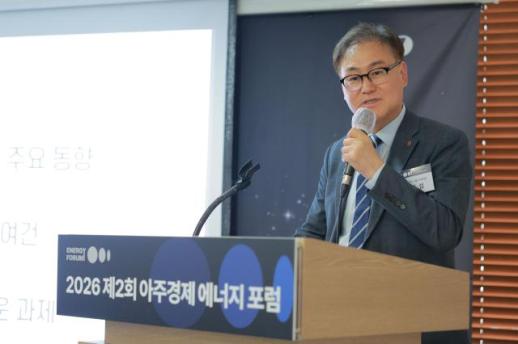 KEPCO official urges proactive grid buildout as AI power demand surges "To support the spread of artificial intelligence and the expansion of renewable energy, we need a paradigm shift so that a proactively built power grid leads demand and generation," Kwak Eun-seop, head of system planning at Korea Electric Power Corp., said Tuesday. Kwak made the remarks at the “2026 Ajunews Second Energy Forum,” held at the Korea Press Center in central Seoul and hosted by Ajunews. He said surging electricity demand from data centers is turning the grid from basic supply infrastructure into a key factor in national competitiveness. “The power grid is the critical link between carbon neutrality and energy security,” he said, adding that it should be treated as a power-system stability issue, not simply a connection problem. Kwak said power density at AI data centers is rising fast. He cited Nvidia GPU racks, saying their power use increased from about 13 kilowatts in 2020 to 130 kilowatts in 2025 and could expand to about 600 kilowatts. “The day is not far off when a single data center uses gigawatt-level power, comparable to one nuclear power plant unit,” he said. He also pointed to the burden of concentration in the Seoul metropolitan area. As of March, 598 of 853 new power-connection applications — 70% — were in the capital region. Yet the region’s recent energy self-sufficiency rate stands at just 0.61, meaning it must draw electricity from outside areas. Kwak said grid expansion is not keeping pace with demand. KEPCO estimates that building a 345-kilovolt transmission line typically takes 13 years. Data centers and renewable energy facilities can be built in two to three years, but transmission projects take far longer due to site selection, local acceptance, permits and construction. “Delays in building transmission networks are not unique to Korea; they are common overseas as well,” he said. “If we wait only for perfect transmission expansion, it will be difficult to keep up with the pace of rising AI and renewable-energy demand.” He said another major variable is how electricity is used. Unlike traditional industrial facilities, AI data centers can see power use swing sharply in milliseconds. “If loads of several hundred megawatts change abruptly, they can trigger voltage and frequency fluctuations and even system oscillations,” he said, warning it could strain equipment across the grid, including shorter transformer life and malfunctions in protective relays. Kwak said South Korea may be more vulnerable because its grid is an isolated system not connected to overseas networks. “Europe and North America can disperse some shocks through cross-border interconnections, but in Korea internal system stability is even more important,” he said. As responses, KEPCO proposed establishing grid-code standards for connecting large data centers, expanding flexible connections using energy storage systems, and introducing a virtual power line, or VPL. “Stronger technical standards are not regulation; they are to stably accommodate more data centers,” Kwak said. “We will work to make sure the expansion of AI and renewable energy is not blocked by making the most of the existing transmission network.” 2026-04-29 17:25:25
 -
 South Korea Labor Ministry Holds Forum With Industrial Accident Victims, Pledges to Close Coverage Gaps The government held a meeting to hear directly from workers injured in industrial accidents and their families during a memorial week for the Day of Workers Killed or Injured in Industrial Accidents. The Ministry of Employment and Labor said Ryu Hyeon-cheol, head of its Occupational Safety and Health Headquarters, hosted a discussion forum on Tuesday afternoon with the Korea Workers’ Compensation and Welfare Service under the theme “Listening to Injured Workers.” The event was organized for the memorial week, held from April 28 to May 4, to remember those killed in industrial accidents and to comfort bereaved families. It was also the first memorial-week event since Ryu took office. About 60 people attended, including members of the bereaved families’ network “Dasisneun,” representatives of industrial accident groups and injured workers. Participants shared difficulties they faced while seeking workers’ compensation, problems in treatment, recuperation and rehabilitation, and areas where they said the system needs improvement. They also held an open discussion on the overall industrial accident insurance system. They called for expanded support to help injured workers return to their jobs and daily lives after treatment, sustained welfare support for families, and greater assistance for related organizations. Ryu said the government would work to “expand the scope of protection by eliminating blind spots in industrial accident insurance, build a fast and accurate compensation system, and support a return to work through early treatment and tailored assistance,” with the goal of making the country safer and healthier for workers. He added that it was meaningful to communicate directly with injured workers and said the ministry would actively review the difficulties and proposals raised at the forum so they can be linked to policy.* This article has been translated by AI. 2026-04-29 13:33:37
 -
 Climate Ministry to Step Up Ozone Controls, Inspect 643 Emission Sites May-August The government will begin an intensive effort from May through August to cut ozone-forming pollutants and protect public health ahead of the season when high ozone levels are most likely. The Ministry of Climate, Energy and Environment said Tuesday it will push an “intensive management plan for the high-ozone period (May-August),” focusing on reducing nitrogen oxides and volatile organic compounds — key precursors of ozone — and strengthening public guidance on how to respond. Ozone formed near the ground in the troposphere is created when nitrogen oxides (NOx) and volatile organic compounds (VOCs) react under strong sunlight. High ozone concentrations can irritate the eyes, nose and respiratory system, and can have a greater impact on vulnerable groups such as children, older adults and people with respiratory illnesses. With climate change contributing to higher temperatures, stronger sunlight and more stagnant air, high-ozone episodes have continued. The number of days ozone advisories were issued rose from 59 in 2017 to 67 in 2021, and stood at 60 in 2025. The government will designate intensive management zones centered on areas with concentrated NOx and VOC emissions and on high-ozone areas, and will focus inspections on major sources based on emissions and their contribution to ozone formation. During the high-ozone period, it will strengthen inspections of 643 large-scale facilities that emit or handle large volumes of relevant substances. It will also provide technical support to 273 sites, including facilities with weak controls on fugitive emissions and gas stations equipped with vapor recovery systems. Starting this year, 63 environmental surveillance officers will be newly designated at regional environment offices. The ministry said it will use advanced measurement equipment and an intelligent monitoring system using artificial intelligence and big data to quickly crack down on facilities suspected of illegal emissions. Vehicle emissions controls will also be tightened. The government will expand on-site checks using vehicle emissions measurement equipment and enforcement cameras, and will conduct special inspections of 300 to 400 private vehicle inspection centers jointly with the ministry, the Ministry of Land, Infrastructure and Transport, and local governments. For about 1,000 major NOx-emitting facilities in sectors such as power generation, steel and petrochemicals, the government will strengthen total emissions management. The total allowable emissions cap for this year is 176,000 tons, about 5.4% lower than last year. Support for early scrappage of older vehicles will also be revised. The government will end purchase support for gasoline and gas vehicles and shift support toward electric, hydrogen and hybrid vehicles, with a plan to supply 337,000 vehicles this year. To reduce VOCs from everyday sources, the government will require low-emission painting methods, such as using rollers, at facilities used by sensitive groups including children and older adults. It will also prepare guidelines for the public sector on purchasing and using environmentally friendly organic solvent products. The government said it will strengthen scientific management by introducing an integrated forecasting system that combines existing numerical models with AI, aiming to raise ozone forecast accuracy from 63% to 71%. To improve accuracy, it will apply integrated prediction information that combines numerical modeling and AI to ozone forecasts. For areas without air-quality monitoring stations, it will provide an ozone estimated concentration image service using satellite data starting next month. It also plans to invest 3.6 billion won through 2030 in projects to identify ozone causes and develop reduction technologies. The government will also expand guidance on how to respond to high ozone for schools, daycare centers, facilities for older adults and outdoor workers. It said it will provide ozone advisory and warning information quickly through the AirKorea mobile app. “From May to August, when sunlight is strong and temperatures are high, the risk of high ozone levels is elevated,” Kim Jin-sik, director general of the ministry’s Air Environment Bureau, said. “We will do our utmost to protect public health by intensively managing precursors such as nitrogen oxides and volatile organic compounds and by providing ozone forecast information quickly.”* This article has been translated by AI. 2026-04-29 12:10:59
 -
 Climate Ministry Begins Talks to Overhaul Power Oversight for 100GW Renewable Era The government is launching talks on overhauling its power oversight system to match the expansion of renewable energy. Working with civil society groups, it plans to discuss how to reshape power-market governance and speed up institutional changes for the energy transition. The Ministry of Climate, Energy and Environment said Tuesday it will hold a forum titled “Power Regulation Governance Forum for the 100GW Renewable Energy Era” on Wednesday morning at the HJ Business Center in Jongno-gu, Seoul, together with six civil society groups: the Energy Transition Forum, Climate Solution, Energy and Space, the Green Energy Strategy Institute, the Public Renewable Energy Forum and the Green Consumers Network. The forum follows up on the government’s “Energy Grand Transition Implementation Plan for the People’s Sovereignty Government,” released on April 6. The government is seeking to shift the energy system from fossil fuels to renewables to strengthen future national competitiveness, aiming for what it calls an “electro-state.” The ministry said the transition is not just a change in generation sources but a restructuring of how electricity is produced and used — from a centralized, one-way system to a distributed, two-way one. It said that makes an overhaul of power oversight increasingly necessary to improve transparency and fairness in the electricity market. A ministry official said the government will push to revise the Electric Utility Act based on views presented at the forum and, through consultations with relevant ministries and discussions in the National Assembly, build an institutional foundation for the energy transition.* This article has been translated by AI. 2026-04-29 12:09:47
 -
 South Korea Proposes Five-Tier Public EV Charging Rates, Sets 391.9 Won for 200 kW+ The government is moving to break public electric-vehicle charging fees into five tiers from the current two, lowering rates for slower charging while raising ultra-fast rates to better reflect cost differences by charging speed. The Ministry of Climate, Energy and Environment said April 29 it will issue an administrative notice on a revised fee system and unit prices for public EV charging stations from April 30 through May 19. The ministry also said it will begin a separate legislative notice, running the same day through June 9, on revisions to subordinate regulations under the Clean Air Conservation Act covering management standards for electric and hydrogen charging facilities. Slower charging cheaper, ultra-fast higher under new fee tiers The centerpiece of the plan is to expand the public charging fee structure from two tiers — under 100 kilowatts and 100 kW or more — to five tiers. Current rates are 324.4 won per kilowatt-hour for under 100 kW and 347.2 won for 100 kW or more. Under the proposal, rates would be set at 294.3 won for under 30 kW; 306.0 won for 30 kW to under 50 kW; 324.4 won for 50 kW to under 100 kW; 347.2 won for 100 kW to under 200 kW; and 391.9 won for 200 kW or more. The revised rates would apply when drivers use public chargers installed and operated by the ministry, or chargers operated under agreements with the ministry, and pay with a ministry membership card. A discount program that applies from 11 a.m. to 2 p.m. on weekends and holidays in spring and fall would keep the same discount levels, applied to the new unit prices. The ministry said the existing system has not adequately reflected differences between charger output and actual operating costs. It said it recalculated unit prices to incorporate operating expenses such as communications fees, maintenance, labor and depreciation. A ministry official said charging services in the field have become more segmented — including slow, mid-speed and fast charging — but the fee system has remained a two-tier structure for about four years and has not kept pace with market changes. On concerns that the 200 kW-and-above ultra-fast rate could raise consumer burdens, the official said not all drivers use 200 kW chargers at all times and that simply comparing ultra-fast charging fees with average gasoline or diesel prices is not appropriate given EV usage patterns. Mandatory price posting, stronger maintenance and disclosure rules The ministry is also pursuing tighter management of EV and hydrogen charging infrastructure through revisions to subordinate regulations under the Clean Air Conservation Act. Operators would be required to make charging fees visible on-site through signs or notices. For charging facilities at highway rest areas, the government plans to require external price signs, similar to those at gas stations, so drivers can check rates before charging. The proposal would also strengthen obligations for preventive maintenance and regular inspections to reduce breakdowns. Operators would have to maintain a system to respond to fault reports and user inquiries, and could face corrective orders for failing to meet management standards. A new disclosure requirement would require operators to post charging fees, detailed location information and real-time availability on the Korea Environment Corporation’s integrated online portal for zero-emission vehicles. The ministry said it expects the measure to address “hidden pricing” and encourage price competition in the private charging market. Separately, the ministry said it is reviewing a seasonal and time-of-use pricing system for public charging fees, linking electricity rates and consumer charging prices so charging can be cheaper when renewable power generation is high. No implementation date has been set. The ministry also plans to revise subsidy guidelines to prevent unnecessary charger replacements. If a charging facility that has not reached its eight-year service life is removed and replaced, subsidies would be provided only when there is a justified reason, such as an irreparable failure. It also plans to allow apartment managers to receive subsidies when they directly install and operate charging facilities, expanding user choice. Jeong Seon-hwa, the ministry’s director general for Green Transition Policy, said, “Reasonable charging fees and convenience in using charging facilities are key to expanding EV adoption,” adding that the government will work to build an optimal charging ecosystem starting with the fee overhaul and management standards. * This article has been translated by AI. 2026-04-29 12:03:30
 -
 South Korea to Spend 52.75 Billion Won to Bring AI to Chip, Auto and Shipbuilding Plants The South Korean government is moving to apply artificial intelligence to production sites in key industries such as semiconductors, automobiles and shipbuilding to strengthen manufacturing competitiveness. It plans to invest 52.75 billion won in state funds next year to accelerate a broad AI shift in manufacturing. The Ministry of Trade, Industry and Energy said Tuesday it will 추진 an “AI Factory Leading Project” to support the development and rollout of industry-specific manufacturing AI technologies, as well as the adoption of AI robots, facilities and equipment. The ministry said the program was designed to lift manufacturing competitiveness as growth slows amid a shrinking working-age population and a decline in potential growth. It also cited unstable global supply chains, geopolitical risks and intensifying competition for technological leadership, which it said are increasing the importance of the ability to implement advanced technologies on factory floors and produce them at scale. Through the project, the ministry said it will push a full-scale “AI transformation” of manufacturing sites, dubbed M.AX, by developing and distributing sector-tailored manufacturing AI and introducing AI robots, facilities and equipment. It will select 32 tasks focused on industries and processes with high urgency and broad impact, and will diversify support types to better match industry demand, including models aimed at cooperation between large firms and small and midsize partners and models that delegate data and AI models. The program will operate under five types, including a “large-small cooperation” model in which major companies share AI models with small and midsize partner firms in their supply chains; a “data and AI model delegation” model that opens and delegates data and AI models to the government; and a “full-stack PoC” to build a full-stack AI factory run solely by AI. The ministry said applications for new tasks will be accepted from Feb. 6 to March 9. Details will be available on the 범부처통합연구지원시스템 website. It also said it will hold a project briefing at 2 p.m. on May 7 at the JW Marriott Dongdaemun Square, targeting manufacturing companies, AI firms and research institutions. The ministry said it will explain the new call for projects, the intent behind the request for proposals and the selection and evaluation plan, and will take questions and gather feedback to improve researchers’ understanding and encourage participation. “An era in which manufacturing and industrial competitiveness is national competitiveness,” a ministry official said, adding that the ministry will 추진 the AI Factory Leading Project without setbacks to become a top M.AX nation by 2030.* This article has been translated by AI. 2026-04-29 11:12:23
 -
 Climate, Energy and Environment Minister Visits Doosan Enerbility Plant to Check New Reactor Equipment Kim Sung-hwan, minister of climate, energy and environment, visited a major nuclear equipment manufacturing site to help ensure the smooth rollout of new nuclear power plant construction. The ministry said Kim visited Doosan Enerbility’s Changwon plant in Seongsan-gu, Changwon, South Gyeongsang Province, on Tuesday morning to inspect production of key nuclear power plant components. The visit was part of on-site checks aimed at moving forward, without setbacks, with new reactors included in the 11th Basic Plan for Long-term Electricity Supply and Demand. The Changwon plant is considered the country’s only comprehensive manufacturing base with the capability to produce major components for large nuclear power plants. It has supplied key equipment to major domestic plants including Shin Hanul, Shin Kori and Shin Wolseong. Kim’s tour was scheduled to proceed from the main forging shop to the nuclear plant. Site managers briefed him on ultra-large forging production facilities, manufacturing processes for major nuclear components and the quality-control system. Kim was to review the production status and delivery schedules for key equipment designed to withstand high-temperature and high-pressure conditions. Kim told workers, “Korea has world-class competitiveness in nuclear equipment manufacturing,” adding that the foundation of that strength is “the dedication and effort of workers on the ground.” He also urged them to “do your utmost in quality control” so that Korea’s nuclear power plants can remain trusted and their safety assured.* This article has been translated by AI. 2026-04-29 10:34:44
 -
 South Korea Approves 3 Regional Job Projects, Pledges 21.2 Billion Won for Busan-Ulsan-Gyeongnam, Daegu-Gyeongbuk and Chungcheong The South Korean government is moving ahead with a large-scale support program aimed at more balanced regional development and job creation built around mega-regional blocs. The Ministry of Employment and Labor said Tuesday it had finalized three joint project plans under its “Wide-Area Link Project” after a public call and review process. The approved regions are Busan-Ulsan-South Gyeongsang; Daegu-North Gyeongsang; and Daejeon-Sejong-North Chungcheong-South Chungcheong. The program is designed to help metropolitan and provincial governments share resources and close policy gaps created by administrative and geographic boundaries. A central goal is to provide multi-year support — over four years — for job initiatives tied to each region’s strategic industries, in an effort to curb population outflows and encourage people to move in from the Seoul metropolitan area and elsewhere. To strengthen implementation, the ministry said it has operated “mega-regional project preparation teams” since October last year, involving local labor offices, local governments and regional human resources development councils. After workshops and intensive consulting by selection reviewers, the ministry said it confirmed each region’s project content and scale. The approved plans focus on creating conditions that help skilled workers stay in the region by building on key local industries. Busan-Ulsan-South Gyeongsang will receive 10 billion won. The region will pursue what it described as a “mega-regional living zone” linking commuting and employment to create quality jobs in shipbuilding, automobiles and machinery parts. Daegu-North Gyeongsang will receive 8 billion won to foster a “future mobility jobs-and-living ecosystem,” including joint research and development among companies across the supply chain and efforts to strengthen workforce capabilities. The Chungcheong region will receive 3.2 billion won to build a “mega-regional career-link ecosystem” aimed at a virtuous cycle of attracting, settling and developing talent in growth industries such as bio and mobility. Across the regions, the ministry said support measures will include help with asset-building and living expenses to improve settlement conditions, assistance for long-term employment and re-employment, and packages such as company visits and on-site training. To boost momentum, the ministry said it will form project task forces led by director-level local government officials, with regional labor office chiefs serving as secretaries, to strengthen public-private cooperation. It also plans to hold a series of “regional implementation pledge events” starting in July to support the project’s rollout. Labor Minister Kim Young-hoon said the project would be “a springboard for creating quality jobs by bringing together regional resources beyond administrative and geographic limits.” He said the central government and mega-regional local governments would work closely to build “a vibrant regional jobs ecosystem where young people choose to stay.”* This article has been translated by AI. 2026-04-29 09:04:18