
Journalist

Jang Sun-a
ruizhi@ajunews.com
-
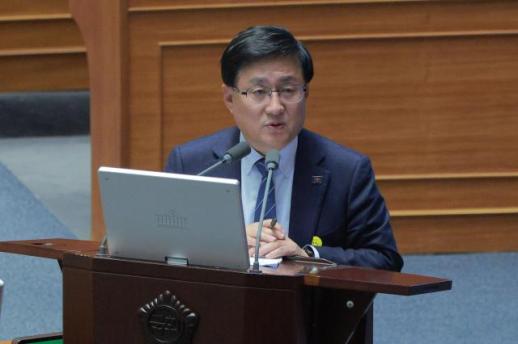 South Korea drops cup price-labeling plan from anti-plastic package, favors voluntary cuts The government on the 28th left out a proposed “cup price labeling system” — a plan to charge separately for cups — from its comprehensive anti-plastic package, saying it will prioritize voluntary reductions to reflect conditions in the field. Instead, it plans to curb single-use cups by expanding discounts for reusable tumblers and increasing the number of stores participating in the carbon-neutral points program. Kim Go-eung, director general for resource circulation at the Ministry of Climate, Energy and Environment, said at a briefing at the government complex in Sejong after a Cabinet meeting that officials had reviewed renaming the separate cup charge as a “cup price labeling system,” but did not include specific measures in the package. He said the ministry will first expand personal-cup discount programs through agreements with related industries. “We are continuing to communicate with the industry” on the cup price labeling plan, Kim said, adding that discussions are underway to design a system that both reflects on-the-ground acceptance and delivers real plastic-reduction effects. The ministry is reviewing ways to expand tumbler discounts now offered by some franchises to independent cafes and to increase the number of participating carbon-neutral points stores. The points awarded for using a personal cup are currently about 300 won. The ministry reported to the Cabinet on the 28th its plan to shift to a “plastic-free circular economy,” targeting a total reduction of 3 million metric tons of plastic by 2030. Minister Kim Seong-hwan told the Cabinet that household and business waste plastic totals about 8 million tons a year and, if the trend continues, could reach about 10 million tons by 2030. He said 1 million tons would be cut by avoiding plastic use at the source, while 2 million tons would be circulated through the use of recycled materials. Officials also raised the possibility of government support to ease the cost burden of recycled plastic. Kim Go-eung said the ministry is considering ways to cover the price gap when recycled feedstock costs more than virgin resin, including direct fiscal support and using reserve funds from the extended producer responsibility, or EPR, system. He said the scale and method of support have not been finalized. The government also plans to introduce a new certification system for recycled-material quality, reflecting concerns raised by makers of pay-as-you-throw trash bags. Officials said they will set quality standards, build a certification framework and boost market confidence. In addition, the government plans structural changes to reduce plastic use, including encouraging switches to alternatives such as paper for products where plastic is unnecessary. It is also reviewing changes to the waste charge, now uniformly set at 150 won per kilogram, to apply different rates based on product lifespan and characteristics. Kim said the current system imposes a uniform charge regardless of product lifespan and needs to be subdivided by product type, adding that the ministry will design the system in detail while considering impacts on industry. * This article has been translated by AI. 2026-04-28 15:31:25
 -
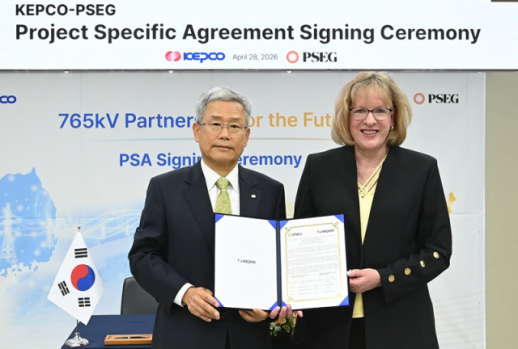 KEPCO Signs 765kV Transmission Technology Cooperation Deal With PSEG Korea Electric Power Corp. said it has partnered with U.S. energy company Public Service Enterprise Group, or PSEG, as it moves to expand into the U.S. extra-high-voltage transmission market. KEPCO said it signed the agreement on April 28 at its Art Center in Seoul’s Yangjae-dong to cooperate on 765-kilovolt transmission projects. The utility said the deal is significant because it represents formal recognition overseas of KEPCO’s capabilities in engineering, procurement and construction, or EPC, for 765kV-class transmission networks, as well as its ability to operate power systems reliably. KEPCO said its long-distance, large-capacity transmission technology and operating experience have helped demonstrate its competitiveness in the U.S. market. KEPCO said it plans to go beyond technical consulting and take a more active role across project development and execution. It said it aims to enter the U.S. power market in earnest by participating directly through equity investment and the establishment of special-purpose companies, or SPCs. KEPCO also said it will work with South Korean equipment makers under a “Team Korea” framework to pursue entry into the U.S. 765kV transmission market. It said the effort is expected to broaden overseas opportunities for South Korea’s power equipment industry and strengthen competitiveness in the global power infrastructure market. KEPCO said it plans to use the extra-high-voltage transmission business as a foothold to gradually expand cooperation in new U.S. energy ventures, including an intelligent digital power plant, or IDPP, and an advanced distribution management system, or ADMS. KEPCO President Kim Dong-cheol said the agreement “served as an opportunity for KEPCO’s 765kV EPC and operational capabilities to be validated in the global market.” He added, “As a responsible public enterprise, we will continue to expand our entry into the U.S. power market in various ways, including equity investment, in cooperation with domestic companies.”* This article has been translated by AI. 2026-04-28 14:17:12
 -
 South Korea launches nationwide carbon-neutral action campaign, forms preparatory committee The government is moving to step up a nationwide public action campaign aimed at carbon neutrality and a major shift in energy use. The Ministry of Climate, Energy and Environment said it will hold a launch ceremony Monday afternoon at Korea House in Jung-gu, Seoul, for the “Republic of Korea Climate Action Preparatory Committee for Carbon Neutrality and the Energy Transition.” At the event, the committee will declare this year the “first year of Republic of Korea climate action” and discuss ways to build and expand everyday public participation to respond to the climate crisis and advance the energy transition. About 100 people from across society — including religious groups, industry, finance, education and civil society — are expected to attend, marking what organizers described as a new start for the initiative. The committee said it plans to systematically spread climate actions rooted in daily life and local communities so that small steps can contribute to carbon neutrality, while building broader public consensus through voluntary private-sector participation. Participants will issue a climate action declaration under the theme “From the declaration of 100 people to the practice of 10 million citizens.” Free remarks will follow, covering topics such as climate action guidelines and ways to broaden participation nationwide, environmental, social and transparent governance (ESG) cases, and policy proposals. Starting Monday, the committee plans promotional activities, including public participation events, through the “2026 Environment Day and Climate Action Launch Event” on June 5. The ministry said it will reflect the committee’s input in a future national climate action plan and build an operating framework based on voluntary participation to link the “declaration of 100 people” to “the practice of 10 million citizens.” Minister Kim Seong-hwan said, “Now is the time for everyone to act together with a sense of urgency.” He added that he hopes the preparatory committee will serve as a hub for nationwide climate action by “spreading declarations into practice, and practice into culture.”* This article has been translated by AI. 2026-04-28 14:03:17
 -
 South Korea to Cut Virgin Plastic Use by 30% by 2030 in Shift to Circular Economy The government will step up its shift to a “plastic-free circular economy,” aiming to cut plastic waste by 2030 and reduce the use of virgin plastic made from oil and naphtha by at least 30%. Climate, Energy and Environment Minister Kim Seong-hwan reported the “Action Plan for Transition to a Plastic-Free Circular Economy” to a Cabinet meeting on Monday, outlining measures to expand recycling and curb demand for new plastic. The plan is being pushed as a key national policy task as the recent war in the Middle East has made supplies of oil and naphtha — key plastic feedstocks — more uncertain. The government said it aims to build a sustainable circular economy ecosystem and strengthen industrial competitiveness. Recycled-content mandates expanded to curb virgin plastic The government will gradually expand mandatory use of recycled materials. The current requirement for PET bottles — 10% recycled content starting this year — will be raised to 30% by 2030. The government also plans to introduce internationally aligned recycled-content target rates for food and cosmetics containers and plastic film products made from polyethylene (PE) and polypropylene (PP). It will support equipment replacement and shifts to smart manufacturing processes, starting with pay-as-you-throw garbage bags, which were among key response items during the Middle East conflict. Officials also said they will review steps to stabilize the market if recycled materials cost more than virgin, petroleum-based inputs. Policies to reduce plastic products will be strengthened. The government will assess items such as cosmetics containers and plastic bags for reusability and ease of recycling, and will encourage switching to alternatives such as paper where plastic is not necessary. Delivery containers and parcel packaging will also face tighter rules. For delivery containers, the government will encourage weight reductions by optimizing structural design while keeping overall size and shape. For parcel packaging, it will limit excessive packaging to reduce plastic use. Packaging that is hard to recycle or that disrupts recycling of other products will face limits on market entry through industry agreements. For major product categories such as clothing and electrical and electronic goods, the government will flesh out a “Korean-style eco-design system” to ensure recyclability is considered from the design and production stages. The waste charge system will also be revised. Rates will be differentiated to reflect varying product lifespans, such as for disposable goods and furniture, and fee reductions for using recycled materials will be expanded. Recycling expanded to plastics now incinerated; reuse pushed The government also plans to bring plastics that have typically been incinerated into the recycling loop, building collection and recycling systems for items long considered blind spots, including clothing and disposable plastic cups. Working with the National Police Agency, the government will collect police uniforms that were previously burned, extract recycled polyester, or use the material as filling and insulation. It plans to expand the program later to other uniforms, including military clothing. Disposable cups, currently subject to waste charges, will be brought under the extended producer responsibility recycling system so they can be managed and recycled together with containers made of the same material. The government will expand preprocessing facilities that open and sort pay-as-you-throw bags and increase deployment of artificial intelligence and optical sorting equipment to recover plastic waste that has been burned or buried. For waste plastic film, it will promote pyrolysis to extract recycled naphtha by building wider-area collection systems and diversifying feedstocks. It will also accelerate a shift to reusable containers, focusing on multiuse facilities where disposable items are heavily used. Funeral halls will switch to reusable tableware through agreements starting with facilities run by public institutions nationwide, with a phased expansion to private facilities based on implementation results. The government will also seek to establish a culture of reusable containers at workplace cafeterias and cafes, sports stadiums, and cafes near public institutions. It plans to expand personal-cup discount programs already used by some coffee chains and to sign agreements to refrain from using mixed-material packaging. The ministry said it plans to extend the source-reduction and circular-use approach beyond plastics to future waste resources across sectors, including used electric vehicle batteries and discarded solar panels. Kim said the Middle East war is a crisis but also an opportunity to address “the structural vulnerability of a linear economy that depends on imported resources while mass-producing and discarding products.” He said the government will push “source reduction and circular use” quickly and forcefully to build a sustainable, plastic-free economy that is resilient to external shocks. 2026-04-28 13:21:25
 -
 South Korea to Brief Exporters on New EU Packaging Rules Taking Effect in August The South Korean government is stepping up support for industry as the European Union prepares to enforce new packaging rules in August. The Ministry of Climate, Energy and Environment said Monday it will hold a joint government briefing Tuesday at the National Railroad Authority auditorium in Dong-gu, Daejeon, titled “Joint Government Briefing on Global Regulations in the Packaging Materials Sector.” The session is designed to help domestic companies respond to the EU’s Packaging and Packaging Waste Regulation, or PPWR, set to take effect in August, and the Food-Contact Plastic Packaging Safety Regulation, due to take effect in September. The PPWR applies to all packaging used in the EU and sets broad sustainability requirements, including limits on hazardous substances, compliance with recyclability grading standards, mandatory use of recycled content and bans on excessive packaging. Key provisions include restrictions on heavy metals and PFAS, a ban on placing products on the market with recyclability below 70%, and a requirement that plastic beverage bottles contain 30% recycled material. The food-contact plastic packaging rule strengthens safety standards for plastic containers that touch food, tightens requirements to prevent contamination from impurities in recycled plastics and expands obligations to provide information to consumers. The government said the rules could affect the production, distribution and consumption of virtually all physical goods, making early preparation necessary. It expects heavier compliance burdens for sectors with high exports to Europe, including food, cosmetics and household products. Officials said ministries have so far tracked the regulations through bilateral consultations with the EU and held separate briefings, but decided a more systematic, comprehensive response was needed. At the briefing, the ministry and the Korea Environment Corporation will explain the PPWR’s main requirements and practical compliance steps, including required documentation. The Ministry of Food and Drug Safety will present response strategies tailored to the food and cosmetics sectors, including the food-contact plastic packaging rule. The Ministry of Agriculture, Food and Rural Affairs and the Ministry of SMEs and Startups will outline sector-specific measures and ministry support programs for the agriculture and food industry and for small and medium-sized businesses, respectively. The government said it will continue operating an interagency working-level task force starting with this briefing. “Stronger EU-led standards on the sustainability and safety of packaging materials will have a significant impact across our industries,” said Kim Go-eung, director general for resource circulation at the ministry. “The government will continue working with industry to prepare thoroughly in advance and enhance the sustainability of our products and export competitiveness.”* This article has been translated by AI. 2026-04-28 12:11:19
 -
 Climate Ministry to Train ESG Specialists, Issue Scope 3 Guides for Petrochemicals and Steel The government will move ahead this year with a program to train ESG professionals and will release guidance on calculating Scope 3 greenhouse gas emissions for the petrochemical and steel industries, aiming to strengthen companies’ ability to respond to environmental, social and governance rules. The Ministry of Climate, Energy and Environment said April 28 it will run an ESG management professional training program from May through November to help companies build capacity for sustainable management. The ministry said the program was designed to help companies develop practical response capabilities as sustainability disclosures expand internationally and product-based environmental regulations tighten. Companies face growing pressure as ESG disclosure requirements and environmental rules such as carbon border adjustment mechanisms strengthen rapidly in global markets. Securing hands-on staff who can collect and analyze relevant data and apply it to management strategy has emerged as a key challenge. The government plans to shift away from theory-heavy instruction and expand training built around practice and case studies. It also plans to broaden “on-site training” tailored to regional demand to improve access for companies outside the capital area. The curriculum will focus on strengthening capabilities for carbon neutrality, with expanded practical content on carbon-reduction technologies and renewable energy transitions to help companies respond to mandatory sustainability disclosures and global carbon regulation trends. Courses will be offered monthly, with notices to be posted in early and mid-month. Separately, the government will support companies in calculating Scope 3 emissions, an area it said is among the most difficult for businesses. Scope 3 covers not only a company’s direct emissions but also indirect emissions across its supply chain, making the boundary broad and data difficult to secure. The ministry has published Scope 3 calculation guides since 2023 reflecting the characteristics of major export industries. This year it will newly release tailored guides for petrochemicals and steel. The petrochemicals guide includes calculation methods reflecting a complex value chain from raw material procurement through product use and disposal. The steel guide includes methods based on key raw materials by process and standard processes, along with examples of using circular resources to improve applicability in the field. The guides were developed through a consultative body involving the ministry, the Korea Environmental Industry & Technology Institute, major companies by sector and industry associations, and present practical, sector-specific guidelines. The guides will be available starting April 29 on the ministry’s official website and the Environmental Responsible Investment Integrated Platform. An English translation of last year’s guide for the semiconductor and display industries will also be released. Jeong Seon-hwa, the ministry’s director general for green transition policy, said, “Amid international ESG regulations and the trend of carbon regulation, securing companies’ practical response capabilities is more important than anything.” She added, “We will systematically support responses to international sustainability disclosures and carbon regulations by linking professional workforce training with the provision of calculation standards.”* This article has been translated by AI. 2026-04-28 12:07:26
 -
 Korea to Tighten Oversight of Green Claims in Online Platform Ads With Industry Training The Ministry of Climate, Energy and Environment and the Fair Trade Commission will provide training to strengthen oversight of environmental labels and advertising in the online retail market, aiming to improve the credibility of green claims. The ministry and the FTC said on April 28 they will hold an “environmental labeling and advertising” training session on April 29 at the Korea Environmental Industry & Technology Institute auditorium in Eunpyeong-gu, Seoul, for major mail-order brokerage operators and sellers on online distribution platforms. As green consumption spreads and interest in eco-friendly values grows, labels and ads highlighting the environmental benefits of products and services have increased rapidly. In online platform sales involving many sellers, the accuracy and consistency of environmental information has become a key factor affecting consumer trust and market integrity. Environmental labeling and advertising are overseen by the climate ministry under the Environmental Technology and Environmental Industry Support Act and by the FTC under the Act on Fair Labeling and Advertising. Industry has called for clearer, more unified guidance on how the rules are interpreted and how investigations are conducted. The training was designed to meet that demand by improving companies’ understanding of the system and strengthening practical compliance capabilities. The Korea Environmental Industry & Technology Institute and the Korea Online Shopping Association will run the program. The agenda includes trends and key issues in the mail-order brokerage system, an overview of environmental labeling and advertising rules, major review cases under the labeling and advertising law, and guidance on proper environmental claims. To allow participation by sellers nationwide, the session will be offered both in person and via live online streaming. The two agencies also plan to prepare and distribute a joint guideline on environmental labeling and advertising by the end of the year. The guide is intended to provide integrated direction on the standards used by both agencies, support companies’ understanding and compliance, reduce unfair green claims, and strengthen consumer protection and market trust. Jeong Seon-hwa, the climate ministry’s director general for green transition policy, said, “We hope this training helps companies accurately understand the environmental labeling and advertising system and use it properly,” adding that the agencies will continue working together to improve consistency and effectiveness in oversight. Information Reum, director general of the FTC’s Consumer Policy Bureau, said the session was arranged so companies do not face difficulties from legal and institutional uncertainty as they pursue “environmental management.” She said the government plans to strengthen monitoring while improving rules on environmental labels and advertising that are closely tied to people’s everyday consumption. * This article has been translated by AI. 2026-04-28 12:05:23
 -
 South Korea Launches Government-Industry Talks to Counter Tighter Global Export Controls The South Korean government has launched a formal communication channel with leading companies in semiconductors, artificial intelligence and quantum technology to respond to rapidly shifting global trade security conditions. The Ministry of Trade, Industry and Energy said it held the first public-private “Trade Security Dialogue” on the afternoon of April 28 at the Korea Institute for Trade Security Management in Seoul’s Gangnam district, with 10 major companies and related industry associations from the semiconductor, AI and quantum sectors. The meeting was organized to strengthen the response capabilities of domestic exporters as the United States, China and the European Union continue to tighten economic security measures amid competition for leadership in advanced technologies. With the potential military use of private-sector technologies expanding, export controls and sanctions rules are becoming more complex, the ministry said. Exporters in key industries such as semiconductors, machinery and aerospace are finding it increasingly difficult to accurately understand and comply with the export control and sanctions rules of different countries, it said. Violations can lead to export restrictions, administrative fines and other penalties, including being placed on sanctions lists. At the session, the government briefed participating companies on trade security issues, including U.S. legislative trends on semiconductor export controls and China’s announcement of supply chain security rules. Officials also discussed export control items related to semiconductors, AI and quantum technologies that are emerging as key topics in international export control regimes, and reviewed response directions. The ministry said the new channel is expected to deepen government-industry communication beyond raising difficulties, expanding it into a forum for international negotiations on export controls and discussions on institutional improvements. The ministry said it plans to set up a “trade security hotline” with relevant associations in the first half of the year to address urgent issues, and to continue the dialogue with major manufacturing sectors such as machinery, robotics and automobiles. Yang Gi-uk, director general for industrial and resource security, said “in-depth communication between the government and companies is key” to establishing and implementing effective trade security policy. He said the government will work with companies to track changes in the global trade security environment and respond with national interests as the top priority, supporting export industries such as semiconductors in maintaining a “super-gap” competitive edge.* This article has been translated by AI. 2026-04-28 11:05:42
 -
 South Korea launches AI project to turn factory know-how into data, speed M.AX shift The South Korean government is launching a project to convert skilled manufacturing workers’ experience and know-how — known as “tacit knowledge” — into artificial intelligence data for use on factory floors, as concerns grow that aging workforces could disrupt the transfer of core techniques. The Ministry of Trade, Industry and Energy said on 28 it will 추진 the “AI model development project based on manufacturing tacit knowledge.” The program will use 48 billion won in central government funding secured through a supplementary budget this year to help turn key shop-floor know-how into data and support AI model development based on it. Tacit knowledge refers to work techniques, judgment standards and hands-on know-how that veteran workers develop through years on the job. It is difficult to document, but is considered a key competitive asset that affects productivity and quality. The ministry said rapid aging in manufacturing is increasing retirements among skilled workers. It warned that if master craftsmen’s tacit knowledge is lost, it could weaken domestic manufacturing competitiveness and undermine the foundation for the manufacturing AI transformation known as M.AX. Industry has also called for systematic efforts to turn tacit knowledge into data and support AI use, the ministry said, adding that concerns are especially high in sectors facing severe labor shortages in higher-risk or more technically demanding processes. The project will support 30 tasks in selected industries and processes deemed urgent and likely to have broad impact. Funding will total 48 billion won — 1.6 billion won per task — and the project period will run for about nine months, from June through February next year. Eligible applicants are consortia involving manufacturing companies and AI firms. The government plans to provide comprehensive support beyond research and development funding, including dataset construction, AI model development, consulting and equipment installation. Work will include securing and refining unstructured data containing master craftsmen’s tacit knowledge, developing AI models using that data, and verifying datasets. The ministry said companies and institutions with strong results will receive preferential treatment in a large-scale follow-up project planned for the future. To broaden participation, the ministry and the Korea Institute for Advancement of Technology will hold regional briefings. After holding a briefing in the Seoul metropolitan area on the 23rd, they plan to run briefings from 28 through 29 in Yeongnam (Changwon), Honam (Gwangju) and the central region (Daejeon). A ministry official called it “a project that is essential to protecting manufacturing competitiveness,” and said the ministry will “communicate closely with industry, research and labor to move quickly.”* This article has been translated by AI. 2026-04-28 06:07:37
 -
 One in Four South Korean Public Agencies Faces Leadership Vacuum as Appointments Stall About one in four public institutions in South Korea is operating with a vacant top post or in a transition period after a term has ended, according to government data. The prolonged delays are drawing concern that policy execution could weaken, particularly at agencies responsible for industry and energy, as geopolitical risks in the Middle East and domestic and external economic strains such as a weak currency and high inflation intensify. As of Monday, the public institution management information system ALIO showed that 35 of 342 state-run enterprises, quasi-government agencies and other public institutions had no chief executive, or 10.2%. Another 31 institutions, or 9.1%, were being led by their outgoing heads on an acting basis because successors had not been appointed even after terms expired. An additional 17 institutions, or 5%, were set to see their leaders’ terms end in the first half of this year. In total, roughly 25% were either in a leadership vacuum or approaching a changeover. Several agencies tied to industry and energy policy remain without permanent leadership. Korea South-East Power, the Korea Power Exchange and the Korea Institute for Advancement of Technology Evaluation and Planning have vacant top posts. At Korea Gas Corp., KEPCO KPS and KEPCO MCS, incumbent chiefs are continuing in their roles after their terms ended because appointments have been delayed. Korea Gas Corp. is a prominent case. President Choi Yeon-hye is still performing her duties after her term expired because a successor has not been named. The company narrowed applicants to five candidates through a recruitment process in November, but it moved to reopen the search after union opposition and a determination of disqualification by the supervising Ministry of Trade, Industry and Energy. Korea Gas Corp. planned to close applications for president candidates at 6 p.m. Monday, but with the selection process typically taking about three months, an appointment within the first half of the year appears unlikely. At KEPCO KPS, President Kim Hong-yeon, who took office in June 2021 for a three-year term, has remained in place for nearly two years after his term ended because a successor has not been chosen. The company’s board recently sought to reorganize its executive recommendation committee, but all related agenda items were voted down during internal discussions, further delaying follow-up work, according to reports. In the industrial sector, the Korea Institute for Advancement of Technology Evaluation and Planning entered an acting-leadership system after its previous head, Jeon Yun-jong, recently moved to lead the Korea Institute for Advancement of Technology. The schedule for recruiting a successor remains unclear. The Energy Economics Institute and the Korea Radioactive Waste Agency are among institutions whose leaders’ terms are also set to expire in the first half of the year. In political circles, some expect delayed appointments to accelerate only after the June local elections. Others have raised concern that top posts could again be used as a tool for post-election patronage. Experts warned that extended leadership gaps could weaken policy responsiveness as uncertainty grows at home and abroad. An industry official said, “It is highly likely that the delayed appointments will be wrapped up sequentially only after the local elections,” adding, “With many pending issues piling up, the selection process should be sped up.”* This article has been translated by AI. 2026-04-27 16:16:15