

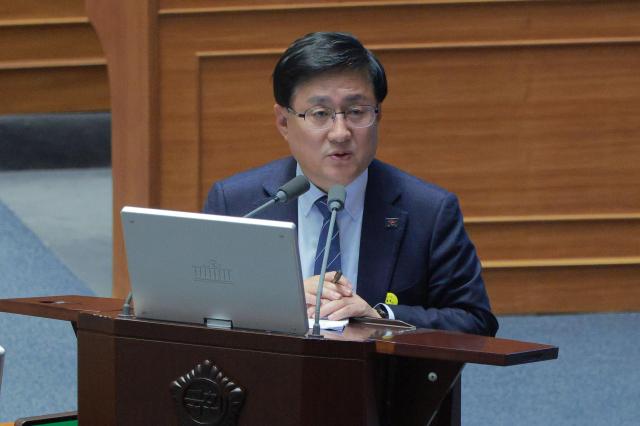
Kim Go-eung, director general for resource circulation at the Ministry of Climate, Energy and Environment, said at a briefing at the government complex in Sejong after a Cabinet meeting that officials had reviewed renaming the separate cup charge as a “cup price labeling system,” but did not include specific measures in the package. He said the ministry will first expand personal-cup discount programs through agreements with related industries.
“We are continuing to communicate with the industry” on the cup price labeling plan, Kim said, adding that discussions are underway to design a system that both reflects on-the-ground acceptance and delivers real plastic-reduction effects.
The ministry is reviewing ways to expand tumbler discounts now offered by some franchises to independent cafes and to increase the number of participating carbon-neutral points stores. The points awarded for using a personal cup are currently about 300 won.
The ministry reported to the Cabinet on the 28th its plan to shift to a “plastic-free circular economy,” targeting a total reduction of 3 million metric tons of plastic by 2030. Minister Kim Seong-hwan told the Cabinet that household and business waste plastic totals about 8 million tons a year and, if the trend continues, could reach about 10 million tons by 2030. He said 1 million tons would be cut by avoiding plastic use at the source, while 2 million tons would be circulated through the use of recycled materials.
Officials also raised the possibility of government support to ease the cost burden of recycled plastic.
Kim Go-eung said the ministry is considering ways to cover the price gap when recycled feedstock costs more than virgin resin, including direct fiscal support and using reserve funds from the extended producer responsibility, or EPR, system. He said the scale and method of support have not been finalized.
The government also plans to introduce a new certification system for recycled-material quality, reflecting concerns raised by makers of pay-as-you-throw trash bags. Officials said they will set quality standards, build a certification framework and boost market confidence.
In addition, the government plans structural changes to reduce plastic use, including encouraging switches to alternatives such as paper for products where plastic is unnecessary. It is also reviewing changes to the waste charge, now uniformly set at 150 won per kilogram, to apply different rates based on product lifespan and characteristics.
Kim said the current system imposes a uniform charge regardless of product lifespan and needs to be subdivided by product type, adding that the ministry will design the system in detail while considering impacts on industry.
* This article has been translated by AI.
Copyright ⓒ Aju Press All rights reserved.