
Journalist

Park Jin-young
sunlight@ajunews.com
-
 Samsung to end sales of premium foldable phone just months after launch SEOUL, March 16 (AJP) - Samsung Electronics will stop selling its twice-folding smartphone just three months after its release in South Korea. According to industry sources, sales of the high-end, premium Galaxy Z Tri-Fold are set to end after Tuesday. Since its rollout on Dec. 12, the device has been sold only in limited batches through Samsung.com, typically once every one to two weeks on Tuesdays. Once Tuesday's inventory sells out, the Galaxy Z Tri-Fold will no longer be officially available here. Despite its hefty price of 3.6 million won, the phone sold out within minutes whenever available, with some units resold on secondhand platforms. In the U.S., where the phone launched later than in South Korea, Samsung will keep selling it until the current inventory runs out. The Galaxy Z Tri-Fold features three displays that unfold to 253 millimeters (10 inches) when fully open and fold down to a 164.8-millimeter (6.5-inch) screen, the same size as Samsung's existing foldable, the Galaxy Z Fold7. Rising production costs are seen as the primary reason for the early discontinuation. Samsung appears to have concluded that it had achieved its goal of showcasing technological innovation, rather than focusing on maximizing profits. Some observers, however, see the move as a strategic shift to focus marketing efforts on the recently released Galaxy S26 series. 2026-03-16 17:12:44
 -
 LS Cable & System Weighs Building Rare-Earth Permanent Magnet Plant in the U.S. LS Cable & System said it is reviewing plans to build a rare-earth permanent magnet plant in the United States and is moving the project forward in stages. The company said Thursday it has selected Chesapeake, Virginia, as a candidate site for new investment and is conducting a feasibility review while holding cooperation talks with the state of Virginia. The site is expected to be near LS Cable & System’s undersea cable plant now under construction, according to the company. Rare-earth permanent magnets are a key material used across advanced industries, including electric vehicles, wind turbines, robots, fighter jets and urban air mobility. About 85% of global output is concentrated in China, and only a handful of companies produce them in the United States, keeping calls alive to diversify supply chains. LS Cable & System said it is also seeking to build a value chain for the business, from securing raw materials to metalmaking and magnet production. Its affiliate LS Eco Energy decided on Dec. 17 to pursue a rare-earth metal business in Vietnam and finalized an investment plan worth about 28.5 billion won. LS Eco Energy plans to install rare-earth metalmaking equipment at its Ho Chi Minh City production unit, LSCV, and refine rare-earth oxides supplied by global mining companies to produce rare-earth metals. Rare-earth metals are a core input for permanent magnets used in drive motors for robots, wind turbines and electric vehicles. The metalmaking process is technically demanding, and commercial production outside China is limited to a few countries, including Japan and the United States. If carried out, the companies expect to form a value chain linking rare-earth oxide procurement from global miners, rare-earth metal production in Vietnam by LS Eco Energy, and permanent magnet production in the United States by LS Cable & System. LS Cable & System said it is also discussing cooperation with global mining companies on rare-earth supply. An LS Cable & System official said that if the rare-earth magnet business becomes a reality, it would create a new growth engine by expanding beyond cables into strategic materials and help strengthen competitiveness in the global mobility supply chain. * This article has been translated by AI. 2026-03-12 11:06:19
 -
 LS Eco Energy Enters Japan Power Market for First Time With Cable Supply Deal LS Eco Energy has entered Japan’s power market for the first time. The company said March 10 that its Vietnam production unit, LS-VINA, signed an annual supply contract with Japan’s Kitanihon Electric Wire for 6.6-kilovolt (kV) constant-voltage transformer (CVT) cables used in power distribution. Kitanihon Electric Wire is a subsidiary of Tohoku Electric Power and supplies distribution cables to major Japanese power companies. Japan’s power market is widely seen as difficult to enter because of proprietary technical standards and strict quality control. LS Eco Energy said it secured the deal in cooperation with LS Cable & System’s Japan unit, LSCJ, marking a full-scale move into Japan’s power infrastructure market. Jang Dong-uk, head of LS-VINA, said winning a supply opportunity in Japan was significant given the market’s demanding technical requirements. He said the company will step up efforts to target advanced power markets including Japan, the United States and Europe, focusing on higher value-added products. LS Eco Energy said it posted about 1 trillion won in revenue based on preliminary 2025 results and expects the improvement trend to continue this year, citing rising exports amid growing global demand for power infrastructure.* This article has been translated by AI. 2026-03-10 08:51:22
 -
 Hyundai, Kia poised to surpass 1 million EVs in cumulative sales in Europe SEOUL, February 15 (AJP) - Hyundai Motor and its affiliate Kia are on the verge of reaching 1 million cumulative electric vehicle sales in Europe by the first half of this year, the automotive giant said on Sunday. Their combined EV sales stood at 915,996 units as of the end of last year, since the launch of Kia's compact sport-utility vehicle Soul in 2014. With monthly sales surpassing 15,000 units, they are on track to surpass 1 million units in cumulative sales soon. The milestone comes after the two automakers achieved annual sales of 100,000 units for the first time, with some 135,408 units sold there in 2021. Sales continued to rise, reaching 143,460 vehicles in 2022 and 147,457 in 2023, before slightly slipping to 121,705 amid reduced EV subsidies in major European countries including Germany. But sales rebounded to 183,912 last year, buoyed by a wave of new releases such as Hyundai's Ioniq 9 and Kia's EV4 and EV5, setting a record. Meanwhile, Europe's EV market has regained momentum since last year. According to the European Automobile Manufacturers' Association (ACEA), annual EV sales reached 2.59 million units last year, accounting for 19.5 percent of the market. In December, EV sales also surpassed those of gasoline vehicles for the first time. 2026-02-15 16:24:03
 -
 Hyundai, Kia Near 1 Million EV Sales in Europe as Market Rebounds Hyundai Motor and Kia are expected to reach 1 million cumulative electric-vehicle sales in Europe in the first half of this year. Hyundai Motor Group said on Feb. 15 that the two automakers sold a combined 915,996 EVs in Europe from the start of Soul EV sales in 2014 through last year. In 2021, they sold 135,408 EVs in Europe, topping 100,000 annual sales there for the first time. Sales continued to rise in 2022 and 2023, reaching 143,460 and 147,457 vehicles, respectively. In 2024, sales fell to 121,705 amid reduced EV subsidies in major European countries including Germany and concerns about an economic slowdown. Last year, sales rebounded to 183,912 on the strength of new models such as the Ioniq 9, EV4 and EV5. That was more than a 50% increase from a year earlier and the highest annual total on record. Given that Hyundai and Kia averaged more than 15,000 EV sales a month in Europe last year, the group said it is likely the companies will surpass 1 million cumulative sales in the European EV market in the first half of this year. Europe’s EV market has also regained momentum since last year. The European Automobile Manufacturers’ Association, or ACEA, said annual EV sales totaled 2,585,187 last year, accounting for 19.5% of the market, and in December EV sales surpassed gasoline vehicles for the first time.* This article has been translated by AI. 2026-02-15 14:06:32
 -
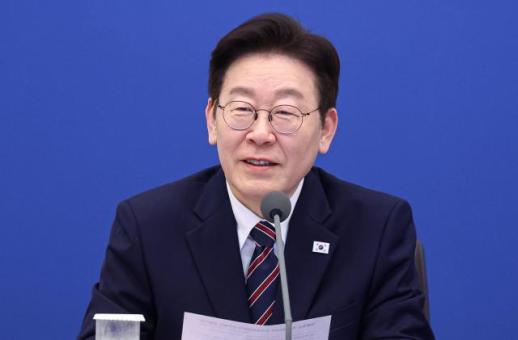 President Lee Jae-myung congratulates Hwang Dae-heon on Olympic 1500m silver President Lee Jae-myung on Saturday congratulated short-track speed skater Hwang Dae-heon after he won a silver medal in the men’s 1,500 meters at the 2026 Milan-Cortina Winter Olympics. In a Facebook post titled, “A calm race by a true ice competitor — congratulations on Korea’s short-track silver,” Lee said, “I sincerely congratulate him,” adding that he applauded Hwang for a “hard-earned silver medal.” Hwang finished second in the men’s 1,500-meter final held Saturday (local time), crossing in 2:12.304 behind Jens van’t Wout of the Netherlands. Hwang, who won silver in the 500 meters at the 2018 PyeongChang Winter Olympics and gold in the 1,500 meters plus silver in the 5,000-meter relay at the 2022 Beijing Winter Olympics, has now medaled at three consecutive Games. Lee said Hwang “proved once again he is among the world’s best” by adding silver to his 2022 Olympic gold, and noted he also set a record as the first in South Korean men’s short track to win medals at three straight Olympics. “Even in a fierce race, he stayed calm to the end and kept his pace,” Lee wrote, calling Hwang a true “ice competitor” and adding, “It’s incredible, and I’m proud.” Lee also voiced support for Hwang’s pledge to become “an athlete remembered for a long time, not a star who shines briefly,” saying he hoped Hwang’s hard work and passion would lead to more strong results. Lee again congratulated Hwang on the silver and offered encouragement to fellow South Korean competitors Shin Dong-min and Lim Jong-eon. * This article has been translated by AI. 2026-02-15 13:24:00
 -
 3.0-magnitude earthquake strikes Gyeonggi Province SEOUL, February 15 (AJP) - A 3.0-magnitude earthquake struck Yeoncheon in Gyeonggi Province early Sunday morning. According to the Korea Meteorological Administration, the quake occurred at around 4:13 a.m. Residents in nearby areas such as Gimpo, Paju, and Pocheon in the province, as well as Cheorwon in Gangwon Province, felt weak tremors. So far, there have been no reports of damage or injuries. It was the strongest earthquake recorded on the Korean Peninsula this year. Of the eight earthquakes of magnitude 2.0 or higher in 2026, this was the first to reach magnitude 3.0, while the rest ranged between 2.0 and 2.9. 2026-02-15 10:12:11
 -
 Kakao's profit jumps 48 percent in record year, plans AI push in 2026 SEOUL, February 12 (AJP) - South Korea’s Kakao Corp. said Thursday its annual revenue exceeded 8 trillion won for the first time last year, with operating profit surging on stronger platform performance and improved cost efficiency. In a regulatory filing, the company said consolidated revenue for 2025 rose 3 percent from a year earlier to a record 8.1 trillion won, while operating profit jumped 48 percent to an all-time high of 732 billion won. Fourth-quarter revenue increased 9 percent year-on-year to 2.13 trillion won, marking the highest quarterly sales in the company’s history. Operating profit more than doubled, rising 136 percent to 203.4 billion won, exceeding 200 billion won for a second consecutive quarter. Platform revenue in the October–December period climbed 17 percent from a year earlier to 1.22 trillion won. Within the segment, Talk Biz revenue grew 13 percent to 627.1 billion won, driven by a 16 percent increase in advertising sales to 373.4 billion won and a 19 percent rise in business messaging revenue. Display advertising revenue advanced 18 percent. Other platform revenue, including mobility and payment services, jumped 30 percent to 523.9 billion won. Kakao said its mobility unit recorded double-digit growth as taxi operations remained stable while parking and quick-delivery services expanded. Kakao Pay also posted balanced growth across payments, financial and platform services. Content revenue totaled 910.6 billion won in the fourth quarter, largely unchanged from a year earlier. Music and media revenue rose 12 percent and 30 percent to 525.1 billion won and 95.8 billion won, respectively, while story content revenue slipped 5 percent to 191.8 billion won. This year, Kakao said it will focus on artificial intelligence and KakaoTalk to drive growth. In the first quarter, the company plans to launch its on-device AI service, “Kanana in KakaoTalk,” on both Android and iOS, while continuing development of its in-house large language model. Chief Executive Jeong Shin-a said restructuring efforts to concentrate resources on core businesses were reflected in the company’s performance. “We will demonstrate progress through improved earnings and deliver tangible results that support Kakao’s mid- to long-term growth outlook,” Jeong said. * This article, published by Aju Business Daily, was translated by AI and edited by AJP. 2026-02-12 08:36:58
 -
 Lunar New Year exodus expected to peak next Tuesday SEOUL, February 11 (AJP) - Holiday traffic is expected to peak on Lunar New Year's Day, which falls next Tuesday, according to SK Telecom's navigation app TMAP. With the country's biggest holiday of the year coming in the latter part of the weeklong break, the annual mass exodus of people heading to their ancestral hometowns is expected to spread out, while their return trips will be concentrated early next week, making Feb. 17 the most likely day for heavy congestion. The next busiest day would be Friday, as some people may travel early to avoid heavy traffic and spend the later part of the break at home. The average driving time from Seoul is estimated at six hours and two minutes to Busan, four hours and 40 minutes to Gwangju, three hours and 40 minutes to Daejeon, and three hours and 34 minutes to Gangneung, about an hour longer than usual overall. Their trip back to Seoul next Tuesday is expected to take over seven hours from Busan, more than five hours from Gwangju, and about three hours and 30 minutes from Daejeon. But traffic is expected to remain at normal levels during late-night and early-morning hours. The app will also offer additional travel information including toll fees and parking availability. 2026-02-11 10:51:21
 -
 Naver/Kurly steps up delivery race to win over Coupang customers SEOUL, February 09 (AJP) - South Korea’s dominant internet platform, has rolled out same-day grocery delivery in partnership with fresh-food unicorn Market Kurly, stepping up efforts to capitalize on mounting reputational troubles at e-commerce leader Coupang. Under the expanded service, Naver and Kurly’s joint grocery platform, Kurly N Mart, began offering same-day delivery on Monday. Orders placed between 11 p.m. the previous day and 3 p.m. on the same day are now delivered before midnight. The option applies to both Kurly N Mart and Kurly’s main platform. Previously, Kurly N Mart focused on early-morning delivery, with orders placed by 11 p.m. arriving by 8 a.m. the following day. While that service remains in place, the addition of same-day delivery is expected to ease pressure around order cutoffs and encourage more frequent purchases. The new delivery window will initially operate in Seoul and Gyeonggi Province, with plans for nationwide expansion. Naver said Kurly N Mart, launched in September last year, has recorded average monthly transaction growth of more than 50 percent. January transaction volume surged more than sevenfold compared with September. Fresh produce transactions rose 82 percent over the same period, while meat sales climbed 74 percent. Ultra-fresh items such as eggs, milk and tofu posted particularly high repurchase rates. After five months of operation, top-selling products shifted from meal kits and ready-to-eat foods to a broader mix including produce, seafood and meat, reflecting growing demand for quality and freshness. Sales of fast-moving consumer goods such as toilet paper, detergent and toothbrushes also jumped more than fivefold, indicating that Kurly N Mart is increasingly used for routine grocery shopping. Repeat purchasing has strengthened as well. The repurchase rate reached 60 percent, roughly double the level recorded in October. Naver attributed the rise in customer loyalty to synergies with its membership program, including lower thresholds for free delivery and additional benefits. More than 90 percent of Kurly N Mart users are Naver Plus members, the company said. The number of “core regulars” who used the service at least 10 times over five months was about 70 times higher among members than non-members. Around 80 percent of transactions are generated through the Naver Plus Store app, underscoring the steady shift toward mobile-based grocery shopping. Naver’s expansion comes as rival platforms benefit from weakening confidence in Coupang following last year’s massive data breach. According to data from IGAWorks’ Mobile Index, new installations of Naver’s shopping app surged to 935,507 in January, up more than 147,000 from December and the highest level since June. Over the same period, Coupang’s app installs fell to 467,641, down nearly 60,000 month on month. Meanwhile, market tracker Wiseapp.Retail reported that Coupang’s monthly active users declined to 33 million in January, down about one million, or 3.2 percent, from December. The drop was nearly ten times larger than the previous month’s decrease. Industry analysts say the figures reflect eroding consumer trust following the November breach that affected almost all of Coupang’s more than 33 million users. 2026-02-09 09:50:42