
Journalist

Chang Seon-a
sunrise@ajunews.com
-
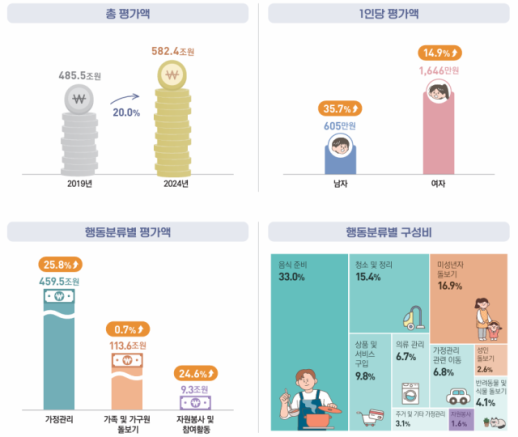 Unpaid Housework Valued at 582 Trillion Won in 2024, Women Contribute 2.7 Times Men Unpaid domestic work such as preparing meals, caring for children and cleaning was worth more than 580 trillion won last year, equivalent to about 23% of nominal gross domestic product, data showed. According to the National Data Agency’s “Household Production Satellite Account” released on the 29th, the value of unpaid domestic work in 2024 was estimated at 582.4 trillion won. That was up 96.9 trillion won, or 20.0%, from five years earlier. Total household production activity was valued at 809.4 trillion won, an increase of 158.02 trillion won, or 24.3%, from 2019. Unpaid domestic work accounted for a large share, but its ratio to GDP was 22.8%, down 1.0 percentage point from five years earlier. By category, household management — including cleaning and meal preparation — was the largest at 459.5 trillion won, followed by caring for family and household members at 113.6 trillion won, and volunteering and participation activities at 9.3 trillion won. Within household management, the fastest growth rates were seen in caring for pets and plants (60.4%), cleaning and organizing (30.2%), and food preparation (27.0%). In family care, care for minors fell 1.8%, while care for adults rose 20.8%, an analysis said, reflecting the impact of an aging population. By gender, the value of women’s unpaid domestic work was estimated at 425.8 trillion won, about 2.7 times men’s 156.6 trillion won. However, the growth rate was higher for men at 35.3% than for women at 15.2%, pointing to a trend of increased male participation in housework. Per capita, unpaid domestic work was valued at 11.25 million won, up 20.0% from five years earlier. The figure was 6.05 million won for men and 16.46 million won for women, leaving a wide gap. By employment status, the value of domestic work by those not employed was 297.4 trillion won, higher than the 284.9 trillion won for those employed, though the growth rate was higher among employed people. By marital status, married people accounted for 511.8 trillion won versus 70.6 trillion won for unmarried people, but the increase was faster among the unmarried. The household production satellite account is a set of statistics that assigns a monetary value to domestic work that is not traded in markets and therefore not included in GDP. It estimates the value by applying occupation-based wages and population factors to unpaid work hours, helping supplement conventional income statistics.* This article has been translated by AI. 2026-04-29 12:06:49
 -
 Garlic Planting Area Rises 5.3% on Higher Prices; Onion Area Slips 0.4% Garlic planting area has increased for the first time in three years as prices rose, while onion acreage edged down slightly. According to the National Data Agency’s “2026 Garlic and Onion Planting Area Survey” released on the 29th, this year’s garlic planting area totaled 24,170 hectares, up 5.3% (1,223 hectares) from 22,947 hectares a year earlier. Garlic acreage had been declining since 2023, but rebounded this year, a shift the agency attributed to last year’s price gains. By province and city, the largest garlic-growing areas were South Gyeongsang (7,857 hectares), North Gyeongsang (5,273), South Chungcheong (3,768), South Jeolla (3,023) and Daegu (874). Onion planting area came to 17,609 hectares, down 0.4% (68 hectares) from 17,677 hectares last year, marking a second straight annual decline. The agency said onion acreage tends to rise and fall each year with price swings, and this year’s change was limited. By province and city, onion acreage was led by South Jeolla (6,072 hectares), South Gyeongsang (3,895), North Gyeongsang (2,225), North Jeolla (1,977) and South Chungcheong (1,296). The agency said higher garlic prices last year encouraged expanded planting, while onion acreage was adjusted only modestly due to factors including prices and weather conditions. The preliminary figures are based on a sample survey conducted from March 16 to April 10 and will be finalized in July when the garlic and onion production survey results are released.* This article has been translated by AI. 2026-04-29 12:04:50
 -
 Finance Ministry to Hold Generative AI Hackathon to Speed Work Innovation The government will hold an internal hackathon to drive administrative innovation using generative artificial intelligence. The Ministry of Finance and Economy said April 29 it will run a “Generative AI Service Discovery Hackathon” from June 10-12 at the Narakioum Taean Training Center. The event is aimed at identifying ministry-specific AI services to be built into the “AI-ONE platform” now under development. Organizers said the focus is on producing prototype results that can be applied to real work, rather than simple idea proposals. Services selected as top projects will be piloted and then reflected in the platform. The ministry said it plans to use AI not as a basic support tool but as a core instrument for policy development and administrative reform. It also plans to introduce “agentic AI” to support key tasks such as taxation, state contracts, state-owned property and economic trend analysis. The ministry said it aims to push AI transformation within the ministry while expanding AI use across the public sector to improve policy quality and public services. Deputy Prime Minister and Finance Minister Koo Yun-cheol called the hackathon “the opening signal of AI transformation that fundamentally changes how our ministry works,” adding that he hopes staff will actively use AI to deliver innovative policy results the public can feel. * This article has been translated by AI. 2026-04-29 10:14:12
 -
 South Korean Won Rises Early as UAE OPEC Exit Stirs Oil Volatility The won weakened early against the U.S. dollar but soon turned lower, as traders weighed easing Middle East-related concerns and shifting oil-price expectations. In Seoul’s foreign exchange market, the won was trading at 1,473.5 per dollar as of 9:30 a.m. on the 29th. The exchange rate opened at 1,474.0, up 0.4 won from the previous session, then reversed direction shortly after trading began. Markets are watching the United Arab Emirates’ decision to withdraw from the Organization of the Petroleum Exporting Countries, which has fueled expectations of increased crude supply in the near term. Traders said the prospect of independent production increases after the exit could curb the recent run-up in oil prices. International crude prices remain elevated, but volatility has increased. On the New York Mercantile Exchange, June West Texas Intermediate briefly rose above $100 a barrel before paring gains to settle up 3.7% at $99.93. The dollar was slightly weaker. The dollar index, which measures the greenback against six major currencies, fell 0.02% to 98.593. Min Kyeong-won, an economist at Woori Bank, said position adjustments ahead of the U.S. Federal Open Market Committee meeting were likely to drive a pullback. He added that importers’ demand for dollars to settle payments has remained “consistently active,” contributing to an intraday backdrop in which upward pressure can dominate. * This article has been translated by AI. 2026-04-29 09:55:35
 -
 Budget Office Holds Town Hall on Public Finances; Minister Park Says People Own the Budget Fiscal authorities on April 28 held a town hall-style meeting to discuss how the nation’s finances are managed and to gather public input. The event, hosted by the Ministry of Planning and Budget, was its first public forum aimed at collecting citizens’ views directly on fiscal policy. After a topic presentation, all participants were invited to speak freely and take part in a question-and-answer session. Park said he has long wrestled with “how to bring budgets and public finances closer to people’s lives,” calling the meeting “a first step” toward finding answers. He set out three goals for future fiscal management: public finances “owned by the people,” management proven by results, and responsible finances that earn trust. Park said he would “dramatically” expand autonomy in budget drafting while making the process transparent and taking responsibility for outcomes. He said the government would build a sound fiscal foundation that passes hope to future generations by ensuring money is spent where it is needed. In the open discussion, participants raised issues including fiscal sustainability for future generations, the role of public finances in a mid- to long-term vision, expanding public participation and communication, and operating performance evaluations that citizens can feel and assess. Many members of the public called for stronger support for young people and budget planning that improves the efficiency of fiscal spending. Some also voiced concerns that supplementary budgets could push up prices and increase burdens on future generations. Park said he shared participants’ concerns. On worries about national debt, he said an active fiscal role is important to support livelihoods and create growth momentum, while also maintaining vigilance on sustainability through restructuring “unnecessary and non-urgent” spending. He added that the core of “people’s sovereignty” in public finances is enabling citizens to feel they are the owners of the budget, and said the criticism and ideas offered would be reflected in future budget drafting and policy planning. The ministry said it will continue outreach with the public, including on a mid- to long-term national development strategy and improving the efficiency of fiscal spending.* This article has been translated by AI. 2026-04-28 17:16:25
 -
 Budget Office to Prioritize Funding for Drones, Robots and Other Advanced Defense Capabilities The Budget Office said it will focus next year’s budget planning on securing advanced military capabilities such as drones and robots. On the 28th, the office held a meeting with officials from major defense companies at the Narakium conference hall in Seoul’s Yeouido district to discuss priority investment directions for the defense sector and ways to strengthen the defense industry ecosystem. K-defense exports have recently expanded, particularly to Europe and the Middle East, widening South Korea’s footprint in the global arms market. The office said, however, that as the market rapidly shifts toward advanced technologies and competition intensifies, there is a growing need to ensure export gains translate into sustainable industrial competitiveness. Company representatives at the meeting said the strategic importance of advanced weapons, including AI and drones, is rising and that major countries are increasing related budgets. They said South Korea also needs expanded investment to shift to advanced weapons systems and support for developing core technologies. Lee Je-hoon, the office’s director for administrative and defense budget review, said, “With the recent trend of declining troop numbers and changes in the nature of future warfare, fostering a smart, elite force through a transition to cutting-edge weapons systems is an important task.” He added, “When drafting the 2027 budget, we will make targeted investments in related funding to secure advanced capabilities, including unmanned-manned integrated systems such as drone and robot platforms, along with upgrading the Korean three-axis system.” Lee also said sustained global competitiveness for K-defense requires growth across the entire ecosystem, urging major firms to share results with smaller partner companies during project implementation and to help build a fair, mutually beneficial industrial environment. The Budget Office said it will use views raised at the meeting to refine defense investment priorities to be reflected in the 2027 budget proposal and the National Fiscal Management Plan (2026–2030).* This article has been translated by AI. 2026-04-28 13:57:45
 -
 South Korea to Require Separate Labels for Pre-Law E-Cigarette Stock Under New Safety Rules The government said it will begin enforcing safety management standards for stockpiled liquid e-cigarette products starting on the 28th. The measure is intended to protect consumers during distribution of products manufactured or imported before the revised Tobacco Business Act took effect on the 24th. Under the “Safety Management Standards for Stockpiled Liquid E-Cigarette Products,” businesses must clearly label and notify consumers that a product is pre-law inventory and provide key information, including nicotine content, on the packaging. Businesses must also request testing for harmful substances before selling inventory products. The government may recommend halting sales of long-held inventory that remains in circulation for more than 12 months after the law’s effective date, as well as products sold by mail or through e-commerce. In addition, businesses must provide accurate information to consumers under the Framework Act on Consumers and take steps to prevent harm caused by their products.* This article has been translated by AI. 2026-04-28 11:05:25
 -
 South Korea Sets 2027 Lottery Sales Target at 8.4 Trillion Won, Keeps Current Rules The Lottery Commission under the Planning and Budget Office has approved an issuance plan that would expand lottery sales in 2027 to about 8.4 trillion won. On the 28th, the commission held its 188th meeting at the Korea Trade Insurance Corp. in Seoul, chaired by Vice Chair Im Ki-geun, and deliberated and approved the “2027 Lottery Issuance Plan” and the “2025 Lottery Fund Project Performance Evaluation Results.” The commission decided to keep current face values, issuance conditions and prize-payment methods for all 12 existing lottery products, including Lotto. Reflecting sales growth over the past three years, it set projected 2027 lottery sales at 8.4175 trillion won, up 321.7 billion won, or 4.0%, from this year’s plan. If sales meet the plan, lottery proceeds used to finance lottery fund projects in 2027 are expected to total 3.4278 trillion won, up 138.6 billion won, or 4.2%, from this year’s planned 3.2892 trillion won. In a performance evaluation of 2025 lottery fund projects, the overall average score came to 82.9 points, slightly higher than the previous year’s 82.4. A total of 79 statutory projects, including transportation support for people with mobility challenges and nighttime protection programs for low-income children and teenagers, received strong ratings, along with 17 public-interest projects such as support to expand inclusive finance and welfare assistance for veterans of war. The commission said it will actively reflect the evaluation results in future budget allocations. When drawing up the 2027 lottery fund management plan, it will apply a principle of increasing funding for highly rated projects and reducing funding for underperforming ones. For statutory projects, it plans to adjust allocations by agency rankings within the limits set by the Lottery Act.* This article has been translated by AI. 2026-04-28 11:04:58
 -
 Won Opens Slightly Weaker as U.S.-Iran Ceasefire Talks Stall The won opened slightly weaker against the U.S. dollar as ceasefire negotiations between the United States and Iran remained stalled. As of 9:28 a.m. in Seoul on April 28, the won was trading at 1,473.5 per dollar. It opened at 1,474.1, up 1.6 won from the previous session. U.S. President Donald Trump is reviewing a new Iranian proposal, putting the deadlocked talks into a new phase. The Wall Street Journal reported on April 27 (local time) that Trump and his national security team were skeptical of Iran’s offer, which included keeping the Strait of Hormuz open and postponing discussions on its nuclear program. The dollar, which had been pressured early in the previous session on expectations of progress in U.S.-Iran war talks, rebounded in New York trading as risk appetite cooled. Oil prices also rose as uncertainty over the negotiations resurfaced. On April 27, June WTI crude on the New York Mercantile Exchange settled up 2.08% at $96.37 a barrel. July Brent crude on the London futures market ended up 2.58% at $101.69 a barrel. Min Kyung-won, an economist at Woori Bank, said steady dollar buying has continued in the local market, including demand for dividend repatriation and payments by importers. “The exchange rate is expected to face stronger upward pressure in the mid-1,470s today,” Min said. * This article has been translated by AI. 2026-04-28 09:33:53
 -
 Surging Treasury Yields Raise Fears of Uneven Blow to Vulnerable Borrowers, Weak Firms A renewed surge in South Korean Treasury yields is fueling concerns that the hit will fall hardest on vulnerable borrowers and financially weak companies. With household loans still heavily tied to floating rates, higher rates could quickly raise interest burdens, curb spending and weigh on domestic demand, analysts said. According to the financial sector on April 27, Treasury yields have continued to rise as markets price in inflation pressure tied to Middle East geopolitical risks and expectations that global monetary tightening will last longer. Because Treasury yields serve as a benchmark for market rates, moves typically feed into corporate bonds, financial bonds and loan rates within days to weeks. Corporate bond yields and bank lending rates are structured to track Treasury yields, meaning higher long-term rates can spread quickly across the financial system. In that transmission process, the burden tends to concentrate on weaker borrowers and marginal firms. Since funding costs are Treasury yields plus a credit spread, the lower the credit quality, the larger the increase in actual borrowing costs. Large companies, with greater access to direct financing such as bond issuance and stronger cash positions, generally have more room to respond early in a rate upswing. Small and midsize firms and marginal companies, however, rely more on bank loans and often have weaker credit, making it more likely that rising rates will tighten funding conditions. If refinancing becomes difficult or new bond issuance costs jump, short-term liquidity pressure can intensify and raise default risks. Households are also unlikely to escape the impact. With a high share of floating-rate household debt, increases in Treasury and bank bond yields can lift banks’ funding costs and flow through to lending rates via benchmarks such as COFIX, after a relatively short lag. That can quickly raise debt-service burdens, especially for vulnerable borrowers with limited repayment capacity or heavy exposure to floating rates. Signs of strain are already appearing in financial indicators. The delinquency rate on won-denominated loans at domestic banks stood at 0.62% at the end of February, up 0.05 percentage points from 0.56% a month earlier, the highest in nine months. For February readings, it was the highest in 10 years. A similar trend is emerging outside the banking sector. As of the end of March, card loan balances at nine major credit card companies totaled 42.9942 trillion won, rising for a third straight month to a record high. The increase points to a balloon effect from tighter bank lending rules and a shift in funding demand toward higher-rate nonbank lenders. Experts warned that if Treasury yields rise beyond a certain level, the impact could spread from higher interest burdens to broader financial stability risks. If distress grows among vulnerable borrowers and marginal firms, it could weaken financial institutions’ asset quality and lead to tighter credit conditions, they said, calling for preemptive steps. Kim Sang-bong, a professor of economics at Hansung University, said, “When bond yields rise, the interest burden on floating-rate loans inevitably increases.” He added, “Because prices are expected to keep rising, Treasury yields will also keep rising.” Kim said restructuring is needed for marginal firms and that policies should also aim to curb growth in household debt. A key concern is that the rate environment may not ease quickly. With the U.S. Federal Reserve maintaining a tightening stance and oil prices rising due to Middle East developments, inflation pressure is persisting. As a result, upward pressure on rates, led by long-term yields, may continue for some time. Markets are watching next month’s Monetary Policy Board meeting, the first to be chaired by newly appointed Bank of Korea Gov. Shin Hyun-song. The focus has sharpened after first-quarter gross domestic product posted a surprise increase above expectations, strengthening the case for monetary tightening. During his confirmation hearing on the 15th, when he was still a nominee, Shin said, “In the current situation, I will put more weight on prices, especially in an economy like Korea that is so sensitive to oil prices, where the oil shock has a considerable impact on inflation.”* This article has been translated by AI. 2026-04-28 06:05:14