
Journalist

Park Sae-jin, Han Jun-gu
swatchsjp@ajunews.com
-
 S. Korean researchers develop AI that transforms single observer video into first-person perspective SEOUL, February 23 (AJP) - Researchers at the Korea Advanced Institute of Science and Technology have developed an artificial intelligence model capable of converting a standard video of a person into a high-quality video showing exactly what that person was seeing. The technology, named EgoX, reconstructs a first-person perspective using only a single third-party video as a source. This development addresses a significant hurdle in the fields of augmented reality, virtual reality, and robotics. While first-person data is essential for training AI and creating immersive content, it typically requires subjects to wear expensive action cameras or smart glasses. By eliminating the need for wearable hardware, the new model allows researchers to generate first-person data from the vast amount of existing video footage already recorded by outside observers. The EgoX system works by analyzing the three-dimensional structure of the environment and the specific movements of the person in the video. Rather than simply rotating the camera angle, the AI calculates the person's exact position and posture to recreate the scene from their eyes. It specifically models the relationship between head movement and visual field, ensuring that when a person in a video turns their head, the generated first-person view shifts naturally. In testing across various daily activities such as cooking and exercising, the model maintained high visual quality without the glitches often found in earlier conversion attempts. Because it understands the geometry of the space, the AI can accurately estimate depth and surroundings even when the lighting or movement in the original video is complex. The technology is expected to have an immediate impact on immersive media and robotics. In the metaverse and VR industries, it can turn standard broadcasts into experiences where users feel as if they are the protagonist. For robotics, it provides a way for machines to practice imitation learning by seeing human tasks from the correct physical perspective. Professor Ju Jae-geul, who led the research, stated that the significance of the work lies in the AI learning to reconstruct human vision and spatial understanding. He noted that the environment is now being created where anyone can produce immersive content using previously filmed videos. The research was a collaborative effort involving Kang Tae-woong and Kim Ki-nam, doctoral students at KAIST, and Kim Do-hyun, an undergraduate researcher at Seoul National University. The findings were first shared on the preprint server arXiv on December 9, 2025, and will be officially presented at the IEEE/CVF Conference on Computer Vision and Pattern Recognition in Colorado on June 3, 2026. The project was supported by the Ministry of Science and ICT through the National Research Foundation of South Korea and the Korea Institute of Science and Technology Information. (Paper information) Journal: The IEEE/CVF Conference on Computer Vision and Pattern Recognition (CVPR) Title: EgoX: Egocentric Video Generation from a Single Exocentric Video DOI: https://keh0t0.github.io/EgoX/ 2026-02-23 15:31:57
 -
 South Korea and Brazil upgrade ties to strategic partnership SEOUL, February 23 (AJP) - South Korean President Lee Jae Myung and Brazilian President Luiz Inacio Lula da Silva agreed to elevate bilateral relations to a strategic partnership following a summit at the presidential Blue House on Monday. During a joint press briefing in the afternoon, Lee announced the adoption of a four-year action plan designed to foster a new leap forward in the bilateral relationship. The leaders oversaw the signing of 10 memorandums of understanding covering sectors such as small businesses, health regulations and agriculture. The talks highlighted several main areas of cooperation, prioritizing artificial intelligence, aerospace, defense, biopharmaceuticals and critical minerals. Both countries also plan to expand collaboration across the digital and green economies. Addressing international trade, Lee said he emphasized the need to quickly resume negotiations for a trade agreement between South Korea and the South American trade bloc Mercosur. Lee noted that Lula agreed the pact is a crucial task, and both leaders committed to seeking a breakthrough based on mutual trust. Brazil is currently unable to negotiate a conventional bilateral free trade agreement with South Korea due to institutional rules within Mercosur, which requires the bloc to negotiate trade deals collectively. Regarding the newly signed memorandums, Lee stated that the agreement focusing on small and medium-sized enterprises will help diversify bilateral trade and investment, which has historically been dominated by large conglomerates. Another key agreement addresses health and regulatory cooperation, which Lee said will further boost the popularity of South Korean cosmetics in Brazil. The arrangement facilitates the exchange of regulatory information for cosmetics, food and pharmaceuticals, alongside technical cooperation to streamline market access. South Korean cosmetics have seen significant growth in the region. According to the Korea International Trade Association, cosmetic exports to Latin America grew by more than 40 percent annually over the past four years, reaching roughly $400 million in 2024. The two governments also signed three memorandums focused on agriculture, food security and supply chains. Lee described Brazil as an agricultural powerhouse with advanced technology, calling the partnerships vital for South Korea's food security and the sustainable development of rural economies in both nations. 2026-02-23 14:43:37
 -
 Brazilian president receives warm welcome from Lee on first state visit in 21 years SEOUL, February 23 (AJP) -Brazilian President Luiz Inacio Lula da Silva was welcomed with a warm embrace by President Lee Jae Myung on Monday, marking his return to South Korea for a state visit — his first in 21 years and the first by a foreign leader since the presidential office returned to Cheong Wa Dae. Lee greeted Lula in the main garden of the presidential compound with open arms as the Brazilian leader stepped out of his vehicle, before the two shared a brief embrace and proceeded to an official welcome ceremony featuring traditional honor guards and a children’s welcoming group. The visit includes bilateral talks, a memorandum of understanding signing ceremony, a joint press announcement, and a state dinner at the Yeongbingwan guest house, with discussions set to focus on deepening cooperation in high-value and emerging industries. The summit agenda covers trade, investment, climate change, energy, defense, science and technology, agriculture and cultural exchanges. Instead of focusing solely on traditional commerce, the talks will prioritize what Brazilian Ambassador to South Korea Marcia Donner Abreu recently described as "productive integration" during an interview with AJP on Feb. 19. The approach is designed to move bilateral ties beyond simple buying and selling, focusing instead on joint value creation through linked supply chains and investments. he two countries plan to collaborate on local downstream processing and refining, moving beyond trade beyond raw materials. The governments also aim to build joint production lines for the C-390 transport aircraft and deepen partnerships in high-growth industries such as biopharmaceuticals, digital technologies and K-beauty. The talks are supported by a personal rapport between the two leaders, who both experienced poverty and sustained work-related injuries as young factory workers. Lee and Lula previously bonded over their shared backgrounds during the Group of Seven summit in Canada last June and the G20 meeting in South Africa in November. Lula will conclude his state visit to South Korea on Feb. 24. 2026-02-23 09:37:20
 -
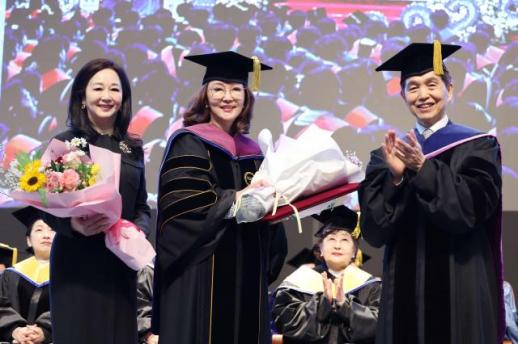 INTERVIEW: Formosa Chairman Sandy Wang emphasizes long-term research partnership with KAIST SEOUL, February 22 (AJP) - Wang Ruey-yu, known by her English name Sandy Wang, described the establishment of the KAIST-Formosa Biomedical Research Center as a foundational step in a rare cross-border collaboration between Taiwanese industry and South Korean academia. Speaking in an interview with AJP on February 22, Wang, an executive member of the Formosa Group and chairperson of Formosa Bio, characterized the partnership as a "first seed" for future cooperation. "This first button is the establishment of the KAIST-Formosa Biomedical Research Center," Sandy Wang said. "Since we have fastened the first button, should we not continue with the second and third?" The collaboration marks the first time the Taiwan-based conglomerate has entered into such a support and research agreement with a South Korean university. While Formosa Group operates across diverse industrial sectors, Sandy Wang noted that the initial focus on life sciences was driven by a shared mission to solve critical health challenges. She explained that her decision to support KAIST was finalized after meeting with Department of Brain and Cognitive Sciences Head Kim Dae-soo and Professor Choi Min-yi. "When I asked what they could do best, I heard the answer, 'I can save people,'" Sandy Wang said. "I was able to make a decision easily at the word that I could save people suffering from diseases. I felt there could be no more important plan for social contribution than this." Sandy Wang identified the leadership of KAIST President Lee Kwang-hyung and the university's research infrastructure as decisive factors in selecting the institution as a strategic partner. She noted that the partnership combines the research capabilities of KAIST with the clinical experience of Formosa’s 12,000-bed Chang Gung Memorial Hospital and Chang Gung University College of Medicine. "The cooperation with KAIST and the support for KAIST were considered significant just by the fact that one more research center was added that could give hope to people suffering from incurable or intractable diseases," Sandy Wang stated. The partnership is structured as an open research platform designed to link laboratory discoveries with industrial commercialization. To facilitate this, researchers participating in the joint center have been appointed as specially appointed professors at Chang Gung University and Ming Chi University of Technology in Taiwan. Sandy Wang emphasized a patient approach to results, stating that she does not intend to be "impatient" about producing immediate research outcomes. "I plan to provide support calmly without being impatient about producing research results," Wang said. "How to realize that value can be considered after the groundwork is laid." Beyond biotechnology, the collaboration is expected to expand into other industrial fields, including energy transition and resource circulation. Chief executives from Formosa Group affiliates have already visited KAIST to identify potential cooperation areas. Sandy Wang expressed confidence that these exchanges will assist Formosa Group in its strategic shift toward carbon-neutral industries. "I am confident that if industry-academic cooperation with KAIST is achieved and exchanges are expanded, it will be of great help in finding new paths for the Formosa Group to move forward," Sandy Wang said. The executive also reflected on the broader implications of the partnership for South Korea and Taiwan, noting that it is very rare for a Taiwanese company to engage in industry-academic cooperation with a South Korean university. Wang reiterated her commitment to her father’s philosophy that a company must return its profits to the society where it took root. "They say a journey of a thousand miles begins with a single step, and you cannot be full with the first spoonful," Wang said. "We have already made an important start together, and I will do my best to cooperate and support this start so it can produce good results." 2026-02-22 13:28:40
 -
 South Korean presidential office to monitor US trade measures after court ruling SEOUL, February 21 (AJP) - The South Korean presidential office said Saturday it will closely monitor follow-up trade actions by the United States and global trends after the US Supreme Court invalidated broad tariffs on South Korean goods. National Security Adviser Wi Sung-lac and Kim Yong-beom, the presidential chief of staff for policy, co-chaired a joint meeting of relevant ministries to discuss the fallout. The session followed a 6-3 US Supreme Court decision on Friday that ruled President Donald Trump lacked the authority to impose tariffs under the International Emergency Economic Powers Act (IEEPA). Presidential spokesperson Kang Yu-jung said in a written briefing that the 15 percent reciprocal tariff currently applied to South Korean exports is now void under the ruling. However, she noted that the US administration has since announced a new 10 percent global tariff based on Section 122 of the Trade Act of 1974. Kang said the government plans to continue friendly consultations based on the special alliance between South Korea and the United States. She added that officials aim to ensure the balance of benefits and export conditions secured in previous agreements are not damaged by the increased uncertainty in the international trade environment. Regarding the recovery of tariffs already paid by South Korean companies, the presidential office decided to work closely with economic organizations and trade associations. This collaboration aims to provide businesses with timely and accurate information on potential refund processes. The meeting participants also reviewed the progress of the Special Act on Investment in the United States. They agreed to proceed with necessary legislative steps, including public hearings, to ensure the process remains on schedule. Attendees included Koo Yun-cheol, the deputy prime minister at the Ministry of Finance and Economy; Cho Hyun, the foreign minister; Kim Jeong-gwan, the minister at the Ministry of Trade, Industry and Energy; and Yeo Han-koo, the minister for trade. Ha Jun-kyung, the senior secretary for economic growth, and Oh Hyun-joo, the third deputy director of national security, also participated. Trump signed an executive order on Friday to formally end the duties imposed under IEEPA in response to the court decision. He immediately invoked Section 122 of the Trade Act of 1974 to impose a 10 percent surcharge on all imports to address international payment imbalances. 2026-02-21 17:37:26
 -
 South Korean prime minister signals cautious review of trade deal after US court ruling SEOUL, February 21 (AJP) - Prime Minister Kim Min-seok said Saturday that South Korea will "wisely" monitor the situation following a US Supreme Court decision that invalidated a key tariff program, suggesting possible adjustments to a previous bilateral trade agreement. The remarks, made during a public briefing in the city of Pohang on Saturday afternoon, address the potential fallout from a 6-3 ruling by the US Supreme Court on Friday. The court found that President Donald Trump exceeded his authority by using an emergency law to impose broad "reciprocal" tariffs. Under that system, South Korea had negotiated a 15 percent duty rate in exchange for a pledge to invest 350 billion dollars in the United States. Kim raised the possibility that the shift in the US legal landscape could change the terms of the existing deal. He questioned whether the previous negotiations could be reset or if certain conditions could be changed, given that the legal foundation for the tariffs has been shaken. "We will monitor the situation very wisely as we move forward," Kim said. He noted that while the government intends to honor the agreements reached between the two nations, the invalidation of the US legal basis for the tariffs represents a significant change in circumstances. The prime minister characterized the trade deal as a political and economic negotiation based on the trade interests of both sides, rather than a purely legal matter. He added that while formal government-level discussions on a specific policy pivot have not yet begun, the administration will look at the situation comprehensively. The ruling in Washington has created a complex situation for major US trading partners. Immediately after the court decision, Trump signed a new proclamation to impose a 10 percent global surcharge under a different law, Section 122 of the Trade Act of 1974. His administration also announced new investigations under Section 301, which could lead to additional duties on countries like South Korea that maintain a large trade surplus with the United States. South Korean officials have expressed concern that the new US strategy aims to maintain the same level of tariff revenue through different legal means. Trump stated in a press conference that he expects the new measures to ultimately collect more money than the previous system. The South Korean presidential office held a joint meeting of relevant ministries at 2 p.m. Saturday to analyze the court ruling. Policy Chief Kim Yong-beom and National Security Adviser Wi Sung-lac led the session to discuss how to protect national interests while managing the alliance with the United States. 2026-02-21 16:36:23
 -
 US trade representative signals new tariff investigations likely to include South Korea SEOUL, February 21 (AJP) - The United States plans to launch broad trade investigations that are expected to target South Korea as President Donald Trump's administration seeks to replace a tariff program recently struck down by the US Supreme Court. US Trade Representative Jamieson Greer said in a statement on Friday (local time) that new investigations under Section 301 of the Trade Act of 1974 will likely cover most major trading partners. These probes allow the US government to impose tariffs on countries deemed to have "unfair" or "discriminatory" trade practices. The move comes immediately after the US Supreme Court ruled on Friday that the administration did not have the legal authority to impose its previous "reciprocal" tariffs under emergency powers. While Trump signed a new 10 percent global surcharge to replace them, that specific authority—known as Section 122—is limited by law to a maximum of 150 days. By launching Section 301 investigations, the White House aims to establish a more permanent legal basis for higher tariffs. South Korea is considered a primary target because it ran a 56.4 billion dollar trade surplus with the United States in 2025, the 11th largest among US trading partners. In South Korea, officials are concerned the US may use local digital regulations as a justification for new duties. The Trump administration has previously criticized the South Korean National Assembly for proposing laws aimed at regulating online platforms and curbing misinformation, claiming they unfairly target US tech giants. Other long-standing disputes, such as network usage fees and the export of high-precision map data, could also be cited in the US investigation. The trade representative noted that the upcoming probes would cover various areas, including "industrial overcapacity, forced labor, pharmaceutical pricing, and discrimination against US digital firms." For South Korea, the new legal strategy creates a significant diplomatic burden. Under a trade deal reached last year, Seoul had already agreed to a 15 percent tariff rate in exchange for investment promises. If the new investigations proceed, South Korea could face even higher duties or be forced into a new round of difficult negotiations to maintain its current market access. While Section 301 investigations typically take up to one year to complete, Greer indicated the administration intends to move much faster. Trade experts suggest the White House wants the new tariff framework ready before the 150-day temporary surcharge expires in late July. The South Korean government is currently analyzing the potential scope of the US investigations. Officials in Seoul have stated they will seek to protect national interests while monitoring how the US administration balances these new legal tools with existing trade agreements. 2026-02-21 13:23:06
 -
 White house to exempt cars and minerals from new 10 percent tariff SEOUL, February 21 (AJP) - The White House has made a decision that could provide significant relief for South Korean manufacturers, announcing Friday (local time) that it will exclude passenger cars and critical minerals from a new 10 percent import tax. The exemptions were included in a proclamation for a new temporary import surcharge that takes effect at 12:01 a.m. on February 24. This new policy follows a United States Supreme Court ruling earlier that day that struck down the centerpiece of President Donald Trump's previous tariff program. For South Korean automakers, the exemption offers a double benefit by protecting their price competitiveness in the US market while ensuring a stable supply of materials. Since passenger cars and their components are excluded, companies like Hyundai Motor and Kia can continue shipping vehicles to the US without the burden of the new 10 percent surcharge. Also, the decision to exempt critical minerals used in electric vehicle batteries helps South Korean firms maintain their production costs and meet US domestic content requirements for federal tax credits. According to the official announcement, the list of items exempt from the tax includes passenger cars, buses, and the parts used to build them. Certain products for the aerospace industry and specific electronics are also excluded from the new costs. The administration also decided not to tax natural resources, fertilizers, and minerals that cannot be found or produced inside the United States. These exemptions are particularly important for South Korean carmakers and battery manufacturers. These companies rely heavily on imported critical minerals and had faced rising costs under the previous "reciprocal" tariff system that the court invalidated. Trump signed these new measures after the Supreme Court decided that the president does not have the legal power to create new taxes on imports using an emergency law called the International Emergency Economic Powers Act (IEEPA). The court ruled 6-3 in the case Learning Resources, Inc. v. Trump that only the US Congress has the power to create such taxes. To keep his trade policies in place, Trump used a different law called Section 122 of the Trade Act of 1974. This law allows a president to set temporary import taxes for up to 150 days to deal with national economic imbalances. The South Korean government has started a close review of the list of exempt products. Officials in Seoul plan to meet with business leaders to see how the new 10 percent tax and the exemptions will affect trade and the large investments South Korean companies have made in the United States. While the new 10 percent tax replaces the older system, the White House also ordered that small packages sent through the mail will no longer be tax-free. These small shipments, known as de minimis entries, will now be charged the 10 percent tax to make sure all imports are treated the same way under the new rules. 2026-02-21 10:57:59
 -
 South Korea's presidential office to hold emergency meetings after US court tariff ruling SEOUL, February 21 (AJP) - South Korea's presidential office announced Saturday it will convene a high-level meeting of relevant ministries this afternoon to discuss the fallout from a United States Supreme Court decision that struck down President Donald Trump's centerpiece tariff policy. The meeting, scheduled for 2 p.m. (0500 GMT), will be co-chaired by National Security Adviser Wi Sung-lac and Kim Yong-beom, the presidential chief of staff for policy. It follows a separate emergency session scheduled for 10 a.m. by the Ministry of Trade, Industry and Energy to assess the consequences for domestic exporters. The US Supreme Court ruled 6-3 on Friday that the International Emergency Economic Powers Act (IEEPA) does not authorize the president to unilaterally impose tariffs. The decision in Learning Resources, Inc. v. Trump effectively halts a significant portion of the duties announced by the Trump administration last year under emergency declarations. Chief Justice John Roberts wrote in the majority opinion that while the law allows for the regulation of commerce, the power to levy duties remains a core responsibility of the US Congress. The ruling creates immediate uncertainty for the reciprocal trade agreement reached between Seoul and Washington last year. Under that deal, South Korean exports were subject to a 15 percent duty rate in exchange for large-scale investment pledges. With the legal basis for the IEEPA-based duties removed, trade deals struck by the administration with countries worldwide are now being reassessed. Trump responded to the ruling by signing a new proclamation from the Oval Office that introduces a 10 percent global tariff under Section 122 of the Trade Act of 1974. He also issued an executive order to continue the suspension of duty-free treatment for small-value postal shipments, a move known as ending de minimis exemptions, which is set to take effect on February 24. "Those members of the Supreme Court who voted against our very acceptable and proper method of TARIFFS should be ashamed of themselves," Trump wrote on social media, Truth Social, following the decision. He described the ruling as "ridiculous" and promised that his administration would take steps to collect more revenue than under the previous system. An official at the South Korean presidential office stated that the government will review the court decision and the response of the US administration to determine a course of action that best serves national interests. The official added that relevant agencies will share information to discuss potential response measures. Economic analysts suggest the ruling could lead to a complex legal process for companies seeking refunds for an estimated 175 billion dollars in duties already collected under the invalidated framework. While the additional duties imposed under IEEPA are being terminated, the US administration has maintained the underlying national emergency declarations and continues to enforce separate tariffs on steel and aluminum under different legal authorities. 2026-02-21 09:56:11
 -
 KAIST confers honorary doctorate on Formosa Group Chair Sandy Wang SEOUL, February 20 (AJP) - The Korea Advanced Institute of Science and Technology (KAIST) announced on February 20 that it has awarded an honorary doctorate in business administration to Sandy Wang, Standing Member of the Formosa Group Executive Management Committee and Chair of Formosa Bio. The ceremony took place during the university's 2026 commencement exercises. Wang was recognized for her role in leading the strategic growth of Formosa Group by prioritizing sustainability and corporate social responsibility. Following the business philosophy of the late founder Wang Yung-ching, she has steered the conglomerate beyond its traditional petrochemical manufacturing roots into sectors such as biotechnology, clean energy, energy storage systems, and resource circulation. According to KAIST, Wang has successfully implemented a corporate model where industrial growth, scientific advancement, and talent development are closely linked. The university highlighted her efforts in building a long-term biomedical research partnership with KAIST, which included expanding research infrastructure and creating a platform for international joint projects. A key result of this partnership was the establishment of the KAIST-Formosa Biomedical Research Center. This center serves as a hub for multidisciplinary research between Formosa Group's medical and academic institutions and the KAIST College of Life Science and Bioengineering. Wang has also been credited with institutionalizing a system that reinvests corporate earnings back into society through consistent funding for research and education. University officials noted that these initiatives have helped create a cycle where scientific breakthroughs are effectively funneled into industrial and social applications. In her remarks, Wang stated that she was honored to receive the degree and felt a strong connection to the university’s mission of contributing to a sustainable future through research. She expressed her hope that the students at KAIST would use their scientific training to lead global development and pledged to continue her support for long-term investments in talent and technology. KAIST President Lee Kwang-hyung described Wang as a leader who has put scientific strategy at the center of responsible management. He added that the university valued her practical support for international cooperation and research infrastructure. 2026-02-20 16:59:09