
Journalist

Soo-young Jang
swimming@ajunews.com
-
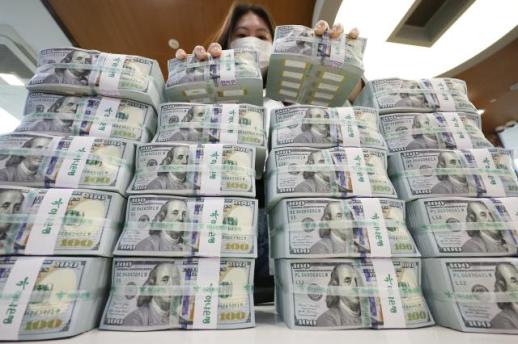 South Korea's FX trading hits record high in Q1 as foreign capital inflows surge SEOUL, April 29 (AJP) - South Korea's foreign-exchange (FX) trading volume hit a record high in the first quarter amid heightened volatility and foreign capital inflows, the Bank of Korea said on Wednesday. According to the central bank, average daily foreign-exchange trading by banks in the first three months of this year including spot and derivatives trading totaled US$102.65 billion, up $18.03 billion, or 21.3 percent, from the previous quarter's $84.62 billion, and the highest since relevant statistics began being compiled in 2008. "The increase was largely attributed to an inflow of foreign investors into South Korean stocks and bonds," said a BOK official. "Growing volatility in the won-dollar exchange rate amid the prolonged conflict in the Middle East also boosted hedging demand to reduce currency risk." Their trading rose sharply to a monthly average of 855 trillion won in the first quarter, up from 475 trillion won in the previous quarter. The BOK added that non-deliverable forward (NDF) and FX swap trading also increased, mainly among companies and institutional investors seeking to lock in future prices and reduce uncertainty from exchange-rate swings. An NDF is a type of forward contract in which parties settle only the difference between the agreed exchange rate and the spot rate at maturity. Foreign investors often use NDFs to hedge currency risk. Seasonal factors also played a role, as trading typically slows in the fourth quarter due to year-end book-closing before picking up again in the first quarter. 2026-04-29 14:47:39
 -
Korea Q1 Daily FX Trading Hits Record $102.65 Billion as Volatility Spurs Hedging Seasonal factors and heightened exchange-rate volatility pushed South Korea’s average daily foreign-exchange trading above $100 billion in the first quarter, the largest level on record. The Bank of Korea said Tuesday that average daily FX trading by foreign-exchange banks — including spot transactions and FX derivatives — totaled $102.65 billion in the first quarter of 2026. That was up $18.03 billion, or 21.3%, from the previous quarter’s $84.62 billion, the highest since the statistics were revised in 2008. A BOK official said trading rose due to seasonal factors, increased foreign investors’ trading in domestic securities, and greater demand for hedging against currency risk as volatility widened. Trading typically slows in the fourth quarter because of year-end book closing and then picks up in the first quarter. Foreign investors’ trading in South Korean securities surged to a monthly average of 855 trillion won in the first quarter from 475 trillion won in the fourth quarter of last year. As volatility increased, both spot and derivatives trading rose. The exchange rate showed high volatility due to the U.S.-Iran war. The won-dollar exchange-rate fluctuation widened to 0.60% in the first quarter from 0.37% in the fourth quarter of last year. By product, average daily spot FX trading came to $42.39 billion, up $8.8 billion, or 26.2%, from the previous quarter. Average daily FX derivatives trading was $60.27 billion, up $9.23 billion, or 18.1%. Average daily forward trading increased $3.65 billion, or 23.9%, to $18.94 billion, led by non-deliverable forward, or NDF, transactions. NDF trading rose $3.38 billion to $15.55 billion. The BOK said the increase reflected more forward and FX swap transactions, mainly by companies and institutional investors, seeking to lock in future prices to reduce uncertainty from exchange-rate swings. An NDF is a type of forward contract in which only the difference between the agreed exchange rate and the spot rate at maturity is settled. It is often used by foreign investors for currency hedging.* This article has been translated by AI. 2026-04-29 12:08:52
-
 South Korea Mortgage Rates Rise for Sixth Month to 4.34%, Highest in 2 Years Mortgage rates in South Korea rose for a sixth straight month, reaching their highest level in 2 years and 4 months. According to the Bank of Korea’s “weighted-average interest rates of financial institutions” data released on the 28th, the average rate on new mortgage loans at deposit-taking banks in March was 4.34% a year, up 0.02 percentage points from the previous month. It was the highest since November 2023 (4.48%). Lee Hye-young, head of the BOK’s financial statistics team, said the increase reflected a sharp rise in long-term benchmark rates, including the five-year bank bond yield. Rates on general unsecured loans also rose, up 0.04 percentage points to 5.57%, turning higher for the first time in three months since January. The overall household loan rate climbed 0.06 percentage points to 4.51%. Across household and corporate lending, the overall bank loan rate fell 0.06 percentage points to 4.20%, as corporate loan rates declined on support such as preferential rates aimed at expanding corporate credit. Rates for large companies (4.11%) and small and midsize firms (4.17%) fell 0.02 and 0.11 percentage points, respectively. The share of fixed-rate mortgages dropped sharply over the month, falling 10.3 percentage points to 60.8% from 71.1%. The fixed-rate share of all household loans also slid to 35.5% from 43.1%, the lowest since September 2022 (33.6%). The average rate on new savings deposits fell 0.01 percentage points to 2.82% a year, reversing course after a month. Rates on time deposits and other pure savings deposits (2.79%), as well as market-linked products such as financial bonds and certificates of deposit (2.98%), also slipped 0.01 percentage points each. With loan rates falling more than deposit rates, the gap between new loan rates and savings deposit rates narrowed by 0.05 percentage points to 1.38 percentage points. However, the gap based on outstanding balances, rather than new lending, widened 0.01 percentage points to 2.27 percentage points.* This article has been translated by AI. 2026-04-28 12:09:12
 -
 Korea Bond Yields Rise on Middle East War, Inflation Fears Despite WGBI Boost South Korea’s government bond yields are climbing again as Middle East war risks and rising inflation pressure outweigh the boost from the country’s inclusion in the World Government Bond Index, or WGBI. While index-tracking foreign inflows are adding downward pressure, concerns about prolonged conflict, higher prices and possible policy-rate hikes are dominating, increasing borrowing costs across the market. According to the Korea Financial Investment Association on the 27th, the three-year government bond yield stood at 3.492% a year. The 10-year yield ended at 3.820%. That is up 53.9 basis points and 43.5 basis points, respectively, from the end of last year (1 basis point equals 0.01 percentage point). After WGBI inclusion on the 1st sent yields down more than 20 basis points in a single day, the market has since reversed much of that drop. The rebound reflects renewed worries about an oil-driven inflation shock as countries continue to spar over a ceasefire in the Middle East. The WGBI factor has not been enough to keep yields down. Finance Ministry data showed foreigners posted net purchases of 8.5 trillion won in Korean Treasury bonds over about three weeks after April’s WGBI inclusion, well above the usual average of 4.5 trillion won. Even so, yields have not returned to prewar levels — the 3.0% range for three-year bonds and the 3.5% range for 10-year bonds. Kiwoom Securities, citing China’s earlier WGBI inclusion, said index entry can broaden demand but does not necessarily drive yields lower on its own. Economic conditions and policy responses, it said, have a larger influence on rates. Expectations for additional policy tightening are also pushing yields higher. With the policy rate at 2.5%, the three-year government bond yield is nearly 1 percentage point above it. Because the three-year tenor typically reflects expectations for the policy path most sensitively, the market is pricing in the possibility that the Bank of Korea could raise rates at least twice more. Increased government bond supply is adding to the upward pressure. Higher government bond yields can spill into the real economy because they serve as benchmark rates for market borrowing costs. When they rise, corporate bond yields and bank lending rates can follow. Corporate financing conditions have already worsened. The yield on three-year AA- rated corporate bonds rose to 4.147% from 3.476% at the end of last year. Smaller companies with weaker credit could face a sharper squeeze, including difficulty raising funds. Households are also exposed: if bank loan rates move higher in line with government bond yields and the COFIX funding rate, borrowing costs for vulnerable borrowers could approach their limits. Prospects for Bank of Korea rate hikes have strengthened after first-quarter gross domestic product growth delivered a surprise that far exceeded market expectations. With Middle East-driven inflation risks already elevated, analysts say stronger-than-expected growth could add to price pressure and lead the central bank to place greater weight on inflation control when setting policy. Cho Yong-gu, a researcher at Shinyoung Securities, said, “With the domestic first-quarter GDP surprise, the terminal rate is now more likely to reach 3.00%,” and forecast an upward revision to the ‘K-dot plot’ in May, a minority dissent for a hike in July, and a 25-basis-point increase in August.* This article has been translated by AI. 2026-04-28 06:09:15
 -
 Bank of Korea: April Business Sentiment Index Rises 0.8 Points as Inventories Shrink Business sentiment, which had been dampened by the war in the Middle East, rebounded in April. The headline improvement, however, largely reflected inventory drawdowns caused by supply disruptions. According to the Bank of Korea's April business survey results and economic sentiment index released on the 28th, the all-industry Composite Business Sentiment Index, or CBSI, rose 0.8 points from the previous month to 94.9 as both manufacturing and nonmanufacturing improved. The central bank said sentiment was supported by higher manufacturing sales and new orders and smaller finished-goods inventories, despite rising raw material prices and production disruptions in some industries tied to the Middle East war. The CBSI is a sentiment gauge calculated from key Business Survey Index components — five for manufacturing and four for nonmanufacturing. A reading above the long-term average of 100, based on data from January 2003 to December 2025, indicates optimism; below 100 indicates pessimism. Lee Heung-hoo, head of the BOK's economic sentiment survey team, said the biggest driver of the April increase was a drop in product inventories as firms met demand by using existing stockpiles amid disruptions in raw material supplies. He added that manufacturing conditions also improved somewhat on continued strong exports and higher selling prices. Lee said the central bank recalculated sentiment excluding the finished-goods inventory component to account for the unusual supply factor, and found that April conditions and the May outlook edged down. He noted the CBSI has been on an upward trend since March 2025 but remains below 100. By sector, the manufacturing CBSI rose 2.0 points to 99.1, led by finished-goods inventories (+2.3 points) and business conditions (+0.7). The nonmanufacturing CBSI inched up 0.1 point to 92.1 as sales (+0.6) offset a decline in profitability (-0.5). For May, the CBSI outlook was 98.0 for manufacturing, up 2.1 points, while nonmanufacturing was unchanged at 91.2. In detailed BSI results, manufacturing improved in chemicals and chemical products, primary metals and fabricated metal products. In nonmanufacturing, wholesale and retail fell, while construction and information and communications rose. The April Economic Sentiment Index, or ESI — which incorporates the BSI and the Consumer Sentiment Index — fell 2.3 points from the previous month to 91.7. The BOK cited weaker readings for the manufacturing outlook on funding conditions (-0.6 points) and for household income and consumer spending outlooks, down 1.0 point and 0.8 point, respectively. * This article has been translated by AI. 2026-04-28 06:04:05
 -
 Banks Lift South Korea Growth Forecasts After Strong Q1, Fueling Rate-Hike Talk South Korea’s economy posted much stronger-than-expected growth in the first quarter, prompting major financial institutions at home and abroad to raise their full-year forecasts. Some global investment banks said the country’s fundamentals look firmer than expected, reviving speculation that the Bank of Korea could eventually shift toward rate increases. As of April 24, the financial industry said JPMorgan raised its 2026 annual gross domestic product growth forecast to 3.0% from 2.2%, a jump of 0.8 percentage points. The bank cited strong momentum in exports and facility investment as key drivers. Park Seok-gil, an economist at JPMorgan, said growth could slow in the second quarter due to base effects from the first quarter and the impact of the Middle East war. Still, he said upside risks are large compared with the bank’s earlier conservative view of 0% growth, and that it was raising its second-quarter outlook to reflect strong export and investment momentum. Over the medium to long term, he added, a technology cycle and improved corporate earnings could lift facility investment and increase the contribution from net exports. Citibank also raised its outlook. In a report, economist Kim Jin-wook said the bank was lifting its 2026 growth forecast to 2.9% from 2.2% to reflect the stronger-than-expected first-quarter GDP figure. Other firms made smaller upward revisions. Nomura raised its forecast to 2.4% from 2.3%, and Goldman Sachs increased its estimate to 2.5% from 1.9%. South Korean brokerages also moved higher, with Samsung Securities and KB Securities each at 2.7% and Daishin Securities at 2.5%, reinforcing expectations for mid-2% growth this year. Lee Jeong-hoon, a researcher at Daishin Securities, said the first-quarter surprise means that, arithmetically, the economy could still grow 2.4% even if it posts zero growth through year-end. He said export momentum may gradually cool in the second half, but domestic demand excluding construction investment could remain solid if the stock market avoids major swings. With growth proving stronger than expected, attention has turned to the Bank of Korea. Analysts said persistent inflation pressure, alongside resilient growth, is strengthening the case that policy rate increases could become a reality. Citing the GDP data, JPMorgan forecast the central bank would shift to a “gradual hiking cycle,” raising the base rate by 0.25 percentage points in the fourth quarter of this year and again in the fourth quarter of next year. Park said the risk of a more hawkish stance has increased due to cost pressures from higher oil prices. With inflation above target and growth above potential, he said, a gradual adjustment in the policy stance would be justified. Citi expects two rate hikes within the year. Kim said the risk of prolonged core inflation has increased, and that with accommodative financial conditions and an active role for fiscal policy, there is growing upside risk that the terminal rate could rise higher than expected to 3.25% to 3.50% by the second to third quarter of next year. Local brokerages also said the likelihood of rate hikes is rising. Kim Myeong-sil, a researcher at iM Securities, said expectations for rate cuts are retreating quickly as the combination of resilient growth and rising prices takes hold, bringing renewed focus on possible tightening. If inflation risks increase further, she said, the policy reaction function could effectively shift toward an asymmetric, hawkish stance.* This article has been translated by AI. 2026-04-24 15:11:55
 -
 Won Weakens to 1,480s per Dollar as U.S.-Iran Tensions Lift Safe-Haven Demand Renewed military tensions between the United States and Iran pushed the won-dollar exchange rate back into the 1,480-won range in early trading. As of 9:12 a.m. on April 24, the won was trading at 1,482.9 per U.S. dollar in Seoul. The rate opened at 1,483.0, up 2.0 won from the previous session. With talks on ending the war failing, rising tensions between the two countries were seen boosting demand for safe-haven assets. Overnight, all three major U.S. stock indexes fell in New York. The Dow Jones Industrial Average closed down 179.71 points, or 0.36%, at 49,310.32. The S&P 500 ended down 29.50 points, or 0.41%, at 7,108.40, and the Nasdaq composite fell 219.06 points, or 0.89%, to 24,438.50. International oil prices also extended sharp gains. Brent crude futures for June delivery settled at $105.07 a barrel, up 3.1% from the previous session. U.S. West Texas Intermediate for June delivery closed at $95.85 a barrel, up 3.11%. U.S. President Donald Trump ordered forces to fire on and sink any vessel laying mines in the Strait of Hormuz. He also reiterated that the United States would continue its blockade of the strait until Iran reaches agreements related to ending the war and denuclearization. Iran, however, said it would not take part in negotiations as long as the U.S. maritime blockade continues, and said it is ready to respond to further threats. Investor sentiment was also affected by reports of hostile aerial activity in Tehran and the activation of air defenses, the first such report since the ceasefire with the United States. At the same time, foreign investors were net sellers of 154.4 billion won worth of shares on the benchmark KOSPI. Min Kyeong-won, an economist at Woori Bank, said the exchange rate is expected to move around the low-to-mid 1,480s amid a stronger dollar driven by higher oil prices and risk-off sentiment. She added that continued foreign selling in local stocks is likely to spur dollar demand and keep downward pressure on the exchange rate limited.* This article has been translated by AI. 2026-04-24 09:30:19
 -
 South Korea’s Q1 Surprise Growth Faces Q2 Test From High Oil Prices and Weak Won South Korea posted a surprise expansion in the first quarter, but attention is shifting to cost shocks expected from the second quarter as high oil prices and a weak won threaten to squeeze manufacturers and households. The first-quarter gain also underscored the economy’s heavy reliance on semiconductors, while external risks tied to the Middle East war have yet to fully show up in the data. Growth’s shadow behind a semiconductor-led surge 23일 the Bank of Korea said manufacturing GDP rose 3.9%, led by computers, electronics and optical equipment, including semiconductors. Lee Dong-won, director general of the BOK’s Economic Statistics Department 2, said semiconductors accounted for “a little over half,” about 55%, of the contribution. Excluding semiconductor manufacturing, the first-quarter growth rate could have fallen by more than half from 1.7%, he said. Demand for high value-added products fueled by the artificial intelligence boom helped semiconductors stay resilient even as the Middle East war pushed up global oil prices. Domestic chipmakers posted record results. Samsung Electronics’ first-quarter operating profit was 57.2 trillion won, exceeding its operating profit for all of last year, 43.6011 trillion won. SK hynix posted 37.6103 trillion won in first-quarter operating profit, nearing its full-year profit of 47.2063 trillion won in a single quarter. Outside semiconductors, other manufacturers and domestic demand remain exposed to external variables. With South Korea heavily dependent on energy imports, rising oil prices and the exchange rate could start to compress margins across manufacturing, limiting how far semiconductors alone can carry growth. From the second quarter, the fallout from the Middle East war is expected to be reflected more clearly. Citi has estimated that if Brent crude stays in the $82-a-barrel range, South Korea’s GDP growth this year could fall by 0.45 percentage points. Higher energy prices raise import costs for raw materials, which can feed into corporate cost pressures and consumer inflation. The won’s weakness — near 1,500 per U.S. dollar — adds to import-price burdens and could also curb corporate investment. The second-quarter outlook, analysts say, will hinge on whether strong exports can offset higher energy and currency costs — and how widely those costs spread from manufacturing to domestic demand. Consumer sentiment turns pessimistic Income conditions have improved in the data, but it remains unclear whether gains tied to better terms of trade will translate into stronger domestic demand. Improved corporate earnings could lift wages and household income, but higher oil prices could erode margins and weaken wage momentum. Private consumption, which accounts for about half of the economy, held up, but weakening sentiment is raising concern. Consumer sentiment turned “pessimistic” for the first time in a year amid the Middle East war. The April Consumer Sentiment Index (CCSI) fell 7.8 points from the previous month to 99.2. It was the first reading below 100 since April last year, when it was 93.6. The drop was the steepest since December 2024, when the index fell 12.7 points during an emergency martial law incident. The government and the central bank said the war’s spillover effects are likely to intensify from the second quarter. Lee said, “No one can know” the impact of the war, adding that credit card monitoring shows private consumption has not yet been hit, “but it is clear that the negative impact has grown because of the war.” A Finance Ministry official said second-quarter quarter-on-quarter growth is likely to be revised down as base effects from the strong first quarter combine with construction material supply difficulties and the war-driven rise in oil prices. The official said a strong semiconductor cycle and government policies may provide some cushioning, but uncertainty remains high.* This article has been translated by AI. 2026-04-24 07:53:35
 -
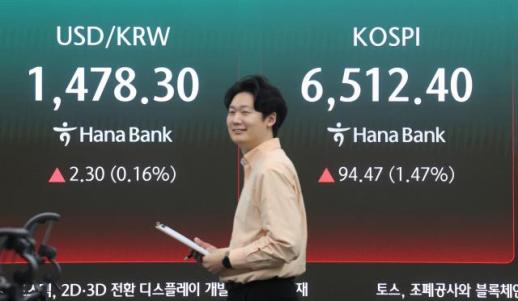 South Korean Won Slips as Oil Prices Rise, Dollar Firms; USD/KRW Near 1,479 The won edged lower against the U.S. dollar. As of 9:50 a.m. on April 23 in Seoul’s foreign exchange market, the won was trading at 1,478.6 per dollar. It opened 2.0 won weaker at 1,478.0. The move was attributed to a firmer dollar amid rising global oil prices. Overnight, crude climbed after reports that Iran’s Islamic Revolutionary Guard Corps seized vessels attempting to pass through the Strait of Hormuz. On April 22 (local time), Brent crude futures for June delivery settled at $101.91 a barrel, up 3.5% from the previous session. U.S. West Texas Intermediate for June delivery ended at $92.96 a barrel, up 3.7%. U.S. stocks rose after U.S. President Donald Trump extended a ceasefire in the Iran war shortly before it was set to expire. The Dow Jones Industrial Average closed up 340.65 points, or 0.69%, at 49,490.03. The S&P 500 gained 73.89 points, or 1.05%, to 7,137.90, and the Nasdaq Composite rose 397.60 points, or 1.64%, to 24,657.57. The S&P 500 and Nasdaq ended at record highs. Min Kyeong-won, an economist at Woori Bank, said the exchange rate is expected to trade around the upper 1,470s, as “dollar strength pressure from higher oil prices remains, while selling near the dollar’s highs offsets it.”* This article has been translated by AI. 2026-04-23 10:01:15
 -
 South Korea’s Q1 GDP Grows 1.7% as Semiconductor-Led Exports Jump South Korea’s economy grew 1.7% in the first quarter from the previous quarter, helped by a surge in exports led by semiconductors. The Bank of Korea said on the 23rd that real gross domestic product rose 1.7% in the January-March period from the prior quarter, based on a preliminary estimate. The figure exceeded the central bank’s February forecast of 0.9%. Exports climbed 5.1%, driven by IT products including semiconductors. Imports rose 3.0% as purchases of machinery and equipment and automobiles increased. Private consumption edged up 0.% on higher spending on goods such as clothing, while government consumption rose 0.1% on higher operating expenditures. Construction investment increased 2.8% as both building and civil engineering work expanded, though it was down 1.4% from a year earlier. Facility investment rose 4.8% as both machinery and transport equipment increased. Exports led growth. Domestic demand, including consumption and investment, contributed 0.6 percentage points to first-quarter growth, while net exports contributed 1.1 percentage points. By industry, electricity, gas and water utilities rose 4.5%, led by water supply and raw-material recycling. Agriculture, forestry and fisheries gained 4.1%, led by crop cultivation. Manufacturing rose 3.9%, driven by computers, electronic and optical products. Services increased 0.4%, led by finance and insurance as well as culture and other sectors. Real gross domestic income, a measure of households’ real purchasing power, rose 7.5%, outpacing the 1.7% increase in real GDP.* This article has been translated by AI. 2026-04-23 08:18:15