
Journalist

AJP
-
 Korean Biopharma Ramps Up U.S. Production as Trump Tariff Uncertainty Grows Uncertainty over tariff policy under the Trump administration is rising again, putting industries on edge. Concerns are growing in South Korea’s biotech sector as the possibility emerges of steep U.S. tariffs on Korean-made pharmaceuticals that have been exported duty-free. Companies say they plan to limit exposure by building inventory and starting production in the United States. According to industry officials on the 23rd, the Trump administration has intensified trade pressure on partners worldwide after the U.S. Supreme Court ruled that reciprocal tariffs imposed under the International Emergency Economic Powers Act, or IEEPA, were illegal. President Donald Trump said on Feb. 20 (local time), shortly after the ruling, that he would use Section 122 of U.S. trade law to impose a 10% tariff on imports from all countries. The next day, he raised it to 15%, the maximum allowed under that provision. The administration has also signaled it could impose tariffs under Section 301 of the Trade Act and Section 232 of the Trade Expansion Act, which would be tougher than the earlier reciprocal tariffs. The court decision invalidated only the IEEPA-based reciprocal tariffs and does not affect tariffs grounded in other statutes. After the ruling, the Office of the U.S. Trade Representative began unfair-trade investigations of major partners under Section 232. In South Korea, it has been investigating whether trade is unfair in nine categories, including pharmaceuticals, since last year. The Korea International Trade Association’s trade research unit said additional tariffs on at least seven categories could materialize by September due to Section 232. With tariff risks resurfacing, South Korean biotech companies are moving faster. Celltrion will begin producing biologic drugs this month at its Branchburg, New Jersey, facility, which it acquired from Eli Lilly. The plant has capacity of 66,000 liters for drug substance production, and Celltrion plans to expand it to 132,000 liters by 2030 through additional investment. The company previously secured two years’ worth of supply for the U.S. market. A Celltrion official said the company has prepared both preemptive inventory and longer-term measures, including operating a U.S. plant, and will respond so that any tariff policy does not affect the company. Samsung Biologics is accelerating work to complete an acquisition. It plans to finish the takeover process by next month for a biologics plant in Rockville, Maryland, which it bought in December, and to start local production immediately after completion. The plant currently has capacity of 60,000 liters, and Samsung Biologics is considering an expansion of 20,000 to 40,000 liters. Lee Seung-gyu, vice chairman of the Korea Bio Association, said biotech companies are minimizing tariff impacts by securing production facilities in the United States, and he urged the government to seek needed support while listening to industry views.* This article has been translated by AI. 2026-02-23 15:18:00
 -
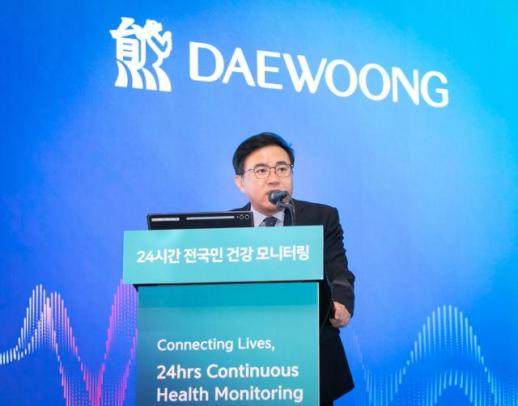 Daewoong Pharmaceutical Unveils ‘ALL New thynC’ AI Platform, Targets 300 Billion Won in Annual Digital Health Sales "We will expand adoption of the real-time inpatient monitoring system 'thynC' to more than 100,000 beds and achieve annual digital health care sales exceeding 300 billion won." Park Hyeong-cheol, head of Daewoong Pharmaceutical’s ETC marketing division, made the remarks on the 23rd at a “digital health care vision” media briefing in Seoul. He also said the company aims to establish a nationwide monitoring system that can support patients at home after discharge. On the sales target, Park said the market size can vary depending on how digital health care is defined, but added he believes the goal is achievable even when counting only products already in use by medical staff. Daewoong Pharmaceutical, which set up a dedicated digital health care organization in 2024, unveiled its upgraded next-generation artificial intelligence health care platform, “ALL New thynC,” at the event. The platform integrates patient health data by linking biometric information collected from wearable sensors — including electrocardiograms, blood pressure and oxygen saturation — with tools such as continuous glucose monitoring, ring-type continuous blood pressure monitoring and an AI voice-recognition medical record solution. Executives from partner companies, including Seers Technology, iCoop, Sky Labs and Puzzle AI, attended the briefing to share the platform’s technical value and examples of use in clinical settings. iCoop’s continuous glucose monitoring solution, CGM Live, tracks real-time blood sugar changes in hospitalized patients. Sky Labs’ ring-type continuous blood pressure monitoring solution, Cart On, automatically measures and records blood pressure. Puzzle AI’s AI voice-recognition solution, CL Note, recognizes clinicians’ speech in real time and links it to electronic medical records. Lee Young-shin, CEO of Seers Technology, said ALL New thynC is evolving into an AI-based platform that supports clinicians’ decision-making and will expand beyond in-hospital monitoring to home care to broaden full-cycle patient monitoring. The briefing also cited a case in which an early warning alert detected by thynC in a real-world medical setting helped identify a patient just before cardiac arrest. Daewoong Pharmaceutical said it plans to further advance monitoring technology so care does not stop outside the hospital. Park said the value lies in connecting technologies through an integrated platform to support clinical decisions, adding the company will continue working with partners across more medical settings.* This article has been translated by AI. 2026-02-23 15:09:00
 -
 IBK Bank Gains as Film ‘The King and the Man He Lives With’ Nears 6 Million Viewers IBK Industrial Bank of Korea is drawing attention again for its track record in cultural-content investing, as the film ‘The King and the Man He Lives With’ continues a strong run and is closing in on 6 million admissions. According to the Korean Film Council’s box-office tracking system, the movie drew 1,414,207 viewers over its third weekend, Feb. 20-22, bringing its cumulative total to 5,828,885. It has held the No. 1 spot since release, and some are even discussing the possibility of topping 10 million admissions. For IBK, which participated as an investor, the box-office momentum could translate directly into returns. The film has already passed its break-even point of 2.6 million admissions, and its pace suggests returns comparable to the bank’s past hits. IBK previously invested 790 million won in the 10 million-viewer film ‘Extreme Job,’ posting a 377% return. It invested 1 billion won in last year’s ‘Exhuma’ and earned a 129% return. Its investment in ‘The King and the Man He Lives With’ is also 1 billion won. Building on its experience in cultural content, IBK plans to invest more than 50 billion won this year. In line with its policy goal of fostering small and midsize content companies that struggle to raise funds, the bank said it will continue to back projects with both commercial appeal and artistic quality. IBK has also been expanding beyond film into performances and musicals. After investing 3 billion won in the musical ‘Wicked’ last year, it invested 1 billion won in the musical ‘Life of Pi,’ which drew attention as a Korean premiere. It also plans to participate in an investment for the musical ‘Lempicka,’ set to open in March. A financial industry official said IBK’s cultural-content investing is positive because it shows a policy lender can go beyond loans and serve as a catalyst for industry growth. The official added that the bank appears to be maintaining strong results by selecting content that combines broad appeal with quality. 2026-02-23 14:54:00
 -
 South Korea and Brazil upgrade ties to strategic partnership SEOUL, February 23 (AJP) - South Korean President Lee Jae Myung and Brazilian President Luiz Inacio Lula da Silva agreed to elevate bilateral relations to a strategic partnership following a summit at the presidential Blue House on Monday. During a joint press briefing in the afternoon, Lee announced the adoption of a four-year action plan designed to foster a new leap forward in the bilateral relationship. The leaders oversaw the signing of 10 memorandums of understanding covering sectors such as small businesses, health regulations and agriculture. The talks highlighted several main areas of cooperation, prioritizing artificial intelligence, aerospace, defense, biopharmaceuticals and critical minerals. Both countries also plan to expand collaboration across the digital and green economies. Addressing international trade, Lee said he emphasized the need to quickly resume negotiations for a trade agreement between South Korea and the South American trade bloc Mercosur. Lee noted that Lula agreed the pact is a crucial task, and both leaders committed to seeking a breakthrough based on mutual trust. Brazil is currently unable to negotiate a conventional bilateral free trade agreement with South Korea due to institutional rules within Mercosur, which requires the bloc to negotiate trade deals collectively. Regarding the newly signed memorandums, Lee stated that the agreement focusing on small and medium-sized enterprises will help diversify bilateral trade and investment, which has historically been dominated by large conglomerates. Another key agreement addresses health and regulatory cooperation, which Lee said will further boost the popularity of South Korean cosmetics in Brazil. The arrangement facilitates the exchange of regulatory information for cosmetics, food and pharmaceuticals, alongside technical cooperation to streamline market access. South Korean cosmetics have seen significant growth in the region. According to the Korea International Trade Association, cosmetic exports to Latin America grew by more than 40 percent annually over the past four years, reaching roughly $400 million in 2024. The two governments also signed three memorandums focused on agriculture, food security and supply chains. Lee described Brazil as an agricultural powerhouse with advanced technology, calling the partnerships vital for South Korea's food security and the sustainable development of rural economies in both nations. 2026-02-23 14:43:37
 -
 IVE Returns With Second Full-Length Album 'Revive+'; Promotes Title Track 'Black Hole' IVE is making a comeback with its second full-length album, 'Revive Plus.' A comeback showcase for the album 'REVIVE+ (Revive Plus)' was held Monday afternoon at YES24 Live Hall in Seoul’s Gwangjin district. The title track, 'Black Hole,' is a shuffle-based song with a cinematic feel, featuring a wide sense of space and film-like sound textures meant to heighten immersion and deliver a strong hook. Using the image of a black hole—where disappearance and birth coexist—the group said it expresses how IVE views the present and change. Member Gaeul said it felt special to return with a full-length album after three years, adding, “We worked hard to show an evolved IVE that doesn’t stop at change.” She added, “We seem to be getting a lot of love starting with the pre-release track 'Bang Bang,' which makes me happy. Riding that momentum, we’ll promote 'Black Hole' as well.” Member Rei said, “I’m proud that we captured what we’ve built under the name IVE in a full-length album in a cooler, more IVE-like way. We’ll show our diverse charms, like our identity, so please give this album lots of love, too.” IVE’s second full-length album, 'Revive Plus,' is set for release at 6 p.m. Monday. * This article has been translated by AI. 2026-02-23 14:42:16
 -
 Ju-ae or Ju-hae? Name debate over North Korea's young heiress SEOUL, February 23 (AJP) - North Korean leader Kim Jong Un on Sunday was re-elected as general secretary of the ruling Workers' Party of Korea, reaffirming the supreme-leader status he has held since 2012. But what has increasingly drawn international attention is not Kim himself, but his brash, omnipresent teenage daughter. The confident, bubbly-looking girl has frequently appeared at her father’s side in recent years, prompting North Korea watchers to speculate that she could be an unconventional choice as the country’s next ruler — breaking with a succession system that has passed power from father to son for three generations. South Korean intelligence authorities estimate her age at 12 to 13, while foreign analysts put it at around 13 to 14. Now, even her name has become a matter of debate. The girl has so far been widely known as Ju Ae, but some close observers believe her real name may be Ju Hae. According to a senior government official, intelligence agencies are verifying the reports that the young girl is playing an unofficial role comparable to “director of the Missile General Bureau” within the regime. They have been closely following the ninth party congress under way in Pyongyang since Feb. 19 for signs of her growing political presence. Kim Ju Ae — or Ju Hae — has increasingly accompanied her father to key weapons tests, fueling speculation about an emerging hereditary succession plan. One intelligence source said she is believed to be receiving briefings and issuing directions to some officials, in place of Jang Chang-ha commanding the missile bureau. Earlier this month, South Korea’s National Intelligence Service briefed lawmakers that Kim’s daughter had entered what it called the “succession designation stage.” The agency said she has begun expressing views on certain state policies, a possible sign of her rising influence. She first drew international attention in 2013, when former NBA star Dennis Rodman told The Guardian that he had “held baby Ju Ae” during a visit to North Korea. Defector testimonies, including that of former diplomat Ryu Hyun-woo, have also cited “Ju Ae” as Kim’s chosen name for his second child, allegedly meaning “one who is loved by all.” However, alternative versions such as “Ju Ye” and “Ju Hye” have circulated for years, and analysts now believe her name may have been altered after she was designated as a successor. Kim Jong Un himself is known to have changed the Chinese character of his given name in 2009, when his own succession path began. For years, Kim Ju Ae was believed to be the second of Kim Jong Un and his wife Ri Sol Ju’s three children, though neither the total number nor their birth order has ever been publicly confirmed. She remains the only child acknowledged through state media appearances. Since her first official appearance alongside her father at an intercontinental ballistic missile launch in November 2022, she has featured prominently at military parades and official banquets. By early 2023, state outlets began referring to her as the “respected daughter,” an honorific previously used for Kim himself before his leadership was announced. By January 2024, the NIS identified her as the “most likely successor,” while cautioning that “many variables” remain, given Kim’s relatively young age and North Korea’s patriarchal political culture. Her expanding public role — and recent intelligence suggesting her name may be Kim Ju Hae — indicates that Pyongyang may be quietly preparing for a fourth-generation transfer of power under the Kim dynasty. Whether that process will include formally recognizing her new name remains one of the regime’s closely guarded secrets. 2026-02-23 14:40:29
 -
 Hyundai Motor Group Weighs Multitrillion-Won Investment in Saemangeum for AI, Robotics and Hydrogen Hyundai Motor Group is pushing a multitrillion-won investment in Saemangeum, North Jeolla Province, to expand its artificial intelligence, hydrogen and robotics businesses. Government and business officials said Monday the group is preparing to sign a memorandum of understanding with the Ministry of Trade, Industry and Energy, the Ministry of Climate, Energy and Environment, North Jeolla Special Self-Governing Province and the Saemangeum Development and Investment Agency on investing several trillion won in the area to foster future businesses. The likely focus is AI, hydrogen and robotics, which Hyundai Motor Group has identified as key growth areas. The exact amount has not been set, but officials expect it to reach several trillion won. The group has previously announced plans to invest a total of 125.2 trillion won in South Korea through 2030 over five years. Saemangeum is seen as a strong candidate for building hubs tied to the group’s priority growth engines, including AI, software-defined vehicles, electrification, robotics and hydrogen. Of the 125.2 trillion won plan, Hyundai Motor Group has pledged to spend 50.5 trillion won in those fields. When it announced the investment plan, the group said it would consult with the government and local authorities and consider investments to help create a “hydrogen AI new city” that applies its core technologies, including AI, hydrogen and V2X. The Saemangeum area is expected to attract facilities such as an AI data center, a physical AI application center, a robot factory and a water electrolysis plant. Saemangeum, with land about 140 times the size of Seoul’s Yeouido and ample sunlight, is considered favorable for building power-hungry AI data centers. Plans for robot manufacturing and foundry plants have also been discussed as part of a push to become a physical AI company. A Hyundai Motor Group official said the company is reviewing investment plans in various ways to help boost regional economies, adding that no specific plan related to Saemangeum has been confirmed. * This article has been translated by AI. 2026-02-23 14:30:15
 -
 Entertainer Nam Chang-hee Marries Former Actress Yoon Young-kyung, Now an Office Worker Entertainer Nam Chang-hee’s wife has been identified as Yoon Young-kyung, a former actress who now works an office job. T&N Entertainment, Nam’s agency, said on the 23rd, “Nam Chang-hee’s wife is Yoon Young-kyung, who previously worked as an actress,” adding, “She is currently an office worker.” Earlier that day, a media outlet reported that Nam’s wife is Yoon. Yoon graduated from Dongduk Women’s University’s Department of Broadcasting and Entertainment and was named a runner-up in the 2013 Miss Chunhyang pageant. She debuted in the 2014 film “Ode to My Father” and appeared in the dramas “Hwajeong” and “Ms. Temper & Nam Jung-gi.” In 2014, she appeared on MBC’s variety show “Infinite Challenge” in a special titled “Hongcheol, Get Married,” and was nicknamed “Han River IU.” Nam and Yoon held their wedding on the 22nd at the Dynasty Hall of the Shilla Hotel in Jung-gu, Seoul. Nam was born in 1982 and Yoon in 1991, a nine-year age gap. 2026-02-23 14:00:05
 -
 HMM Launches Generative AI Chatbot for Shippers to Streamline Service HMM said on the 23rd it has introduced a generative AI-based chatbot service for shippers, stepping up digital transformation at customer touchpoints. The chatbot, co-developed with LG CNS, is aimed at improving customer experience and strengthening service competitiveness that shippers can directly feel, the company said. HMM said the service is designed so shippers can get needed information through natural Q&A, like talking with an agent, without knowing precise shipping terms or complex procedures. It can help users check vessel schedules and freight rates, and handle tasks that require specialized knowledge, including △country-specific customs procedures △complex regulatory requirements △whether cargo qualifies as dangerous goods for transport. To serve shippers worldwide, the chatbot includes real-time translation in 17 languages. HMM said it expects shippers will be able to handle needed tasks immediately, anytime and anywhere, without language barriers, easing their workload. HMM said it will continue to upgrade its digital services based on actual customer usage data and gradually expand digital transformation closely aligned with shippers’ overall business flow. An HMM official said the chatbot is focused on fundamentally addressing inconveniences shippers have faced, adding that the company will strengthen its differentiated competitiveness by innovating the shipper experience.* This article has been translated by AI. 2026-02-23 13:24:17
 -
 HD Hyundai Heavy Delivers Philippine Offshore Patrol Vessel 5 Months Early HD Hyundai Heavy Industries has delivered the first offshore patrol vessel, or OPV, ordered by the Philippine Navy ahead of schedule. The company said Monday it recently delivered the Rajah Sulayman, the first of six OPVs it is building for the Philippine Navy, nearly five months earlier than the contracted delivery date. The 2,400-ton ship is equipped with an anti-submarine acoustic detection system and includes space to operate various mission modules. It was designed for use in multiple settings, including maritime surveillance, maritime security missions and military operations. HD Hyundai Heavy said the accelerated delivery will help the Philippine Navy field the ship sooner. Delivery schedules are considered a key measure of a shipbuilder’s capability because they directly affect force readiness and a country’s ability to sustain defense capabilities. Ahead of delivery, the company also provided a pre-delivery training program with cooperation from the South Korean navy to support stable operation of the vessel. “Through the early delivery of this Philippine Navy offshore patrol vessel, we proved both our reliability and our competitiveness in meeting delivery schedules,” a company official said. The official added that HD Hyundai Heavy will continue building and delivering the remaining ships to support modernization and stable operations for the Philippine Navy. HD Hyundai Heavy has participated in the Philippine Navy modernization program since 2016 and has won orders for 12 ships, including frigates and offshore patrol vessels. It delivered the first frigate, Jose Rizal, one month early and has delivered five ships ahead of schedule to date.* This article has been translated by AI. 2026-02-23 13:09:26