

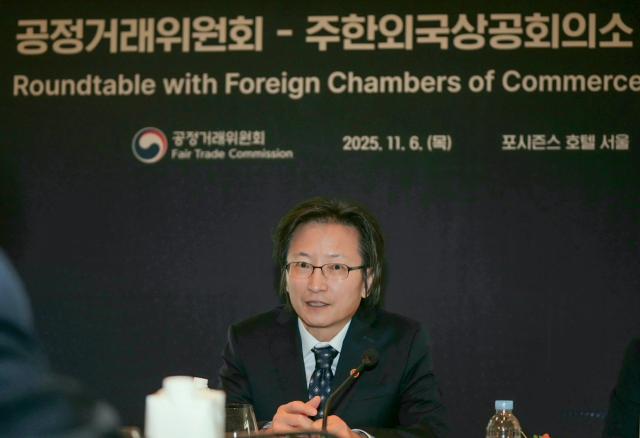
The Korea Fair Trade Commission (FTC) said Monday it has commissioned an external study to redesign its sanctions framework for unfair trade practices, laying the groundwork for tougher legislation later this year.
At the center of the reform is a proposal to calculate fines based on a company’s total sales, rather than limiting them to revenue generated in the specific market tied to a violation.
Under the new approach, larger firms would automatically face heavier penalties—aimed at preventing major conglomerates, or chaebol, from treating fines as a routine business expense.
“Companies often find that the profits gained from violations exceed the penalties imposed,” said Sun Jung-gyu, director-general of the FTC’s Competition Policy Bureau.
“The goal is to make collusion and unfair practices economically unviable.”
He added that President Lee Jae Myung has repeatedly criticized Korea’s cartel fines as being too lenient by international standards.
A System Favoring Large Firms
Currently, the FTC calculates penalties based on “related turnover,” or sales linked directly to the offending activity. In practice, this has produced sharply uneven outcomes.
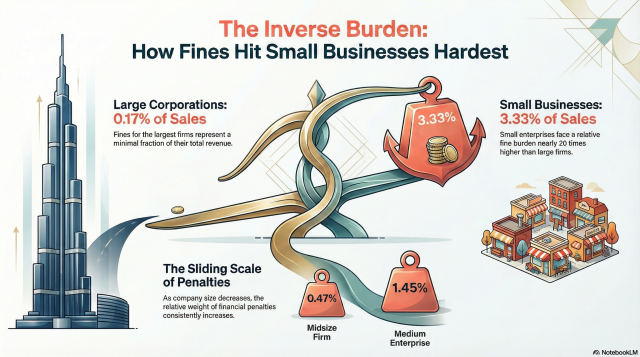
A 2020 study by the Korea Institute of Public Finance found that between 2011 and 2017, fines imposed on large corporations averaged just 0.17 percent of their total sales. By contrast, midsize firms paid 0.47 percent, medium enterprises 1.45 percent, and small businesses 3.33 percent.
The smallest firms—often penalized for minor violations—shouldered fines equal to more than 22 percent of revenue.
Learning from Europe
The reform draws inspiration from European competition policy, which bases fines on company-wide turnover.
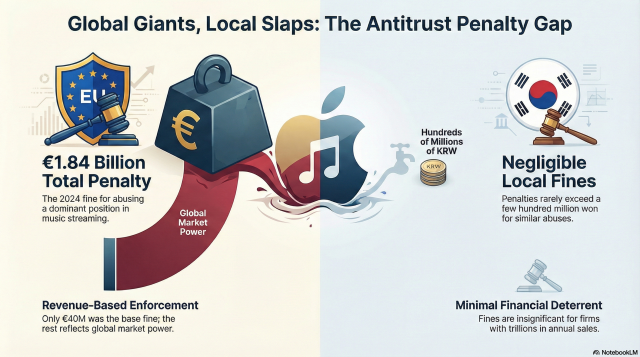
In 2024, the European Commission fined Apple €1.84 billion for abusing its dominant position in music streaming. Only €40 million was the base penalty, while the remainder reflected Apple’s global revenue and market power.
By comparison, Korean penalties for similar abuses have rarely exceeded a few hundred million won—negligible for firms with trillions of won in annual sales.
Introducing a Minimum Floor
Regulators are also considering minimum fine thresholds to prevent token penalties.
The new system could impose either a fixed minimum amount or a baseline percentage of turnover, ensuring that no major violation results in nominal punishment.
Under current rules, “very serious” abuse of market dominance carries a minimum fine of 3.5 percent of sales during the violation period. Officials are reviewing plans to raise that floor by the end of February.
The FTC is also reassessing fixed-amount penalties—typically ranging from 500 million won to 4 billion won—used when violations cannot be clearly tied to specific sales.
“These static limits fail to reflect corporate gains or social harm,” an FTC official said. “A revised system would allow stronger sanctions even when market impact is hard to measure.”
Legislative Push and Corporate Resistance
To institutionalize the changes, the FTC plans to submit amendments to the Fair Trade Act in the first half of the year. The bill would raise both maximum and flat-rate penalties, expanding regulatory discretion.
Business groups are already pushing back, warning that heavier fines could dampen investment and innovation amid slowing exports and economic uncertainty.
“Firms will argue this hurts business activity, while regulators will stress deterrence,” said Professor Lee Hwang of Korea University Law School. “The challenge is balancing discipline with economic dynamism.”
Lee also emphasized the legal distinction between administrative surcharges and criminal penalties.
“This reform concerns administrative sanctions, not criminal punishment,” he said. “It is about deterrence, not criminalization.”
The FTC’s policy blueprint, expected later this year, is likely to present multiple models for scaling fines. Officials say the intent is not to penalize corporate success but to ensure accountability proportional to financial capacity.
Supporters argue that scale-sensitive fines will strengthen market discipline and public trust noting that Japan and Australia also employ similar systems.
Critics, however, warn that aggressive enforcement could trigger prolonged legal battles and encourage firms to shift profits or operations offshore. Some also fear that minor compliance lapses could be punished too harshly.
The reform comes amid rising public frustration over price-fixing scandals and collusion among major conglomerates, making competition policy a politically sensitive issue.
For President Lee’s administration, tightening corporate accountability aligns with its pledge to create a “level playing field” for small and medium-sized enterprises.
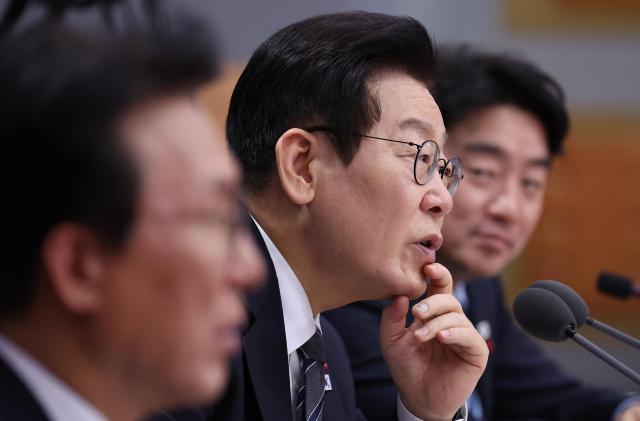
Lee publicly condemned the claim as “fake news,” prompting an official apology from the group, led by Chey Tae-won, chairman of SK Group.
The FTC initiative represents one of the most ambitious regulatory shifts since Korea strengthened its competition laws in the late 1980s.
If enacted, revenue-based fines would significantly reshape the relationship between the state and big business, marking a decisive move toward tougher enforcement.
Copyright ⓒ Aju Press All rights reserved.
