
Journalist

AJP
-
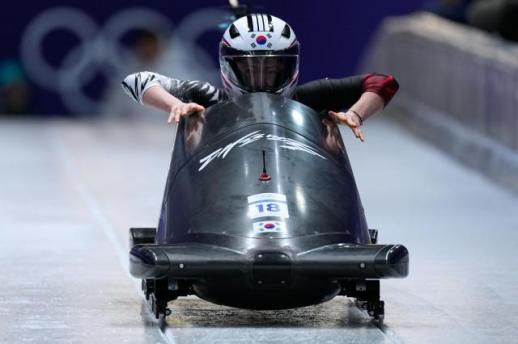 South Korea’s Kim Yuran finishes 22nd in Olympic women’s monobob, misses final run Kim Yuran finished 22nd in the women’s monobob at the Milan-Cortina d’Ampezzo Winter Olympics, failing to advance to the fourth and final run. Kim posted 1 minute 00.51 seconds in the third run on Feb. 16 (local time) at the Cortina Sliding Center in Cortina d’Ampezzo, Italy. Her combined time for runs 1-3 was 3:02.37, placing her 22nd among 24 athletes and outside the top 20 who qualified for run 4. She was 23rd after the first two runs with a combined 2:01.86 and moved up one spot in the third run, but did not break into the top 20. Kim placed 14th in the women’s two-woman bobsleigh at the 2018 PyeongChang Winter Olympics. At the 2022 Beijing Games, she became the first South Korean to compete in the newly added monobob and finished 18th.* This article has been translated by AI. 2026-02-17 05:30:00
 -
 South Korea Faces Short Track Gold Drought at Milan-Cortina Olympics; Women’s 1,500 Last Individual Chance South Korea’s short track team, long a reliable source of Olympic gold, is facing growing concern that it could finish the Games without a top podium in the sport. Through Feb. 16 (Korea time), South Korea has won one silver and two bronze medals across six short track events at the 2026 Milan-Cortina d’Ampezzo Winter Olympics. Lim Jong-eon opened the medal count with bronze in the men’s 1,000 meters. Hwang Dae-heon added silver in the men’s 1,500, and Kim Gil-li took bronze in the women’s 1,000, giving South Korea three medals overall. But a gold medal has yet to come. With only three events remaining — the women’s 1,500-meter individual race and the men’s and women’s relay events — there is speculation South Korea may not surpass the two golds it won at the Beijing Games four years ago. The men’s team has already completed its individual events without winning a gold. It is the third time South Korea’s men have gone without an Olympic individual gold, after the 2002 Salt Lake City Games and the 2014 Sochi Games. The women’s team is also under pressure. After missing gold in the 500 and 1,000, only the 1,500 remains in the individual program. If South Korea fails to win that race as well, it would mark the first time in Olympic history that the country wins no gold medals in both men’s and women’s individual short track events. The absence of a dominant star has added to the challenge. Choi Min-jeong, the team’s ace who defended South Korea’s pride with back-to-back Olympic golds at Pyeongchang 2018 and Beijing 2022, has struggled in individual events at this Olympics. As South Korea has stumbled, rivals have surged. The Netherlands, once known mainly for speed skating, has made rapid gains in short track and has broken South Korea’s hold on the top step. The Dutch have swept up four gold medals at these Games, setting a new national record for most Olympic golds in the sport.* This article has been translated by AI. 2026-02-17 04:51:00
 -
 Milano 2026: Kim Gil-li Wins Bronze in Women’s 1,000 Meters; JTBC Apologizes for Flag Graphic JTBC issues official apology for airing Japanese flag graphic JTBC, which is exclusively broadcasting the 2026 Milano-Cortina Winter Olympics, issued an official apology after a Japanese flag graphic appeared during a South Korea-Japan women’s curling match. In a statement posted on its website on the 16th, JTBC said that at about 11:23 p.m. on the 15th, a Japanese national flag graphic was briefly shown on an advertising screen during the process of airing a mid-broadcast commercial break in the live curling telecast. The network said it was sorry for the inconvenience caused by a production error and pledged stricter checks and management to prevent a repeat. The incident occurred during live coverage of the women’s curling round-robin fifth match between South Korea and Japan at the Cortina curling stadium in Italy. After the fifth end ended, an unrelated Japanese flag graphic aired for about 10 seconds during the commercial break. Seoul Mayor Oh Se-hoon visits air defense unit ahead of Lunar New Year Seoul Mayor Oh Se-hoon visited an air defense position of the 1st Air Defense Brigade on the 16th, a day before Lunar New Year, to encourage service members defending the capital’s airspace. He received a briefing on the unit and had lunch with troops. “With you here, Seoul residents can go about their daily lives with peace of mind,” Oh said. “Because Seoul has many key national infrastructure facilities, maintain a constant state of readiness and serve with pride in the mission of protecting the capital.” Oh later boarded and inspected the surface-to-air guided weapon system known as the “Chunma,” then took commemorative photos with service members. Kyiv mayor warns Ukraine’s survival as an independent state is not guaranteed Kyiv Mayor Vitali Klitschko warned in an interview with the Financial Times that he cannot guarantee Ukraine will remain an independent state as Russia continues attacks on infrastructure. He said the capital is facing a near-collapse crisis and residents are under severe pressure to survive during a harsh winter. According to AFP, heating has been cut to about 1,600 buildings in the capital, and disruptions to electricity and heat are spreading amid cold below minus 20 degrees Celsius. Even when damaged energy facilities are repaired, additional airstrikes soon knock them out again, he said, adding that Europe’s support alone is not enough to respond. Klitschko said he has had disagreements with President Volodymyr Zelenskyy over crisis response, but stressed unity is needed against attacks aimed at fueling internal instability. Meanwhile, the U.S. administration led by Donald Trump is pressing for talks to end the war, including territorial compromise and early elections, as the conflict moves into a phase combining military operations and negotiations. * This article has been translated by AI. 2026-02-16 21:48:00
 -
 Kim Jin-su duo sits 12th after two runs in Olympic two-man bobsled; Seok Young-jin 19th South Korea’s men’s two-man bobsled teams led by Kim Jin-su and Seok Young-jin were outside the top 10 after the first two heats at the 2026 Milan-Cortina Winter Olympics. Kim, with brakeman Kim Hyeong-geun (both from Gangwon Provincial Office), was 12th among 26 teams with a combined time of 1 minute, 51.69 seconds in heats 1 and 2 on Feb. 16 at the Cortina Sliding Center in Cortina d’Ampezzo, Italy. The Kim team had raised expectations by finishing fourth in the season’s first World Cup in November on the same Cortina track that is hosting the Olympic races. They were fifth in the first heat in 55.53 seconds, but slipped to 15th in the second heat with 56.16, dropping in the overall standings. Seok, with brakeman Chae Byeong-do (Catholic Kwandong University), was 19th in 1:52.50. Germany swept the top three spots after the first two heats. Johannes Lochner and Georg Fleischhauer led in 1:49.90, followed by Francesco Friedrich and Alexander Schueller in 1:50.70, and Adam Ammour and Alexander Schaller in 1:51.14. Heats 3 and 4, which will decide the final standings, are scheduled for 3 a.m. on Feb. 18 (Korea time).* This article has been translated by AI. 2026-02-16 21:30:00
 -
 Kim Gil-li Wins Bronze in Women’s 1,000 Meters Short Track at Milan 2026 South Korea short track skater Kim Gil-li of Seongnam City Hall won bronze in the women’s 1,000 meters at the 2026 Milan-Cortina d’Ampezzo Winter Olympics. Kim finished third in 1:28.614 in the final on Feb. 16 (Korea time) at the Milan Ice Skating Arena in Milan, Italy, behind Sandra Felzebur of the Netherlands and Courtney Saro of Canada. The result gave South Korea its sixth medal of the Games. South Korea’s medal haul through that day included Kim Sang-gyeom’s silver in the men’s parallel giant slalom snowboarding on Feb. 8, Yoo Seung-eun’s bronze in women’s big air snowboarding on Feb. 10, Choi Ga-on’s gold in women’s halfpipe snowboarding on Feb. 13, Lim Jong-eon’s bronze in the men’s 1,000 meters short track on Feb. 13, and Hwang Dae-heon’s silver in the men’s 1,500 meters short track on Feb. 15. Kim’s path to the podium was turbulent. In the quarterfinals, she placed second in her heat in 1:29.102, behind Felzebur, to reach the semifinals. In the semifinal, Kim moved up from the back, passing Kristen Santos-Griswold of the United States on the inside with three laps remaining and crossing the line second. She advanced to the final after officials reviewed the race and granted her an advance: With five laps left, Hanne Desmet of Belgium pushed her by hand, sending Kim down. Kim got up and finished, and Desmet was penalized. The final was also tight. Starting from the fifth lane, Kim ran last among the five skaters until four laps remained. She then surged on the outside as Arianna Fontana of Italy dropped back, jumping to second, and took the lead on the inside with three laps to go. With two laps left, Felzebur and Saro passed her in succession, dropping Kim to third. She tried to respond on the final lap but could not catch them and finished with bronze. South Korea’s star Choi Min-jeong of Seongnam City Hall did not reach the final, finishing fourth in her semifinal. She placed third in the B final and ended eighth overall.* This article has been translated by AI. 2026-02-16 21:27:00
 -
 Kim Gil-li advances to women’s 1,000 final at Milan-Cortina Olympics; Choi Min-jeong to placement race Kim Gil-li of South Korea advanced to the women’s 1,000-meter final in short track at the 2026 Milan-Cortina d’Ampezzo Winter Olympics after receiving an advance ruling. Choi Min-jeong did not reach the final and will skate in the placement race, while Noh Do-hee was eliminated in the quarterfinals. Competing in Milan on Feb. 16 (Korea time), Kim secured her spot in the final after officials reviewed an incident in the semifinal. Earlier, she placed second in her quarterfinal heat in 1 minute, 29.068 seconds to move on. In semifinal Heat 1, Kim raced against Hanne Desmet of Belgium, Florence Brunelle of Canada, Gong Li of China and Xandra Velzeboer of the Netherlands. With eight laps remaining, Kim moved up on the outside and took the lead. As Velzeboer continued to challenge, Desmet collided during an overtaking attempt and Kim went down. After the ruling, Kim was advanced to the final and Desmet was disqualified. Choi advanced from her quarterfinal heat by finishing second in 1:28.613, behind Arianna Fontana’s 1:28.452. She managed the race in a strong field but fell short of a final berth in the semifinal and will compete in the placement race. Noh finished last in her quarterfinal in 1:32.174. She lost speed late after contact with another skater and did not advance to the semifinals.* This article has been translated by AI. 2026-02-16 20:27:00
 -
 South Korea’s Lim Jong-eon, Hwang Dae-heon eliminated in Olympic men’s 500 short track heats South Korea’s Lim Jong-eon and Hwang Dae-heon were both eliminated in the men’s 500 meters short track heats at the 2026 Milano-Cortina d’Ampezzo Winter Olympics. Lim, who previously won bronze in the men’s 1,000, finished third in Heat 8 on Feb. 16 (Korea time) at the Ice Skating Arena in Milan, Italy, clocking 41.289 seconds and missing the quarterfinals. The race was physical from the start. Lim tangled with Niall Treacy of Britain in the first corner and went down, and the battle for position continued after a restart. With two laps left, Lim tried to pass but Lin Xiaojun of China held his line. Lim made another move on the outside in the final corner, lost balance and speed, and finished third. Lin placed second in 41.242 to advance. Hwang, the men’s 1,500 silver medalist, also failed to advance from Heat 4. He settled into third after the start and looked for openings through the corners but could not get through. He lunged at the line, but photo review showed he finished second in 41.191, just 0.012 behind winner Felix Pizon of Poland, who posted 41.179. With their individual events complete, Lim and Hwang will next chase a medal in the men’s relay.* This article has been translated by AI. 2026-02-16 20:09:00
 -
 South Korean financial stocks lead market gains in February SEOUL, February 16 (AJP) - South Korean financial stocks surged this month as the benchmark KOSPI index hit a series of record highs. The securities index jumped 24.5 percent from Jan. 30 to Feb. 13, rising to 7,684.70 from 6,172.47, far outpacing the KOSPI's 5.31 percent gain over the same period, according to data from the Korea Exchange released Monday. The KOSPI 200 Financials index, composed of 22 stocks including financial holding companies, banks and insurers, climbed 22.34 percent for the second-largest gain. Other sectors posted smaller increases, with telecommunications up 14.59 percent, insurance up 13.81 percent and construction up 13.37 percent. Financial strength also showed up in broader KRX indexes covering both the KOSPI and KOSDAQ markets. The KRX Bank index rose 25.36 percent to lead all sectors, followed by KRX300 Financials up 22.22 percent and KRX Securities up 21.19 percent. Analysts attributed the gains to rising investor interest in brokerage shares amid the broader market rally, as well as buying in bank and insurance stocks ahead of dividend season. Changes to dividend taxation also played a role. Starting this year, dividend income is subject to separate taxation, making bank stocks more attractive to high-net-worth investors. "Separate taxation on dividend income has made bank stocks a favorable investment tool for wealthy investors expecting more than 20 million won in financial income," said Kim In, an analyst at BNK Investment & Securities. "If tax-free dividends are introduced, the appeal of bank stock dividends would likely broaden to retail investors as well." 2026-02-16 17:41:44
 -
 Global solid-state battery market projected to reach $20 billion by 2032 SEOUL, February 16 (AJP) - The global solid-state battery market is projected to grow more than tenfold to nearly $20 billion by 2032, driven by expanding applications in electric vehicles and robotics, according to a market research report released Monday. South Korean battery makers are accelerating development efforts as commercialization of the next-generation technology draws closer. The worldwide solid-state battery market is expected to expand from $1.97 billion last year to $19.97 billion in 2032, representing a compound annual growth rate of 39.2 percent, according to market research firm Coherent Market Insights. Solid-state batteries use solid electrolytes instead of the liquid electrolytes found in conventional lithium-ion batteries, reducing fire and explosion risks while enabling higher energy density, the report said. Initial demand is expected to come from small electronics including home appliances, wearables and medical devices. Applications are projected to expand to electric vehicles and robots as technology matures and manufacturing processes stabilize, according to the report. However, high manufacturing costs and complex processes remain key constraints. The ability to establish mass-production systems and achieve stable yields will be critical in determining commercialization timing, the firm said. Coherent Market Insights identified U.S.-based Solvay, Cymbet and Solid Power, along with Japan's Panasonic, as companies leading solid-state battery technology. Samsung SDI was the only South Korean company included in the list. Samsung SDI built South Korea's first solid-state battery pilot line in 2023 and has been supplying samples to customers for performance verification. In late 2025, the company agreed with BMW and Solid Power to jointly pursue a technology verification project for vehicle applications. In an earnings conference call earlier this month, Samsung SDI said it is preparing next-generation solid-state batteries with a mass production target for next year and proceeding with planned investment to expand production lines this year. LG Energy Solution aims to commercialize graphite-based solid-state batteries for electric vehicles in 2029 and plans to apply anodeless solid-state batteries to humanoid robots in 2030. SK On, targeting commercialization in 2029, is considering the defense sector as an initial application. The company has built a pilot plant at its Daejeon Future Technology Institute to develop sulfide-based solid-state batteries and lithium-metal batteries in parallel. It is also collaborating with Solid Power on cell design and process technology while receiving supplies of sulfide-based solid electrolytes to accelerate development. 2026-02-16 17:08:33
 -
 Olympic Snowboard Gold Medalist Choi Ga-on Returns to South Korea After Halfpipe Win Choi Ga-on, wearing her gold medal from the 2026 Milan-Cortina d’Ampezzo Winter Olympics, returned home on the 16th. Choi, who delivered the first gold medal for the South Korean team, met reporters at the arrivals hall of Incheon International Airport’s Terminal 2 and said it still felt unreal. “I was in Milan until yesterday, so it didn’t really sink in,” she said. “But coming into Korea and being welcomed makes it feel more real, and I’m happy.” She added, “I didn’t expect so many people to come, so I’m flustered and embarrassed,” saying she was grateful. Choi won the women’s snowboard halfpipe final held in Livigno, Italy, on Feb. 13 (Korean time). She was 11th out of 12 before her third and final run, then posted a 90.25 to surge to a dramatic victory. Her win also stopped Chloe Kim, considered the event’s biggest star, from winning a third straight Olympic title, drawing global attention. Choi has been on an upswing, including three wins on the International Ski Federation World Cup circuit in the 2025-2026 season. She raised concern after taking a hard fall on her first run and appearing to limp. “My knee is much better,” she said, adding she plans to undergo a hospital checkup. Asked what she wanted to eat most after returning, Choi said yukjeon made by her grandmother, adding she also wanted “Dujjonku and malatang,” prompting laughter. Choi also thanked Shin Dong-bin, chairman of Lotte Group, who helped cover surgery costs after she badly injured her back at a World Cup event in Switzerland in January 2024. “His support and encouragement at the hardest time made it possible for me to be here,” she said. At the athletes’ village, she said she met short track star Choi Min-jeong. “I watched her race and she was so impressive that I said I wanted to meet her, and I got the chance,” Choi said. “We kept telling each other we were amazing.” For her schedule back home, Choi said she planned a celebration party with her family and a pajama party with friends. Choi said she would work to show a wider range of skills. “In halfpipe, the most important thing is to enjoy riding,” she said. “I hope younger athletes can have fun and not get hurt.”* This article has been translated by AI. 2026-02-16 17:06:00