
Journalist

AJP
-
 Ham So Won Says She Lived With Ex-Husband Jin Hua for a Year After Divorce Actress Ham So Won said she continued living with Jin Hua for a year after their divorce. A video titled “Ham So Won lived for a year after divorce in one home with her mother, Jin Hua and daughter Hyejeong?!” was posted Tuesday on the MBN “Dongchimi” YouTube channel. Ham said she finalized the divorce in December 2022, and that when she went to Vietnam in 2023, Jin Hua came and the four of them lived together — Ham, Jin Hua, her mother and their daughter, Hyejeong. A doctor on the program reacted with surprise. Ham said that after she completed the divorce process and left for Vietnam, Jin Hua asked, “So we’re divorced now?” She said she replied, “How many times do I have to say it? It’s over.” She said he then asked, “But where am I supposed to live?” After that, she said, the four ended up sharing a home. Ham said that when it was just the two of them, they would argue, but they would stop when her mother was around. Living together in Vietnam, she said, made it hard to know what to do when she got angry because her mother could see their fights. She said she would raise her voice and then say, “My mom can hear.” She said the stress built up and “it was so hard.” Ham debuted in entertainment after winning Miss Korea Pacific in 1997. She drew attention after registering her marriage to Jin Hua in early 2018, and they had a daughter in December that year. * This article has been translated by AI. 2026-02-05 09:36:00
 -
 Striker Oh Hyeon-gyu signs with Turkish club SEOUL, February 5 (AJP) - Striker Oh Hyeon-gyu has transferred from Belgium's KRC Genk to Turkey's Beşiktaş JK. According to the Turkish club, he signed a deal running through June 2029 for a transfer fee of 14 million euros. Beşiktaş JK, based in Istanbul, are one of Turkey's most decorated clubs with 16 Turkish Süper Lig titles and 11 Turkish Cup trophies. Oh began his European career in January 2023 with Scottish powerhouse Celtic FC after leaving Suwon Samsung, then moved to Genk in the summer of 2024, where he scored 10 goals along with three assists in 32 appearances this season, including in the UEFA Europa League. 2026-02-05 09:30:19
 -
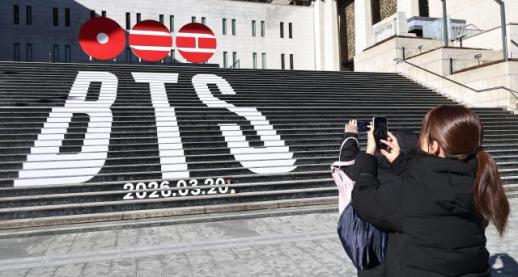 National Museum’s MU:DS to Expand Globally With New BTS Collaboration The National Museum’s merchandise brand MU:DS, which drew attention last year with an “open-run” rush for limited items, is preparing to push further into global markets on the back of a new collaboration with BTS. Attention is also on whether MU:DS can produce another hit following the popularity of its “magpie-and-tiger” badge. A “BTS MU:DS” line is currently in development, though details such as designs and a specific release date have not been disclosed. Industry watchers expect the products to be released around the timing of BTS’ comeback. The partnership is also expected to accelerate MU:DS’ overseas expansion. BTS are set to hold a festival blending tradition and modern culture on the 21st at Gwanghwamun Square and Gyeongbokgung Palace. The performance is scheduled to be livestreamed via Netflix to more than 190 countries and regions, a move seen as a major platform to publicize the group’s return. MU:DS’ approach of reinterpreting traditional cultural elements with a modern sensibility aligns with the stated intent of the Gwanghwamun event. With global fans awaiting a full-group comeback, some observers expect MU:DS to benefit from a so-called “BTSnomics” effect. MU:DS previously collaborated with BTS on a 2024 “Dalmajung” series, which drew attention at home and abroad with items inspired by national-treasure-level artifacts such as the pensive bodhisattva and a white porcelain moon jar. The brand’s wider recognition was also boosted after BTS leader RM disclosed that he owns a MU:DS miniature modeled on the National Treasure gilt-bronze pensive Maitreya bodhisattva, the article said. The latest collaboration is also viewed as a step toward a full-scale global rollout. The National Museum of Korea, the National Museum Foundation of Korea and HYBE signed a memorandum of understanding in October last year to cooperate on MU:DS’ overseas expansion and promotion using HYBE’s global distribution network. With BTS set to begin with the Gwanghwamun performance and continue through next year with “BTS World Tour Arirang” across 34 locations for a total of 82 shows, analysts say MU:DS could also raise its profile worldwide. At the signing, National Museum of Korea Director Yu Hong-jun said the partnership with HYBE would help “deliver the beauty of Korea’s cultural heritage to the world” by bringing tradition and modernity together and “further broaden the horizons of K-culture.” HYBE Chairman Bang Si-hyuk responded that the company would “do its best to share our cultural pride with the world, with all of HYBE’s infrastructure and sincerity.” MU:DS posted record annual sales last year of 41.3 billion won. Riding the popularity of “K-pop Demon Hunters,” the magpie-and-tiger badge sold about 90,000 units over the year and generated 1.3 billion won in sales, with strong demand across the product lineup. MU:DS has also promoted the value of Korean cultural heritage overseas. MU:DS items sold out within a week during an overseas touring exhibition of donations from the late Lee Kun-hee held at the Smithsonian’s National Museum of Asian Art in Washington. During the 2026 Milan-Cortina d’Ampezzo Winter Olympics, 19 popular MU:DS products — including the “pensive bodhisattva miniature Mind series,” the magpie-and-tiger badge and key rings — will be sold at Korea House in Italy. 2026-02-05 09:27:00
 -
 KAIST researchers create faster AI chip to speed up YouTube-style recommendations SEOUL, February 05 (AJP) - Researchers at the Korea Advanced Institute of Science and Technology have developed a new AI chip called AutoGNN that makes digital recommendation systems significantly faster and more energy-efficient. The technology speeds up the way computers analyze complex connections, such as those used to suggest videos on YouTube or detect credit card fraud. Professor Jung Myoung-soo and his team at the Korea Advanced Institute of Science and Technology (KAIST) School of Electrical Engineering solved a major technical problem that usually slows down artificial intelligence. Before an AI can make a recommendation, it has to organize a massive pile of messy data—a step called preprocessing. This preparation phase is so slow that it takes up nearly 90 percent of the total processing time, creating a digital bottleneck that even powerful Nvidia chips struggle to clear. The team created a semiconductor that acts like a shape-shifter. Unlike standard chips that have a fixed internal layout, AutoGNN changes its own internal circuitry in real time to match the specific shape of the data it is analyzing. It uses two specialized parts: one to pick out the right data and another to count and organize it instantly. In testing, this new technology was 2.1 times faster than high-end Nvidia graphics chips and 9 times faster than a standard computer processor. It also used 3.3 times less electricity, making it both faster and greener for large data centers. Because the chip adjusts itself automatically, it can handle different types of information without slowing down. This could lead to more accurate real-time results for social media apps, banking security systems, and even the development of new medicines. The research was presented on February 4 at the IEEE International Symposium on High-Performance Computer Architecture in Sydney, Australia. (Paper information) Journal: IEEE International Symposium on High-Performance Computer Architecture (HPCA 2026) Title: AutoGNN: End-to-End Hardware-Driven Graph Preprocessing for Enhanced GNN Performance DOI: https://bit.ly/4avvoRj 2026-02-05 09:24:54
 -
 K Car Holds 2025 Employee Awards, Highlighting Collaboration and Challenge K Car said Wednesday it held its “2025 Employee Awards” event a day earlier at the Paradise City hotel on Yeongjong Island in Incheon. The company said it honored employees who delivered standout results across business areas including sales, customer satisfaction and safety management, helping strengthen the organization’s competitiveness. Awards were also presented to teams and larger units, underscoring K Car’s emphasis on creating greater value through collaboration. The event included year-end and fourth-quarter awards. Categories included Proud K Car Person, Top Performance, Excellence in Safety and Health, Excellent CS Branch, Top Member and Top Leader, with prize money awarded alongside the honors. Lee Dong Min, who won the top vehicle purchasing award for the second straight year, said, “My know-how is to carefully inspect and purchase vehicles as if I were choosing my own car,” adding, “I feel very proud to be making a big contribution to the company’s performance.” Im Neung Seop, who received the top sales performance award, said he believed the recognition reflected his focus on trust with customers and doing his best in the field. CEO Jeong In Guk said he thanked employees for producing results despite a difficult business environment, and said K Car will continue to build a workplace where staff can take pride in their work and fully develop their capabilities while growing as a company that earns greater trust from customers.* This article has been translated by AI. 2026-02-05 09:21:00
 -
 Hyundai’s XCIENT hydrogen fuel cell trucks top 20 million kilometers in Europe Hyundai Motor Co. said Wednesday that its XCIENT Fuel Cell hydrogen-electric truck fleet in Europe has surpassed a cumulative 20 million kilometers (12.4 million miles) of driving. The XCIENT Fuel Cell began operating in Switzerland in October 2020 and has been developed in multiple specialized versions, including refrigerated and freezer vans, street sweepers, hook-lift container trucks and cranes. A total of 165 trucks are now running in five European countries: Switzerland, Germany, France, the Netherlands and Austria. In Germany, hydrogen-industry companies, including a commercial hydrogen-vehicle leasing specialist, have purchased about 110 hydrogen fuel cell trucks and are using them for logistics such as deliveries for supermarket chains, Hyundai said. In France, the trucks are also used for supermarket logistics and are deployed in Paris, Lyon, Pays de la Loire and Burgundy for specialized uses including street sweepers, hook-lift trucks and crane trucks. In Switzerland, the Netherlands and Austria, the trucks are used in logistics for food, beverages and industrial textiles, the company said. Hyundai said the trucks emit no carbon dioxide while driving, helping cut emissions. Under guidelines from the U.N. Intergovernmental Panel on Climate Change, the company said, operating hydrogen fuel cell trucks for 20 million kilometers would reduce carbon emissions by about 13,000 metric tons compared with diesel commercial trucks. Hyundai said that is equivalent to the amount of carbon absorbed annually by about 1.5 million pine trees. Hyundai said it plans to analyze data gathered during the 20 million kilometers of operation — including driving distance, hydrogen consumption and fuel cell performance — and apply the findings to future hydrogen fuel cell technologies. A Hyundai official said the XCIENT Fuel Cell, which started in Switzerland, is contributing to emissions reductions with partners in various fields, adding that the company will keep working to expand the hydrogen ecosystem and strengthen the role of hydrogen commercial vehicles as an eco-friendly mobility solution.* This article has been translated by AI. 2026-02-05 09:12:00
 -
 NOL Universe launches official merchandise for 2027 Chungcheong Universiade NOL Universe said Wednesday it has launched 18 types of official merchandise for the 2027 Chungcheong Universiade, including hooded sweatshirts, caps and key rings. The release follows an October agreement with the Chungcheong Universiade Organizing Committee on an official merchandising rights project. Under the deal, NOL Universe is responsible for developing, producing and selling souvenirs using the event’s intellectual property, including its logo, emblem and mascot. The items are available through the Chungcheong Universiade category on NOL MD shop, the company’s sports merchandise platform. To mark the launch, NOL Universe is offering discounts of up to 50% on related products until further notice. Separately, the organizing committee will run an Instagram event through March 5, offering prizes to customers who post proof of purchase of the newly released goods. Baek Sae Mi, head of NOL Universe’s entertainment business, said the company has released sports merchandise with teams and associations to help fans and athletes unite. She said the 2027 Chungcheong Universiade goods will help support people worldwide in cheering on the student-athlete festival. The 2027 Chungcheong Universiade is an international sports festival for university students. It will be held Aug. 1-12 next year across four provinces and cities in the Chungcheong region: Daejeon, Sejong, North Chungcheong and South Chungcheong. About 15,000 student-athletes from about 150 countries are expected to compete in 18 sports. * This article has been translated by AI. 2026-02-05 08:57:00
 -
 'A Man Living With the King' Tops South Korea Box Office With 117,792 on Opening Day The film 'A Man Living With the King' debuted at No. 1 at the box office on its opening day. According to the Korean Film Council's integrated ticketing network, the movie drew 117,792 admissions on its first day of release. Its cumulative total reached 147,547, putting it atop the overall box office. The film had held the top spot in advance ticket sales before release and moved straight to No. 1 upon opening. It also posted a 99% Egg Score shortly after release, continuing a run of positive audience response. Set in Cheongnyeongpo in 1457, the historical drama follows a village chief who volunteers to live in exile to revive his community and a young deposed king sent into exile. Jang Hang Jun directed, and Yoo Hae Jin and Park Ji Hoon star.* This article has been translated by AI. 2026-02-05 08:54:00
 -
South Korea striker Oh Hyeon-gyu joins Besiktas from Genk for 14 million euros South Korea national team striker Oh Hyeon-gyu has left Belgium’s Genk to join Turkey’s Besiktas. Besiktas announced the signing on its website on Feb. 5, Korea time. The club said the transfer fee was 14 million euros ($14 million), about 24.1 billion won. The deal runs through June 2029, a term of 3 1/2 years. Oh will wear No. 9, typically associated with a team’s starting center forward. Besiktas, based in Istanbul, are one of Turkey’s most successful clubs, with 16 Turkish Super Lig titles and 11 Turkish Cup trophies. This season, Besiktas are fifth in the 18-team league at 10-6-4 (36 points). Oh began his European career in January 2023, leaving Suwon Samsung in South Korea’s second-tier K League 2 to join Scottish powerhouse Celtic. Over a season and a half, he scored 12 goals in 47 appearances in all competitions and helped the club complete a domestic treble. He moved to Genk in the summer of 2024 and has 10 goals and three assists in 32 matches in all competitions this season, including the UEFA Europa League.* This article has been translated by AI. 2026-02-05 08:48:00
-
 Seochon March Spring Festival to Run March 12-31 at Credia Classic Club Studio The spring festival “2026 Seochon March” will open in March. Credia said Wednesday that Seochon March will run from March 12 to 31 at Credia Classic Club STUDIO under the theme “Seochon March.” The first movement, a live concert, will open with a chamber performance by eight principal players from the Dito Orchestra. It will be followed by the Kim Dae Ho Trio, performing improvised jazz rooted in the bebop tradition. This year’s lineup also includes a kids’ classical concert by Le Petit Ensemble, open to audiences from newborns, as well as stages by crossover artist Park Hyun Soo and pianist Park Jong Hae. The second movement, a lecture series titled “Seochon Pungnyu,” will begin with a talk by Jeon In Geon, director of the Kansong Art Museum, on flower-and-bird painting. It will also feature a lecture by Jeong Byeong Mo, head of the Korean Minhwa School, exploring minhwa through the character “Duffy” from the film “K-pop Demon Hunters,” and a humanities talk with classical columnist Yoo Yoon Jong on composer Gustav Mahler’s music and life, tied to Eulyoo Publishing’s “Masters of Modern Art” book series. The third movement, “Haegeum Seoga Talk Concert,” will be hosted by haegeum player and author Cheon Ji Yoon, with conversations featuring pansori master Ahn Yi Ho, Gyeonggi folk singer Lee Hee Moon and scientist Jeong Jae Seung. Credia Classic Club STUDIO, a small multiuse cultural space in Seochon, is about a five-minute walk from Gyeongbokgung Station. Organizers said the intimate venue allows close communication with performers and speakers. Tickets are available through NOL Ticket and the Club Balcony website. * This article has been translated by AI. 2026-02-05 08:45:00