
Journalist

AJP
-
 Special Prosecutor Says Kim Keon Hee Ruling Is Hard to Accept, Will Appeal Breaking: Special prosecutor says Kim Keon Hee first-trial ruling is hard to accept; will appeal* This article has been translated by AI. 2026-01-28 16:15:23
 -
 South Korea Secures Record 54,000 New-Build Rental Homes, Plans 44,000 Starts in Capital Area 정부가 지난해 역대 최대 규모의 신축매입약정을 체결하고 도심 주택공급에 속도를 낸다. The Ministry of Land, Infrastructure and Transport and the Korea Land and Housing Corp. (LH) said Tuesday they secured 54,000 homes through new-build purchase agreements last year, the largest total on record. The figure was up 128% from the previous year’s 41,955 homes and about six times the 9,253 recorded in 2023, the ministry said. About 48,000 of the homes were in the Seoul metropolitan area, including 15,000 in Seoul. Under the new-build purchase-lease program, LH buys privately built or planned homes after completion and supplies them as rental housing. Many are non-apartment units, including small apartment buildings and multi-family housing. Based on last year’s results, the ministry said it plans to start construction on more than 44,000 new-build purchase homes in the capital area this year, including 13,000 in Seoul. It said the plan is intended to keep on track with targets in the Sept. 7 housing supply expansion plan: 70,000 capital-area starts in 2026-2027 and a total of 140,000 by 2030. LH said it will recruit tenants this year for 11,000 purchase-lease homes in the capital area, including 3,000 in Seoul, and supply about 60% of them to young people and newlyweds. The ministry and LH said they will also strengthen quality control to provide higher-quality, tailored housing for newlyweds and young people. They also said they will conduct a full review of whether purchase prices under the program were appropriate, after President Lee Jae Myung last year criticized LH for buying newly built private homes at high prices for the purchase-lease program. The ministry said it will form an external expert-led review committee and complete the review by April. “Especially when the housing market is difficult, it is important for the public sector to send a clear supply signal backed by results,” Minister Kim said. “If last year was a year of preparation with record agreements, this year will be a year of execution through starts of more than 44,000 homes in the capital area and more than 13,000 in Seoul.” Cho Kyung-sook, LH’s acting president, said about 11,000 homes contracted in Seoul last year are in strong locations with proven infrastructure, including near transit hubs. She said LH will “take the lead in stabilizing the housing market” through strict quality control, phased starts and on-time supply.* This article has been translated by AI. 2026-01-28 16:15:00
 -
 Factory Fire in Siheung’s Geumi-dong Sends Up Thick Black Smoke A fire broke out in Geumi-dong in Siheung, Gyeonggi province. On Tuesday, the Siheung city government said in a disaster safety text alert, "A factory fire has occurred at 554-4, Geumi-dong, and a large amount of black smoke is being generated." It urged nearby drivers to detour and asked residents in the area to close their windows and take other safety precautions. * This article has been translated by AI. 2026-01-28 16:13:28
 -
 Samsung C&T Posts 29.6% Jump in Q4 Operating Profit to 822.2 Billion Won Samsung C&T said in a regulatory filing Tuesday that its fourth-quarter operating profit rose 29.6% from a year earlier to 822.2 billion won on a consolidated basis. Revenue increased 8.4% to 10.8324 trillion won. Net profit surged 137.6% to 1.5582 trillion won. For the full year, revenue totaled 40.7422 trillion won and operating profit was 3.2927 trillion won. Compared with the previous year, revenue fell 3.2% while operating profit rose 10.4%. Samsung C&T said it maintained solid results despite growing global uncertainty and shifts in the business environment, citing a diversified portfolio and competitiveness across its divisions. By business segment, the construction unit posted weaker results as large projects, including high-tech work, moved into completion stages. The trading unit lifted revenue by expanding sales despite the spread of protectionism, but operating profit edged down. The fashion unit saw a slight rise in revenue, but operating profit declined due to higher costs including marketing. The resort unit reported higher revenue on expanded food service and food-and-beverage distribution.* This article has been translated by AI. 2026-01-28 16:13:11
 -
 Hong Kong Signs Precious Metals Cooperation Deal With Shanghai Gold Exchange Hong Kong’s Financial Services and the Treasury Bureau said Jan. 26 that it signed a cooperation agreement on precious metals trading with mainland China’s Shanghai Gold Exchange at the Asian Financial Forum being held in Hong Kong. The agreement includes setting up a new company, the Hong Kong Precious Metals Central Clearing System, fully funded by the Hong Kong government. The Hong Kong Precious Metals Central Clearing System will be chaired by Financial Services and the Treasury Secretary Christopher Hui, with a Shanghai Gold Exchange representative serving as vice chair. A Hong Kong central clearing system specializing in gold trading, managed by the company, is expected to begin a pilot run within the year. The agreement also includes support to expand gold storage capacity at the Airport Authority Hong Kong and financial institutions. The goal is to increase capacity to more than 2,000 tons within three years. Hui said the Hong Kong government plans to submit a bill in the first half of this year to include precious metals among eligible investments for tax incentives for “single family offices,” including those set up for funds or a single wealthy family.* This article has been translated by AI. 2026-01-28 16:13:05
 -
 South Korea rejects Lotte Insurance turnaround plan, moves toward stricter corrective action South Korea’s financial regulators plan to step up prompt corrective action against Lotte Insurance to a management improvement demand after rejecting the insurer’s turnaround plan. The Financial Services Commission said it disapproved Lotte Insurance’s management improvement plan, submitted on Jan. 2, at a regular meeting on Tuesday. The FSC said the plan lacked specificity, feasibility and supporting grounds. After a prior-notice process, the company’s current management improvement recommendation is expected to be upgraded to a management improvement demand. Prompt corrective action has three levels: recommendation, demand and order. If a management improvement demand is imposed, regulators can require steps such as replacing executives, partially suspending insurance business, reducing staff and organization, limiting or disposing of risky assets, and restructuring subsidiaries. They can also restrict branch closures, mergers or openings, or require the company to draw up a sale plan. Measures that were previously only recommended — including raising capital, cutting business expenses, disposing of bad assets, restructuring staff and organization, limiting dividends — can also be required. After receiving a management improvement demand, Lotte Insurance must submit a revised plan within two months. If regulators also reject that plan, the action could be escalated to a management improvement order, the highest level. Industry observers said the rejected plan likely did not sufficiently address a capital increase sought by regulators. Lotte Insurance has said its ability to raise capital on its own is limited because any capital increase is decided by its largest shareholder, JKL Partners. If the corrective action is upgraded, Lotte Insurance may again pursue legal action. When it received a management improvement recommendation in November last year, it filed a lawsuit seeking to overturn the measure and also sought an injunction at the Seoul Administrative Court. The injunction request was denied. A financial regulator said authorities will “review necessary follow-up measures in accordance with laws and principles.”* This article has been translated by AI. 2026-01-28 16:12:43
 -
 Korea Sports Council Vows Zero Tolerance in Ski National Team Selection Probe The Korea Sports Council said it will take strict action under a zero-tolerance policy over allegations of match-fixing and unfairness in selecting national team athletes in skiing. The council said Tuesday that it is “actively cooperating” with an ongoing police investigation. It said that if authorities confirm match-fixing, improper interference in selections or conflicts of interest that undermined fairness, it will act “regardless of position, relationships or past practices,” applying a zero-tolerance standard. In the sports community, questions have been raised about whether an unsuitable person was involved with a Korea Ski Association committee during the selection process for the national team in snowboard cross. The council said it asked the Korea Ski Association last year to improve its system to ensure fair national team selections. It said it has prepared revisions to its “National Team Selection and Operations Regulations” to, in principle, exclude people with a stake in the outcome from the selection process. The proposed revisions are set to be reviewed and voted on at the council’s board meeting in February. The council said it revised its “Member Sport Organization Regulations” in November to establish a basis for its guidance and oversight of sport governing bodies. It said it is also checking for possible rules violations, management accountability and needed system improvements. The council said that since Yu took office, he has consistently emphasized that “fairness is not a choice but a core value of sports.” It said it will not tolerate any conduct that undermines fairness and principles, and will work to block room for privilege or cheating and restore trust in national team selections and overall competition operations. 2026-01-28 16:12:22
 -
 Lee Jun Hyuk Cast in SBS Occult Drama 'Awakening' as an Exorcist Priest Actor Lee Jun Hyuk has confirmed his casting in SBS’ new drama “Awakening.” SBS’ “Awakening,” written by Jang Yoon Mi and directed by Oh Jun Hyuk, is an occult drama set in an exam-driven high school that has become a playground for evil spirits. An exorcist priest fights to save students. SBS, which expanded interest in Korean-style occult dramas with its 2023 series “Revenant,” is developing the new project with a goal of airing it in 2027. Lee will play Antonio, a new head priest assigned to Holy Spirit High School. Though he stirs students’ curiosity and anxiety, Antonio is an exorcist priest ordained by the Vatican’s Dicastery for the Doctrine of the Faith. Behind his detached exterior, he is portrayed as perceptive and empathetic. The character has endured terrifying situations alone and repeatedly prevailed in battles with evil spirits. Dispatched to the school to investigate, Antonio confronts a series of strange incidents and vows to risk everything to track down whoever is pulling children into a deadly race. SBS’ “Awakening” is scheduled to air in 2027.* This article has been translated by AI. 2026-01-28 16:12:00
 -
 PHOTOS:Mobile game meets Korean traditional art SEOUL, January 28 (AJP) -Once confined to mobile screens, familiar characters step into the physical world — reimagined through brushstrokes, fabric and light. “CookieRun: Kingdom Art Collaboration Special Exhibition – Legacy of the Great Kingdom,” presented by Devsisters, brings the popular game’s universe into dialogue with Korean traditional crafts and interactive media art. The exhibition runs through April 12 at Ara Art Center in Insa-dong, Jongno-gu, Seoul. CookieRun: Kingdom is a mobile role-playing game built on a fantasy narrative in which cookie characters embody distinct values and histories within a shared world. At the core of its storyline are two contrasting groups: the Ancient Cookies, who represent ideals that have been preserved over time, and the Beast Cookies, who reflect those same values when they are distorted or taken to extremes. The exhibition draws on this narrative structure to explore broader questions about choice, direction and consequence. The exhibition features 10 works created by Korean master artisans, each inspired by characters from CookieRun: Kingdom. Traditional techniques such as mother-of-pearl inlay, buncheong ceramics, embroidery and hanji are combined with contemporary character imagery, allowing long-preserved craft traditions to expand into a modern visual language. Through this process, the CookieRun characters gain added narrative depth within a cultural context. Spanning six exhibition rooms from the first floor to the fourth basement level of the Ara Art Center, the show presents pairs of Ancient Cookies and Beast Cookies in each space. These pairings explore five core values—will, history, knowledge, happiness and solidarity. Rather than depicting a simple confrontation between good and evil, the exhibition emphasizes how the same value can take on entirely different meanings depending on how it is chosen and applied. Interactive media art created in collaboration with the artist collective Nerdy Artist Union expands the meaning of the craft works throughout the space. Visitors participate using NFC-enabled wristbands that activate responses of light, sound and imagery. In the final exhibition room, hands-on content allows visitors to see characters they have drawn move through a folk-painting-inspired digital landscape, completing the exhibition’s narrative. “Legacy of the Great Kingdom” presents a moment in which characters once limited to mobile platforms are reborn through traditional crafts and media art. At the intersection of past and present, game narrative and craftsmanship, the exhibition suggests new possibilities for both cultural heritage and the expansion of intellectual property. 2026-01-28 16:06:11
 -
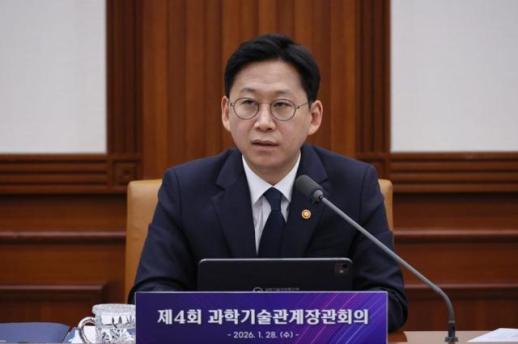 Trump' tariff threat has nothing to do with Coupang, Science and ICT minister says SEOUL, January 28 (AJP) - U.S. President Donald Trump's post on social media earlier this week about raising tariffs on South Korea has nothing to do with regulating big-tech companies including disputes over e-commerce giant Coupang, Science and ICT Minister Bae Kyung-hoon said on Wednesday. Shortly after Trump's abrupt threat on Monday, it was revealed that Seoul had received a letter from the U.S. about two weeks ago raising concerns over South Korea's push to regulate digital platforms. When asked by reporters about the letter he received from acting U.S. Ambassador to Seoul James Heller on Jan. 13, Bae dismissed any link to tariffs. "The letter simply requested that South Korea approach the matter of regulating digital platforms in a more reciprocal way," he said. Trump threatened to raise reciprocal tariffs on Seoul from 15 percent back to 25 percent, citing delays in the implementation of a bilateral agreement reached by the two countries in late October last year, only to soften his stance a day later, saying he would "work something out with South Korea." Some have speculated that disputes over Coupang prompted Trump's tariff threat, after several U.S. lawmakers raised concerns over "discriminatory measures" against Coupang in South Korea's investigation into a massive data leak detected late last year. In a related development, the Wall Street Journal reported on Tuesday that U.S. Vice President JD Vance, during his meeting with South Korean Prime Minister Kim Min-seok in Washington, D.C., warned South Korea "not to target tech companies with discriminatory regulations and investigations, in the latest U.S. effort to protect American internet platforms as it threatens higher tariffs on the country." But Bae said the matter is "completely unrelated" to the tariff issue. He said South Korea has been in discussions with the U.S. through multiple channels on issues related to online platforms and artificial intelligence-related laws and regulations. Deputy Prime Minister and Minister of Economy and Finance Koo Yun-cheol also said, "The government is looking into Trump's latest threat through various channels to figure out the intentions behind it." 2026-01-28 15:59:29