
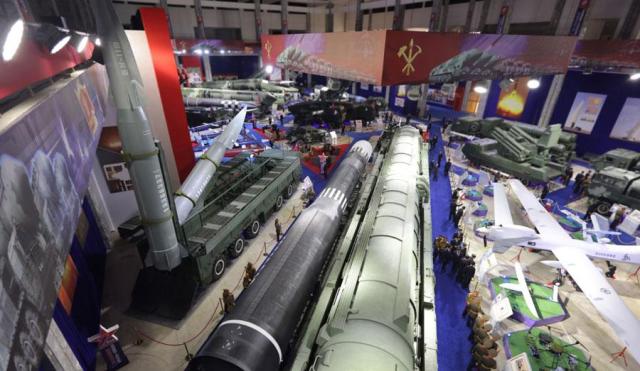
The Joint Chiefs of Staff (JCS) said it detected the missiles around 8:10 a.m., which were launched from an area south of Pyongyang.
They flew about 350 kilometers and likely landed in North Hamgyong Province, rather than in the East Sea as the JCS initially speculated.
Wednesday's launch, the North's first missile provocation since President Lee Jae Myung took office in June, came about five months after the reclusive country fired a couple of short-range ballistic and cruise missiles in May.
The launch also comes ahead of the Asia-Pacific Economic Cooperation (APEC) summit scheduled to be held in Gyeongju next week.
Shortly after the North's fresh missile provocation, an emergency meeting was convened with diplomatic and security officials here to discuss measures.
In a statement issued after the meeting, officials said, "The government is closely monitoring the situation to implement necessary measures while maintaining military readiness to respond to any further provocations."
Copyright ⓒ Aju Press All rights reserved.
Related News
-
 Pyongyang's new ICBM blends technical ambition with political theater
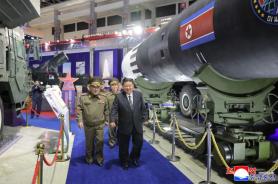
This photo, released by North Korea’s state-run Korean Central News Agency on Oct. 5, shows an intercontinental ballistic missile (ICBM) displayed at the “Defense Development 2025” weapons exhibition in Pyongyang. Analysts say the missile, showcased on Oct. 4, is believed to be the newly unveiled Hwasong-20. Yonhap SEOUL, October 13 (AJP) - North Korea unveiled a new intercontinental ballistic missile (ICBM), the Hwasong-20, during a military parade in Pyongyang last Friday, underscoring its continued drive to advance long-range missile capabilities—possibly with Russian assistance—and to strengthen its leverage ahead of any potential resumption of dialogue with the United States. The Oct. 10 parade, marking the 80th anniversary of the founding of the Workers' Party of Korea, showcased North Korea's latest strategic weapons, including new hypersonic and cruise missiles. Senior officials from China, Russia, and Vietnam attended as VIPs, highlighting Pyongyang's bid to demonstrate solidarity within the emerging "neo-Cold War" axis. The Hwasong-20 is believed to be an upgraded solid-fuel ICBM featuring a high-thrust engine and a carbon-fiber composite motor casing. North Korea claims the new engine can generate up to 1,971 kilonewtons of thrust—roughly enough to lift 200 tons. Unlike traditional solid-fuel engines that rely on heavy metal casings, the use of a carbon-fiber composite shell reduces weight, allows for larger propellant capacity, and boosts thrust efficiency—critical advantages for long-range missile performance. Graphics by AJP Song Ji-yoon Visually, the missile's diameter appears slightly larger than its predecessor, the Hwasong-19, and its rounder nose suggests room for additional re-entry vehicles—detachable warheads capable of targeting multiple locations, an essential feature of modern ICBMs. The 11-axle transporter erector launcher (TEL) appears unchanged, and analysts estimate the Hwasong-20 could have a theoretical range of up to 15,000 kilometers, enough to strike the U.S. mainland. "Overall, the Hwasong-20 looks almost identical to the Hwasong-19, using the same TEL," said Shin Seung-ki, research fellow at the Korea Institute for Defense Analyses (KIDA). "The missile's nose appears slightly rounder, which may allow it to carry more re-entry vehicles—perhaps six to eight compared with four or five on the Hwasong-19." Shin added that Russian technical support or materials may have contributed to the upgrade, citing the deepening military cooperation between Pyongyang and Moscow. Despite the apparent sophistication, experts remain cautious about the missile's actual capabilities. The Hwasong-20 has so far undergone only ground testing and has not yet been flight-tested, leaving its real-world performance unproven. South Korea's Unification Ministry noted that while Kim Jong-un avoided direct mention of the U.S. or South Korea in his speech, the display itself carried a clear strategic signal. "From North Korea's perspective, unveiling this type of strategic weapon itself carries a message to South Korea and the U.S.," ministry spokesperson Koo Byung-sam said Monday in Seoul. Analysts see the parade as Pyongyang's latest effort to position itself as a de facto nuclear power on par with Russia and China. "North Korea's message is clear," said Yang Uk, research fellow at the Asan Institute for Policy Studies. "Pyongyang is signaling that it can strike the U.S., that it sees itself standing shoulder to shoulder with Russia and China, and that no one should expect it to give up its nuclear weapons."
-
 Pyongyang unveils new weapons, warns Seoul and Washington at military exhibition
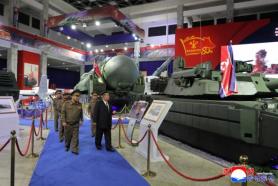
North Korean leader Kim Jong-un inspects weapons on display at the Defence Development-2025 military exhibition in Pyongyang on October 4. KCNA/Yonhap SEOUL, October 05 (AJP) - North Korean leader Kim Jong-un said his country will continue to strengthen its military capabilities to counter what he called growing threats from the United States and South Korea, as he opened a major military hardware exhibition in Pyongyang showcasing new missile systems, including what appears to be a hypersonic variant of the KN-23. The exhibition, titled "Defence Development-2025," opened in the North Korean capital on October 4 to mark the upcoming 80th anniversary of the Workers' Party of Korea. In a speech carried by the state-run Korean Central News Agency (KCNA) on October 5, Kim said the event offered a visual display of the country's "general level attained by our defence capabilities," describing its nuclear deterrent as the "backbone" of national security. "This exhibition features the recent results of the important projects that we have pressed on with in order to put the structure of the DPRK’s military capabilities, with its nuclear deterrent as the backbone, on an increasingly modern, advanced footing," Kim said. He thanked scientists and technicians in the munitions industry, saying their work "constitutes the highest praise for our Party’s 80-year-long history." Kim said North Korea’s defense sector had reached a level "much higher than the founder generation of the Juche-oriented defense industry hoped to reach," and warned that the country could not afford to ease its pace of weapons development. "The moment we feel complacency leads to the beginning of our advance getting sluggish," he said. "The U.S.–ROK nuclear alliance is making rapid progress... and the United States is taking measures for expanding the stockpile of its military assets in and around the ROK, posing a real and serious threat to the security of our country and others in the region." He accused Washington of upgrading its reconnaissance and strike capabilities to make "preemptive strikes" easier and said Pyongyang had "assigned special assets to the major targets of our concern" in proportion to the U.S. buildup in South Korea. "They themselves should have to judge whether the territory of the ROK would be a safe place in any case," Kim warned. North Korean leader Kim Jong-un inspects weapons on display at the Defence Development-2025 military exhibition in Pyongyang on October 4. KCNA/Yonhap Photos released by KCNA showed new missile systems on display, including one labeled "Hwasong-11 Ma." Analysts in Seoul identified it as a new version of the KN-23, a short-range ballistic missile often referred to as the North Korean version of Russia’s Iskander. According to Yonhap News Agency, the Hwasong-11 Ma appears to carry a hypersonic glide vehicle (HGV) warhead, a design that would allow the missile to fly at speeds above Mach 5 while maneuvering at low altitude to evade interception. The KN-23 has been among North Korea’s most frequently tested missiles, with versions launched from road vehicles, railcars, and even submarines. It is estimated to have a range exceeding 800 kilometers (around 500 miles), allowing it to strike targets anywhere in South Korea. During his speech, Kim also suggested that new strategic goals would soon be announced for North Korea’s defense industry. "Our powerful assets for national defence capability will develop more rapidly without a moment of delay," he said. "Everyone will soon know the new goals to be set forth for the defence technology sector and the aspect of its development at the next stage." KCNA said the exhibition featured "ultra-modern weapon systems developed into the pivotal military hardware of our armed forces," describing the venue as "full of the latest defence assets, an ensemble of the Juche-oriented defence sci-tech strength." Senior officials, military commanders, and defense scientists attended the opening ceremony, where Kim reviewed a guard of honor before touring the exhibition hall.
-
 North Korea unveils new ICBM at late-night military parade
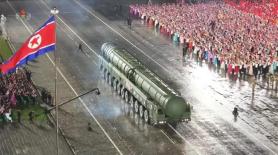
North Korea's new Hwasong-20 intercontinental ballistic missile is displayed at a military parade in Pyongyang on Oct. 10, 2025, in this photo released by the state-run Korean Central News Agency the following day. In a speech at the parade, Kim Jong-un said his military "should continue to grow into an invincible entity that destroys all threats," without directly mentioning the U.S. or South Korea. Other weapons on display included short-range ballistic missiles, cruise missiles, howitzers, and battle tanks, as well as hypersonic missiles, which North Korea has previously claimed are capable of striking targets in the South. The unveiling of the Hwasong-20 follows North Korea's announcement last month of a successful test of a new high-thrust solid-fuel engine, which KCNA said was the ninth and final test in the development of "next-generation" ICBMs. The engine reportedly has a maximum thrust of 1,971 kilonewtons, indicating progress toward developing a missile capable of carrying multiple warheads.