As birthrates collapse and the number of available conscripts shrinks, the question facing militaries such as South Korea's is no longer whether machines will join the ranks, but how much work they can take off human soldiers.
For now, that does not mean robotic infantry charging across a battlefield.
The more immediate possibility is less dramatic but potentially more useful: humanoid machines taking over repetitive, dangerous and physically demanding jobs aboard ships, inside bases or near frontline positions, freeing increasingly scarce soldiers for tasks that still require human judgment.
South Korea offers one of the clearest test cases.
Its active-duty military shrank by roughly a fifth between 2019 and 2025 to about 450,000 personnel as the population of military-age men contracted. The Defense Ministry says the number of men eligible for military service fell to 257,000 in 2022 from 332,000 just three years earlier.
The demographic arithmetic is now forcing changes to a conscription system that has underpinned South Korean defense for more than seven decades.
Able-bodied men remain subject to compulsory service, with Army conscripts generally serving 18 months. But the government is exploring a more selective system combining traditional conscription with longer-term service by technically skilled personnel, while seeking greater use of drones, robots and other unmanned systems.
That is where humanoids have an unusual advantage over other machines.
Warships, military vehicles, barracks and much of the equipment inside them were built around the human body. Doors have handles. Ships have ladders, switches and steering wheels. Maintenance crews use hand tools. Soldiers climb stairs, carry boxes, plug in cables and operate equipment designed for fingers and arms.
South Korea's Navy put that idea to the test in July.
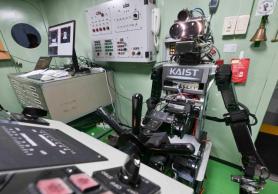
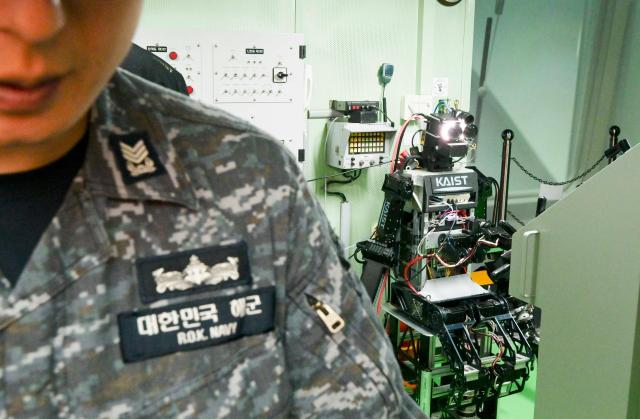
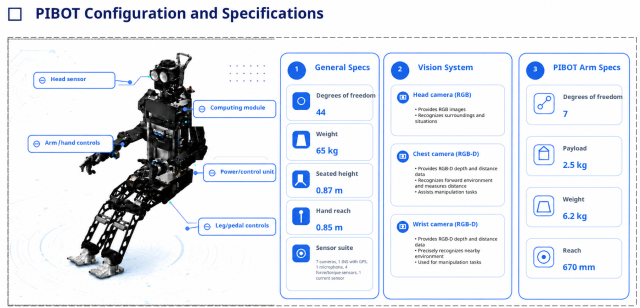
At the Naval Education and Training Command in Changwon, South Gyeongsang Province, a humanoid robot called PIBOT took the helm during the Navy's first combat experiment involving a robotic crew member.
Developed by a Korea Advanced Institute of Science and Technology team, PIBOT was placed at a ship-handling simulator and asked to perform the work of an enlisted helmsman.
When an officer issued a steering command, the robot repeated the instruction, turned the wheel and reported completion, following the same read-back procedure used by human sailors.
It successfully carried out steering orders under simulated conditions including narrow waters, nighttime operation and bad weather.
A large language model helped PIBOT interpret ship-handling procedures and spoken commands.
More importantly, the experiment required no redesign of the existing controls for the robot.
That small detail points to the broader attraction of humanoids: instead of building a special unmanned ship around a robot, the military could eventually put a human-shaped machine into a space already built for sailors.
The Navy said the experiment was intended to identify duties that could be handed to robots and reduce sailors' workloads as part of its manned-unmanned "Navy Sea GHOST" concept.
It remains a long way from replacing a sailor.
A 2025 study by researchers at Korea National Defense University assessed South Korea's humanoid technology as still being at an early stage, largely capable of structured industrial work or walking demonstrations in controlled environments.
The machines have yet to demonstrate the rough-terrain mobility and ability to perform complex, unstructured missions required in military operations, the researchers said.
The study nevertheless identified humanoids as potentially useful for reconnaissance, logistics, hazardous-material handling and other high-risk missions in which human forces could be supplemented rather than replaced.
South Korea's Agency for Defense Development is also working on the country's first bipedal military humanoid, with a prototype targeted for 2027.
The biggest obstacles are increasingly apparent.
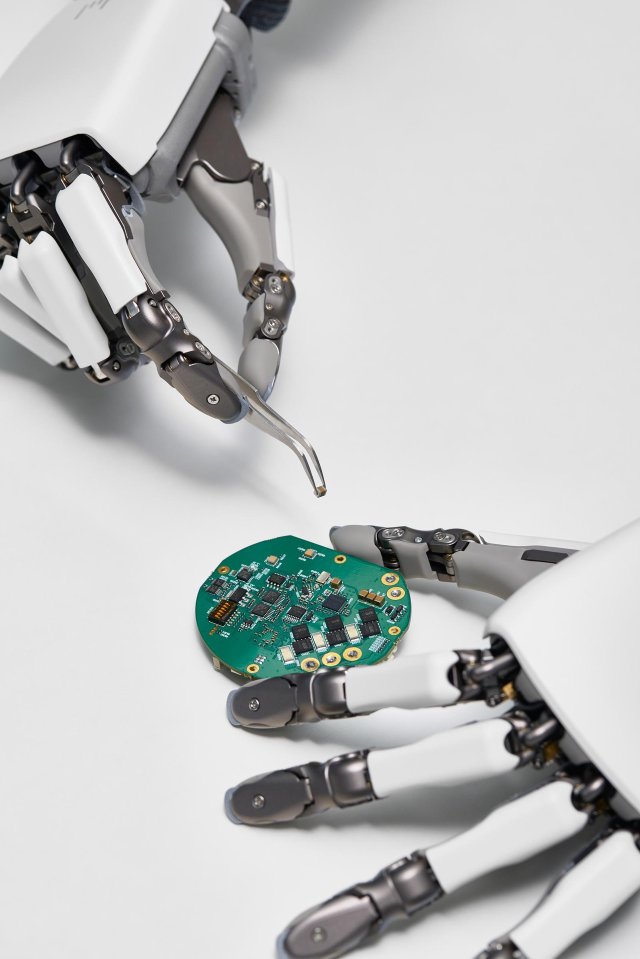
The human hand contains more than 25 bones and more than 30 joints connected through muscles and tendons capable of making minute adjustments almost without conscious thought, according to a Hyundai Motor Securities report on humanoid robot hands.
Trying to reproduce those movements mechanically requires dozens of actuators, adding size, weight and cost.
High-end robotic hands alone can cost tens of millions of won.
Then comes control.
A person can pick up an egg gently and immediately grip a heavy tool more firmly. A robot must calculate how each joint moves and how much force it should apply while continuously processing information from its sensors.
Touch presents another gap.
Human hands contain thousands of receptors capable of detecting pressure, texture and temperature and feeding that information almost instantly to the nervous system.
Robotic hands operate with far fewer tactile sensors and still lag humans in processing speed and precision.
That helps explain why many humanoid developers continue to use simple two- or three-finger grippers rather than fully articulated five-finger hands.
For a factory robot performing the same motion thousands of times, that limitation may be manageable.
For a military robot, it becomes much harder.
A soldier may need to open a hatch, pull a cable, pick up a tool, turn a valve, move ammunition and then climb into a vehicle — tasks requiring different combinations of strength, touch and dexterity within minutes.
"The key will be whether companies can develop robotic hands with sufficient degrees of freedom while sharply reducing costs," said Park Jun-young, an analyst at Hyundai Motor Securities.
The problem helps explain why humanoid soldiers remain more science fiction than battlefield reality.
Yet South Korea may not need robots capable of doing everything a soldier does for them to become valuable.
Replacing a sailor at the helm for several hours, carrying supplies through a base, inspecting a hazardous area or conducting routine surveillance could remove individual jobs from units already struggling for personnel.
And the manpower pressure is unlikely to disappear.
Public opinion suggests Koreans still recognize the need for national service. An Ipsos survey conducted in late 2025 found 68 percent of South Korean respondents supported mandatory military service for young people, compared with a 30-country average of 52 percent. Some 62 percent said they would be willing to join formal preparation or training in case of foreign invasion.
But support for the existing model has long been less clear-cut. A Gallup Korea survey in 2021 found 42 percent favored retaining conscription and 43 percent supported an all-volunteer military. On whether women should also be drafted, opinion was almost evenly divided, with 47 percent favoring male-only conscription and 46 percent supporting conscription of both sexes.
Technology offers another route.
South Korea's military reform plans increasingly envisage soldiers working alongside drones and robots rather than trying to maintain manpower solely by widening the draft.
The Korea National Defense University researchers said humanoid technology remains short of what is required for immediate battlefield deployment and warned that technological uncertainty makes it difficult even to define military requirements before systems are tested in the field.
That makes PIBOT important less as a glimpse of a robot army than as a demonstration of something more practical.
A machine performed one job previously assigned to one sailor, using a workspace and controls designed for a human.
Multiply that across ships, bases, logistics units and hazardous duties, and humanoids could begin to ease the demographic squeeze without ever becoming autonomous soldiers.
For conscription-based militaries confronting a shrinking generation, that may be enough to make robots a lifeline.
AJP Takeaways
△ South Korea is turning to humanoid robots as its pool of military-age men shrinks and pressure grows on its conscription-based armed forces.
△ The near-term goal is not to replace soldiers, but to assign robots repetitive, hazardous and manpower-intensive duties aboard ships, bases and frontline facilities.
△ The Navy’s PIBOT test showed a humanoid can operate human-designed military controls without requiring major changes to existing equipment.
△ Dexterous hands, tactile sensing, mobility and cost remain major barriers to wider military deployment.
△ For Korea, humanoid robots are more likely to become force multipliers than autonomous soldiers, helping stretch a shrinking military workforce.

Copyright ⓒ Aju Press All rights reserved.