
Journalist

AJP
-
 Asian equities end first full week of 2026 strong as Korean defense stocks surge SEOUL, January 09 (AJP) - Asian equities finished strong on Friday, with South Korean stocks extending gains as defense shares surged on expectations of increased military spending following remarks by Donald Trump. In Seoul, the benchmark KOSPI rose 0.8 percent to close at 4,586.3, supported by sharp rallies in defense-related stocks. The tech-heavy KOSDAQ also finished higher, gaining 0.4 percent to 947.9. Defense stocks led the market after Trump outlined plans to significantly raise U.S. defense spending, fueling optimism over stronger global demand for military equipment. Hanwha Systems surged 27.5 percent to 76,900 won ($52.7), while Hanwha Aerospace climbed 11.4 percent to 1,214,000 won, marking some of the strongest performances on the main board. The rally followed a strong rebound in U.S. defense stocks overnight after Trump’s remarks. Shares of major U.S. contractors, including Lockheed Martin, RTX and General Dynamics, rose in New York trading on expectations of larger government contracts, a move that carried over into Asian markets and supported buying in Korean defense shares. Automakers also posted solid gains. Hyundai Motor jumped 7.5 percent to 366,000 won, while Kia rose 6.7 percent to 133,200 won, as investors continued to favor globally competitive exporters. Among heavyweight technology shares, Samsung Electronics edged up 0.1 percent to 139,000 won, while SK Hynix fell 1.6 percent to 744,000 won, underperforming the broader market amid profit-taking. Entertainment stocks weakened amid lingering uncertainty over overseas content demand. YG Entertainment slipped 1.5 percent to 67,200 won, SM Entertainment fell 2.7 percent to 114,700 won, Hybe declined 1.34 percent to 331,000 won, and JYP Entertainment dropped 2.4 percent to 69,800 won. The Korean won weakened against the U.S. dollar, closing at 1,458.7 per dollar, tracking broader dollar strength in regional markets. Elsewhere in Asia, Japan’s Nikkei 225 rose 1.61 percent to 51,939.9, while China’s Shanghai Composite Index advanced 0.9 percent to 4,120.4, as regional sentiment improved. 2026-01-09 17:13:43
 -
 Over 150,000 KT subscribers switch to other mobile carriers SEOUL, January 9 (AJP) - More than 150,000 subscribers of telecom company KT have switched to different mobile service providers, industry sources said on Friday. The massive exodus comes after the country's second-largest mobile carrier began waiving early termination fees following a major data breach detected in September last year. Of some 154,851 users who left KT from Dec. 31 to early this week, 15,701 or 64.7 percent switched to SK Telecom. Another 5,027 joined LG Uplus, while 3,524 moved to budget providers. As part of its compensation package following the breach, KT is allowing subscribers to terminate their contracts without penalties until next Tuesday. Rival SK Telecom offered a similar program after a major data leak last summer, which led about 166,000 subscribers to leave in about 10 days. 2026-01-09 17:06:21
 -
 S. Korea's airline passengers hit record high last year on strong short-haul demand SEOUL, January 09 (AJP) - The number of airline passengers traveling through South Korea's airports reached an all-time high last year, boosted by a surge in short-haul international routes, particularly to Japan and China. According to aviation statistics released Friday by the Ministry of Land, Infrastructure and Transport and the Korea Civil Aviation Association, the combined number of domestic and international air passengers totaled 124.79 million last year, up 3.9 percent from 120.06 million a year earlier. The figure surpassed the previous record set in 2019, before the COVID-19 pandemic, when passenger traffic stood at 122.36 million, by about 1.2 percent. Domestic air travel declined 2.8 percent on the year to 30.25 million passengers, while international traffic rose 6.3 percent to a record 94.55 million, offsetting the domestic downturn. By region, Japan-bound routes carried 27.31 million passengers, an 8.6 percent increase from the previous year and a sharp 44.8 percent jump compared with 2019 levels. Analysts attribute the rise to the prolonged weak yen and an expansion of routes, including services to smaller regional cities. Passenger numbers on China routes climbed 22 percent to 16.8 million, recovering to 91.2 percent of pre-pandemic levels. The rebound was supported by China's visa-free entry policy for South Korean travelers, the resumption of visa-free entry for Chinese group tourists to South Korea from late September, and aggressive low-fare strategies by Chinese airlines. As traffic concentrated on Japan and China, routes to other Asian destinations, including Southeast Asia, edged down 0.5 percent year on year to 34.82 million passengers, or 95.6 percent of 2019 levels. Transpacific routes to the Americas recorded 6.82 million passengers, up 4.7 percent, while European routes carried 4.85 million, a 5.5 percent increase. International passenger numbers rose overall across the industry, but airline performance varied widely. Among low-cost carriers, Jeju Air saw the steepest decline, with passenger numbers falling 9 percent to 7.78 million. Air Busan carried 4.16 million passengers, down 7.4 percent, while Air Seoul posted an 8.4 percent drop to 1.68 million. In contrast, airlines that expanded seat capacity recorded sharp gains. Aero K saw passenger numbers surge 75.4 percent to 1.5 million, while Eastar Jet carried 3.07 million passengers, up 59.7 percent. Air Premia also posted strong growth, with 1.08 million passengers, a 42.3 percent increase. T’way Air transported 7.06 million passengers, up 7.3 percent, while Jin Air carried 6.67 million, a 2.2 percent rise. Parata Air, a new entrant that launched international services in November, recorded about 71,000 passengers. Among full-service carriers (FSC), Korean Air carried 19.14 million international passengers, an 8.2 percent increase, while Asiana Airlines transported 12.15 million, up 1.3 percent. Industry officials said safety concerns following recent aviation incidents prompted some passengers to shift demand toward full-service carriers from early last year. 2026-01-09 16:40:19
 -
 In AI-driven infrastructure, the scale of memory demand is unfathomable SEOUL, January 09 (AJP) - The memory cycle shaping today’s intelligence-driven computing is being defined less by consumer gadgets than by infrastructure — a shift underscored by the latest performance of industry leader Samsung Electronics. The South Korean tech giant reported operating profit of 20.0 trillion won ($14 billion) for the October–December quarter, more than tripling from a year earlier and marking its strongest three-month result on record. Revenue rose 22.7 percent to 93.0 trillion won, according to preliminary earnings released Thursday. While the numbers recall the last memory supercycle in 2018, the forces behind the current upswing are fundamentally different. The center of gravity in memory demand had already shifted from smartphones and PCs to data centers in the late 2010s. Artificial intelligence has now accelerated that transition — not only in scale, but in intensity. “The industry’s growth engine moved from smartphones and PCs to data centers after 2017,” said Ahn Ki-hyun, secretary general of the Korea Semiconductor Industry Association. “What is different now is that AI is no longer just a corporate tool. As individuals increasingly use AI services, demand for GPUs and memory is expanding on an entirely new scale.” From cloud cycle to AI-driven expansion According to TrendForce and Counterpoint Research, average selling prices for DRAM jumped 45–50 percent in the fourth quarter, while NAND prices rose more than 30 percent, as chipmakers shifted capacity toward high-margin AI memory such as high-bandwidth memory (HBM) and DDR5. At Samsung, the device solutions (DS) division is estimated to have generated about 16–17 trillion won in operating profit during the quarter, with HBM shipments to AI server customers emerging as the primary growth engine. The demand shift is also visible in how memory consumption is structured. Data from World Semiconductor Trade Statistics (WSTS) show that data centers now account for more than half of global memory demand, up sharply from roughly a quarter during the previous supercycle — effectively turning cloud service providers into the industry’s largest customers. HBM, once a niche product used mainly in graphics and specialized computing, has become a central profit driver. TrendForce estimates that HBM’s share of total DRAM revenue has climbed from less than 5 percent in 2022 to more than 30 percent in 2025, even though its shipment volume remains far smaller than conventional memory — a reflection of its premium pricing and strategic importance in AI servers. Ripple effects across the memory market The pivot toward AI memory is reshaping the broader market as well. As manufacturers prioritize HBM and DDR5, output of legacy products such as DDR4 has tightened sharply, triggering a rare price surge of more than 30 percent for DDR4 in late 2025 — an unusual development in a segment long regarded as commoditized. “The rise of AI is changing the structure of the memory industry,” Ahn said. “Today, it is not just enterprises but individuals using AI services that are driving demand for GPUs, and that directly translates into higher demand for advanced memory.” Behind the surge is an unprecedented wave of capital spending by global technology firms. Amazon, Microsoft, Alphabet and Meta together are expected to invest well over $300 billion this year in data centers, custom chips and AI infrastructure, cementing cloud providers — and increasingly AI service platforms — as the new center of gravity in the semiconductor cycle. Industry researchers estimate that AI server shipments are growing at a compound annual rate of more than 20 percent, while power consumption at data centers is projected to rise nearly 175 percent by 2030 from 2023 levels — a signal that memory demand is likely to remain structurally elevated. A longer cycle for memory makers For Samsung, the shift reinforces a broader strategic realignment. The company is repositioning its memory business away from the short swings of consumer-electronics cycles and toward a role as a core enabler of AI infrastructure, betting that the combination of HBM, advanced packaging and foundry capabilities will anchor earnings even as traditional device markets remain volatile. As the memory industry moves deeper into the AI era, analysts increasingly view the current upcycle not as a short-lived rebound but as the beginning of a longer structural phase — one in which data centers and AI workloads, not smartphones, set the pace of global semiconductor demand. 2026-01-09 16:32:15
 -
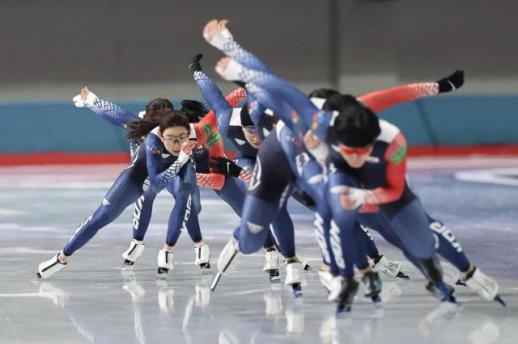 Korean skaters prepare for Milano Cortina 2026 Winter Olympics SEOUL, January 09 (AJP) - 2026-01-09 16:14:27
 -
 South Korea targets 2% growth, betting on boosted private consumption SEOUL, January 9 (AJP) - South Korea's economy is forecast to grow 2 percent this year, on the back of rising consumer spending and a recovery in construction investment following a prolonged slump, the government projected at a televised meeting of economic officials at the government complex in central Seoul on Friday It also pledged to make this year the starting point for an "economic leap" and to draw up a master plan for spurring growth and narrowing economic gaps. To achieve these goals, the government plans to roll out action plans by the first half of the year, setting growth targets through 2045, the 100th anniversary of the country's liberation from Japanese colonial rule and establishing a long-term vision to address mid- to long-term objectives. The 2-percent target is higher than the roughly 1.8 percent forecasts recently presented by major institutions such as the Korea Development Institute and the Bank of Korea. With external uncertainties and structural constraints weighing on the economy, the government's target appears ambitious. The government said domestic demand will be this year's main growth engine, projecting that private consumption, which grew 1.3 percent last year, will rise 1.7 percent in 2026, supported by improved consumer sentiment, policy measures, favorable employment conditions, and households' stronger purchasing power. Investment in construction is expected to rebound 2.4 percent this year after falling 9.5 percent in 2023. The government said the shift after a prolonged downturn should help boost the economy and domestic demand, though it expressed concern that unsold homes outside the capital and other provincial areas could limit the recovery. Exports are projected to rise 4.2 percent this year, supported by strong semiconductor demand, despite concerns that global trade could slow as the effects of U.S. tariffs intensify. Vice Minister Lee Hyeong-il said, "In recent forecasts, the growth rate of semiconductor sales has risen to 40 to 70 percent," adding that this increase is reflected in this year's outlook. The government forecast the current account surplus will widen to US$135 billion this year from $118 billion last year. It projected inflation will rise 2.1 percent, unchanged from last year, citing factors including lower international oil prices. Facility investment is also expected to rise 2.1 percent, driven by technology sectors including memory chips. With competition intensifying in advanced industries such as artificial intelligence (AI), the government projected a 3.3 percent increase in investment in intellectual property, driven by higher spending on research and development (R&D). But the job market is expected to slow due to structural factors such as a shrinking working-age population and an aging society. The government projected that the number of employed people will increase by 160,000 this year, about 30,000 fewer than last year. To meet its growth target, the government emphasized an expansionary fiscal stance, increasing total spending by 8.1 percent, the highest in four years. It also raised planned investment by public institutions by 4.3 trillion won, bringing the total to 70.5 trillion won. Based on this, the government plans to allocate 633.8 trillion won to support advanced strategic industries and small- and medium-sized businesses. To boost domestic demand, tax incentives for passenger cars will be extended until June, along with a 1 million won subsidy for those purchasing electric vehicles and other eco-friendly cars. More promotional and sales campaigns to support small business owners will also be organized to stimulate consumption. To spur corporate investment, the government will provide 54.4 trillion won in facility investment, while also encouraging foreign-invested companies to shift towards domestic R&D investment. While risks such as foreign exchange volatility, real estate market instability, household debt, and structural challenges remain, the government pledged to manage external risks and enhance the quality and sustainability of growth. "While focusing on economic recovery last year, we achieved visible results including strengthening growth momentum and the KOSPI surpassing 4,000 points," Lee said. "Based on these results, we will make an all-out effort for a major economic leap this year." 2026-01-09 16:14:21
 -
 CES 2026 : Boston Dynamics' Atlas wins CNET's top robot honor at CES 2026 SEOUL, January 09 (AJP) - Hyundai Motor Group said Thursday that Atlas, a humanoid robot developed by its robotics company Boston Dynamics, won CNET’s Best Robot award in the Best of CES 2026 honors. Atlas is central to Hyundai Motor Group’s AI robotics strategy unveiled in Las Vegas. The next-generation, electric Atlas development model, shown for the first time at CES 2026, was designed for high efficiency in real manufacturing settings, with autonomous learning and flexibility to handle varied work environments, the group said. CNET cited Atlas’ natural, humanlike walking ability and refined design in naming it Best Robot at CES 2026. The outlet said the robot supports the group’s vision of human-centered AI robotics through next-generation machines built to collaborate with people. “Atlas was easily the best of the many humanoid robots we saw at CES 2026,” CNET said. “The prototype demonstrated on the show floor left a strong impression with its natural gait, and the product version, closer to mass production, has completed preparations to be deployed at Hyundai Motor Group manufacturing plants starting this year.” Hyundai Motor Group plans to deploy Atlas first in 2028 at Hyundai Motor Group Metaplant America, or HMGMA, in Savannah, Georgia. It will begin with processes where safety and quality gains have been verified, such as parts sequencing, and then expand use in stages. By 2030, the group plans to broaden Atlas’ role to various parts-assembly processes and more complex work, including repetitive tasks and handling heavy loads, to improve worker safety and accelerate smart-factory innovation. After performance verification, it plans to expand deployment across the group’s global production sites. Developed for industrial use, Atlas is a general-purpose humanoid robot designed to integrate smoothly with existing factory equipment. It can lift up to 50 kilograms (110 pounds) and perform delicate tasks, and it is designed to be waterproof and washable for easier maintenance. The robot is built to operate reliably from minus 20 degrees Celsius to 40 degrees Celsius (minus 4 to 104 degrees Fahrenheit). It also includes advanced rotary joints and sensors for autonomous movement and work in complex industrial environments, and it can quickly adapt to new tasks through AI-based learning. With a fully rotating joint structure offering 56 degrees of freedom and a human-size hand equipped with tactile sensors, it can autonomously handle high-difficulty tasks. Robert Playter, CEO of Boston Dynamics, said, “Atlas is the best robot we have developed, and this award means the team’s efforts are bearing fruit as we work to bring the world’s top humanoid to market.” * This article, published by Aju Business Daily, was translated by AI and edited by AJP. 2026-01-09 15:56:10
 -
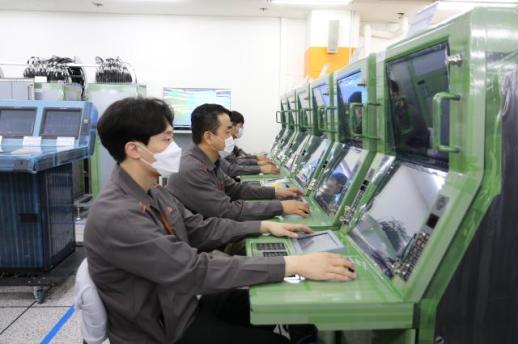 Hot Stock: Hanwha Systems almost hits the ceiling on Trump-era military ambitions SEOUL, January 09 (AJP) - Shares of Hanwha Systems surged close to the daily trading ceiling on Friday, fueled by expectations of a sharp increase in U.S. military spending. The stock jumped as much as 24.7 percent to 75,200 won ($51.7) intraday before paring gains to 74,200 won by 2:30 p.m., far outperforming the benchmark KOSPI, which was up less than 0.5 percent. The rally followed remarks by U.S. President Donald Trump, who vowed to raise the U.S. defense budget by more than 50 percent to $1.5 trillion by 2027, after ordering what he described as a “surgical” military raid in Venezuela and issuing increasingly confrontational remarks toward other regions, including Greenland. Defense stocks had been volatile earlier in the week after Trump criticized U.S. defense contractors for prioritizing dividend payouts and share buybacks. Sentiment, however, rebounded on expectations that a significantly larger defense budget would translate into expanded government contracts. Major U.S. defense firms, including Lockheed Martin and Northrop Grumman, recovered earlier losses following Trump’s budget comments, helping lift defense shares globally. Hanwha Systems, an affiliate of Hanwha Group, specializes in radar, command-and-control systems and electronic warfare solutions. The company has also been expanding into space-related businesses, including satellite communications and other advanced defense technologies. The sharp rise came amid broad gains across South Korean defense stocks, including Hanwha Aerospace, while trading volume in Hanwha Systems spiked markedly, underscoring strong intraday demand. 2026-01-09 15:55:33
 -
 After a string of EV contract losses, LG Energy Solution reports Q4 loss SEOUL, January 9 (AJP) - LG Energy Solution, having endured multiple headwinds including a labor raid at its U.S. plant and the cancellation of major battery supply contracts, swung to an operating loss in the fourth quarter, even as full-year profit more than doubled on strong data-center-driven demand for energy storage systems. In preliminary earnings released Friday, the South Korean battery maker reported full-year operating profit of 1.35 trillion won ($1.0 billion) for 2025, more than doubling from 575.4 billion won in 2024. Full-year revenue came to 23.67 trillion won, down 7.6 percent from a year earlier. For the October–December quarter, the company posted an operating loss of 122.0 billion won, compared with a loss of 225.5 billion won a year earlier, while quarterly revenue slipped 4.8 percent year on year to 6.14 trillion won. Excluding tax credits under the Inflation Reduction Act, the fourth-quarter operating loss widened to 454.8 billion won, translating into a negative margin of 7.4 percent. The figures are preliminary and may change following audits of overseas subsidiaries and affiliates. LG Energy Solution said it will release final results, including net profit and a detailed breakdown by business division, later this month. The poor quarterly results follow a string of setbacks in the company’s electric-vehicle battery business. LG Energy Solution last month terminated a 3.9 trillion won ($2.7 billion) battery supply contract with Freudenberg Battery Power Systems, marking the second major cancellation after it ended a 9.6 trillion won battery supply contract with Ford Motor Co. The two cancellations bring the total value of terminated contracts in December to 13.5 trillion won—equivalent to more than half of the company’s annual revenue of 25.6 trillion won recorded in 2024. The company also suffered a disruption at its battery plant construction site in Georgia in September, when U.S. authorities conducted a large-scale labor raid that led to the arrest of 475 workers and a temporary halt to construction. Shares ended Friday 0.8 percent down at 363,000 won. 2026-01-09 15:54:56
 -
 OPINION: Time to open the next chapter for BTS and Bang Si-hyuk BTS is a global phenomenon. Yet its stature cannot be measured by sales figures, chart rankings, or stadium records alone. The group’s true significance lies in its origin story: seven unknown young men, without elite credentials, inherited privilege, or a glamorous starting line, rising to the top through discipline, creative labor, and mutual trust. That narrative itself became culture. For young people around the world, BTS offered a quiet but powerful lesson: it is not where you come from, but the direction you choose, that shapes the future. For parents, the group represented rare popular content that felt ethically and educationally trustworthy. Above all, BTS’s lyrics consistently pointed beyond present wounds toward dignity, resilience, and hope. This is why BTS became more than a music group. It became the face of K-Culture. Its fandom, ARMY, evolved not as a consumer bloc but as a global civic community bound by shared values. At this point, transformation is no longer optional. Without a credible next chapter, BTS cannot fully persuade its global audience. And without that trust, neither the moral credibility of K-Culture nor the deeper promise of K-Spirituality can be completed. Culture that loses ethical trust loses direction before it loses speed. The recent controversy surrounding Bang Si-hyuk is, first and foremost, a matter for legal judgment. This column does not presume guilt, nor does it attempt to substitute for judicial process. Its purpose is more limited—and more fundamental: to clarify the standards society must demand where cultural power and capital intersect. The supposed dilemma—hesitating to enforce the law for the sake of K-Pop, or hesitating to protect culture for the sake of the law—is a false one. K-Pop does not need to cry, and the law must not either. The law must apply equally to all, and culture cannot be an exception. At the same time, the presumption of innocence must be fully respected. The only way to honor both principles is timely, voluntary, and transparent action. Global cultural industries offer a clear lesson. After internal misconduct scandals and governance failures, Disney restored trust through independent investigations and public structural reforms. Britain’s BBC likewise pursued accountability and institutional change alongside legal proceedings. As cultural influence becomes a global asset, the standards of law and ethics do not soften; they become stricter. What is required of Bang Si-hyuk now is not a lawyer’s defensive strategy, but a cultural leader’s self-reckoning. First, independent of any investigation, there must be an immediate and public commitment to governance reform and strengthened internal controls—not vague declarations, but a concrete roadmap with timelines, benchmarks, and external oversight. Second, there must be a long-term decision to return a portion of accumulated success to the world’s most vulnerable children—those deprived of education and healing by war, poverty, and disaster. This should take the form not of symbolic donations, but of a professionally governed foundation with an independent board and transparent audits, supporting education, recovery, and access to culture. Such actions would not serve as absolution. They would represent an expansion of responsibility—a moment when a cultural ecosystem proves that the values it celebrates in art can be embodied in leadership. BTS has long sung about hope, dignity, and solidarity. The leader who built that ecosystem is now called to demonstrate those values through action. As the management thinker Peter Drucker once observed, leadership is defined by the courage not to evade responsibility. This is precisely what global ARMY is asking for: let the courts decide the legal questions, but show moral direction without delay. More importantly, this moment marks a crossroads for both K-Culture and K-Spirituality. If K-Culture is Korea’s global language of emotion and competitiveness, K-Spirituality is its ethical depth. Rooted in the ideal of Hongik Ingan—to benefit humanity and harmonize the world—this tradition is not confined to any single faith. When combined with Christian love, Buddhist compassion, Confucian benevolence, and Taoist respect for nature, K-Culture can grow beyond entertainment into a universal human culture. That ethical depth is what gives cultural influence durability. Time is limited. The world moves quickly, and trust responds to speed. Hesitation is read as silence, and silence erases meaning. If decisive action is taken now, it will not be remembered as crisis management. It will be remembered as the moment the next chapter of BTS was opened—and as a signal that K-Culture has matured into a civilization-level culture grounded in ethics as well as artistry. A renewed BTS can persuade ARMY. ARMY can persuade the world. And at that horizon, K-Culture and K-Spirituality can finally stand complete—together. Now is the time for that decision. *The author is the President of Global Economic and Financial Research Institute (GEFRI) 2026-01-09 14:55:08