
Journalist

AJP
-
 How a Samsung project helped save Korea's provisional government in Shanghai SEOUL, January 06 (AJP) - When South Korean President Lee Jae Myung steps into a modest brick building in Shanghai on Wednesday during his state visit to China, he will be entering a carefully restored fragment of Korean history — one preserved not by a government initiative, but by an idea that began decades ago inside a corporate office at Samsung C&T. Restoration of the site — once home to Korea’s provisional government during Japan’s colonial rule — was completed more than 30 years ago, not with a government directive or diplomatic accord, but with an internal proposal submitted by an employee of Samsung C&T. In the late 1980s, as Samsung C&T prepared to enter the Chinese market, the company invited employees to submit ideas for cultural and social contribution projects. One proposal stood out. Lee Jae-cheong, then a sales manager in the firm’s distribution division, had recently returned from a business trip to Shanghai. While there, he visited a dilapidated building that had once housed Korea’s government-in-exile, which operated from July 1926 to April 1932 before relocating to Hangzhou. Years of private use had taken their toll. The structure was severely damaged, its original form barely recognizable, its historical significance largely obscured. Lee proposed that Samsung C&T take the lead in restoring the site. His idea was selected in the company’s internal contest and, after receiving management approval, became what Samsung later called the “Sungsan Project.” The effort soon evolved into a complex undertaking that required careful diplomacy, historical research and logistical coordination at a time when formal channels between the two countries were limited. Samsung C&T conducted preliminary studies to determine whether restoration was feasible and worked with South Korea’s Ministry of Culture and the Independence Hall of Korea to authenticate historical details. In 1991, the company signed a restoration agreement with the Shanghai municipal government — a notable step given the absence of full diplomatic relations at the time. To accelerate construction, Samsung C&T also covered relocation costs for residents living in the building. Using archival records and historical research, the company reconstructed the interior to reflect the late 1920s, collecting period-appropriate tables, chairs and beds. Rooms were recreated to resemble the provisional government’s meeting hall, office spaces, reception room, kitchen and living quarters for key independence figures. The restored building officially reopened on April 13, 1993, timed to coincide with the anniversary of the founding of Korea’s provisional government. About 100 people attended the ceremony, including descendants of independence activists whose lives had once been intertwined with the site. Today, as South Korea’s president prepares to walk through its halls, the Shanghai site stands not only as a symbol of the nation’s independence movement, but also as a reminder that corporate initiatives — sometimes sparked by a single employee — can play an unexpected role in preserving national memory far beyond the balance sheet. 2026-01-06 14:45:42
 -
 Lee seeks Chinese legislature's support in strengthening relations SEOUL, January 6 (AJP) - President Lee Jae Myung started his third day in China by holding talks with Zhao Leji, China's top legislator, on Tuesday. Lee met with Zhao earlier in the morning, a day after his 90-minute summit with Chinese President Xi Jinping at the Great Hall of the People in Beijing, and called for support in strengthening bilateral relations. Sharing what the two discussed, Lee said they agreed to "maturely develop a strategic cooperative partnership." Stressing the role of the National People's Congress (NPC), China's supreme organ, Lee said he believes it could help raise mutual understanding and broaden common ground. Lee also praised Zhao for helping facilitate exchanges between the two countries. Zhao was quoted as saying that deepening the bilateral relationship serves the "interests of both peoples" and contributes to the peace and prosperity of the Korean Peninsula and global security. Zhao also pledged that China would work with South Korea to implement agreements reached by the two leaders and to deepen cooperation. 2026-01-06 14:28:13
 -
 HD Korea Shipbuilding lands $1 billion ultra-large LNG carrier deal SEOUL, January 06 (AJP) - HD Korea Shipbuilding & Offshore said on Tuesday it has secured its first order of the year, signing a contract to build four ultra-large liquefied natural gas (LNG) carriers worth a combined 1.5 trillion won ($1.03 billion). Each vessel will have a cargo capacity of 200,000 cubic meters and measure 294.8 meters in length, 48.9 meters in width and 26.7 meters in height. The ships will be built at HD Hyundai Heavy Industries’ shipyard in Ulsan and delivered in stages by the first half of 2029. Compared with conventional 174,000-cubic-meter LNG carriers, the larger vessels can transport more cargo per voyage, reducing unit transportation costs, the company said. They will also be equipped with features including a high-efficiency shaft generator and an LNG reliquefaction system to improve operational efficiency. Clarksons Research, a U.K.-based shipping and shipbuilding consultancy, said global LNG carrier orders are expected to remain active this year as new LNG projects advance and demand grows to replace aging vessels. Separately, HD Hyundai Heavy Industries said it has delivered a 22,000-cubic-meter liquefied carbon dioxide carrier to Greece-based Capital Clean Energy Carriers. The vessel, named ACTIVE, is the first of four such carriers ordered from the shipbuilder in 2023 and 2024. An HD Korea Shipbuilding & Offshore official said the company plans to accelerate the development of environmentally friendly technologies as the market expands, while continuing to focus on securing orders for high-value vessels. The company said it set its shipbuilding and offshore order target for this year at $23.31 billion. 2026-01-06 14:12:41
 -
![[CES2026] SK hynix to spotlight next-generation AI memory at CES 2026](https://image.ajunews.com//content/image/2026/01/06/20260106140003564227_518_323.jpg) [[CES2026]] SK hynix to spotlight next-generation AI memory at CES 2026 SEOUL, January 06 (AJP) - SK hynix will showcase its next generation artificial-intelligence memory solutions at CES 2026 in Las Vegas, highlighting new high-bandwidth memory and low-power products as demand for AI infrastructure accelerates. The chipmaker will operate a customer-focused exhibition booth at the Venetian Expo from Jan. 6 to 9, shifting its emphasis from large-scale brand promotion to direct engagement with key clients, the company said. At the center of the display will be a 16-layer HBM4 product with 48 gigabytes of capacity, which SK hynix plans to unveil publicly for the first time. The company will also present its 12-layer HBM3E with 36GB, a product positioned to support near-term growth in AI servers. Beyond high-bandwidth memory, SK hynix will introduce SOCAMM2, a low-power memory module designed for AI servers, along with LPDDR6 for on-device AI applications. In NAND flash, the company plans to showcase a 321-layer 2-terabit QLC product aimed at high-capacity enterprise solid-state drives for data centers. The company will also operate an “AI System Demo Zone,” where it will demonstrate how future memory technologies — including customized HBM, processing-in-memory solutions and CXL-based memory modules — could integrate into next-generation AI systems. SK hynix said the exhibition reflects its strategy to deepen its role in AI infrastructure by expanding its portfolio of specialized memory products and strengthening collaboration with customers. “As innovation triggered by AI accelerates further, customers’ technical requirements are evolving rapidly,” said Justin Kim, president and head of AI Infrastructure at SK hynix. “We will meet those needs with differentiated memory solutions, and through close cooperation with customers, create new value that contributes to the advancement of the AI ecosystem.” 2026-01-06 14:05:32
[[CES2026]] SK hynix to spotlight next-generation AI memory at CES 2026 SEOUL, January 06 (AJP) - SK hynix will showcase its next generation artificial-intelligence memory solutions at CES 2026 in Las Vegas, highlighting new high-bandwidth memory and low-power products as demand for AI infrastructure accelerates. The chipmaker will operate a customer-focused exhibition booth at the Venetian Expo from Jan. 6 to 9, shifting its emphasis from large-scale brand promotion to direct engagement with key clients, the company said. At the center of the display will be a 16-layer HBM4 product with 48 gigabytes of capacity, which SK hynix plans to unveil publicly for the first time. The company will also present its 12-layer HBM3E with 36GB, a product positioned to support near-term growth in AI servers. Beyond high-bandwidth memory, SK hynix will introduce SOCAMM2, a low-power memory module designed for AI servers, along with LPDDR6 for on-device AI applications. In NAND flash, the company plans to showcase a 321-layer 2-terabit QLC product aimed at high-capacity enterprise solid-state drives for data centers. The company will also operate an “AI System Demo Zone,” where it will demonstrate how future memory technologies — including customized HBM, processing-in-memory solutions and CXL-based memory modules — could integrate into next-generation AI systems. SK hynix said the exhibition reflects its strategy to deepen its role in AI infrastructure by expanding its portfolio of specialized memory products and strengthening collaboration with customers. “As innovation triggered by AI accelerates further, customers’ technical requirements are evolving rapidly,” said Justin Kim, president and head of AI Infrastructure at SK hynix. “We will meet those needs with differentiated memory solutions, and through close cooperation with customers, create new value that contributes to the advancement of the AI ecosystem.” 2026-01-06 14:05:32 -
![[CES 2026] South Koreas Hyundai Wia unveils industrial robots, mobility parts](https://image.ajunews.com//content/image/2026/01/06/20260106083447635364_518_323.jpg) [[CES 2026]] South Korea's Hyundai Wia unveils industrial robots, mobility parts LAS VEGAS, January 06 (AJP) - South Korea's Hyundai Wia has unveiled its manufacturing and logistics robot brand, H-Motion, at CES 2026, which opened here on Tuesday. H-Motion is Hyundai Wia’s first robotics brand and platform, covering autonomous mobile robots (AMRs), parking robots and collaborative robots designed for industrial use. The company said its AMRs and parking robots have already been supplied to Hyundai Motor manufacturing sites, including Hyundai Motor Group Metaplant America in Georgia, while the collaborative robot has completed mass-production testing at Hyundai Mobis. Hyundai Wia’s AMR can carry loads of up to 1.5 tons and supports both lidar-based autonomous navigation and guided driving using QR-code recognition. Its modular top unit, which loads cargo, can be replaced depending on the task, including lift modules that adjust height and turntable modules that change cargo direction. The parking robot operates as a paired system, with two robots moving beneath a vehicle, lifting its wheels and transporting it. The system can handle vehicles weighing up to 3.4 tons at speeds of up to 1.2 meters per second. The H-Motion lineup also includes collaborative robots designed to work alongside humans, automated guided vehicles that follow fixed routes using QR codes or magnets embedded in floors, and mobile platform robots that combine an AMR with a robotic arm. Alongside robotics, Hyundai Wia showcased future mobility components at CES, including a distributed heating, ventilation and air-conditioning (HVAC) system for next-generation vehicles. “Through CES, people will be able to see Hyundai Wia’s mobility and robotics capabilities in a comprehensive way,” CEO Kwon Oh-sung said. 2026-01-06 14:03:59
[[CES 2026]] South Korea's Hyundai Wia unveils industrial robots, mobility parts LAS VEGAS, January 06 (AJP) - South Korea's Hyundai Wia has unveiled its manufacturing and logistics robot brand, H-Motion, at CES 2026, which opened here on Tuesday. H-Motion is Hyundai Wia’s first robotics brand and platform, covering autonomous mobile robots (AMRs), parking robots and collaborative robots designed for industrial use. The company said its AMRs and parking robots have already been supplied to Hyundai Motor manufacturing sites, including Hyundai Motor Group Metaplant America in Georgia, while the collaborative robot has completed mass-production testing at Hyundai Mobis. Hyundai Wia’s AMR can carry loads of up to 1.5 tons and supports both lidar-based autonomous navigation and guided driving using QR-code recognition. Its modular top unit, which loads cargo, can be replaced depending on the task, including lift modules that adjust height and turntable modules that change cargo direction. The parking robot operates as a paired system, with two robots moving beneath a vehicle, lifting its wheels and transporting it. The system can handle vehicles weighing up to 3.4 tons at speeds of up to 1.2 meters per second. The H-Motion lineup also includes collaborative robots designed to work alongside humans, automated guided vehicles that follow fixed routes using QR codes or magnets embedded in floors, and mobile platform robots that combine an AMR with a robotic arm. Alongside robotics, Hyundai Wia showcased future mobility components at CES, including a distributed heating, ventilation and air-conditioning (HVAC) system for next-generation vehicles. “Through CES, people will be able to see Hyundai Wia’s mobility and robotics capabilities in a comprehensive way,” CEO Kwon Oh-sung said. 2026-01-06 14:03:59 -
 Ex-DP lawmaker's aide under police investigation for alleged bribery SEOUL, January 6 (AJP) - A former aide to ex-Democratic Party lawmaker Kang Sun-woo is being questioned over bribery allegations, police said on Tuesday. Questioning began around 7 a.m. at a police station in Mapo, western Seoul, with the aide suspected of receiving 100 million won on behalf of Kang in return for the DP's candidate nominations for the 2022 local elections and holding onto the cash. The investigation came after a relevant recording surfaced last week, which led Kim Byung-ki to resign from his post as the DP's floor leader after it appeared he had overlooked the alleged bribery. Kang said she had instructed her aide to return the money and confirmed that it was returned, but the aide claimed to know nothing about it. Meanwhile, Seoul city official Kim Kyung, who is believed to have handed the money to Kang, left for the U.S. shortly after the allegations were revealed. 2026-01-06 13:52:40
 -
 CES 2026: PlayStation on Honda self-driving EVs to be possible on U.S. roads by late 2026 LAS VEGAS, January 05 (AJP) - Imagine cruising down the highway while battling mythical beasts in God of War Ragnarök or listening to bespoke soundscapes by a Japanese music producer — all from inside a self-driving electric vehicle. That future rolled into CES 2026 on Monday as Sony Honda Mobility unveiled its first production-ready model, the Afeela 1, blurring the line between automobile and entertainment hub. The four-year-old joint venture between Sony Group and Honda Motor said customer deliveries in California will begin later this year, with prices starting at $89,000. "Mobility will evolve into an experience that understands every user," said Izumi Kawanishi, representative director and president of Sony Honda Mobility. "Being a car will no longer be about driving it. It will be about making the most of your time and space." Afeela 1 packs 40 sensors and computing power capable of up to 800 trillion operations per second. It launches with Level 2+ advanced driver assistance under "Afeela Intelligent Drive," with the company aiming for Level 4 autonomous capability over time. One signature feature is the integration of PlayStation Remote Play, enabling occupants to stream games from a PS5 directly to the vehicle's panoramic display. Eric Lempel, senior vice president at Sony Interactive Entertainment, also announced exclusive Afeela themes from Astro Bot, including custom wallpapers and sounds. "We want PlayStation to be the best place to play and to give players more ways than ever to access the games they love," Lempel said. "We're excited to bring Remote Play to Afeela." The vehicle's electrical architecture is powered by Qualcomm Technologies via the Snapdragon Digital Chassis. Nakul Duggal, executive vice president at Qualcomm, called the collaboration a shared bet on the intelligent car's future. Afeela's conversational AI — the Afeela Personal Agent — runs on Microsoft Azure OpenAI Service, enabling personalized, natural dialogue tuned to driver preferences and context. Adding an artistic layer, Grammy-nominated Japanese producer Tomoko Ida crafted a custom audio experience that turns electric acceleration into a musical instrument, blending Japanese and Western styles rather than mimicking traditional engine sounds. Yasuhide Mizuno, representative director, chairperson and CEO, confirmed that trial production began last fall at Honda's East Liberty Auto Plant in Ohio, with pre-production vehicles on display at CES. Sales are initially limited to California, with delivery hubs opening this spring in Torrance and Fremont. Demo drives for early reservation holders are planned later this year. Expansion to Arizona follows in 2027, while Japan deliveries are slated for the first half of the same year. Sony Honda Mobility also debuted the Afeela Prototype 2026, a compact SUV-style concept expected to reach U.S. roads as early as 2028. 2026-01-06 13:30:08
 -
 Nvidia AI chip for self-driving to test on Mercedes Benz in US roads Q1 LAS VEGAS, January 06 (AJP) -Nvidia unveiled a next-generation “reasoning AI” for autonomous driving at CES 2026 on Monday, signaling a deeper push into the self-driving vehicle market with real-world deployments planned as early as the first quarter of this year. At a press conference at the Fontainebleau Live Theater in Las Vegas, Nvidia CEO Jensen Huang introduced the technology, dubbed Alpamayo, describing it as “the world’s first self-driving AI that thinks and reasons.” “The ChatGPT era of physical AI has arrived,” Huang said onstage. “Machines have begun to understand the real world directly and to reason and act on their own.” Huang said Alpamayo is designed to address autonomous driving’s so-called “long-tail” problem — rare, complex scenarios that are difficult to anticipate through conventional data collection alone. Unlike traditional systems that react primarily to sensor inputs, Alpamayo reasons step by step, Huang said, and can explain why it chose a particular action. “Alpamayo not only takes sensor input to control steering, braking and acceleration, it also reasons about what action to take and tells you why,” he said. “It can respond safely even in complex long-tail scenarios.” The model is a vision-language-action system built on Nvidia’s physical AI platform, Cosmos, which the company describes as a world foundation model. Nvidia said Alpamayo was trained using human driving demonstrations and trillions of miles of AI-generated data. During the presentation, Huang showcased a live demonstration of a vehicle equipped with Alpamayo navigating downtown San Francisco, verbally explaining its decision-making process in real time. “The long tail of driving can’t be solved by collecting every scenario in the real world,” Huang said. “But it can be solved by breaking it down into smaller, normal situations and reasoning through them.” A video shown onstage featured an AI-powered Mercedes-Benz vehicle driving through San Francisco traffic while a passenger sat behind the steering wheel with their hands resting in their lap. “It drives so naturally because it learned directly from human demonstrators,” Huang said. “In every single scenario, it reasons about what it’s going to do and why.” Nvidia said it plans to release Alpamayo as open source, with the underlying code made available on the machine-learning platform Hugging Face, allowing autonomous-vehicle researchers to access and retrain the model. Several companies and research groups have already lined up to use Alpamayo for Level 4 autonomous driving development, including Lucid Motors, Jaguar Land Rover, Uber and Berkeley DeepDrive. “Robotaxis will be the first to benefit,” Huang said, adding that Mercedes-Benz vehicles equipped with Alpamayo are expected to begin operating on U.S. roads in the first quarter. Nvidia also said it is planning a robotaxi pilot service in 2027 with partners including Uber. The company declined to name additional partners or specify locations for the rollout. “Our vision is that someday, every single car, every single truck, will be autonomous,” Huang said. 2026-01-06 13:29:17
 -
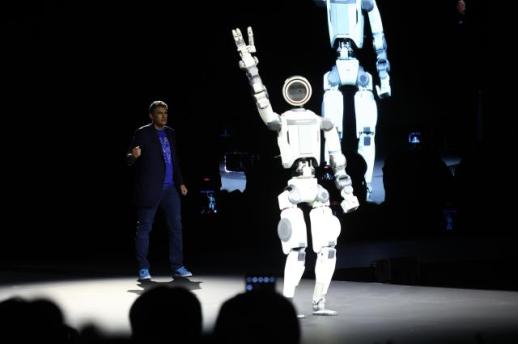 HOT STOCK: Hyundai Motor jumps over 4% early Tuesday on robotics timeline SEOUL, January 6 (AJP) - Shares of Hyundai Motor surged in early trading Tuesday, as investors cheered the company's newly unveiled AI and robotics roadmap at CES 2026, fueling optimism that growth engines beyond its core automotive business are taking clearer shape. As of 9:14 a.m., Hyundai Motor was trading at 317,500 won(US$235), up 13,000 won, or 4.27 percent, from the previous close of 304,500 won. The stock briefly climbed as high as 330,000 won before paring gains amid broad profit-taking. By 10:24 a.m., shares eased to 307,500 won, tracking a broader market pause after recent gains. The KOSPI slipped 0.4 percent to 4,438.4 as investors locked in profits following the index's year-end rally. The stock opened strong following Hyundai Motor Group's overnight presentation at CES in Las Vegas, where the company laid out a detailed timeline for AI-driven robotics and so-called "physical AI" technologies, underscoring its push to integrate artificial intelligence into manufacturing, mobility and industrial automation. Chung Euisun, chairman of Hyundai Motor Group, has recently described artificial intelligence as a "winnable game" for the group, citing strengths in physical manufacturing, mobility platforms and real-world data. According to industry sources, Chung has emphasized that Hyundai's ability to integrate AI across vehicles, robots and production systems gives it a structural edge over peers. At CES, the group showcased its humanoid robot Atlas, outlining plans to begin mass production in 2028 and deploy the robots at scale on U.S. assembly lines by 2030 — a timeline that analysts said helped crystallize Hyundai's commercialization strategy. Momentum was further bolstered after Hyundai's autonomous mobility robot platform MobED won the Best of Innovation Award in the robotics category at CES 2026. The accolade marked Hyundai’s first top-tier innovation award at the exhibition and was widely viewed as external validation of its robotics technology and commercialization potential. Hyundai said it plans to leverage its software-defined factory (SDF) framework to test and validate robotics technologies in live manufacturing environments before scaling them into broader industrial, commercial and daily-life applications. Analysts said the approach signals a shift from concept-driven showcases toward practical deployment and ecosystem building — improving visibility on future monetization from AI and robotics initiatives. Hyundai Motor reported on Monday that it sold 4.14 million vehicles in 2025, down 0.1 percent from 2024, with domestic sales rising 1.1 percent while overseas sales fell 0.3 percent. 2026-01-06 11:27:50
 -
 KOSPI takes breather while Asian markets stay broadly strong SEOUL, January 06 (AJP) - South Korean stocks took a pause on Tuesday after a relentless rally since year-end, while broader Asian markets largely maintained upward momentum following overnight gains on Wall Street, despite lingering geopolitical jitters tied to Venezuela. In Seoul, the benchmark KOSPI edged down 0.1 percent to 4,451.94 as of 11:00 a.m., as institutional investors locked in profits after the index recently scaled fresh record highs. The tech-heavy KOSDAQ also slipped 0.3 percent to 954.93. Overall market moves were measured, with investors rotating toward market leaders amid recent volatility. Gains in select industrial, defense and shipbuilding stocks helped offset profit-taking in heavyweight chipmakers. Samsung Electronics fell 2.1 percent to 135,200 won ($93.4), while SK hynix slid 1.7 percent to 684,500 won in early trade, reflecting profit-taking after a strong rally. Despite the pullback, sentiment toward chipmakers remained constructive, with analysts pointing to steady AI-driven demand. Battery and industrial shares traded mixed. LG Energy Solution, the country’s third-largest company by market capitalization, rose 1.1 percent to 375,500 won, while HD Hyundai Heavy Industries advanced 2.1 percent to 524,000 won. Hanwha Aerospace, however, slipped 1.78 percent to 994,000 won amid profit-taking after recent gains. By contrast, entertainment stocks underperformed the broader market, weighed down by lingering uncertainty over overseas content demand and regulatory risks. HYBE fell 1.9 percent to 333,500 won, while JYP Entertainment slid 1.2 percent to 71,800 won. SM Entertainment dipped 0.4 percent to 118,500 won, and YG Entertainment eased 0.2 percent to 65,000 won. In the currency market, the Korean won traded little changed against the dollar, hovering around 1,447.6 won per dollar, as investors balanced improved equity sentiment against external risk factors. In Tokyo, Japanese stocks extended gains in early trade. The Nikkei 225 rose 0.7 percent to 52,196.3, supported by advances in autos, financials and technology-related shares. Among major heavyweights, Toyota Motor climbed 2.1 percent to 3,472 yen ($22.2), while Mitsubishi UFJ Financial Group gained 2.7 percent to 2,613.5 yen on strength in financial shares. Elsewhere in Asia, market moves were more restrained. Mainland China’s Shanghai Composite added 1.4 percent to 4,023.4, while Hong Kong’s Hang Seng Index rose 0.6 percent to 26,507.3. 2026-01-06 11:26:46