
Journalist

Abe Kwak
-
 Samsung Electronics CEOs Urge Staff to Avoid Loss of Competitiveness Ahead of Union Strike Samsung Electronics Vice Chairman Jun Young-hyun and President Roh Tae-moon, the company’s co-CEOs, issued a formal message to employees as the labor union prepares for a general strike. Samsung Electronics said the two CEOs posted the statement on the company intranet on the 7th, outlining the status of wage talks. They said the company has negotiated with the union since last December and has presented alternatives after considering employee interests, the company’s future competitiveness and business conditions, while seeking to broaden mutual understanding through dialogue. They said they regretted that the sides have not yet reached a final agreement and acknowledged that prolonged negotiations have likely left many employees concerned and frustrated. The CEOs also urged staff to help prevent damage to the company’s future competitiveness. “In a severe global business environment, all management, including myself, will approach this with a responsible attitude so we do not lose future competitiveness,” they wrote, asking employees to do their best in their respective roles. They added that the company would continue discussions with an open attitude and work toward an outcome employees can support. Samsung and the union have negotiated since last December over 2026 wages, but talks were suspended after failing to narrow differences over performance-bonus standards. The union plans to begin an 18-day general strike starting on the 21st. With the strike about 14 days away, concerns have grown that the dispute could spill into a broader economic issue. If a strike occurs, Samsung’s losses are estimated at about 30 trillion won. Samsung Electronics board chairman Shin Je-yoon wrote on the company intranet on the 5th that a strike would hurt the company’s business competitiveness, erode customer trust and cause losses for shareholders and investors, with serious negative effects on the national economy. He said it could reduce exports by tens of billions of dollars and cut tax revenue by tens of trillions of won, while triggering a weaker currency and lowering GDP. * This article has been translated by AI. 2026-05-07 14:53:39
 -
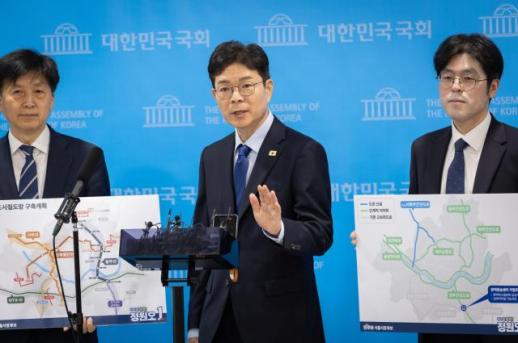 Seoul mayoral candidates clash on transit: card merger vs. free bus fares for 70+ Jung Won-oh, the Democratic Party candidate for Seoul mayor, on May 7 proposed expanding rail service in northern Seoul and merging the city’s Climate Companion Card with the government’s K-Pass. Rival candidate Oh Se-hoon of the People Power Party said savings from a merger should be used to subsidize bus fares for residents 70 and older. Jung announced the plan at the National Assembly press center as part of his “30-minute commute” pledge. His proposals include building a new Dongbu Line linking Suyu-dong in northern Seoul with the Sports Complex in Gangnam, expanding rail networks in the north, creating a grid-style rail system across Seoul, and setting up an express-bus transfer hub at the Man-nam Square area in Yangjae-dong. “We will connect Seoul’s rail lines more tightly and link roads without bottlenecks, tying Gangbuk and Gangnam together and starting a transportation revolution toward a 30-minute commute city,” Jung said. He also pledged to create a nationwide transit card by integrating Seoul’s Climate Companion Card with the government’s “Everyone’s Card” (K-Pass), under the name “K-Everyone’s Climate Companion Card,” to reduce the burden of public transportation costs. Jung said the existing Climate Companion Card benefits would be maintained while expanding the usable area nationwide, adding that he would build a system in which benefits increase with heavier use. Oh raised the issue of merging the Climate Companion Card while presenting housing pledges earlier May 7, outlining how he would use the savings. Oh, who introduced the Climate Companion Card during his time as Seoul mayor, said the Lee Jae-myung government rolled out a card using the same system, forcing residents to weigh which card offers better value. After reviewing whether the two needed to coexist, he said, he concluded they should be integrated to spare residents that inconvenience. Oh said a merger would cut Seoul’s budget and free up 70 billion won to as much as more than 100 billion won, which he plans to use to support bus fares for seniors 70 and older. He said he would announce details soon.* This article has been translated by AI. 2026-05-07 14:52:29
 -
 Pope Leo XIV’s Bank Call Ends Abruptly After Agent Doubts His Identity Even Pope Leo XIV, leader of the world’s 1.4 billion Catholics, could not get past a U.S. call center. A bank agent reportedly hung up on him when he called for help with his account. The New York Times reported May 5 that the story was shared by the pope’s close friend, Father Tom McCarthy, at a recent event in Naperville, Illinois. McCarthy, a well-known figure in the U.S. South, is chaplain at St. Rita of Cascia High School, a Catholic private school in Chicago. He met Leo XIV in Chicago in the 1980s, and both grew up in working-class neighborhoods, the Times said. According to the Times, about two months after his election, the pope called a bank in his hometown of Chicago. The pope, whose birth name is Robert Francis Prevost, told the call center he was Robert Prevost and said he wanted to change the phone number and address on file. He answered security questions, the report said. The agent told him the information was not sufficient and that he would need to visit a branch in person. The pope replied, “I don’t think I can,” and asked whether it would make a difference if he said he was Pope Leo. The agent then hung up, the Times reported. McCarthy confirmed by email that the account was true. He said the issue was resolved after another priest intervened and connected them with the bank’s president. The Times reported there was no further word about the call center agent. First American pope As the Roman Catholic Church’s first American pope, Leo XIV’s U.S. tax obligations again drew attention during this year’s tax season, following last year’s interest. In the United States, income tax returns are due each year by April 15, and Americans living abroad typically report worldwide income. The pope holds U.S. and Peruvian citizenship and also has Vatican citizenship, for a total of three nationalities. In a March report, U.S. Catholic broadcaster EWTN said the Vatican press office did not respond to questions about whether the pope filed a U.S. income tax return. Antonio Cizzoniti, a professor of canon law at the Catholic University of the Sacred Heart in Italy, told Vatican-focused outlet ACI Stampa that the pope, as head of state of Vatican City, has immunity that prevents foreign governments from enforcing civil or administrative obligations. Leo XIV has also drawn attention for high-profile moves on international conflicts and interfaith unity. He is set to meet U.S. Secretary of State Marco Rubio on the 7th to seek ways to address the Iran issue. Reuters reported that U.S. Ambassador to the Holy See Brian Burch said Rubio expected a “candid” meeting with the pope during the Vatican visit. Last month, the pope prayed jointly at the Vatican’s Urbano Chapel with Archbishop of Canterbury Sarah Mullally, the Anglican Communion’s first female leader, for religious unity and harmony. His appointment earlier this month of Bishop Evelio Menjivar-Ayala, who is from El Salvador, as head of the Diocese of Wheeling-Charleston in West Virginia also drew notice.* This article has been translated by AI. 2026-05-07 14:51:18
 -
 South Korea launches task force to normalize fiscal management, boost transparency The government has launched a task force to correct what it called irrational systems and practices in fiscal management, aiming to strengthen transparency and efficiency. The effort will focus on tightening oversight of fraudulent receipt of national treasury subsidies and normalizing research and development investment, among other reforms. The Planning and Budget Office said it held the first meeting of the “Fiscal Management Normalization Task Force” on Thursday afternoon at the Fiscal Information Service, chaired by Vice Minister Lim Ki-geun. The task force was formed as part of the Lee Jae-myung administration’s “national normalization project,” which seeks to build what it describes as a country grounded in fundamentals. It will review and improve inefficiencies and unreasonable practices that remain in fiscal operations. Lim will lead the group, which includes three director-level officials from the office and six private-sector experts in public finance. Last month, President Lee Jae-myung called for fair, transparent and rational reforms across society, saying the country must end an era in which breaking rules brings benefits while following them brings losses. He instructed ministries to identify and pursue tasks to “normalize the abnormal.” At Thursday’s meeting, participants discussed priority tasks based on ideas developed by the office’s working-level staff and proposals from outside experts. They agreed to focus on steps to improve fiscal transparency and effectiveness, including stronger controls against improper subsidy claims; normalizing R&D investment and restoring trust; and creating a public-interest reporting incentive fund to encourage reporting of wrongdoing such as stock manipulation and collusion. “Planning Office is an institution that oversees public finances beyond individual fiscal projects,” Lim said. “We will continuously review and improve fiscal management until the public is satisfied, and ensure people can feel changes on the ground.” The office said it will finalize the list of tasks after consultations with related agencies, including the Office for Government Policy Coordination. At a second meeting scheduled for early June, it plans to review progress by task and disclose related results to the public.* This article has been translated by AI. 2026-05-07 14:48:47
 -
 South Korea’s top court says arrest of suspect who voluntarily appeared was unlawful South Korea’s Supreme Court has ruled that police unlawfully executed an arrest warrant by taking a suspect into custody after he voluntarily appeared at a police station, saying the grounds and necessity for arrest were not met. According to the legal community on Wednesday, the Supreme Court’s First Division (Justice Ma Yong-ju presiding) upheld an appeals court ruling that sentenced a man identified only as A to 18 months in prison, a 10 million won ($7,300) fine and 17.6 million won in forfeiture for violating the Act on the Punishment of Acts of Arranging Sexual Traffic (arranging prostitution). Prosecutors said A rented four units in an officetel in Uijeongbu, north of Seoul, from August 2020 to January 2021, hired female workers and arranged paid sex for male customers who came after seeing online advertisements. Lower courts imposed the same sentence and rejected A’s claim that police executed the arrest warrant illegally. The Supreme Court said the request for and issuance of the arrest warrant were lawful, but the arrest carried out under the warrant was illegal. A prosecutor at the Uijeongbu District Prosecutors Office sought the warrant on Jan. 22, 2021, at the request of an officer with the Gyeonggi Nambu Provincial Police Agency, and a judge at the Uijeongbu District Court issued it on Jan. 25, the court said. Police searched and seized A’s bank account on Jan. 26 and the officetel he rented on Feb. 4. Just before the officetel search, police contacted A for the first time to ask whether he would participate in the warrant execution process, but he declined, saying he was in Jeonju, North Jeolla Province, among other reasons. Police later repeatedly demanded that A appear, calling his mobile phone. A responded that it was difficult because he was out of town and that he would appear after consulting a lawyer, then agreed to come in voluntarily at 3 p.m. on Feb. 19. When he arrived at the police station at that time, police executed the warrant and arrested him. The court said the conclusion that the grounds and necessity for arrest were satisfied was “markedly lacking in rationality” under common experience. It noted that A arrived exactly at the agreed time at the guidance desk at the main gate and was asking where the relevant department was located, showing no special behavior suggesting a risk of destroying evidence or fleeing. The court added that, aside from the fact that a warrant had been issued, it was difficult to find circumstances supporting the reasons and need for arrest at the time of execution. It also said the “suspect arrest report” prepared immediately after the arrest listed only the circumstances of A’s voluntary appearance and his prior criminal record, without explaining why the warrant had to be executed or the basis for concluding there was a risk of evidence destruction or flight. Still, the Supreme Court dismissed A’s appeal, saying the lower court did not commit an error that affected the verdict by misunderstanding legal principles on the warrant’s execution and alleged illegality in the investigation and trial procedures. The court said interrogation records prepared by investigators and A’s written statements made while he was detained following the unlawful arrest could not be used as evidence of guilt. However, it said the remaining evidence cited in the first- and second-instance rulings, excluding A’s statements, was sufficient to find the criminal facts proven beyond a reasonable doubt. * This article has been translated by AI. 2026-05-07 14:47:22
 -
 Ruling, opposition parties clash over constitutional amendment vote in South Korea Rival parties traded sharp words May 7 over a constitutional amendment bill set to be brought to the National Assembly floor. The Democratic Party urged the People Power Party to take part in the vote, while the PPP said it would oppose what it called a rushed, patchwork revision. At a meeting at the National Assembly ahead of the plenary session, Democratic Party floor leader Han Byeong-do said the bill would add references to the Bu-Ma Democratic Protests and the spirit of the May 18 movement to the Constitution’s preamble. He said it would also strengthen parliamentary control over emergency martial law and include the state’s duty to pursue balanced national development. Han rejected criticism that the proposal was aimed at elections, saying balanced development could not be dismissed as an election tactic. He called for lawmakers to look beyond immediate political advantage and consider the country’s long-term future, arguing the Constitution should be updated gradually as circumstances change. PPP floor leader Song Eon-seok said he believes constitutional revision is necessary, but compared the current approach to altering only a few parts of ill-fitting clothing. He said a proper revision should redesign the entire document, including the preamble, main text and supplementary provisions. Song said he would fully support talks on issues such as human dignity in the age of artificial intelligence and how to protect citizens’ rights and human rights. But he said he would firmly oppose a revision discussed to match election timing and limited to selected provisions. The Assembly is scheduled to hold a plenary session May 7 to handle the amendment bill and 115 bills related to people’s livelihoods. The PPP plans to skip the amendment vote and enter the chamber when the livelihood bills are taken up.* This article has been translated by AI. 2026-05-07 14:46:13
 -
 South Korea to Accept Land-Deal Permit Applications on Saturday, May 9 South Korea’s Ministry of Land, Infrastructure and Transport said Wednesday it will accept applications for land-transaction permits on Saturday, May 9, at district offices in Seoul and at relevant city and district offices in Gyeonggi province where the properties are located. The ministry said the Saturday intake applies only to permit applications tied to the temporary suspension of heavier capital gains taxes for multi-homeowners. Applications will not be accepted at Seoul City Hall, the Gyeonggi provincial government office, or at the city halls of Suwon, Seongnam, Yongin and Anyang. The ministry said the move was agreed upon by the ministry, Seoul, Gyeonggi province and local permitting authorities to improve public convenience. Parties to a transaction can submit required documents in person from 9 a.m. to 6 p.m. on May 9. Officials expect a late surge in applications because May 9 is the final day the tax-relief measure officially remains in effect and it falls on a nonbusiness day. Seoul city statistics show 7,653 new apartment-related land-transaction permit applications were filed in March, up 69.7% from 4,509 in February. It was the highest monthly total since Seoul introduced the land-transaction permit system citywide in October last year. The city attributed the record pace to the approaching end of the tax-relief period for multi-homeowners. A Seoul official said the Saturday intake is intended to prevent unnecessary disputes over the filing deadline and to minimize inconvenience or disadvantage to applicants by administratively reflecting the fact that the deadline falls on a holiday. * This article has been translated by AI. 2026-05-07 14:45:19
 -
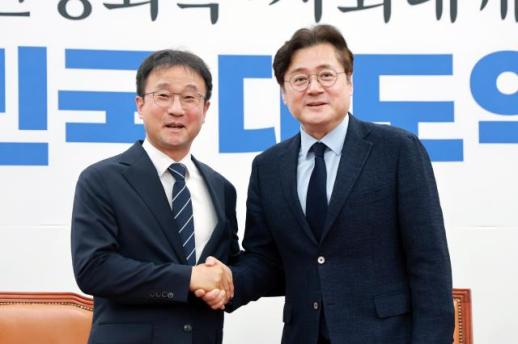 DP Floor Leader Han Byung-do Meets Senior Presidential Aide, Vows to Finish Key Bills by December Democratic Party floor leader Han Byung-do met Thursday with Hong Ik-pyo, the presidential senior secretary for political affairs, and pledged to complete legislation tied to the government’s already identified policy agenda by December to support stable state administration. Han also stressed a “one-team” approach among the party, government and presidential office, saying he would work to deliver results and help drive the success of the Lee Jae-myung administration in the National Assembly. Hong visited the National Assembly to congratulate Han on his new post. Han said the next year would be a “golden time” for the administration’s success and called the meeting a milestone to reaffirm the one-team spirit aimed at government success and economic recovery. Han was elected floor leader Wednesday at a party lawmakers’ meeting with majority support. He is the first in the Democratic Party to win a second term as floor leader. Han said that since becoming floor leader in January, 396 bills have been passed at plenary sessions, with about 115 more expected to be handled Thursday. That would bring the total to more than 500 bills in about four months, he said. He added that the party would serve as a reliable backer through responsible legislation and budgeting so the government can focus on managing external crises and protecting national interests. Hong said President Lee asked him to convey congratulations and expectations for Han’s role as floor leader. Hong added that the next year would likely determine the fate of the administration’s reform agenda, and said the Democratic Party — particularly under Han’s leadership — would play an important role, including in passing bills and fostering a cooperative political culture in the National Assembly.* This article has been translated by AI. 2026-05-07 14:41:54
 -
 Haesung DS jumps 11% to record high as brokerages raise price targets Haesung DS surged more than 11% on a wave of brokerage price-target upgrades, hitting an intraday record high. According to the Korea Exchange, shares were up 9,000 won, or 11.54%, at 87,000 won as of 2:16 p.m. on Thursday. The stock climbed as high as 87,700 won during the session, setting a new all-time high. Investor sentiment appeared to improve after multiple brokerages raised their targets. Since the start of this month, Samsung Securities, BNK Investment & Securities, iM Securities, Meritz Securities, Kyobo Securities and Eugene Investment & Securities have all lifted their price targets for Haesung DS. The revised targets range from 92,500 won to about 100,000 won. The company’s first-quarter profitability, however, temporarily weakened due to higher raw material costs. First-quarter revenue totaled 188.7 billion won, up 37% from a year earlier and 5% from the previous quarter. Operating profit was 11.0 billion won, down 50% from the prior quarter, with an operating margin of 5.8%. Analysts said profitability was temporarily hurt by a lag between a sharp rise in London Metal Exchange prices and increases in product selling prices, but they expect results to normalize starting in the second quarter as price hikes take fuller effect. Eugene Investment & Securities analyst Lee Ju-hyung said, “The weak first-quarter results are disappointing, but considering that most of the gap between estimates and actual operating profit was due to the sharp rise in LME prices, we expect the company’s performance to normalize from the second quarter, when the impact of higher selling prices will be reflected in earnest.” Eugene forecast second-quarter revenue of 195.5 billion won and operating profit of 24.3 billion won, up 24% and 196%, respectively, from a year earlier. Expectations for a stronger second half are also growing, as mass-production sales of heat spreaders for a new North American customer are expected to be reflected, and supply of new package (PKG) products to a Chinese plant of a domestic IDM company is expected to expand. Kyobo Securities analyst Park Hee-cheol said, “Although one-off profit deterioration occurred, considering the visible expansion of new product lines for big-tech customers in the lead-frame business and the smooth progress of qualification tests for package substrates, this is a section with high investment appeal compared with peers.”* This article has been translated by AI. 2026-05-07 14:35:55
 -
 Pros’ CFD Buying Surges in Samsung Electronics, SK Hynix as Chip Stocks Rally Professional investors have been concentrating money in large semiconductor stocks that have been leading recent gains in South Korea’s market. Their buying has also been evident in contracts for difference, or CFD, positions, with Samsung Electronics and SK Hynix showing the clearest rise in balances. As of the end of April, both the number of shares and the value of CFD balances in Samsung Electronics and SK Hynix rose sharply among the top CFD holdings, according to the financial investment industry on May 7. CFDs are leveraged products that settle only price differences without owning the underlying shares, and they are available only to professional investors. Samsung Electronics posted the biggest jump. Its CFD balance increased by 296,277 shares from the end of March, up 38%. The balance value rose by 72.123 billion won, a 78% surge. SK Hynix also climbed: its CFD balance increased by 21,689 shares, up 9.9%, while the balance value expanded by 42.456 billion won, up 34%. The inflows were attributed to strong share prices amid expectations for AI semiconductors and high-bandwidth memory, or HBM. Outside semiconductors, Seojin System stood out. Over the past month, its CFD balance saw a net inflow of 1,378,511 shares, and the balance value increased by 69.512 billion won. By balance value, it rose from around the top 20 to about seventh. The move was linked to growth expectations tied to data centers and power infrastructure. Some growth stocks, however, showed profit-taking. APR’s CFD balance fell by 151,248 shares, while its balance value dropped by 28.839 billion won, declines of 37.68% and 38.95%, respectively. Market watchers said recent CFD flows reflect a leadership rally centered on AI and semiconductors. With professional investors rapidly increasing exposure to Samsung Electronics and SK Hynix, they said the concentration of demand in chip stocks could persist for some time. Brokerages have also argued that a re-rating of the memory cycle is still in its early stages, saying there is room for further gains even after Samsung Electronics and SK Hynix broke past record highs. SK Securities on May 7 raised its target price for Samsung Electronics to 500,000 won from 400,000 won a month earlier, about 87% above the current price. It also lifted its target for SK Hynix to 3,000,000 won from 2,000,000 won, implying about 87% upside from the current share price.* This article has been translated by AI. 2026-05-07 14:34:54