
Journalist

Adrian Beaumont
-
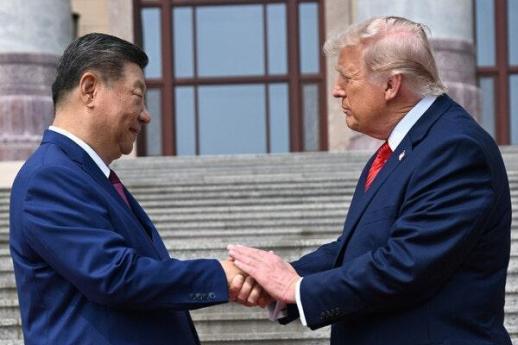 China and U.S. Reach New Consensus During Trump’s Visit Chinese Foreign Ministry officials announced that U.S. President Donald Trump and Chinese President Xi Jinping reached a "series of new consensuses" during their recent summit. However, they did not confirm Trump's claims of a "fantastic trade agreement" or any specific cooperation regarding Iran and the Hormuz Strait. Instead, China emphasized the importance of maintaining stable U.S.-China relations over concrete outcomes. On May 15, a spokesperson for the Chinese Foreign Ministry stated that the two leaders engaged in deep discussions on significant issues affecting both nations and the world, resulting in a series of new agreements. This visit marks Trump's first trip to China as president in nine years, according to the ministry. The Foreign Ministry noted that both leaders agreed to establish a "constructive strategic stability relationship" as a new standard for U.S.-China relations. This framework is expected to provide strategic guidance for the relationship over the next three years and beyond. The ministry added that it aims to promote stable, healthy, and sustainable development in bilateral relations, contributing to global peace, prosperity, and progress. The schedule of the summit was also highlighted. The Foreign Ministry reported that Xi hosted a welcome ceremony and banquet for Trump the previous day, and the two leaders visited Tian Tan together after their discussions. The ministry assessed that their interactions enhanced mutual understanding and trust, benefiting practical cooperation and the welfare of both nations' citizens. However, there is a noticeable difference in tone between the Chinese statement and the U.S. announcement. Following the meeting, Trump claimed they had reached a "fantastic trade agreement" and highlighted China's commitment to increasing purchases of U.S. agricultural products and cooperation on issues related to Iran and the Hormuz Strait. In contrast, the Chinese statement did not mention specifics regarding the trade agreement, U.S. agricultural purchases, imports of U.S. crude oil, or the reopening of the Hormuz Strait. Instead, China emphasized communication on international and regional issues. The Foreign Ministry stated that the two leaders reached an important consensus on appropriately addressing each other's concerns and agreed to strengthen communication and coordination on international and regional matters. While this could encompass issues like the Iran conflict and the Hormuz Strait, it does not imply specific concessions or commitments from China on these matters. Regarding the Taiwan issue, a firm stance was reiterated in a separate briefing. Foreign Ministry spokesperson Geng Shuang stated that Xi told Trump that "the Taiwan issue is the most important issue in U.S.-China relations." He warned that mishandling the situation could lead to conflict or confrontation, pushing U.S.-China relations into a very dangerous situation.* This article has been translated by AI. 2026-05-15 14:28:35
 -
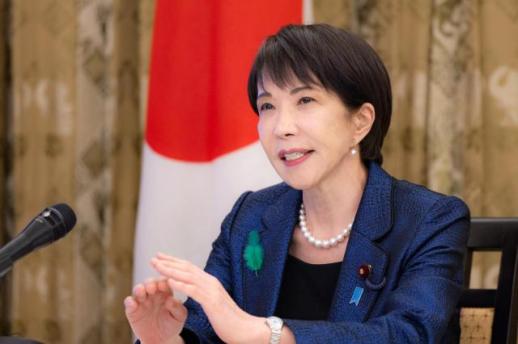 Strengthening Shuttle Diplomacy Between South Korea and Japan Amid Global Instability Shuttle diplomacy between South Korea and Japan is gaining momentum once again. President Lee Jae-myung and Japanese Prime Minister Sanae Takaichi are set to hold a summit on May 19-20 in Andong, North Gyeongsang Province. Following President Lee's visit to Japan in January, this meeting marks the first time a Japanese leader will visit South Korea, signaling a renewed commitment to regular mutual visits between the two countries' leaders.The relationship between South Korea and Japan has long been fraught with historical grievances, security issues, and economic disputes. Controversies over forced labor and comfort women, along with export restrictions, have severely strained relations, often exacerbated by hardline rhetoric from political leaders. However, the global landscape has shifted dramatically. The war in Ukraine continues to drag on, while tensions in the Middle East are rising amid potential conflicts involving Iran and Israel. The trade war between the United States and China has escalated into a broader conflict over tariffs and supply chains, destabilizing the global economic order. Fluctuations in international oil and commodity prices have also increased, creating an era of uncertainty in both economic and security realms. In this context, South Korea and Japan find themselves inextricably linked as neighbors. Both nations rely heavily on exports and depend on foreign sources for significant portions of their energy and raw materials. They share a common foundation as economies centered on advanced manufacturing, making cooperation more essential than ever amid supply chain disruptions and technological competition. The security environment is similarly precarious. North Korea's advancements in nuclear and missile technology pose direct threats to both countries. The growing military cooperation between Russia and China, coupled with rising military tensions in Northeast Asia, further complicates regional security. Deteriorating relations between South Korea and Japan could ultimately burden both nations. The significance of shuttle diplomacy cannot be overstated. Diplomacy is not merely about avoiding conflict; it is about managing it through ongoing dialogue. Maintaining regular communication channels between leaders can prevent relationships from deteriorating into crises, even when unexpected events or political clashes arise. Historically, the most severe downturns in South Korea-Japan relations have coincided with periods of halted dialogue, leading to increased mistrust. Recently, both countries have prioritized economic security and supply chain cooperation as key agenda items. Collaboration on semiconductor materials, advanced components, and energy is not just an economic issue; it directly impacts national survival and industrial competitiveness. The United States has also consistently urged for strengthened trilateral cooperation among South Korea, Japan, and itself. In a world increasingly defined by bloc politics, collaboration between South Korea and Japan is becoming a practical necessity rather than a choice. Nonetheless, structural issues in South Korea-Japan relations remain unresolved. Historical grievances continue to be sensitive topics, and certain factions within Japanese politics perpetuate conflicts over historical narratives. Nationalistic sentiments within both countries can also disrupt relations at any moment. Therefore, a more stable dialogue structure is essential. As emotions run high, diplomatic channels must be activated more frequently. Crucially, it is important not to treat the improvement of relations as a mere political event. Increasing the frequency of meetings between leaders is not sufficient on its own. The focus should be on institutionalizing and creating sustainable frameworks for economic security cooperation, supply chain responses, and cultural exchanges. This underscores the need for a cooperative system that remains resilient despite changes in government. The South Korea-Japan relationship is geopolitically inseparable. While competition exists in certain areas, it is vital to collaborate in sectors where cooperation is necessary. In times of significant global upheaval, strategic partnerships with close neighbors become even more critical. What is needed now is not a repetition of emotional confrontations but a mature diplomacy that acknowledges reality.* This article has been translated by AI. 2026-05-15 14:25:41
 -
 Dongkuk Pharmaceutical Reports Record First Quarter Performance with 332% Increase in Centellian24 Exports Dongkuk Pharmaceutical announced that it achieved record sales and operating profit in the first quarter of this year. The company reported consolidated sales of 251 billion won ($211 million), operating profit of 27.3 billion won ($23 million), and net profit of 26.3 billion won ($22 million) for the first quarter. These figures represent increases of 12.2%, 8%, and 46.4%, respectively, compared to the same period last year. On a standalone basis, sales rose by 15.9% to 212.4 billion won ($178 million), while operating profit increased by 12.3% to 23.3 billion won ($19.5 million). Net profit also saw a significant rise of 40.6%, reaching 23.6 billion won ($19.8 million). The company attributed its sales growth to improved efficiency in selling and administrative expenses and enhanced profitability in its Health & Beauty (H&B) division. The dermacosmetic brand Centellian24 continued to grow in global markets, including North America, Japan, China, Southeast Asia, Europe, and the Middle East, with exports increasing by 332% compared to the previous year. Centellian24 is expanding its presence in key channels such as Watsons, beauty edit shop Beautrium, Central Department Store, and the beauty platform Konvi, while also strengthening its local distribution network in Thailand through various online and offline channels. The company's strategy to leverage its established trust as a pharmaceutical firm to expand into consumer goods, including cosmetics and beauty devices, has been recognized as a key driver of sales growth. By business division, the over-the-counter (OTC), prescription (ETC), Health & Beauty, global business sectors, and subsidiary Dongkuk Life Sciences all experienced balanced growth. The OTC division continued its growth based on strengthened brand competitiveness and expansion into the general product market. Although the ETC division faced price reductions affecting injectables, it still expanded due to the growth of the cholesterol treatment drug Rosutanjett. The global (export) division was also bolstered by the expansion of Lorelin in the Latin American and Asian markets, with increased sales of the general anesthetic Propofol and the antibiotic raw material Teicoplanin. The antibiotic raw material Teicoplanin has also shown consistent growth. Dongkuk Pharmaceutical plans to expand its future pipeline through open innovation and accelerate the development of new products based on its drug delivery system (DDS). The company is currently commercializing the prostate cancer treatment Lorelin (one-month and three-month formulations) using microsphere technology. Additionally, it aims to strengthen its growth drivers through new products in its DDS pipeline, including obesity treatments, acromegaly treatments, and immunosuppressants.* This article has been translated by AI. 2026-05-15 14:24:15
 -
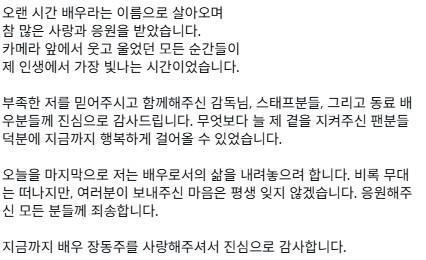 Actor Jang Dong-joo Announces Retirement 배우 장동주가 은퇴한다고 밝혔다. On May 15, actor Jang Dong-joo announced his retirement via social media, stating, "I have received so much love and support while living as an actor for a long time." He added, "Every moment I laughed and cried in front of the camera has been the brightest time of my life," expressing gratitude to the directors, staff, and fellow actors who believed in him and supported him throughout his career. Jang emphasized, "Above all, I have been able to walk this path happily thanks to the fans who have always stood by my side. Today, I will lay down my life as an actor." In closing, he said, "Although I am leaving the stage, I will never forget the love you have sent me. I apologize to everyone who has supported me, and I sincerely thank you for loving Jang Dong-joo until now." Jang Dong-joo first gained attention in October of last year when he posted a message saying, "I’m sorry" along with a black screen on his social media, leading to concerns about his well-being. He was located the following day, and the situation was resolved. In January, he revealed that he had been a victim of phone hacking and extortion. He recounted, "A call came from an unknown number. A man who knew my exact movements. That voice is still vivid in my memory. I checked the number, and it turned out to be a burner phone. What followed were personal photos from my phone, screenshots of conversations, and my contact list. My phone was completely hacked." During this ordeal, Jang admitted to accumulating debts amounting to billions of won, stating, "I sincerely apologize to those who have been hurt and affected because of me. If you trust and wait for me, I will work hard to repay every single won. Please help me." Jang made his acting debut in 2017 with the KBS drama 'School 2017' and has appeared in works such as 'Criminal Minds,' 'Mr. Temporary,' 'Honest Candidate,' and 'Trigger.' 2026-05-15 14:21:00
 -
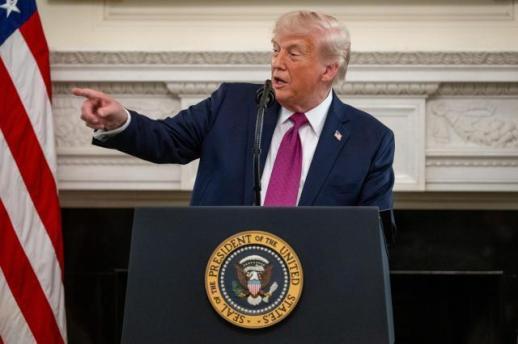 Trump Highlights Trade Agreement with Xi During China Visit President Donald Trump concluded his visit to China by emphasizing the outcomes of his summit with Chinese President Xi Jinping. He highlighted a trade agreement and the expansion of U.S. agricultural product purchases, while also stressing China's alignment with the U.S. on issues related to the Iran conflict and the Strait of Hormuz. On May 15, Trump told reporters in Beijing after a private meeting with Xi, "The visit was unbelievable," adding, "We reached a fantastic trade agreement for both countries." He noted that they addressed several issues that others had failed to resolve. Trump stated that topics discussed during the meeting included trade, technology, Taiwan, and the Iran conflict. In the realm of trade, the expansion of Chinese purchases of U.S. agricultural products was a key achievement. Jamieson Greer, the U.S. Trade Representative, expressed optimism that an agreement would lead to China purchasing "tens of billions of dollars" worth of U.S. agricultural products annually over the next three years. Reuters reported that this could include not only soybeans but also corn and sorghum, in addition to existing commitments. Energy discussions were also part of the agenda. According to AP, Trump explained that China could increase its imports of U.S. crude oil. This move is seen as an effort to diversify China's energy import structure away from reliance on the Middle East and expand U.S. energy exports. Regarding the Iran issue, Trump emphasized China's cooperation, stating, "President Xi expressed his willingness to help end the Iran conflict." He also noted that Xi indicated China would not supply military equipment to Iran. Trump remarked, "We feel very similarly in that we do not want Iran to have nuclear weapons and we want the Strait of Hormuz to remain open." Greer also mentioned in an interview with Bloomberg that China desires to keep the Strait of Hormuz open without tolls or military control. He explained that China views the easing of tensions in the Middle East pragmatically and has shown a willingness to limit military support to Iran. However, it is difficult to view this meeting as a resolution to the underlying U.S.-China conflicts. Xi raised the Taiwan issue as a core matter in U.S.-China relations, sending a warning to the United States. AP noted that while both sides projected a friendly atmosphere, complex issues regarding Iran, Taiwan, and technology controls remain unresolved.* This article has been translated by AI. 2026-05-15 14:16:20
 -
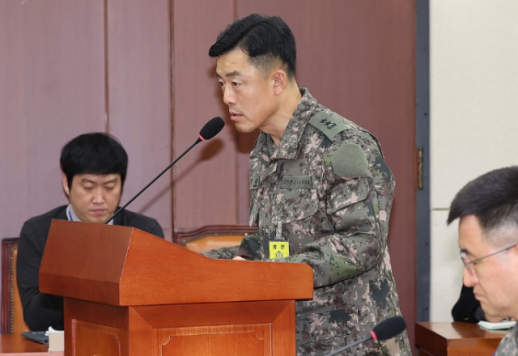 Former Intelligence Chief Moon Sang-ho Faces Five-Year Sentence for Leaking Agent List The Insurrection Special Prosecutor's team, led by Cho Eun-seok, has requested a five-year prison sentence for former Intelligence Command Chief Moon Sang-ho for allegedly leaking the names of intelligence agents during the martial law declared on December 3. During a sentencing hearing on May 15 at the Seoul Central District Court, presided over by Judge Lee Hyun-kyung, the prosecution argued for the sentence based on charges of military secret leakage and violations of the Personal Information Protection Act. The prosecution also sought five-year sentences for Kim Bong-kyu, a former head of the Central Newspaper Division (Colonel), and Jeong Seong-wook, a former head of the 100th Brigade's Second Business Division (Colonel), on similar charges. The prosecution stated, "The defendants colluded with civilian Noh Sang-won, a former Intelligence Command Chief, who had no authority to access military information, to participate in the unconstitutional and illegal enforcement of martial law, leading to the leak of military secrets, specifically the list of intelligence agents. The exposure of this list poses a significant risk, as it could make agents direct targets for terrorist groups." They further emphasized, "The defendants were aware that the personal information of agents constituted military secrets and that leaking this information could lead to catastrophic consequences. They neglected their duties and used their subordinates as tools for power rather than protecting them, thereby undermining the foundations of democracy and the rule of law." The prosecution noted that the leaked list was utilized in the formation of the Second Investigation Team, which was created to investigate allegations of election fraud, immediately following the declaration of martial law. They stressed the need for severe accountability. The prosecution explained that the requested sentence reflects the seriousness of the crime and the defendants' lack of remorse. Moon Sang-ho and others are accused of conspiring with former Defense Minister Kim Yong-hyun to leak personal information, including the names of approximately 40 intelligence agents, to Noh Sang-won in order to establish an unofficial organization, the Second Investigation Team, to investigate election fraud allegations. Previously, the prosecution had also sought a five-year sentence for former Minister Kim on the same charges. Noh Sang-won, who allegedly received the list of intelligence agents from Kim, has been sentenced to two years in prison by the Supreme Court.* This article has been translated by AI. 2026-05-15 14:14:04
 -
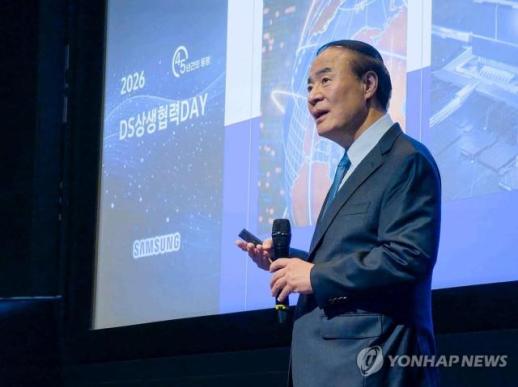 Samsung Executives Call for Unconditional Dialogue Amid Strike Threat Samsung Electronics executives, including Vice Chairman Jeon Young-hyun and President Roh Tae-moon, have reiterated their call for 'unconditional dialogue' with the union amid indications that the union may proceed with a general strike. In an official statement titled 'We Apologize to the Public,' the executives acknowledged, "We have caused significant burden and concern to the public and the government due to labor-management issues at Samsung Electronics," adding, "As our achievements grow, the expectations from society for Samsung have become stricter and greater, which we have failed to adequately address." The executives expressed a deep sense of responsibility for the current situation, stating, "We feel a heavy responsibility for how things have come to this point. We sincerely apologize." They urged the union to resume dialogue, emphasizing, "We consider the union as part of our family and a community of shared destiny, and we will approach discussions with an open mind. We again request the union to engage in dialogue promptly, keeping in mind the concerns of the public and the national economy." Additionally, Samsung highlighted its commitment to resolving internal issues amicably and strengthening its core competitiveness. The executives noted, "We are in an era of infinite competition where the global business environment is rapidly changing, and we cannot afford to waste time on internal problems. It is time for labor and management to unite and secure business competitiveness through continuous technological innovation and bold investments for the future." They further stressed the importance of maintaining operations in the semiconductor industry, stating, "Unlike other industries, semiconductors require continuous 24-hour operations, and strikes should not occur. Failing to meet our commitments to customers would result in a complete loss of trust." The executives pledged to collaborate on addressing the current economic situation and the long-term future of South Korea, promising, "We will become a steadfast pillar of the national economy through sound management, continuous technological innovation, and bold future investments." The statement was signed by all members of the executive team, including Vice Chairman Jeon Young-hyun, President Roh Tae-moon, and other executives such as Kim Soo-mok, Kim Yong-kwan, Kim Woo-jun, Kim Won-kyung, Nam Seok-woo, Mauro Porcini, Park Seung-hee, Park Yong-in, Park Hong-geun, Baek Soo-hyun, Song Jae-hyuk, Yong Seok-woo, Yoon Jang-hyun, Lee Won-jin, Choi Won-jun, and Han Jin-man. 2026-05-15 14:10:41
 -
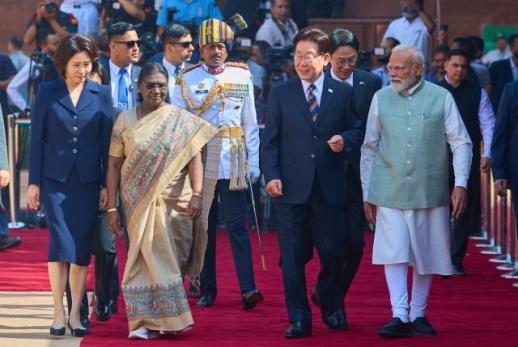 Korea and India in One Frame: Bridging a translation gap SEOUL, May 15 (AJP) -The meeting between South Korean President Lee Jae Myung and Indian Prime Minister Narendra Modi in New Delhi on April 20 was amicable, but slow. The words of both leaders traveled through English first then into Hindi because the Korean entourage lacked a translator who spoke Hindi. Technically, communication occurred. But something was lost in that detour, and everyone in the room knew it. Back at home, Lee complained out loud. At a cabinet meeting on April 28, he rebuked Foreign Minister Cho Hyun directly: find a way, he said, to make sure this never happens again. Train someone. Grow one. It is absurd, he argued, to navigate a country of 1.4 billion people through double translation. The rebuke was warranted. But the problem it exposed runs deeper than a staffing gap in the foreign ministry. Korea and India are not strangers by any reasonable measure. They share a continent. They share the memory of colonial humiliation and the hard-won pride of recovery. They share booming trade figures, growing diplomatic ties, and — increasingly — the attention of the same geopolitical moment. And yet, for decades, India has occupied a curious blind spot in the Korean imagination: present in the abstract, absent in the particular. A civilization of 1.47 billion people, reduced in popular consciousness to a handful of images. The interpreter was missing because, for a long time, the genuine curiosity was too. Language is a measure of intent. The languages a nation chooses to learn are a record of where it has decided to look. By that measure, India has long sat outside Korea's field of vision. Not out of hostility — out of something perhaps more consequential: indifference dressed as familiarity. This is what made the response to this year's Korea-India Essay and AI Video and cohosted by the Indian Cultural Centre and the Embassy of India in Seoul and Aju Press (AJP). Over 550 people answered to our call. They were students, writers, and ordinary citizens who had decided, for reasons of their own, to look. What they saw was worth recording. Sonali Ray, whose essay One Frame, Two Worlds took the top prize, wrote about kimchi and Indian achar — not as the same food, but as the same idea. Two cultures that understood, long before modern science confirmed it, that fermentation is philosophy: the patient transformation of humble ingredients into something alive and complex. She wrote about Korean pojangmacha and Indian dhabas operating on identical democratic principles — honest food, generous portions, a cook with opinions no critic could shake. She wrote about the way a Korean grandmother's doenjang jjigae and an Indian mother's dal speak the same grammar of love: slow-cooked, unpretentious, irreplaceable. These are not the observations of someone looking at a foreign country. They are the observations of someone recognizing a reflection. Kim Ji-young, who took the gold prize, arrived at India from a different direction — through language itself. In Hindi, she discovered, a single word carries two opposite meanings: kal means both yesterday and tomorrow. For a student of Hindi, it is an early lesson in grammar. For Kim, it became something else: a lens through which to examine a culture that refuses the false comfort of finality. She encountered this refusal everywhere — in the Indian professor who answered questions with a tilt of the head meaning perhaps, in the philosopher Sri Aurobindo's words that man is a transitional being, never complete, always becoming. She returned to Korea with a quieter mind and a more honest question: why are we so desperate to conclude? It is a question worth sitting with. Korea is a society that has, at remarkable speed, built extraordinary things. That speed has costs. Among them is a certain intolerance for ambiguity — a cultural impatience that manifests in everything from the pressure to declare one's MBTI type within minutes of meeting a stranger, to the fear that a classroom moment of genuine connection might constitute a legal liability. Kim's essay does not argue for India over Korea. It argues for what each might offer the other: that a civilization comfortable with kal — yesterday and tomorrow in a single breath — might have something to teach one that has forgotten how to wait. This is what cultural exchange looks like when it works. Not the exchange of tourist impressions, not the soft diplomacy of trade delegations, but the slow, unglamorous work of one person genuinely trying to understand how another civilization has organized its experience of being human. The awards ceremony takes place tomorrow, May 16th, at Yeouido Hangang Park, alongside India Day festivities that will fill the riverbank with color, music, and the specific warmth of two cultures meeting in the open air. It is, by any measure, a small event. It will not produce a Hindi interpreter overnight. It will not, by itself, close the distance that an empty chair at a translation table exposed. But 550 people looked toward India this year and found, in that looking, something that surprised them. A word that contains its own opposite. A pickle that is not the same pickle but the same wisdom. A civilization that has been there all along, patient as fermentation, waiting to be seen whole. The summit will happen again. Next time, perhaps, the words will travel direct. 2026-05-15 14:09:47
 -
 Nobel Laureate Peter Howitt: Education, Finance, and Welfare Must Adapt to AI Era Peter Howitt, a Nobel laureate in economics and professor at Brown University, emphasized that the rise of artificial intelligence (AI) will fundamentally transform not only industries but also education, social safety nets, and financial systems. He urged South Korea to undertake a comprehensive redesign of its economic framework. The Korea Development Institute (KDI) and the Economic and Social Research Institute hosted a conference on May 15 at the Westin Chosun Hotel in Seoul, where Howitt delivered a keynote address on innovative growth strategies for the South Korean economy in the AI era. Howitt diagnosed that the South Korean economy faces multiple challenges, including the spread of AI, rising protectionism, demographic changes, and the transition from follower to leading growth. He defined AI as a “General Purpose Technology,” akin to electricity, electric vehicles, and personal computers, indicating that it is a technology that can reshape the entire economic structure rather than being confined to specific industries. “General Purpose Technologies tend to go through initial disruption and prolonged adjustment periods before their productivity-enhancing effects spread across industries,” Howitt said. “To reap future benefits, all countries need to actively embrace this technology.” He stressed the necessity for a comprehensive institutional redesign that encompasses education systems, social safety nets, and the stability of financial systems to respond to the spread of AI. He also highlighted the importance of collaborative industrial policies among government, businesses, and academia. Howitt underscored the need to maintain an open economic system despite the rise of protectionism. “International trade enhances competitive pressure and provides access to global markets and learning opportunities, which fosters innovation,” he said, suggesting that South Korea should seek new trade alliances while also strengthening its domestic market in response to declining demand from existing trading partners. Regarding the issue of population decline, he cautioned against excessive pessimism. “Population decline is not necessarily a constraint on growth, as some may fear,” he noted, adding that expanding selective immigration policies to attract talented individuals from abroad is a desirable direction. Howitt proposed establishing a “leading growth system” as a key objective for South Korea's economic strategy. He stated that for the economy to transition to leading growth, a more innovative corporate ecosystem is needed, emphasizing the importance of strengthening support for small and medium-sized enterprises, expanding antitrust policies, and creating a technology-friendly financial system. Concerns about the structural slowdown in the South Korean economy were prominently raised during the conference. Kim Se-jik, head of KDI, remarked, “It is time for a new growth strategy focused on ‘real growth’ rather than short-term economic responses,” referring to the trend of the economy experiencing a decline of 1 percentage point in growth rates every five years over the past three decades. Deputy Prime Minister and Minister of Economy and Finance Ku Yun-cheol also emphasized in his congratulatory remarks the need for a shift from a follower-type economy to an innovation-driven transformation based on “creative destruction” to address external uncertainties such as the Middle East conflict and the structural issue of declining potential growth. 2026-05-15 14:05:29
 -
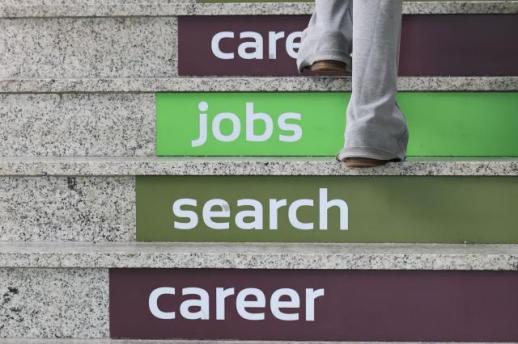 Government to Announce Employment Stability Plan Amid Industrial Transition The South Korean government plans to unveil a basic employment stability plan during the first half of the year in response to growing concerns about job disruptions caused by industrial changes, including artificial intelligence (AI), digital transformation, and carbon neutrality. This initiative aims to proactively address the potential for large-scale job shifts resulting from these transitions. On May 15, the Ministry of Employment and Labor held a meeting at the Seoul Business Center to gather input from labor representatives, business leaders, and youth organizations. Since November of last year, the government has been working with expert forums to develop policies aimed at preventing job shocks and creating new employment opportunities stemming from industrial transitions. The urgency arises from the rapid spread of AI, digitalization in manufacturing, and the restructuring of green industries, which could destabilize existing sectors and labor markets. There is a growing awareness that while some jobs may quickly disappear during the transition, new roles may not be created in time to replace them. A notable example is the decline in jobs for workers at traditional power plants due to the shift toward renewable energy. Similarly, workers in the internal combustion engine vehicle sector face increasing pressure as the industry shifts to electric vehicles. As job restructuring pressures mount, concepts like 'just transition' are gaining traction in the United States and the European Union. These regions are strengthening policies to mitigate labor shocks resulting from industrial changes, and there are calls for South Korea to adopt a more systematic transition strategy. To this end, the government has been accumulating foundational data on the status of industrial transitions and their employment impacts through a first phase of forums held from November last year to March this year. The second phase, conducted in April and May, focused on five specialized areas: job outlook, employment safety nets, business support, vocational training, and social dialogue. During the recent meeting, reports prepared by the expert forum and review materials from the labor ministry were discussed. The government plans to announce the basic employment stability plan next month, following public discussions and feedback from an expert committee on employment stability during industrial transitions. Lim Young-mi, head of the Employment Policy Office, stated, "There is a gap between the speed of industrial transition and the readiness of the labor market. If we do not train the necessary talent in line with facility and equipment investments, successful transitions will be difficult." She added, "We will establish a robust support system in collaboration with relevant ministries to ensure that talented individuals can work in a timely manner throughout the entire cycle of industrial transition." She emphasized the need to strengthen measures to ensure that workers' jobs and livelihoods remain stable during the transition period while also seizing new opportunities.* This article has been translated by AI. 2026-05-15 14:03:00