
Journalist

Amira Guirguis
-
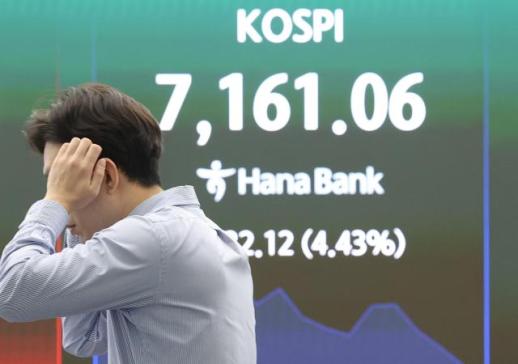 AJP Watch: Liquidation frequency flags deep retail loss in Korea's stock craze SEOUL, May 27 (AJP) - KOSPI is on fire, surging more than 93 percent so far this year. But the bonanza has hardly been evenly shared. On Wednesday, decliners overwhelmed gainers 826 to 75 even as the benchmark index closed near a record 8,330, underscoring how narrowly concentrated the world's best-performing rally has become. The imbalance also helps explain why South Korean retail investors were forced to dump borrowed stocks on one out of every six trading days over the past six months, signaling that many retailers were losing in the leveraged bets on the red-hot market. According to data released Wednesday by a think tank affiliated with the Korea Financial Investment Association (KOFIA), the forced liquidation ratio exceeded 2 percent on 20 of the 122 trading days between Nov. 22 and May 22. The forced liquidation ratio measures how much outstanding margin debt ends up in forced selling after investors fail to meet collateral requirements on borrowed stock purchases. A higher ratio indicates that a larger share of leveraged bets is turning into actual losses. Although the 2 percent threshold is not an official regulatory benchmark, market participants widely view it as a warning signal because the ratio typically hovers around 1 percent under stable market conditions. Analysts say the trend has moved beyond temporary volatility in individual speculative stocks and now points to mounting stress from excessive leverage and deteriorating investor sentiment. The spike in liquidation ratios since November was concentrated mainly in March and May. Days exceeding the 2 percent threshold totaled one in November, two in February, nine in March, one in April and seven in May. The highest single-day ratio was recorded on May 20, when 7.6 percent of margin credit accounts were forcibly liquidated. Outstanding margin credit stood at 1.64 trillion won ($1.1 billion), while actual forced liquidations reached 145.8 billion won. The previous peak came on March 5, when the ratio hit 6.5 percent, with outstanding credit at 2.14 trillion won and liquidations totaling 77.7 billion won. The liquidation ratio also breached the severe 4 percent level on five occasions: May 20 (7.6 percent), March 5 (6.5 percent), May 18 (6.0 percent), May 11 (5.4 percent) and May 19 (4.6 percent). The recent figures mark a stark deterioration from earlier periods. Between May 22 and Nov. 22, 2024, the ratio exceeded 2 percent only three times, peaking at 4.6 percent on Aug. 6. During the preceding six-month period from Nov. 21, 2023, to May 21, 2024, it never crossed 2 percent, reaching a high of just 1.8 percent. Average liquidation ratios have also climbed sharply. While average ratios during previous six-month periods ranged between 0.6 percent and 0.8 percent, the average over the latest six months jumped to 1.45 percent. At the same time, both outstanding margin credit and liquidation volumes expanded significantly. Average daily outstanding margin credit over the past six months reached 1.1 trillion won, exceeding the roughly 940 billion won averages recorded in the prior three periods. Average daily forced liquidations surged to 17.33 billion won, compared with 5 billion won to 8 billion won previously. The data excludes other major leverage channels such as margin loans, stock loans and contracts for difference (CFDs), suggesting overall exposure to forced selling may be substantially larger. Other leverage indicators have also risen rapidly. Brokerage margin loan balances nearly doubled from around 18.5 trillion won in late May 2024 to about 36 trillion won this month. Stock loan balances increased from 1.2 trillion won in late May last year to 1.6 trillion won at the end of January. Outstanding stock-collateralized loans, in which investors borrow against existing equity holdings, also climbed sharply from roughly 18.5 trillion won in late May 2024 to 25.7 trillion won this month. Analysts warn that elevated leverage across multiple channels could amplify broader market sell-offs during periods of volatility, as forced liquidations trigger additional downward pressure on stock prices. Concerns are also growing over the recent launch of single-stock exchange-traded funds (ETFs) and exchange-traded notes (ETNs) tied to companies such as Samsung Electronics and SK hynix, whose combined weighting in the local stock market exceeded 50 percent during Wednesday's intraday trading. Critics argue that introducing such leveraged products under current market conditions could expose retail investors to even greater risks, including “volatility drag,” in which repeated market swings gradually erode returns over time even if the underlying stocks continue to rise. "If leverage transactions accumulate excessively, massive volumes of forced liquidations can hit the market with a time lag," said Yom Dong-chan, an analyst at Korea Investment & Securities. "As the scale of liquidations expands, market volatility is highly likely to amplify in tandem, making this a period that demands extreme caution from investors." 2026-05-27 16:48:29
 -
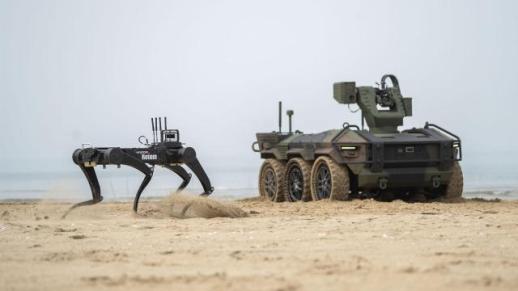 Hyundai Rotem wins state projects for AI-based unmanned military robots SEOUL, May 27 (AJP) - Hyundai Rotem said Tuesday it has been selected for two state-funded research and development projects aimed at advancing unmanned robot technologies based on physical artificial intelligence. The company said it was chosen as the final contractor for two projects commissioned by the Ministry of Trade, Industry and Energy and the Agency for Defense Development (ADD). The industry ministry project focuses on developing control software that can manage multiple types of unmanned robots through natural language commands and text. Until now, operators had to control each unmanned robot separately by entering fixed commands through dedicated remote-control devices. Once the integrated control system is developed, a small number of operators will be able to control multiple unmanned platforms at the same time using spoken or written commands. Hyundai Rotem plans to apply the technology to its key unmanned platforms, including the HR-Sherpa multipurpose unmanned ground vehicle and quadruped robots. The project is part of a government program designed to support the rapid commercialization of AI-based products. The ADD project involves developing a digital twin simulator and a modular unmanned robot platform. The simulator is designed to test the performance of unmanned robots in virtual environments that closely resemble real-world conditions. The modular unmanned robot platform will have detachable wheels on four legs and will be able to carry various mission equipment, including robotic arms and explosive detection devices. The ADD project is part of a future challenge defense technology R&D program designed to develop innovative defense technologies before formal military requirements are set. Hyundai Rotem also signed a memorandum of understanding with U.S. defense technology firm Anduril earlier this month, as part of efforts to expand technology cooperation across the public and private sectors. “We are devoting all our capabilities to advancing physical AI technologies that put national security and public safety first,” a Hyundai Rotem official said. “We will continue working to develop manned-unmanned weapon systems that the Republic of Korea Army can trust and use.” 2026-05-27 16:17:21
 -
 Number of newborns in S. Korea reaches highest in seven years SEOUL, May 27 (AJP) - The number of newborns in South Korea in March rose above 25,000, marking the highest level for the month in seven years, government data showed Wednesday. The rebound in births has now extended into a second straight year, supported by a rising number of marriages and more births among women in their early and late 30s. According to South Korea’s monthly population data for March released by the Ministry of Data and Statistics, 25,200 babies were born in March, up 19.4 percent from a year earlier. It marked the sharpest year-on-year increase for the month since the agency began compiling related data in 1981. The number of births had fallen below 20,000 a month at several points in 2024, fueling concerns over the country’s shrinking population and long-term labor shortages. However, South Korea saw its total number of newborns at 75,013 in the first quarter of 2026, up 14.8 percent from a year earlier. It was the highest first-quarter increase on record and the largest number of births for the January-March period since 2019. The improvement was also reflected in the country’s fertility rate. South Korea’s total fertility rate, the average number of children a woman is expected to have in her lifetime, stood at 0.93 in March, up from 0.78 a year earlier, remaining above 0.9 for a third consecutive month. If the trend continues, the annual figure could climb toward 0.9 this year after hitting a record low of 0.80 in 2025. The rise in marriages also continued, though the pace of growth slowed from the previous year. The number of marriages during the first quarter rose 6.1 percent from a year earlier to 62,309, compared with an 8.4 percent increase a year earlier. 2026-05-27 16:10:55
 -
 AJP Focus: War-driven metal rally lifts South Korea's battery makers, squeezes carmakers SEOUL, May 27 (AJP) - A war-driven oil shock is reshaping the economics of South Korea's electric vehicle supply chain, lifting prices of lithium, nickel and cobalt to multi-year highs and handing the country's top battery makers a long-awaited tailwind even as carmakers Hyundai Motor and Kia confront fresh cost pressure. Battery-grade lithium traded at US$25.15 per kilogram on May 13, more than triple the $8.10 average of June last year and the highest level since September 2023, according to data from Fastmarkets. Nickel changed hands at $19,017.50 a ton on the London Metal Exchange the same day, up 27.8 percent from December, while cobalt hit $57.83 a pound, the strongest reading since July 2022. The rally reverses a brutal two-year slump in battery metals brought on by an electric-vehicle demand lull and a glut of Chinese supply. It now coincides with two converging forces: surging EV sales in Europe and Asia as drivers flee record-high petrol prices triggered by the Iran war, and a parallel boom in energy-storage demand tied to artificial intelligence data centers. Battery-electric cars accounted for 19.4 percent of the EU market in the first quarter, up from 15.2 percent a year earlier, the European Automobile Manufacturers' Association said. March registrations alone jumped 51 percent on the year to more than 224,000 vehicles across 15 key European markets. Fastmarkets said in its January 2026 battery raw materials update that lithium prices had nearly doubled over the prior two months, driving battery cell costs up by 15 to 20 percent to around $46 to $48 per kilowatt-hour at the start of 2026. Supply has struggled to catch up, with Chinese giant CATL's Jianxiawo lepidolite mine in Jiangxi province idled since last August and Western refiners reluctant to invest. Indonesia and the Democratic Republic of Congo, which together dominate global nickel and cobalt output, have also tightened mining and export quotas. For LG Energy Solution, Samsung SDI and SK On — collectively the only serious non-Chinese force in the global battery market — the timing is fortunate. The three are linked to automakers through pricing contracts that pass raw-material costs through to customers with a lag of about three months, a mechanism that punished earnings during the 2024 to 25 price slide but should now flip into a tailwind. LG Energy Solution said in an April 30 statement that despite increase in shipments of both cylindrical EV and ESS batteries and ongoing cost-reduction efforts, the company posted a quarterly loss, driven by initial ramp-up costs associated with the expansion of ESS production sites. The company added that its ESS business now represents the mid-20 percent range of total revenue, underscoring the pivot from electric-vehicle cells to stationary storage that all three Korean firms are pursuing. "Western governments have little incentive to invest in lithium refining," said Choi Tae-yong, an analyst at DS Investment & Securities. The flip side is darkening for South Korea's carmakers. Batteries account for about 40 percent of the cost of an electric vehicle, and Hyundai Motor Group — which includes Kia — is already navigating fierce Chinese price competition at home and abroad. Hyundai sources roughly 95 percent of parts for its domestically built combustion-engine cars from Korean suppliers, but management is reviewing a broader shift to Chinese components. The group's global parts bill jumped to 84 trillion won last year, up 45 percent from 2021. Chinese batteries already power several South Korean-built models. Hyundai uses CATL cells in the Kona, while Kia equips the Ray, Niro, EV5 and PV5 with batteries from the Chinese supplier. CATL's batteries are about 10 to 20 percent cheaper than those produced here. Domestic market data tell a similar story. About 220,177 EVs were newly registered in Korea last year, with Kia ranking first at 60,609 units, or 27.5 percent of the market, followed by Tesla at 59,893 units and Hyundai at 55,461 units, the Korea Automobile & Mobility Association said. Chinese-made EVs surged 112.4 percent to 74,728 units, capturing a 33.9 percent market share. Whether higher cell prices will be absorbed by automakers or passed on to consumers remains an open question. Battery raw-material costs filtering into retail EV pricing would undercut the industry's long-stated goal of price parity with combustion-engine cars — and could deepen the cost advantage of Chinese rivals built around cheaper lithium iron phosphate, or LFP, chemistries. For now, the war-led surge has handed South Korean battery makers a near-term reprieve after their first simultaneous quarterly loss. For Hyundai and Kia, the road ahead looks rockier. 2026-05-27 15:58:07
 -
 Survey shows South Korean smokers harbor misconceptions about electronic cigarettes SEOUL, May 27 (AJP) - Nearly half of South Korean smokers trying to quit believe electronic cigarettes help them stop smoking, despite strong warnings from medical experts that the devices hinder cessation efforts. The findings were released Wednesday at a forum in Seoul organized by the Korean Society for Research on Nicotine and Tobacco and the Korea Medical Broadcast Journalists Association. Researchers polled 500 smokers aged 25 to 59 who had attempted to quit in the past year or plan to do so within the next six months. The survey showed 43 percent of respondents view electronic cigarettes as a useful tool for quitting, while 23.5 percent intend to use them for this purpose in the future. Another 20 percent have already tried using them to quit, primarily hoping to reduce withdrawal symptoms and manage their daily cravings. Medical experts at the forum dismissed these beliefs as widespread misunderstandings. Cho Hong-jun, a professor emeritus at the University of Ulsan College of Medicine, noted that about 70 percent of smokers who use electronic cigarettes to quit fail to do so, continuing to use the devices for over six months. He added that people who use both conventional and electronic cigarettes have only a 5 percent chance of transitioning entirely to electronic versions after two years. Instead, up to 80 percent of these dual users simply revert to smoking regular cigarettes. "Long-term studies show electronic cigarette users are highly likely to become dual users, and the quitting effects remain uncertain," Cho said. "Because the evidence that electronic cigarettes are less harmful than conventional ones is unclear, it is desirable to regulate all tobacco products equally." The survey also highlighted that many smokers switch to electronic devices because they smell less and seem less harmful to the body. However, Lee Sung-kyu, head of the Korea Center for Tobacco Control Research and Education, warned that using heated tobacco products indoors can spike nicotine concentrations up to 86 times the acceptable health limit. Lee noted that public perception is significantly detached from scientific reality. "Just because it lacks a smell or has a sweet scent does not mean it is safe," Lee said. The forum also addressed public confusion surrounding nicotine replacement therapies, which are legally classified as over-the-counter drugs rather than tobacco products in South Korea. The survey found 48 percent of respondents who knew about the therapies did not understand how they helped, while 46 percent mistakenly believed the nicotine in these medical treatments is identical to the nicotine in cigarettes. Choi Su-jeong, a family medicine professor at Gachon University Gil Medical Center, stressed that equating the two products is a clear error. "Following the correct usage of different formulations like patches, gum, and candy, and utilizing combination therapy as needed, can further increase the success rate of quitting smoking," Choi said. 2026-05-27 15:43:51
 -
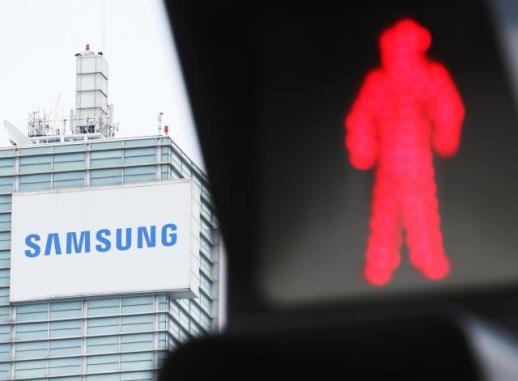 South Korea's AI bonus wars set off domino effect beyond chips SEOUL, May 27 (AJP) - May is typically a labor unrest season in South Korea, but this year the epicenter of disputes is no longer traditional factories — it is high tech. The bonus bonanza at the country's two chipmakers, which rode the AI wave to become two of only three Korean companies valued at more than US$1 trillion, is spilling across industries. Employees from manufacturers to platform operators and biotech firms are demanding a greater share of record earnings, even as median wages for ordinary salary earners remain largely stagnant in Korea, exposing widening tensions over compensation, contribution and corporate inequality across the country's industrial landscape. For decades, South Korea's export-driven economy operated on a form of "trickle-down" growth, in which profits generated by large conglomerates flowed through layers of suppliers, subcontractors and smaller manufacturers. Now, workers and industry officials warn that conflicts surrounding AI-era bonuses may be creating a different kind of trickle-down effect — one driven not by shared prosperity, but by widening pay gaps, internal resentment and intensifying labor tensions. "I could have made more money feeding ducks in the memory campus," grumbled Lee HJ, a 33-year-old engineer in the system LSI division of a major Korean conglomerate. The joke has spread widely across Korean workplace forums after employees assigned to memory-chip businesses were expected to receive bonuses worth hundreds of millions of won, while Ph.D.-level engineers in loss-making system LSI and foundry units were set to receive far less. "Someone feeding ducks can receive 400 million to 500 million won just because they belong to the semiconductor division," Lee said, capturing growing frustration over widening internal pay gaps. The tensions are most visible at Samsung Electronics, where the company's representative union approved a tentative 2026 wage agreement on Wednesday, averting an immediate strike at the world's largest memory-chip maker and easing concerns over disruptions to AI supply chains and South Korea's stock market. Electronic voting held from May 22 through Wednesday morning drew participation from 95.5 percent of 65,593 eligible voters, with 73.7 percent approving the deal. The agreement — reached just one day before a planned strike deadline — includes an average 6.2 percent wage increase and a newly created special performance bonus tied to operating profit. Under the deal, Samsung will institutionalize a bonus pool linked to 10.5 percent of annual operating profit, mirroring a structure already adopted by SK hynix. Inside Samsung, compensation gaps between business divisions have widened dramatically. Workers in the company's memory semiconductor division — which benefited directly from soaring demand for high-bandwidth memory chips used in AI servers — are expected to receive compensation packages worth as much as 600 million won this year. By contrast, employees in Samsung's foundry and system LSI divisions, which remain under earnings pressure, are expected to receive around 210 million won, while some workers in the smartphone and consumer-electronics businesses may receive only around 6 million won. The nearly 100-fold disparity has fueled unusually sharp tensions inside Samsung over widening compensation inequality. The rush to carve up corporate earnings has spilled well beyond the lucrative chip segment. Park Byung-jin, a professor at Hanyang University's School of Business, said Samsung's bonus deal would have a "domino effect" across South Korea's labor market and corporate compensation systems. "A bonus structure with no clear ceiling at the country's most influential company could trigger broader 'bonus inflation' across Korea," he said. "Once it becomes a reference point, unions at other major firms will naturally push for similar payouts." Unions at Hyundai Motor and Kia have demanded bonuses equivalent to 30 percent of net profit this year. HD Hyundai Heavy Industries, whose shipbuilding business is benefiting from a supercycle driven by surging orders for high-value vessels, has included a proposal for "30 percent operating-profit sharing" in this year's wage negotiations. HD Hyundai Heavy Industries' union has included 30 percent operating-profit sharing in its bargaining proposal, while Kakao's union is pushing for bonuses worth 13 percent to 14 percent of operating profit. LG Uplus has also faced demands for bonuses tied to roughly 30 percent of operating profit. SM, a 33-year-old senior manager at a major Korean automaker, said the dispute ultimately comes down to how a limited pool of money is divided. "There is no such thing as a win-win structure," he said. "The more one side takes, the less remains for someone else. Eventually, somebody has to give something up." The conflict is no longer a simple clash between labor and management. It is spreading across multiple fault lines: business divisions, job categories, regular and subcontracted workers, primary contractors and suppliers, and even shareholders and employees. Inside platform and ICT firms, tensions are increasingly emerging between developers, marketers, sales teams and support staff over who truly creates value in AI-driven businesses and how those profits should be distributed. Similar disputes are surfacing across other industries. Samsung Biologics faced its first-ever strike earlier this month after talks collapsed over demands including profit-linked bonuses and higher compensation. The rise in profit-linked bonuses is also widening disparities between large corporations and smaller firms, intensifying feelings of relative deprivation among workers outside the AI boom. According to Labor Ministry data released in 2025, bonuses and incentives accounted for 24.7 percent of wages at companies with more than 1,000 employees in 2024, compared with about 8 percent at smaller firms. Monthly bonuses at large corporations averaged roughly 1.33 million won, nearly four times the 340,000 won average at smaller companies. According to National Tax Service data on 2024 earned-income filings, the average annual salary for Korean workers stood at roughly 45 million won, or about 3.75 million won per month. However, the median annual salary — the midpoint at which half of workers earn more and half earn less — was only 34.17 million won, or about 2.85 million won per month. The gap of more than 10 million won between the average and median underscores how high-income earners continue to skew overall wage statistics upward, while the majority of workers experience significantly lower real incomes. On a pretax basis, nearly half of Korean salary earners make less than 3 million won a month. Against that backdrop, compensation demands such as those raised by Samsung's union risk deepening the sense of inequality felt by ordinary workers. Some industry estimates suggest that if Samsung were to allocate 15 percent of operating profit to performance bonuses, as demanded by labor representatives, employees in the DS memory division could receive average bonuses totaling 2.61 billion won per person between 2026 and 2028. "Some people are barely getting through the month, while others are fighting over bonuses worth hundreds of millions of won," said David Song, a 35-year-old employee at an IT company in Seoul. "Smaller companies don't have the unions or bargaining power. It feels like we are living in a different world." The disputes are also spreading through Korea's broader contractor ecosystem. Large manufacturers depend heavily on subcontractors and outsourced workers, from logistics providers to cafeteria, cleaning and security staff operating inside the same industrial sites. "Is it reasonable to pay cleaners 80 percent of what regular employees receive?" said Kim JW, a 28-year-old employee at a major manufacturing conglomerate. "Situations like this only deepen resentment toward subcontracted workers." The issue has become more sensitive following revisions to South Korea's labor union law — often referred to as the "Yellow Envelope Act" — which expanded the responsibilities of primary contractors and increased pressure on large manufacturers to address widening bonus gaps across contractor networks. A logistics subcontractor union tied to SK hynix has demanded collective bargaining over bonus disparities, while a cafeteria-service union linked to Hanwha Ocean has also called for expanded bonus payments. The conflict is increasingly moving beyond directly employed workers into the wider subcontractor ecosystem. The debate is also colliding with shareholder concerns. Some investors argue that shareholders absorb losses during downturns while employees increasingly demand larger shares of profits during boom years. Critics warn that escalating bonus structures could weaken dividends and reduce long-term investment capacity. Park of Hanyang University said the widening bonus gap is forcing Korean companies into a difficult balancing act between preserving organizational cohesion and rewarding increasingly concentrated AI-era profits. He said Samsung's current OPI (Over Profit Incentive) structure still retains a strong "group reward" character, in which entire divisions benefit collectively when one business unit performs well. "That means companies may end up rewarding thousands of employees just to retain a handful of key engineers," he said. To address the problem, Park said Korean companies would eventually need to scale back broad group-based bonuses such as OPI and shift more resources toward targeted retention bonuses designed to prevent critical talent from leaving. "That would help reduce overall cost burdens while protecting irreplaceable engineers and top performers," he said. Park also argued that companies should first account for shareholder returns and capital costs before distributing incentives based on economic value added, or EVA — a measure of profit after deducting capital costs — in order to ease tensions between shareholders and employees. He further suggested replacing part of large cash payouts with restricted stock units, or RSUs, arguing that bonuses above a certain threshold should be paid in shares with multiyear lockup periods rather than immediate cash. Such a structure, he said, would align employees more closely with long-term shareholders. Park also warned that applying identical profit-based compensation standards to both highly profitable memory-chip divisions and future-growth businesses such as foundry and system LSI could deepen internal divisions. Instead, he said, future-oriented businesses should be evaluated using longer-term indicators such as technology milestones, customer orders and market-share growth rather than short-term profits alone. "The core shift," Park said, "is moving away from broad group bonuses toward a more targeted compensation system focused on shareholders and irreplaceable talent." Samsung's approved agreement partly reflects that transition. Under the deal, portions of special bonuses will be paid in company shares subject to lockup periods, marking an early shift away from immediate cash payouts toward longer-term stock-linked compensation. South Korea's AI-era bonus wars are no longer simply disputes over wages. They are becoming a broader test of whether Korean companies can preserve organizational and social cohesion while fairly distributing increasingly concentrated profits in the AI economy. 2026-05-27 15:20:26
 -
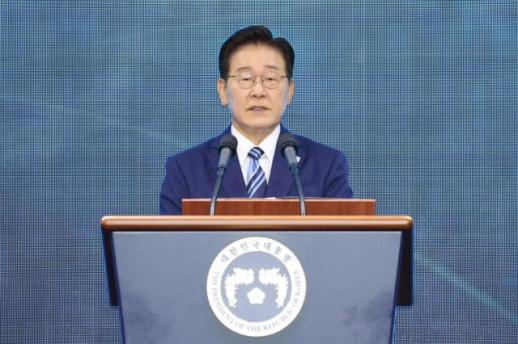 Lee to mark first anniversary in office with news conference early next month SEOUL, May 27 (AJP) - President Lee Jae Myung will hold a news conference early next month to mark his first anniversary in office and set out his vision and goals going forward. In a press briefing at Cheong Wa Dae on Wednesday, Lee Kyu-yeon, senior presidential secretary for public relations, told reporters that the press conference will be held on June 8, where Lee will "reflect on his first year in office" and lay out his vision and key tasks for his second year. It will be the president's fourth news conference since taking office in June last year, following one on July 3 last year to mark his first month, Sept. 10 to celebrate 100 days, and a New Year's news conference on Jan. 21. According to the presidential secretary, his first-anniversary address would stress "democratic values," charting a path for all walks of life to move forward together. About 160 reporters from domestic and international media outlets are expected to attend the press conference, whose roughly 100-minute session will be divided into three key areas - policy, the economy, and society and culture. In particular, two university students working as campus reporters will also be invited and given a chance to question Lee about the concerns and challenges facing younger generations. 2026-05-27 15:13:25
 -
 Mirae Asset lifts target prices for Samsung and SK hynix, citing memory re-rating SEOUL, May 27 (AJP) - Mirae Asset Securities has raised its target prices for Samsung Electronics and SK hynix on Wednesday, arguing that South Korea's two memory makers remain steeply undervalued against global peers even after this year's rally, a call based on a re-rating of valuations rather than any upgrade to earnings forecasts. The brokerage lifted its target for Samsung Electronics to 550,000 won ($366.7) from 480,000 won, up 14.6 percent, and for SK hynix to 3.8 million won from 3.2 million won, up 18.8 percent. The new targets imply upside of roughly 74 percent and 65 percent from the two stocks' levels in Wednesday morning trading, when both were rising sharply alongside a broad chip rally. Analyst Kim Young-gun said the firm's earnings estimates were unchanged and that the higher targets instead reflected applying valuation multiples closer to those global rivals already command. The core of the argument is that the Korean pair trade at a deep discount to peers such as Micron Technology and Kioxia. For SK hynix, Kim pointed to a sharp expected jump in profitability: he estimated average return on equity — a measure of how efficiently a company generates profit from shareholders' capital — would reach 66 percent over 2026 to 2028, against a ten-year average of 19 percent, driven by higher memory prices and a growing share of long-term supply agreements. That improvement, he said, justified a higher valuation. In detail, Kim raised the multiple applied to SK hynix's price-to-book ratio to 6.2 times from 5.3. For Samsung Electronics, he lifted the applied multiple of enterprise value to forward EBITDA — earnings before interest, taxes, depreciation and amortization, a common gauge of cash-generating power — to seven times from six, matching the current average for Micron and Kioxia. He argued Samsung remains markedly cheaper than its peers. At current prices, its forward price-to-book and price-to-earnings ratios stand at about 2.3 and 5.7 times, against peer averages of 6.2 and 10.1 times. "For now, most companies in the sector are trading strongly and the valuation gap is running in parallel," Kim wrote, "but as individual companies approach their fair value, the multiples should converge toward the upper end." Kim added that for both companies, a new valuation benchmark, set against next year's earnings, was likely to take shape as the year moves into the second half. 2026-05-27 14:55:21
 -
 ASIA INSIGHT: Hidden danger behind Japan's new defense plan By mixing business supply lines and robot drones into its military strategy, Japan is turning factories into front lines. SEOUL, May 27 (AJP) - When Chinese officials stopped shipping rare minerals to Japan last year, nobody saw a military attack. There were no warplanes in the sky and no warships at sea. Instead, the blow hit Japan right on its factory floors and technology labs. It was a silent punishment. Japan's Prime Minister, Takaichi Sanae, had just warned China about Taiwan, so China hit back where it hurt. For decades, Japan thought national security was just about soldiers and guns, while business was separate and peaceful. That dream ended the moment China cut off the minerals. Japan learned that if you cannot get the parts you need to build things, you cannot defend your country. The answer to this problem came this week from Japan's ruling political party. Leaders revealed a new plan to change the country's defense strategy by the end of the year. They call this new idea collective autonomy. The name sounds boring on purpose so it does not scare voters. But it marks a massive shift in how a peaceful country prepares for war. It means Japan realizes it cannot protect its borders without protecting its trade. They are turning normal trade deals into tools for global competition. This shift is not just an emergency reaction to China. It is a complete blending of business and war. By putting trade security directly into military rules, Japan is giving up on its long history of peace. They are building a high-tech fortress. The goal is to partner closely with Western allies for safety, while Japanese factories switch to building smart weapons and computer chips. In doing so, Japan is erasing the line between everyday business and actual combat. The name collective autonomy actually has a funny contradiction. Autonomy means standing on your own feet. But Japan's plan admits that it cannot secure its factories alone. To survive China's trade threats, Japan is rushing to make friends. The Prime Minister went to Vietnam, expanded trade deals, and worked out a mineral agreement with Washington. They are building a shield. Together with Europe, Japan is setting up new rules to block cheap goods from China. It is a group of countries working together to isolate a rival before any real weapons are fired. The real change shows up in how Japan plans to fight. The ruling party wants the military to learn from the wars in Ukraine and the Middle East. The old idea of brave pilots and big navy ships is being replaced by computers. The new plan calls for putting artificial intelligence into the military immediately. This will make decisions happen much faster. Satellites will send pictures to computers, and AI will choose the targets before a human can even think about it. This means Japan will soon use huge swarms of robot drones. Lawmakers want to build these unmanned planes, boats, and vehicles at home within five years. This is a massive change for Japanese factories. By building their own long-range drones, Japan gets a powerful weapon without looking like an aggressive invader. These cheap, robot swarms can defend islands easily. The factory line has become the front line, and businesses are shifting to make weapons at a massive scale. To pay for all this, Japan is throwing away its old budget rules. For a long time, Japan spent only about one percent of its money on the military. Now, they want to match neighbors like South Korea and Australia, or Western countries in NATO, which spend two or three percent. Japan is spending big to become one of the top military powers in Asia. But mixing business, trade, and war is a dangerous game. When giant electronics and car companies start making their money from military contracts, the country suddenly needs tension to keep those factories running. Normal citizens lose their voice because these big choices are made by a few leaders behind closed doors. Japan thinks this new plan is a shield to protect its factories. But as computers take over and factories churn out robot weapons, Japan might be building a war machine it can no longer control. 2026-05-27 14:45:31
 -
 Gyeonggi gubernatorial candidates set to face off in first TV debate SEOUL, May 27 (AJP) - Three major gubernatorial candidates for Gyeonggi Province are set to clash in a televised debate on Wednesday night, just two days before early voting begins, ahead of the June 3 local elections. According to the National Election Broadcasting Debate Commission, Choo Mi-ae of the ruling Democratic Party (DP), Yang Hyang-ja of the main opposition People Power Party (PPP), and Cho Eung-cheon of the minor Reform Party are scheduled to face off in a live debate co-hosted by terrestrial broadcasters KBS, MBC, and SBS at 11:00 p.m. With this first and only debate during the official campaign period, all three candidates are reportedly preparing intensively, as they see it as crucial for winning over undecided voters. It is known that they took the day off from campaigning to rehearse for the debate. Meanwhile, a survey of more than 800 voters in the province with the largest population, conducted in mid-May, found that nearly half or 47.9 percent chose Choo as the most suitable candidate, followed by Yang at 33.8 percent and Cho at 5.5 percent. 2026-05-27 14:44:32