

Journalist

CGTN
-
 South Korea’s Democratic Party to Introduce Special Act for Jeonnam-Gwangju Special City The Democratic Party said it will introduce, as a party-line bill, a special act to establish “Jeonnam-Gwangju Special City,” a key step toward administrative integration between Gwangju and South Jeolla Province. The party said on Tuesday that its special committee on the Gwangju-Jeonnam integration plan postponed the filing of the bill that had been scheduled for that day. The delay was to address shortcomings in the draft. Provincial and city officials and local lawmakers had agreed to hold a meeting Wednesday morning, but canceled it and decided to hand the bill to the party’s legislative support group. The committee said the legislative support group will review the Jeonnam-Gwangju Special City bill, along with other regional integration measures, so it can be processed quickly and introduced as the party’s official position. A day earlier, the committee agreed to name the merged local government “Jeonnam-Gwangju Special City,” and to use “Gwangju Special City” as an abbreviated name. It had said it would file the special act on Tuesday. The location of the main city hall will be left to the authority of the unified mayor, whose term begins July 1.* This article has been translated by AI. 2026-01-28 21:57:00
 -
 Ruling Bloc Slams Court After Kim Keon Hee Gets 1 Year, 8 Months; Parties Agree on Chip Bill Ruling bloc blasts court after Kim Keon Hee gets 1 year, 8 months Yoon Suk Yeol’s wife, Kim Keon Hee, who was indicted on charges including stock-price manipulation involving Deutsche Motors, was sentenced in a first trial to 1 year and 8 months, far below what prosecutors sought. Lawmakers in the ruling bloc responded with broad criticism of the court. On Tuesday, Park Soo-hyun, senior spokesperson for the Democratic Party, said, “Kim, a ‘comprehensive case of power-type corruption,’ was sentenced to 1 year and 8 months.” He said it marked “the first case in constitutional history in which a former president and spouse have both been punished,” but added the sentence was “nowhere near enough” for “shaking democracy with insurrection and ruining state affairs for private gain.” Park said the ruling “left many regrets,” arguing there was clear evidence Kim “manipulated the capital market and gained more than 800 million won in illicit profits,” yet the court did not recognize her as a co-perpetrator. He criticized the court’s reasoning, quoting it as saying it was “difficult to conclude co-perpetration even if she recognized price-manipulation acts.” Parties agree to pass chip bill, filibuster chair-transfer rule at plenary The ruling and opposition parties agreed to pass a special semiconductor bill and a revision to the National Assembly Act at a plenary session on Wednesday. The agreement was reached Tuesday in a meeting in the National Assembly steering committee chair’s office between Democratic Party floor leader Han Byung-do and People Power Party floor leader Song Eon-seok. The proposed Assembly Act revision would allow the National Assembly speaker to transfer presiding authority during prolonged unlimited debate, citing fatigue. The parties decided to keep the current handwritten method for voting to end a filibuster, rejecting a switch to electronic voting. Late ex-Prime Minister Lee Hae-chan to be buried in Sejong after Jan. 31 rites Former Prime Minister Lee Hae-chan, who died on Jan. 25 while on a business trip to Vietnam, will have a funeral procession on Jan. 31, followed by a memorial service at the National Assembly, and will be buried in Sejong City. Lee Hae-sik, a Democratic Party lawmaker serving as vice chair of the funeral committee’s executive body, told reporters Tuesday at the funeral hall at Seoul National University Hospital. According to Lee, the procession will be held at 6:30 a.m. on Jan. 31, followed by visits to the office of the National Unification Advisory Council and the Democratic Party headquarters for rites. A memorial service will be held at 9 a.m. at the National Assembly Members’ Office Building, followed by cremation at 11 a.m. at the Seoul Memorial Park in Seocho-dong. The cortege will then visit the deceased’s home in Jeondong-myeon, Sejong, before burial at Sejong’s Eunahsu Park. Presidential office: Real estate tax overhaul not ready within a month or two The presidential office said it is approaching discussions on real estate tax changes cautiously because of their potential market impact, while stressing the need for a long-term review to address underlying housing issues. On Tuesday, Kim Yong-beom, the presidential office’s policy chief, told a news briefing that “taxation is an important part” if the government is to find a fundamental solution to real estate problems. But he said it is “not something to announce within a month or two,” adding it is a topic that requires “long-term, in-depth discussions involving multiple ministries.” His remarks suggested the government is not immediately reviewing tax regulations, while acknowledging taxation as a possible tool for addressing deeper real estate problems. It also left room for the possibility of using tax measures if market conditions change sharply.* This article has been translated by AI. 2026-01-28 21:42:00
 -
 Ruling, opposition parties agree to pass chip bill and filibuster rules change at Assembly session South Korea’s ruling and opposition parties agreed to pass a semiconductor special act and a revision to the National Assembly Act at a plenary session on Jan. 29. Democratic Party floor leader Han Byung-do and People Power Party floor leader Song Eon-seok reached the deal during a meeting on Jan. 28 in the office of the National Assembly steering committee chair. The Assembly Act revision would allow the National Assembly speaker to hand off presiding duties if an unlimited debate, or filibuster, drags on, citing the speaker’s fatigue. The parties also agreed to keep the current manual method for voting to end a filibuster, rejecting a switch to electronic voting. Separately, Democratic Party deputy floor leader for Assembly operations Chun Jun-ho and People Power Party counterpart Yoo Sang-bum agreed later that day to put noncontroversial bills on the plenary agenda. A total of 90 bills, including the semiconductor special act, were placed on the agenda. The move was seen as an effort to speed up legislation supporting national strategic industries and people’s livelihoods. An amendment to the espionage law was excluded because the parties remain divided over a provision that would create a new offense for distorting the law. The February extraordinary session of the National Assembly opens on Feb. 2. Speeches by the leaders of the two parties’ negotiating groups are scheduled for Feb. 3 and 4.* This article has been translated by AI. 2026-01-28 21:33:27
 -
 Late Prime Minister Lee Hae-chan to be cremated Jan. 31, laid to rest in Sejong Late Prime Minister Lee Hae-chan, who died while on a business trip to Vietnam on Jan. 25, will be laid to rest in Sejong City after a funeral procession and memorial service on Jan. 31. Lee Hae-sik, a lawmaker from the Democratic Party who serves as vice chair of the funeral committee’s executive body, told reporters at the funeral hall at Seoul National University Hospital on Tuesday about the planned schedule. According to Lee, the funeral procession will begin at 6:30 a.m. on Jan. 31. The cortege will then visit the office of the National Unification Advisory Council and the Democratic Party headquarters for farewell rites. A memorial service will be held at 9 a.m. at the National Assembly Members’ Office Building, followed by cremation at 11 a.m. at Seoul Memorial Park in Seocho-dong. The cortege will then visit the deceased’s home in Jeondong-myeon, Sejong, before burial at Sejong’s Eunahsu Park. Explaining the choice of burial site, Lee Hae-sik said, “Both his father and mother (graves) are at Eunahsu Park,” adding, “It was his wish to go to Eunahsu Park. He was also advised to consider a national cemetery, but we decided to lay him to rest at Eunahsu Park in line with the family’s wishes.” Born in 1952 in Cheongyang, South Chungcheong province, Lee graduated from Seoul National University and entered politics after winning a seat in the 13th general election in 1988 in Seoul’s Gwanak-eul district. He served seven terms in the National Assembly. Under the Kim Dae-jung administration, he served as education minister, and under the Roh Moo-hyun administration, he served as prime minister. During the Moon Jae-in administration, he led the Democratic Party and oversaw the party’s record victory of 180 seats in the 21st general election. After stepping down as party leader in August 2020, he announced his retirement from politics. While serving as a senior vice chair of the National Unification Advisory Council, he collapsed from a heart attack on Jan. 23 during a trip to Vietnam and was treated at a local hospital. He did not regain consciousness and died at 73. The funeral’s official name was set as the “State Funeral for the Late Lee Hae-chan, 36th Prime Minister.”* This article has been translated by AI. 2026-01-28 21:06:00
 -
 South Korea presidential office says real estate tax overhaul not imminent The presidential office said it is taking a cautious approach to discussions on revamping real estate taxes, citing the potential impact on markets, while stressing the need for a long-term review to address housing issues at their root. In a briefing with reporters on Tuesday, Policy Chief Kim Yong Beom said that if the government is to find a fundamental solution to real estate problems, the tax system is “an important part” of that effort. But he said it is not something that can be announced “within a month or two,” given its market effects, adding that it requires “long-term, in-depth” talks involving multiple ministries. Kim’s remarks suggested the government is not immediately moving to tighten tax rules, but sees taxation as a possible tool if market conditions shift sharply. He said the government had signaled during last year’s Oct. 15 measures that it would review real estate taxes based on principles including tax fairness, and that related research projects are underway. Kim said there are “many possible combinations” for what to do and when, indicating that ministries are conducting deeper discussions and simulations. He also addressed President Lee Jae Myung’s comment at a New Year’s news conference that real estate tax regulation would be a “last resort,” saying it did not mean it would be used as a priority, but that the government would prepare thoroughly so it can be used whenever necessary. Citing Lee’s remarks about the dangers of real estate-driven national decline, Kim said the government is keeping all options open for a fundamental solution. On the closely watched issue of the temporary suspension of heavier capital gains taxes for multi-homeowners, Kim reaffirmed the principle that it will end as scheduled. “Under the principles of administration, there will be no extension,” he said, while adding that “technical” adjustments are under review. Kim noted the end date is May 9 and said, in hindsight, that date may have been set too hastily. He said the office is internally considering ending the measure not on May 9 but a month or two later, after contracts are signed and transactions are completed. He stressed this would not be an extension, but a possible shift of the cutoff date by about one or two months. He added that nothing has been decided. 2026-01-28 20:39:00
 -
 Ruling party bloc slams court after Kim Keon Hee gets 1 year, 8 months in stock case Former President Yoon Suk Yeol’s wife, Kim Keon Hee, was sentenced in a first trial to 1 year and 8 months in prison on charges including alleged stock manipulation, drawing sharp criticism from politicians aligned with the ruling camp who said the punishment was far lighter than prosecutors had sought. On Tuesday, Park Soo Hyun, senior spokesperson for the Democratic Party, said Kim — whom he called a “comprehensive case of power-related corruption” — received a 1-year, 8-month term, adding it marked the first time in South Korea’s constitutional history that a former president and spouse have both been legally punished. Still, he said the sentence was “far from enough” for wrongdoing he said shook democracy and damaged state affairs for private gain. Park said the ruling left “many regrets,” arguing there was clear evidence Kim manipulated the capital market and gained more than 800 million won in illicit profits, yet the court did not recognize her as a co-perpetrator in the stock manipulation. He criticized the court’s reasoning that even if she knew about price-rigging acts, it was hard to conclude she was a joint offender. He also pointed to the court’s partial acceptance of allegations that Kim received polling results from political broker Myung Tae Kyun and accepted valuables — including an expensive necklace and Chanel bags — while receiving requests from the Unification Church. Park said the decision left a “bizarre precedent,” with one luxury bag deemed not taken in exchange for influence-brokering while another was. Park said he deeply regretted what he called a ruling out of step with the facts, the public and legal common sense, and urged a special prosecutor to appeal. He said the sentence was so light it seemed aimed at protecting the standing of Kim, who he said was known as “V0” and wielded influence over state affairs. Rep. Park Jie Won, a member of the National Assembly’s Legislation and Judiciary Committee, criticized the ruling as one that “rolled out the red carpet” for Kim to walk free soon, adding, “This is too much.” Democratic Party lawmaker Kang Deuk Gu called it a biased ruling that ignored public common sense, and party Supreme Council member Lee Sung Yoon said it felt as if the judges were acting like Kim’s lawyers. Rep. Park Sung Joon asked whether Kim had become a sanctuary immune from punishment and called for judicial reform, saying he was seriously concerned about the court’s grasp of reality. Cho Kuk, leader of the Rebuilding Korea Party, wrote on social media that Kim, an “unelected power,” exercised authority alongside Yoon, alleging she engaged in influence peddling, intervened in candidate nominations and used political prosecutors as underlings — but that the court saw it differently. He said Kim may have wanted to shout “manse” in court after hearing the sentence, while the public would have felt empty, drained and angry. Cho said equality before the law was still far off, arguing it was easy to find cases where people received two or three times heavier sentences for conduct that did not reach even half of Kim’s alleged wrongdoing. He said the verdict should be overturned on appeal and said he would renew his resolve, as the head of a party that has advocated prosecutorial and judicial reform. Earlier Tuesday, the Seoul Central District Court’s Criminal Division 27, led by Presiding Judge Woo In Sung, sentenced Kim to 1 year and 8 months in prison and ordered her to forfeit 12,815,000 won. Kim had been tried on charges of violating the Capital Markets Act and the Political Funds Act, and for influence peddling under the Act on the Aggravated Punishment of Specific Crimes. Of the three main allegations, the court found her guilty only of receiving valuables tied to the Unification Church. It acquitted her of all charges related to the Deutsch Motors stock manipulation and receiving polling results from Myung. The special prosecutor team led by Min Joong Ki said the ruling was unacceptable legally and as a matter of common sense, and said it would appeal.* This article has been translated by AI. 2026-01-28 19:57:00
 -
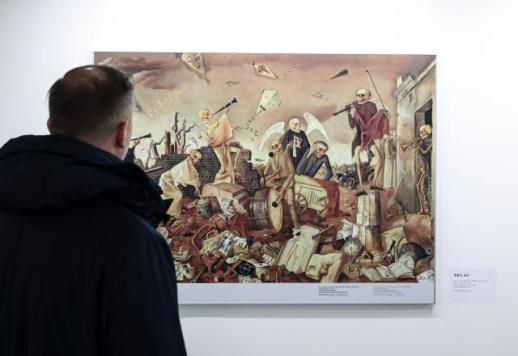 Remembrance as an obligation: Nussbaum exhibit in Seoul SEOUL, January 28 (AJP) -Silence settled over the Democracy Movement Memorial Hall in Seoul on Jan. 27, as the Israeli and German embassies came together to mark International Holocaust Remembrance Day. Beneath the vaulted stillness of the space, remembrance took shape not through speeches alone, but through the collective pause of those gathered. Around 150 people — diplomats, scholars and ordinary citizens — stood in quiet attention, their faces composed, their gazes drawn inward as much as toward the images before them. In the absence of sound, memory did the speaking. Titled “Remembering for the Future,” the special exhibition traces the fragile boundary between civilization and its collapse. Works by Jewish-German artist Felix Nussbaum, painted in exile and fear, confront visitors with fractured bodies and haunted landscapes. Nearby, images from “The Auschwitz Album,” preserved by the Yad Vashem World Holocaust Remembrance Center, document lives suspended between arrival and annihilation — moments captured just before history closed in. International Holocaust Remembrance Day, designated by the United Nations in 2005, calls not only for mourning the dead but for vigilance among the living — a reminder that human dignity, once stripped away, is difficult to reclaim. The exhibition will remain open to the public free of charge from Jan. 28 to March 15, inviting visitors to linger, to look, and to bear witness — not as an act of the past, but as a responsibility carried forward. 2026-01-28 19:39:22
 -
 HiteJinro Sales and Operating Profit Fall as Alcohol Demand Slumps HiteJinro said weaker alcohol consumption pushed down both revenue and operating profit last year. According to a filing on the electronic disclosure system on Tuesday, the company’s consolidated operating profit fell 17.3% from a year earlier to 172.1 billion won, down from 208.1 billion won. Revenue slipped 3.9% to 2.4986 trillion won from 2.5992 trillion won. Net profit dropped 57.3% to 408.5 billion won from 957.4 billion won. HiteJinro said the overall alcohol market shrank and its top line continued to decline, leading to a sharp fall in operating profit. It said the revenue decline was relatively limited despite the broader market downturn. A company official said, “Despite the overall contraction in alcohol consumption, we minimized the decline in revenue,” adding that it plans to pursue market-boosting efforts this year and step up its push into overseas markets.* This article has been translated by AI. 2026-01-28 19:27:00
 -
 Samcheok City Council Reviews 2026 Work Plans, Seeks Solutions on Local Issues Samcheok’s City Council on Tuesday held the fifth plenary session of its 269th extraordinary meeting, receiving 2026 major work-plan briefings from six departments, including the economy division, and debating local issues and development priorities. Council members offered proposals on boosting the local economy, youth policy, tourism infrastructure, traditional-market revitalization and improvements to the education environment. Council member Kim Hee Chang called for measures such as improving traditional-market facilities and expanding incentives for the Samcheok Love Card to upgrade the markets’ image and increase use. He also urged the city to maximize floor-to-ceiling height in any redevelopment of the current Samcheok Medical Center site to improve space efficiency, and to ensure a private developer is selected with the financial capacity and project experience to deliver the work. Council member Kim Won Hak proposed turning the second floor and rooftop of the Central Market’s main building into resident-friendly spaces to draw visitors and increase market use. He also said the city should expand its “day to meet abandoned animals” into an event that includes both pets and abandoned animals, developing it into a community festival to improve awareness and promote adoption. Council Chair Kwon Jeong Bok said that as teenagers increasingly use debit cards in daily life, the city should consider easing the minimum age requirement for issuing the Samcheok Love Card to encourage youth participation in economic activity. Council member Lee Gwang Woo asked officials to visit Central Market to check operations during peak tourist hours, identify needed improvements and use the findings to craft steps to attract more weekday visitors. Council member Jeong Yeon Cheol said the Nogok branch school revitalization project should go beyond reusing the closed school and pursue development linked to the broader area. Council member Kim Jae Gu called for identifying more effective youth policies, including support for the cost of obtaining a driver’s license, to improve conditions for young people to settle in the city. On the relocation of the Samcheok Fire Station, he said access roads and pedestrian paths at the new site should be designed with safety and convenience in mind. Council member Jeong Jeong Sun urged the city to link the detailed programs under its private-sector job-creation support initiative so they build a system for stable employment. She also called for a temporary-use plan to prevent hollowing out of the area during the redevelopment period for the Samcheok Medical Center site. Council member Yang Hui Jeon asked the city to expand convenience measures at Central Market, including small carts, mobility assistance services and improved pedestrian routes. He also requested that planners consider adding a small public bathhouse as part of the Nogok branch school project aimed at easing inconvenience for local residents. * This article has been translated by AI. 2026-01-28 19:24:00
 -
 Prosecutor criticizes acquittal in Deutsche Motors stock manipulation case Kim Tae Hoon, chief prosecutor of the Daejeon High Prosecutors Office who led the investigation into the Deutsche Motors stock manipulation case under the Moon Jae-in government, criticized a trial court ruling that acquitted first lady Kim Keon Hee of violating capital markets law, calling it an “unfair decision.” Kim posted his statement Tuesday on the prosecution’s internal network, e-Pros, under the title, “As a member of the first Deutsche Motors investigation team, I share my view on this ruling.” He said the court acknowledged Kim Keon Hee’s awareness of the stock manipulation but still found her not guilty as a joint principal offender. He argued that conclusion is hard to accept in light of earlier rulings that found former Deutsche Motors chairman Kwon Oh Soo and former Black Pearl Invest CEO Lee Jong Ho guilty, as well as legal principles on joint offenders and continuing offenses. Kim said earlier rulings found that Kim Keon Hee took part in multiple matched-order trades, citing a sell order for 100,000 shares on Oct. 28, 2010, and a large sell order on Nov. 1, 2010, known as the “7-second trade.” He also said earlier rulings recognized that 2 billion won Kim provided to Black Pearl was used as key funding for the manipulation scheme. “Even though it was confirmed that matched orders and large-scale buying using Kim Keon Hee’s funds contributed to the price increase, not recognizing her as a joint principal offender runs counter to precedent that joint liability can be established through functional control based on a division of roles,” he wrote. He also challenged the court’s statute-of-limitations analysis. Citing precedent, he said that even if an accomplice participated in only part of a continuing offense, the limitations period runs from the end of the overall crime, not from each individual act. He argued the court’s decision to separate acts from October 2010 to January 2011 and find the limitations period had expired conflicts with established legal principles. “As a member of the first investigation team that investigated the Deutsche Motors stock manipulation accomplices and indicted them in custody, I find it difficult to accept this acquittal,” he wrote, adding that he hopes it will be corrected on appeal. On Tuesday, the Seoul Central District Court’s Criminal Division 27, led by Presiding Judge Woo In Sung, sentenced Kim Keon Hee to 1 year and 8 months in prison on a separate charge of receiving improper solicitations. But it acquitted her of violating the Capital Markets Act, saying it was difficult to conclude she carried out the crime as a joint principal offender with the price-manipulation group.* This article has been translated by AI. 2026-01-28 19:18:00