

Journalist

CGTN
-
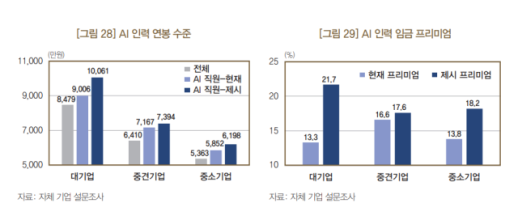 Low pay for AI talent is driving skilled workers overseas, BOK warns SEOUL, December 05 (AJP) - South Korea offers the lowest wage premiums for artificial intelligence specialists among major advanced economies, placing the country at a disadvantage in the global battle for high-tech talent, the Bank of Korea said in a report released Friday. The analysis, presented at a seminar co-hosted with the Korea Chamber of Commerce and Industry, called for upgrading compensation systems and research environments to meet international standards. Using data from LinkedIn profiles compiled by Revelio Labs, the report estimated South Korea had about 57,000 AI-skilled workers last year — more than double the 27,000 recorded in 2010 but far behind the United States (780,000), the United Kingdom (110,000) and France (70,000). South Korean AI professionals earned only a 6 percent wage premium over non-AI workers, compared with 25 percent in the U.S. and 18 percent in Canada. Wage premiums were higher in specialized fields such as pattern recognition and neuroscience, but remained low in core areas such as deep learning and machine learning. The weak premium has contributed to a persistent talent drain. Except for 2020, South Korea recorded a net outflow of AI professionals every year from 2010 to 2024. Last year, about 11,000 South Korean AI specialists were working overseas, including 6,300 in the U.S. “The high rate of overseas employment among workers facing low domestic wage premiums suggests a clear link between compensation and international mobility,” said Oh Sam-il, one of the report’s authors. “South Korea is losing ground in the global competition for AI talent.” Oh said rigid wage structures and intense global competition are suppressing domestic premiums. He urged the government and companies to focus on improving career development pathways and offering competitive compensation packages to retain and attract top-tier AI professionals. * This article, published by Aju Business Daily, was translated by AI and edited by AJP. 2025-12-05 16:28:36
 -
 OPINION: Massive data breaches expose urgent need for stronger security and accountability SEOUL, December 5 (AJP) - In early 2026, a man received a phone call from an unknown caller who appeared to know every detail about him, including his home address, online habits, and shopping patterns. This incident shows how phishing has evolved from random attacks to highly targeted schemes that exploit detailed personal information. Massive data breaches have affected millions in South Korea, involving major companies such as Coupang and SK Telecom. Similar incidents in the public sector are also on the rise, with more than 100 cases reported last year alone. Despite South Korea's technological prowess, personal data remains highly vulnerable. The maximum compensation for data breaches is usually around 100,000 Korean won per person, regardless of the extent of data leaked, as proving corporate negligence is quite challenging for victims, leading to limited accountability. The maximum compensation for data breaches is usually around 100,000 Korean won per person, regardless of the extent of the data leaked, because victims often struggle to prove corporate negligence, resulting in limited accountability. Although fines and penalties have increased recently, most victims are barely compensated. Companies often treat such breaches as a cost of doing business and face only administrative orders, with fines flowing to state coffers rather than victims. To address this issue, punitive damages must be effectively implemented. Current stringent requirements for proving intent or negligence make it difficult for individuals to succeed in lawsuits, which are particularly unsuitable for cases like large-scale data breaches. Legal systems must evolve to meet the challenges of a rapidly changing era. Coupang's latest data leak exposes serious gaps in security measures and legal compliance, even as companies continue to accumulate vast amounts of sensitive personal information. It is not just about preventing hacking or data leaks, it is about ensuring that companies invest in security measures and provide adequate compensation. Without these changes, data breaches will continue. * This article, published by Aju Business Daily, was translated by AI. 2025-12-05 16:03:04
 -
 SK's battery recycling technology published in international journal SEOUL, December 05 (AJP) - South Korea's SK Innovation said Friday its lithium iron phosphate (LFP) battery recycling technology has been published in the international journal Separation and Purification Technology. The company said conventional recycling processes for LFP batteries have struggled with environmental and cost burdens, including byproduct treatment and wastewater generation. Its newly developed method uses only water, carbon dioxide and hydrogen peroxide to selectively extract high-purity lithium carbonate, eliminating the need for harsher chemicals. SK Innovation described the process as an eco-friendly solution that overcomes long-standing challenges in LFP recycling. The company expects the technology to support the broader battery ecosystem by reducing environmental impact while enabling more efficient resource recovery. SK On, SK Innovation’s battery-making unit, is preparing to manufacture pouch-type LFP cells for EVs and energy storage system applications. As LFP adoption accelerates, industry officials say securing stable recycling channels — particularly for lithium recovery — has become a critical element of supply-chain resilience and cost competitiveness. “This achievement surpasses the limitations of existing battery recycling methods and is a key technology for sustainable battery market growth,” said Kim Pil-seok, head of SK Innovation’s Environmental Science and Technology Institute. “By stably recovering high-purity lithium carbonate, we aim to mitigate lithium supply risks and expand collaboration with domestic and international battery makers and recyclers.” * This article, published by Aju Business Daily, was translated by AI and edited by AJP. 2025-12-05 16:01:29
 -
 PHOTOS: Snow-covered Hallasan SEOUL, December 05 (AJP) - Snowfall that began in the mountainous areas of Jeju on December 4 left Baengnokdam and the 1,100-meter plateau covered in white by the morning of December 5. 2025-12-05 15:48:32
 -
 PHOTOS: Seoul turns white after the season's first snow SEOUL, December 05 (AJP) - Seoul woke up white after an overnight snowfall that began during the evening commute. The city saw its first snow of 2025 last night — two weeks later than average and eight days later than last year. Streets whitened quickly as cars crawled through Gwanghwamun and people walked with their shoulders tucked in against the cold. Snowfall reached 1 to 3 centimeters per hour, with bursts of more than 5 centimeters, coating palace roofs and drifting through the lights of the city. In just a short time, the first snow carried Seoul fully into winter. A heavy-snow alert was issued, and emergency warnings were sent across Seoul and Gyeonggi Province. Some areas saw more than 5 centimeters an hour, leading to traffic delays and icy roads. Many people slipped on frozen sidewalks, and cars slowed through streets where snow removal could not keep up. Morning temperatures fell to minus 6 degrees Celsius, turning much of the snow into packed ice. Even so, many stepped outside to enjoy the white scenery, choosing to face the cold to take in the first snow of the season. 2025-12-05 15:30:59
 -
 PHOTOS: Seoul's royal shrine caught in clash between history and modernization SEOUL, December 04 (AJP) - On a frigid day in early December, a profound silence settles over the Jongmyo Shrine in the heart of Seoul, broken only by the crunch of footsteps on the stone paths. Though a steady stream of tourists, drawn by its status as a UNESCO World Heritage site, still visits, the ancient royal sanctuary has been swept into a very modern controversy: a pitched battle over redevelopment and the city's skyline. The Seoul Metropolitan Government’s proposal to ease height restrictions in the adjacent Sewoon Commercial District has pitted preservationists against developers, making this solemn space for the spirit tablets of Joseon Dynasty royalty the frontline in a debate about South Korea's future. The stakes are immense: is Seoul willing to sacrifice a 600-year-old traditional scenic axis — the view lines stretching to Bugaksan and Namsan — for the sake of urban revitalization? For international visitors, Jongmyo is best known for the Jongmyo Jerye (Royal Ancestral Rite) and Jeryeak (Ritual Music), a performance tradition recognized globally. Yet, the shrine's true weight — its symbolic status in a Confucian-rooted nation — is often underappreciated. Founded in 1395, Jongmyo was not merely a memorial; it was the spiritual anchor of the Joseon royal legitimacy. Protecting this house of spirits was synonymous with guarding the nation's destiny. Its main hall, the Jeongjeon, stands as one of the world's longest single wooden structures, an architectural marvel whose restrained, simple lines perfectly capture the aesthetic principles of Joseon architecture. The entire precinct, with its forests and sacred stone walkways, remains a profound sanctuary. The current flashpoint lies where history and the metropolis converge. Advocates for development argue that relaxing height limits is essential to inject life into the aging Sewoon district. Preservationists counter that new high-rises will irrevocably harm the sanctuary's sightlines, desecrating a vital piece of the nation's heritage. The collision of a rapidly modernizing city and its deep historical roots is a problem unique to Seoul, and it’s now centered on the distance between Jongmyo and the Sewoon district. Despite enduring wars and fires across six centuries, the Jeongjeon architecture and the ancestral rites persist. Even though the dynasty vanished, the Jerye ceremonies continue today, held every May and November. As the colorful spectacle of K-Pop and K-dramas spreads globally, the world's fascination with South Korean culture only deepens. That global interest provides a timely opportunity to turn attention to Jongmyo from which modern Korean identity sprang. Jongmyo is a place of powerful, resonant silence, where the deep current of Joseon’s time still flows, challenging the city to remember its past. 2025-12-05 15:26:38
 -
 Breakout success of ARC Raiders paves the way for Korean style extraction shooting SEOUL, December 05 (AJP) - Nexon's ARC Raiders has crossed 7 million global sales just over a month after launch, spawning the rise of what industry watchers are calling a new "K-extraction shooter" genre defined by communal play, lower violence and robot-target gun-down. Developed by Nexon subsidiary Embark Studios, ARC Raiders logged 400,000 cumulative sales within two weeks of its Oct. 30 release. Steam concurrency rose from 350,000 in the first weekend to 480,000 by week three, signaling durable demand rather than an early-launch spike. The extraction shooter format—where players risk losing all collected items upon death—has traditionally remained a niche, high-pressure genre. The brutal penalty system attracted dedicated enthusiasts but deterred broader audiences. ARC Raiders dismantles that barrier with a free-loadout system giving all players basic weapons and recovery items at no cost, softening the sting of failure and encouraging experimentation. The shift to a third-person perspective—rare in extraction shooters dominated by first-person modes—creates a wider field of view suited to its heavy PvE structure, where squads or solo raiders fight imposing AI-trained robotic enemies called Arcs. Just as notable is the community culture reshaping the game. Instead of the cutthroat PvP typical of the genre, players increasingly signal truces with in-game emotes and form spontaneous alliances to fight towering robot bosses. "It's more psychologically layered than your typical run-and-gun shooter," said Lee Jae-hyeong, a 27-year-old player. "Do I pull the trigger, or do we haul the loot together? The satisfaction comes from playing the long game." Steam forums brim with stories of strangers forming temporary groups of three to five to tackle high-tier enemies. Solo lobbies, players say, are filled with "overly friendly" raiders who naturally lean toward cooperation. The official Discord server has surged to roughly 683,000 members, generating faction groups and informal codes of conduct. One faction, the "Civilians of Speranza," drafted internal rules prohibiting PvP, requiring members to revive downed players, and mandating a uniform. Steam achievement data shows about 17 percent of PC players have never knocked out another raider, and more than half engage in minimal PvP—opting instead for robot hunting and resource gathering. The community's unofficial mantra, "It's us against the clankers, gentlemen," captures the game's human-versus-robot ethos. Critical reception has been equally strong. IGN awarded ARC Raiders a score of nine out of ten, calling it the new standard for extraction shooters, while GameSpot praised it as "totally unpredictable, immersive, thrilling." On Steam, about 209,000 user reviews show an 89 percent positive rating. The title topped Steam sales charts across Asian markets including South Korea, Japan, Taiwan and Thailand. "We are delighted that many players have praised ARC Raiders for its accessible design that lowers entry barriers and its high level of immersion," a Nexon spokesperson told AJP. "It is truly meaningful that the game earned a nomination for The Game Awards less than a month after launch. We will continue to do our best to deliver quality service." The breakout success is fueling broader interest in Korean-made extraction shooters. Krafton will run the first closed alpha test for PUBG: Black Budget on Dec. 12–14 and Dec. 19–21. The first-person extraction title is set on an island permeated with supernatural phenomena, leveraging Battlegrounds intellectual property to draw global fans. Kakao Games subsidiary XL Games will roll out The Cube, Save Us in the first quarter of next year. The large-scale extraction action game supports up to 63 players competing to gather resources inside a massive alien-made cube while battling monsters and rival players. WemadeMax is preparing a January early-access launch on Steam for Midnight Walkers, a zombie-apocalypse extraction shooter that has already accumulated around 300,000 wishlists, emphasizing night exploration and high-tension survival. The cluster of upcoming releases points to a fast-forming K-extraction shooter ecosystem—one that blends Korean-style cooperative culture with hardcore genre mechanics, widening the appeal of a once-exclusive category for global audiences. 2025-12-05 15:12:39
 -
 Coupang sees drop in daily users after massive data breach SEOUL, December 5 (AJP) - Coupang, South Korea's leading e-commerce giant, has been seeing a drop in daily users after a massive data breach was detected late last month. According to an analysis by market researcher IGAWorks on Thursday, Coupang's daily active users fell to 17.80 million last Tuesday, down from a record 17.98 million the previous day. This marks the first decline after three consecutive days of increase since last Saturday, despite the breach. With daily users still above 17 million, many customers appear to continue using the platform, either overlooking the risk of a data leak for convenience or finding it difficult to switch to alternative platforms for daily necessities. But industry observers believe many users will gradually leave the platform, attributing last week's initial surge in logins to those rushing to change their passwords or close their accounts following the breach. Meanwhile, many users have been complaining about difficulties terminating their accounts, which involves a lengthy process including verification of personal information. The Korea Communications Commission (KCC) is investigating whether the process may infringe on users' rights to discontinue services. The breach was initially believed to affect around 4,500 users but was later revealed to impact more than 33.70 million. * This article, published by Aju Business Daily, was translated by AI and edited by AJP. 2025-12-05 15:06:58
 -
 Amazon executive, South Korea's AI officials explore cooperation SEOUL, December 05 (AJP) - South Korea’s AI Strategy Committee said Friday that David Zapolsky, Amazon’s senior vice president for global public policy and legal affairs, has visited the committee's vice chairman, Lim Moon-young, to discuss cooperation on artificial intelligence and cloud infrastructure. During the meeting, Amazon outlined its ongoing investments in AI and cloud services in South Korea and discussed potential collaboration on the government’s “AI highway” project and building data infrastructure. The company also highlighted its commitment to supporting local businesses with advanced computing capacity and cloud-based AI development. The two sides also reviewed plans Amazon announced at the APEC CEO Summit in October to invest 7 trillion won ($5.3 billion) in AI data centers and cloud infrastructure between 2025 and 2031, with a focus on deepening ties with South Korea’s AI ecosystem. “Building an AI highway is essential to fostering an innovation ecosystem,” Lim said, stressing that Amazon’s large-scale investment could help position South Korea as a global hub for AI infrastructure. * This article, published by Aju Business Daily, was translated by AI and edited by AJP. 2025-12-05 14:51:08
 -
 Korea to up crackdown on drug trafficking on record smuggling SEOUL, December 05 (AJP) - South Korean authorities will up border control and crack down on drug trafficking after seizing a record 3,000 kilograms of illicit substances this year, mostly brought in through smuggling channels. The Korea Customs Service (KCS) said Friday it confiscated 2,913 kilograms of illegal drugs between January and October, nearly quadruple the volume seized during the same period last year. The surge underscores what officials describe as the sharpest escalation in smuggling attempts in recent years. Air travelers accounted for the most cases, with 505 detected attempts, while substantial quantities were also intercepted in express cargo shipments and international mail. Southeast Asia remained the dominant source of inflows, with Cambodia and Laos emerging as fast-growing hubs for trafficking routes targeting Korea. “Because most illegal drugs distributed domestically originate from overseas smuggling, we will move quickly to strengthen pre-emptive border-control measures,” KCS Commissioner Lee Myeong-ku said. To bolster enforcement, the KCS will launch joint operations with 10 countries where trafficking activity has been most pronounced. Korea’s existing cooperation with Thailand, Vietnam, Malaysia, the United States and the Netherlands will now expand to include Cambodia, Laos, Canada, Germany and France. Under the plan, participating nations will station customs officers in each other’s airports and border offices to jointly screen high-risk travelers and cargo. The agency said it has also agreed with Cambodia to conduct coordinated anti-smuggling operations following an emergency meeting between the two sides, amid mounting concerns over organized criminal networks operating across the region. Korea recently imposed a travel ban and raised advisories for several Cambodian cities after a spike in online scam syndicates and drug-related crimes involving Korean nationals. *This article, published by Economic Daily, was translated by AI and edited by AJP. 2025-12-05 14:35:47