

Journalist

CGTN
-
 Heavy snow advisory issued for Jeju's mountainous areas SEOUL, December 3 (AJP) - A heavy snow advisory was issued for the mountainous areas of the southern resort island of Jeju, the Korea Meteorological Administration (KMA) said on Wednesday. Such an advisory is issued when more than 5 centimeters of snowfall is expected within 24 hours, warning pedestrians and drivers to exercise extra caution. A strong wind advisory also remains in place for most parts of Jeju. Meanwhile, biting cold swept across the country, with morning lows at -9 degrees Celsius in Seoul, -1 degrees in Busan, and -12 degrees in Gwangju. In Seoul, a cold wave advisory was issued for all 21 districts and surrounding areas the previous day, as morning temperatures were expected to plunge by more than 10 degrees. According to KMA, Seoul is likely to see the season's first snowfall on Thursday. 2025-12-03 14:40:23
 -
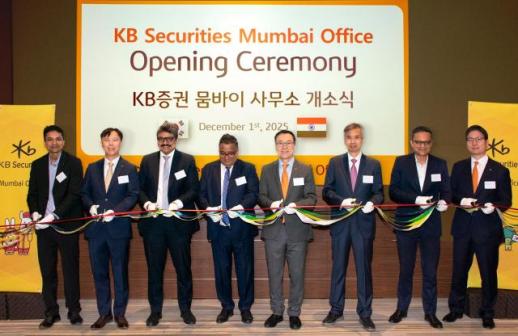 South Korea's KB Securities opens Mumbai office to tap India's financial markets SEOUL, December 03 (AJP) - South Korea’s KB Securities has formally opened an office in Mumbai, marking its entry into India’s fast-growing financial market. The new office is located in Lower Parel, positioned between Mumbai’s traditional business center of Nariman Point and the Bandra Kurla Complex (BKC), the city’s financial hub. KB Securities said the branch will focus on exploring investment opportunities and strengthening its presence in India’s capital markets. The opening ceremony, held on Dec. 1, was attended by senior figures including Yoo Dong-wan, South Korea’s consul general in Mumbai, and Rohit Kumar, head of business development at the National Stock Exchange of India. The firm said in a press release that the Mumbai branch will serve as a base for securing M&A and equity investment opportunities, adding that the firm aims to link its global business expertise with India’s growth potential through close cooperation with local financial institutions and regulators. * This article, published by Aju Business Daily, was translated by AI and edited by AJP. 2025-12-03 14:39:26
 -
 Hanwha Aerospace wins second contract for Cheongeom air-to-ground missiles SEOUL, December 03 (AJP) - South Korea’s Hanwha Aerospace said on Wednesday it has signed a second production contract with the Defense Acquisition Program Administration (DAPA) to supply additional Cheongeom air-to-ground missiles, in a deal valued at 225.4 billion won ($170 million). The new order follows an earlier 162.3 billion won contract, bringing total procurement for the program to 387.7 billion won. Deliveries of the missiles and launchers to the South Korean military are scheduled by 2028, the company said. The Cheongeom — the country’s first domestically developed air-to-ground missile — was completed in 2022, with Hanwha serving as the prototype manufacturer. The precision-guided weapon is equipped with a dual-mode seeker enabling day- and night-time targeting and a wired data link designed to enhance resistance to jamming. It also supports post-launch target updates to adapt to changing battlefield conditions. Hanwha is working to expand deployment options for the missile, including integration with manned and unmanned ground vehicles. A lighter variant, the Cheongeom-L, is under development for infantry units and for installation on armored vehicles and tanks. “We aim to support stable mass production and diversify operational platforms, contributing to South Korea’s defense capabilities while pursuing tailored export opportunities,” Hanwha Aerospace said in a press release. * This article, published by Aju Business Daily, was translated by AI and edited by AJP. 2025-12-03 13:55:39
 -
 Korea's life expectancy rises to 83.7, outliving OECD average SEOUL, December 03 (AJP) - South Koreans born last year are expected to live up to 83.7 years on average, outpacing the OECD average, according to the 2024 Life Table released by the Ministry of Data and Statistics on Wednesday. Life expectancy for men reached 80.8 years and for women 86.6 years, each up 0.2 years from the previous year. The gender gap has continued to narrow since peaking in 1985, now standing at 5.8 years. For those already aged 60, men are expected to live another 23.7 years and women 28.4 years, marking increases of 0.3 years and 0.2 years, respectively. South Korean men now live 2.3 years longer than the OECD male average of 78.5 years, while Korean women exceed the OECD female average by 2.9 years. Cancer continues to be the leading cause of deaths in Korea, accounting for 19.5% of lifetime mortality risk, followed by pneumonia (10.2%), heart disease (10.0%), and cerebrovascular disease (6.9%). The likelihood of dying from cancer and pneumonia has increased, while COVID-19 mortality has declined sharply. Over the past decade, pneumonia has shown the steepest rise in death rates for both men and women. As people age, the risk of dying from pneumonia, heart disease, sepsis, and Alzheimer’s disease rises, whereas risks from suicide and accidents fall. Removing cancer from the mortality profile would extend life expectancy by 3.3 years; eliminating heart disease would add 1.2 years, and removing pneumonia would add 1.0 year. Healthy life expectancy — the number of years a newborn can expect to live without illness — stood at 65.5 years, while subjective healthy life expectancy was 73.8 years. * This article, published by Aju Business Daily, was translated by AI and edited by AJP. 2025-12-03 13:20:02
 -
 Korea's GDP fared better than expected in Q3, nominal GNI falls on sharp won weakening SEOUL, December 03 (AJP) - South Korea's economy grew faster than earlier estimated on the back of stronger capital investment, but its nominal income declined against a strong dollar, reflecting the Korean won’s status as one of the weakest performers among major traders. According to the Bank of Korea (BOK) on Wednesday, real gross domestic product increased 1.3 percent from the previous quarter — the strongest since the fourth quarter of 2021 — accelerating from the 0.7 percent gain in the second quarter and 1.2 percent in preliminary data. Against a year-ago period, real GDP expanded 1.8 percent, setting the economy on track to meet this year's revised annual growth target of 1.0 percent. The economy added 1.6 percent in the second quarter and zero growth in the first. The upward revision owed to increases in construction investment (0.6 percent), facilities investment (2.6 percent), and intellectual property investment (1.2 percent), the BOK said. Other data on the domestic front also showed improvements. Private consumption grew 1.3 percent, driven by gains in both goods, such as passenger cars, and services, such as dining out. Government expenditure increased by 1.3 percent, centered on the cost of goods and health insurance benefits. The external environment, however, turned dim. Exports expanded 2.1 percent, slowing from the 4.5 percent growth in the second quarter, while imports also slowed to 2.0 percent from 4.2 percent in the second quarter. In nominal terms, GDP added just 0.7 percent, compared to 2 percent in the second quarter, placing gross operating surplus growth at 0.8 percent versus 4 percent previously, due to the strength of the dollar against the Korean won, which fell around 6 percent in the third quarter. The GDP deflator, which reflects the level of prices, rose by 2.7 percent. The gross national income (GNI) in nominal terms decreased 0.3 percent from the previous quarter. The fall was significantly impacted by the shrinkage in net factor income from the rest of the world (NFIA) — the difference between the country’s earnings from foreign investments and payments made to foreign investors — which fell from 14.1 trillion won ($9.6 billion) to 8 trillion won. In real terms, GNI rose 0.8 percent from the previous quarter, marking a slight slowdown from the 1 percent increase recorded in the second quarter. The deterioration in the terms of trade also contributed to sluggish GNI, with the real loss on terms of trade widening from 8.6 trillion won ($5.86 billion) to 10.3 trillion won. Real net factor income from the rest of the world also added downward pressure, declining from 10.2 trillion won in the second quarter to 8.6 trillion won in the third quarter. Gross national income fell 0.1 percent. Both the savings rate and the investment rate declined, painting a darker picture for the economy moving forward. The gross saving ratio fell 1.2 percentage points to 34.4 percent, while the net household saving ratio inched up 0.1 percentage point to 8.9 percent. The gross national investment ratio also fell 0.2 percentage point sequentially to 28.6 percent. 2025-12-03 11:47:37
 -
 KOSPI bounces above 4,000 in broad mixed Asia markets SEOUL, December 03 (AJP) - South Korea’s benchmark KOSPI climbed back above the 4,000 level on Wednesday, supported by overnight gains on Wall Street. In Seoul, the KOSPI rose 1.1 percent to 4,039.21 as of 10:08 a.m., recovering the 4,000 mark for the first time in nine sessions. The tech-heavy KOSDAQ added 0.3 percent to 930.74. Among blue chips, Samsung Electronics advanced 1.9 percent to 105,350 won ($71), while SK hynix slipped 0.3 percent to 556,500 won. Except for SK hynix, all of the top 10 stocks by market capitalization traded higher. Samsung C&T jumped 10 percent to 247,000 won, the biggest gainer among the top 50 firms. The rally followed news that Hong Ra-hee, widow of the late Samsung Group Chairman Lee Kun-hee, will donate her entire 1.06 percent stake in Samsung C&T to her son, Samsung Electronics Chairman Lee Jae-yong. After the share transfer, Lee’s stake in Samsung C&T will rise from 19.93 percent to 20.99 percent, while Hong’s holdings will drop to zero. Hong had inherited the stake in 2021 after her husband’s death, with the shares valued at roughly 400 billion won ($272 million). Entertainment stocks were mixed: HYBE gained 0.2 percent to 298,500 won, YG Entertainment added 0.2 percent to 62,900 won, while JYP Entertainment edged down 0.2 percent to 68,500 won and SM Entertainment lost 1.1 percent to 105,700 won. Overnight, U.S. stocks advanced as buying in tech shares lifted all three major indexes. The Philadelphia Semiconductor Index gained 1.8 percent as Nvidia rose 0.9 percent. In Japan, the Nikkei 225 rose 0.7 percent to 49,664.16, though Toyota Motor shares fell 1.3 percent to 3,007 yen ($19). Honda declined 0.4 percent to 1,508 yen, Sony dropped 0.8 percent to 4,406 yen and Nintendo slid 1.2 percent to 12,705 yen. SoftBank gained 2.9 percent to 16,125 yen. China’s Shanghai Composite slipped 0.2 percent to 3,889.45, and Hong Kong’s Hang Seng Index fell 0.8 percent to 25,889.32. 2025-12-03 11:44:09
 -
 PHOTOS: One year since martial law crisis SEOUL, December 03 (AJP) - South Korea on Wednesday marked the first anniversary of the martial law decree imposed by former President Yoon Suk Yeol. President Lee Jae Myung used his address to the nation to reflect on the unprecedented crisis and highlight the role of citizens in defending the constitutional order. "The fact that our citizens peacefully defeated the illegal martial law and expelled the unjust power is a monumental event that will be eternally remembered in the history of world democracy," President Lee said. He added that the attempted coup "paradoxically served as an opportunity to announce the remarkable resilience of South Korean democracy to the entire world." To commemorate the anniversary and the powerful display of civic action, the National Assembly is hosting a three-day series of events titled "Democracy of Light, An Unfading Memory." The commemorative activities, which run from Dec. 3 to 5, include guided tours of key sites within the Assembly compound related to the crisis. These locations include the main gate where citizens confronted martial law troops and the Assembly field where a military helicopter landed. 2025-12-03 11:30:16
 -
 Former president shares thoughts on martial law debacle, urges stronger democracy SEOUL, December 3 (AJP) - Former President Moon Jae-in shared his thoughts on social media on Wednesday, joining others in marking last year's martial law debacle that plunged the country into political turmoil. "I am very proud of our citizens who defended democracy and demonstrated the country's remarkable democratic resilience to the world," Moon wrote on Facebook. But he pointed out, "The forces behind have shown no remorse" and urged "continued vigilance," stressing the need to strive for a "strong democracy that cannot be shaken." Apparently referring to disgraced former President Yoon Suk Yeol and the conservative People Power Party (PPP), Moon said, "Those responsible, who shocked and angered South Korean society, have yet to apologize." He also warned that political extremism, which fuels hatred and division, poses a serious threat to democratic values. He expressed his belief that democracy is strengthened through trials and challenges, urging everyone to remember the lessons from a year ago and work toward a "stronger democracy." * This article, published by Aju Business Daily, was translated by AI and edited by AJP. 2025-12-03 11:22:51
 -
 South Korea's Doosan Bobcat files 14 patent suits against US machinery maker Caterpillar SEOUL, December 03 (AJP) - Doosan Bobcat’s North American unit has filed a series of patent infringement lawsuits against U.S. construction machinery maker Caterpillar. The company said Wednesday it has lodged complaints covering 14 patents with the U.S. District Court for the Eastern District of Texas, the U.S. International Trade Commission, the Unified Patent Court in Europe, and a federal court in Germany. “The patents in this lawsuit protect unique features of our construction equipment, including mobility, performance and precision,” a Doosan Bobcat spokesperson said. “We initiated this action to safeguard our patented technologies and ensure fair competition in the market.” * This article, published by Aju Business Daily, was translated by AI and edited by AJP. 2025-12-03 10:55:36
 -
 Hanwha Systems plans to develop Korea's first homegrown satellite semiconductor SEOUL, December 03 (AJP) - Hanwha Systems has launched development of what it says will be South Korea’s first satellite semiconductor built entirely with domestic technology, marking a major step toward self-reliance in defense-oriented space systems. The company said Wednesday it has signed an agreement with the Defense Technology Promotion Research Institute to co-develop “transceiver space semiconductor technology for (ultra) small-satellite multi-channel beamforming systems.” The transceiver semiconductor will serve as a core component for South Korea’s planned military low earth orbit (LEO) satellite communications network, enabling stable ground-to-space links in extreme environments. Defense-grade semiconductors used in systems such as missiles and radar require far higher reliability and durability than commercial chips. A key feature of the new device is its support for digital beamforming, which concentrates signals toward specific receivers rather than dispersing them. Digital processing enables precise, real-time beam control and offers more stable, high-speed and high-capacity communications than analog-based systems, the company said. Designed with multiple channels to improve frequency efficiency and reduce space requirements, the semiconductor can operate with fewer components and can be mounted on small communications satellites. Military LEO communications — sometimes described as “military space internet” — provide resilient, high-speed connectivity regardless of location. Operating at altitudes of 500 to 1,200 kilometers, LEO constellations can support stable communications during peacetime and act as a last-resort link during wartime. Hanwha Systems in 2023 began work on a commercial LEO-based communications system tailored for South Korea’s military, integrating existing tactical networks with satellite links. The new semiconductor program is expected to accelerate domestic production of LEO communications satellites, which currently rely heavily on U.S. and European technology. “This development brings us closer to achieving a self-reliant K-space defense,” Hanwha Systems said in a press release. “Hanwha Systems is committed to advancing the localization of South Korea’s strategic space assets.” * This article, published by Aju Business Daily, was translated by AI and edited by AJP. 2025-12-03 10:27:16