

Journalist

CGTN
-
 SK hynix owed 70% to US and 25% to Nvidia for record 2025 sales SEOUL, March 17 (AJP) - SK hynix has effectively pivoted into an American-centric powerhouse, with nearly 70 percent of its record-breaking 2025 revenue originating from U.S. customers, with NVIDIA alone accounting for a quarter, according to its annual business report released Tuesday. The fiscal transformation, fueled by an insatiable appetite for High Bandwidth Memory (HBM) among Silicon Valley giants, pushed the company into a "net cash" position for the first time in six years. Cash and cash equivalents skyrocketed by 146.8 percent to 34.94 trillion won (approximately $26.47 billion), far outstripping its total debt of 22.25 trillion won (approximately $16.86 billion). The American Surge The report underscores a dramatic shift in the company’s geographic footprint. Revenue from the U.S. market hit 66.89 trillion won ($50.67 billion) in 2025, a staggering jump from previous years when the U.S. share hovered between 39 percent and 53 percent. This 68.9 percent revenue concentration in the U.S. highlights the success of SK hynix’s strategy to tether its fate to the North American AI infrastructure build-out. While China sales grew to 19.14 trillion won (approximately $14.50 billion), the U.S. market expanded by more than 47 trillion won in a single year, widening the gap between the two regions to an all-time high. The NVIDIA Anchor Central to this U.S. dominance is a tightening grip on the supply chain for NVIDIA. SK hynix generated an estimated 23.26 trillion won ($17.62 billion) from the California-based AI leader alone—accounting for nearly a quarter (23.9 percent) of its total global sales. Following its success as a primary supplier of HBM3E, the company is now accelerating its transition to next-generation HBM4.The improved financial liquidity, characterized by a debt-to-equity ratio that fell to 45.95 percent from 62.15 percent, provides the necessary capital to lead the high-stakes AI memory race. Financial Fortification This robust cash flow is now being channeled into a massive R&D push. SK hynix reported a 35.9 percent increase in research and development spending, reaching 6.73 trillion won ($5.10 billion) in 2025. This record investment specifically targets the development of 16-layer HBM4 and next-generation packaging technologies essential for the evolving AI ecosystem. 2026-03-17 19:39:55
 -
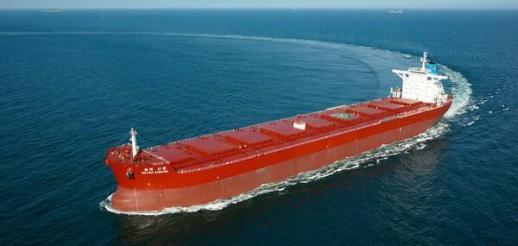 Janggeum Shipping Emerges as Key VLCC Player as War Roils Tanker Market Middle East-driven war fallout is jolting global shipping markets, and South Korea’s Janggeum Shipping is being cited as a quiet winner. The privately held company is little known at home, but industry watchers say it has become a core player in the tanker market, led by very large crude carriers, or VLCCs, and is generating daily earnings in the hundreds of millions of won. Industry sources said March 17 that Janggeum Shipping has recently been securing about $500,000 a day in charter fees for VLCCs, or about 750 million won. That is about 10 times last year’s average, as freight rates that jumped after the war have flowed directly into profits. The gains did not come by chance. Before the war intensified, Janggeum Shipping, through its tanker unit Janggeum Maritime, moved aggressively to secure VLCCs. Ship data firm VesselsValue said Janggeum Maritime has completed about 30 VLCC transactions so far this year. With those deals, the VLCCs it operates have risen to more than 100 ships, about 12% of the estimated global VLCC fleet of 880. Janggeum Maritime is led by Chung Ga-hyun, vice chairman and son of Janggeum Shipping Chairman Chung Tae-soon. Chung Ga-hyun owns 100% of Janggeum Maritime, which the industry views as a key growth pillar for the group. Analysts say a shift toward a tanker-heavy portfolio and early investment have put management to the test, with this shipping cycle offering evidence of results. The article said the war’s impact has also lifted earnings as the Strait of Hormuz was blocked, turning Janggeum’s VLCCs into floating crude storage. With onshore storage reaching its limits, refiners have increasingly chartered tankers as temporary storage, it said. The strategy has drawn attention abroad. Bloomberg recently highlighted Janggeum Shipping’s tanker buildup and profit structure, calling it “one of the smartest beneficiaries” amid turmoil in global energy markets. Bloomberg said Janggeum Shipping amassed large crude tankers before the war and, as a result, has emerged as one of the biggest winners from the disruption. It also said early fleet deployment and aggressive investment have shaken up the global tanker market. Janggeum Maritime’s rapid growth is also being watched for what it could mean for governance. As fleet size and profitability expand, the unit could become central to a future succession structure, the article said. The broader shift in emphasis from containers to bulk and tankers is also expected to accelerate alongside second-generation management. “One industry boom at Janggeum Shipping is not just a simple wartime windfall, but the result of a generational transition and a shift in business structure coming together,” a shipping industry official was quoted as saying. “On top of a strategy that quietly expanded the fleet, the second generation’s execution is emerging as a variable that can reshape the global shipping market.”* This article has been translated by AI. 2026-03-17 18:03:21
 -
 KOSPI outperforms on Nvidia-driven momentum despite oil jitters SEOUL, March (AJP) — South Korean equities outperformed regional peers on the back of AI-driven buying, brushing aside rising oil prices that weighed on broader Asian markets. Seoul’s main bourse drew strength from its exposure to Nvidia’s supply chain, as momentum from the U.S. chipmaker’s GTC 2026 conference continued to support investor positioning in artificial intelligence-related stocks. Brent crude rose 3 percent to $103.23 a barrel, while West Texas Intermediate gained 3.6 percent to $96.80, bringing energy risks back into focus as tensions around the Strait of Hormuz intensified. Across Asia, the divergence was clear. Japan’s Nikkei 225 fell 0.2 percent and China’s Shanghai Composite dropped 0.9 percent, while Hong Kong’s Hang Seng Index edged up 0.2 percent. The benchmark KOSPI rose 1.63 percent to 5,640.48, supported primarily by strong institutional buying that offset selling by foreign and retail investors. Institutions bought a net 733.8 billion won ($492 million), effectively driving the market higher, while foreigners and individuals sold 173.8 billion won and 575.2 billion won, respectively — highlighting fragile underlying sentiment despite the headline gains. Technology and AI-linked stocks led the advance. Samsung Electronics rose 2.8 percent, while SK hynix briefly reclaimed the 1 million won level before paring gains. SK Square added 4.5 percent, reflecting continued positioning in AI infrastructure and platform exposure. Both Samsung Electronics and SK hynix took part in Nvidia’s event as key suppliers of next-generation HBM4 chips. Gains extended to autos and battery makers, with Hyundai Motor rising 3.2 percent and LG Energy Solution adding 4 percent. Platform and biotech shares also moved higher. NAVER climbed 2.8 percent, while Samsung Biologics rose 1.2 percent and Celltrion gained 3 percent. In contrast, defense and energy-related names lagged despite ongoing geopolitical tensions. Hanwha Aerospace fell 5.4 percent and Doosan Enerbility slipped 1.2 percent. The index, however, gave up much of its intraday gains after rising nearly 3 percent earlier in the session, as higher oil prices and late-session profit-taking weighed on sentiment. The tech-heavy KOSDAQ underperformed, slipping 0.12 percent to 1,136.94 after surrendering earlier gains. Foreign and institutional investors led the decline, selling a combined 94.6 billion won, while retail investors stepped in with net purchases of 140.1 billion won. The reversal underscored weakening momentum in smaller-cap and growth-oriented stocks, in contrast to the relative resilience of large-cap AI-linked names on the KOSPI. In currency markets, the Korean won held near 1,490 per dollar, supported by a modest pullback in the U.S. currency. 2026-03-17 17:46:18
 -
 Korea Zinc’s indium draws U.S. attention as quantum computing material Korea Zinc, the only producer of the strategic mineral indium in South Korea, is drawing attention as indium gains prominence as a key material for the fast-growing quantum computing industry. With competition intensifying over next-generation technologies tied to quantum computing, industry officials say Korea Zinc’s stable indium output is positioning it as an important partner in advanced-industry supply chains, including those linked to South Korea and the United States. According to the industry on March 17, quantum computers use quantum mechanics — including superposition and entanglement — to perform complex calculations far faster than conventional computers. As the quantum computing sector enters a growth phase, indium’s strategic value has risen. Academic sources say indium is needed to make connectors for QPU (quantum processing unit) chipsets, which serve as the “brain” of quantum computers. Indium phosphide (InP) is also cited as a key material for producing photonic integrated circuits (PIC). Demand for indium is likely to increase as quantum computers improve and move closer to commercialization. The United States, home to many advanced technology companies, is working at the national level to advance quantum computing. In November 2025, the U.S. Department of Energy said it would provide $625 million to support next-generation research programs at the National Quantum Information Science Research Centers (NQISRC). The U.S. has also supported quantum technology research systematically since enacting the National Quantum Initiative Act in 2018. As the industry develops, securing stable supplies of key materials is increasingly seen as central to competitiveness and economic security. Indium is used not only in quantum computing but also widely in displays, touchscreens, thin-film solar power systems and advanced semiconductors. With indium’s importance growing, Korea Zinc has also come into focus. The company produces 99.999% high-purity indium using what it calls rare-metal concentration and recovery technology based on an integrated zinc, lead and copper process. After Chairman Choi Yun-beom took office, Korea Zinc raised indium output to about 90 to 100 metric tons a year. It produced 97 tons in 2025. Korea Zinc’s role in the U.S. indium supply chain is significant. According to the U.S. Geological Survey, South Korea ranked No. 1 in indium exports to the United States from 2020 to 2023, accounting for 29% of U.S. indium imports over that period. Given that Korea Zinc is the only indium producer in South Korea, the company effectively serves as a key partner supporting U.S. supply chains for advanced industries. “Indium is a critical mineral whose strategic importance is being highlighted not only in displays and semiconductors but also recently in the quantum computing industry,” a Korea Zinc official said. “As the only indium producer in South Korea, Korea Zinc will fulfill its role and responsibility as a backbone industry, based on world-class rare-metal recovery technology.”* This article has been translated by AI. 2026-03-17 17:37:38
 -
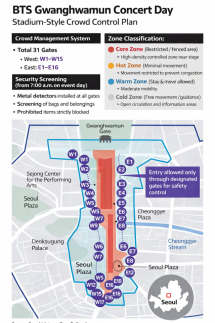 BTS Live D-4 : Transit tip for the concert big day SEOUL, March 17 (AJP) - An estimated 260,000 people are expected to flood central Seoul Saturday for the BTS comeback concert, turning the historic Gwanghwamun district into a vast open-air theater. Authorities estimate that while 22,000 ticketholders will be seated near the main stage, the larger crowds packing the city’s main boulevard and surrounding streets will effectively transform much of downtown into a pedestrian-saturated festival zone. In anticipation of the large numbers of international fans, Seoul is rolling out new measures to improve transit access. Starting Tuesday, overseas-issued credit and debit cards will be accepted at subway ticket machines across 273 stations, allowing visitors to purchase single-use tickets and short-term transit passes without cash. To accommodate the surge, major roads around Gwanghwamun Square will be gradually shut down. Sections of the Sejong-daero boulevard will be closed from Friday evening, with additional restrictions extending through Saturday and into early Sunday as crowds disperse. Public transportation will also be reconfigured. To ease congestion, 62 bus routes, including city, regional and airport lines, will be diverted away from the area, while nearby subway stations such as Gwanghwamun, City Hall and Gyeongbokgung may temporarily skip stops or restrict access during peak hours. Bike-sharing services will also be scaled back, with 58 public rental stations near the venue suspended in stages ahead of the event. “The concert is exciting, but the scale of traffic controls feels excessive, especially for people who still need to commute or work over the weekend,” said Kim Jun-hwan, a 30-year-old office worker in Seoul. Safety measures will also be in force. Fifteen temporary medical stations will be installed between Gwanghwamun Square to Sungnyemun Gate. Mobile intensive care units and on-site medical teams will also be deployed nearby. Information for non-Korean speaking visitors remains a concern. “The subway system is great, but I haven’t really seen much information about the transit pass or event logistics,” said Sarah Shaun, a 28-year-old BTS fan from the United States. “I’m excited for the concert, but with road closures and subway disruptions, we’re still figuring out how to get to the venue,” her husband Ethan added. “BTS concerts are always intense, so I think even a crowd of 260,000 can be manageable,” Sarah said. 2026-03-17 17:32:54
 -
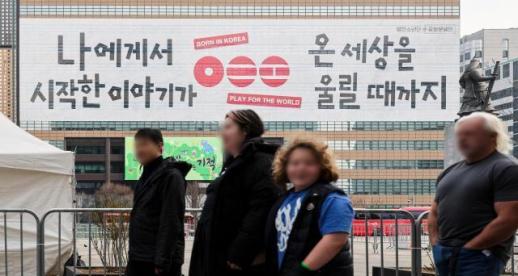 BTS Live D-4: How to navigate Seoul's biggest concert day SEOUL, March 17 (AJP) — The countdown is on. As BTS’s long-awaited comeback concert at Gwanghwamun draws near, both Seoul residents and international visitors are bracing for what could be one of the most crowded days the city has ever seen. Nearly 300,000 people are expected to pack into an area roughly the size of three soccer fields — raising a simple but pressing question: how do you get there, move around and make it through the day? Transport disruptions expected Authorities say major subway stations near the venue — including Gwanghwamun Station (Line 5), City Hall Station (Lines 1 and 2) and Gyeongbokgung Station (Line 3) — will skip stops on the day of the event, with some exits closed to manage crowd flow. Anguk Station (Line 3) may also be shut if congestion intensifies. Above ground, traffic controls will be extensive. Key roads such as Sejong-daero will be closed, and 62 bus routes will be temporarily rerouted. Safety measures ramped up The city is preparing for a massive influx of visitors. Around 6,500 police officers will be deployed across the area, while approximately 2,500 temporary restrooms will be installed near the venue. Real-time updates on transport, safety and facilities will be available through the Seoul Metropolitan Government’s integrated online platform, with multilingual support for foreign visitors. Still, officials acknowledge the day will be long and physically demanding. With access points restricted and nearby buildings limiting entry, even basic needs — finding restrooms or food — could become a challenge. Navigation apps such as KakaoMap will provide live updates on road closures, congestion levels, temporary facilities and first-aid stations. Businesses adapt to the surge Local businesses are already adjusting operations ahead of the concert, introducing pre-orders, delivery alternatives and flexible staffing. A nearby Salady outlet is offering advance orders with delivery to the venue, while a staff member at Subway said group orders can be placed one to two days in advance, though delivery will be limited due to road closures. Convenience store chain CU plans to significantly boost stocks of essentials such as bottled water and kimbap. Starbucks Korea is also preparing for a surge in both domestic and international customers. “We expect a significant increase in visitors and will adjust staffing flexibly to ensure safe and smooth operations,” a company official said. Most stores will remain open until 10 p.m., though some locations near restricted zones will close due to limited access. Tourist areas see early impact The concert’s ripple effects are already visible in tourist districts such as Myeongdong. A currency exchange operator said demand has picked up sharply in recent days, driven mainly by Japanese and Taiwanese visitors arriving ahead of the event. Restaurants slightly removed from the venue are also preparing for increased foot traffic, particularly from foreign tourists. Fan takeaway: plan ahead With transport disruptions, restricted access and massive crowds expected, preparation will be essential: • Expect subway disruptions and station closures • Plan restroom use in advance — queues will be long • Secure food early through takeout or pre-orders • Allow extra time for movement due to road closures and crowd control 2026-03-17 17:28:27
 -
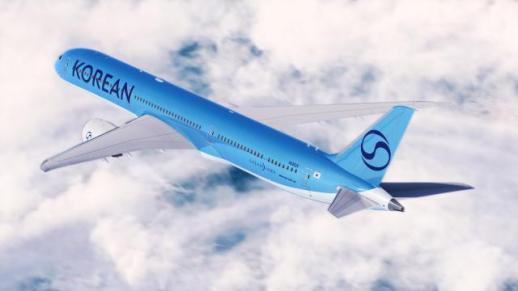 Korean Air Extends Incheon-Dubai Flight Cancellations Through April 19 Korean Air said Tuesday it has extended cancellations on its Incheon-to-Dubai route through April 19. The airline took emergency turnaround and cancellation measures for flights KE951 and KE952 starting Feb. 28 after the outbreak of war in the Middle East. Before the airstrikes on Iran, Korean Air was the only South Korean carrier operating a Middle East route, flying round-trip to Dubai seven times a week. The suspension had been set to run through March 5, but cancellations have continued as the conflict persists. Whether service will resume April 20 will be decided later depending on conditions at local airports. A Korean Air official said the extension was due to airspace restrictions tied to the war involving the United States, Israel and Iran.* This article has been translated by AI. 2026-03-17 17:24:14
 -
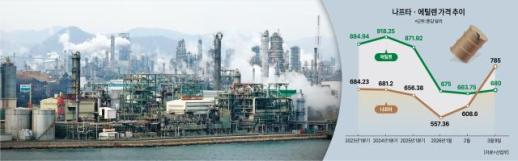 Korea Petrochemical Sector Exposed as Russia, Middle East Naphtha Supplies Tighten South Korea’s petrochemical industry has been laid bare by the latest naphtha crunch, with experts pointing to a fragile supply chain now squeezed on multiple fronts. With imports of Russian naphtha already blocked and Middle Eastern supplies disrupted by war risks, the sector is facing what industry officials describe as a potential collapse in operations. While restarting Russian naphtha imports is cited as the most direct remedy, analysts say it is effectively impossible for South Korea, a U.S. ally, because it must comply with sanctions on Russia. The same constraint is expected to limit efforts to expand imports of “commercial tank” naphtha, which can be blended from multiple origins. Industry officials said Tuesday that Korean petrochemical companies previously secured naphtha steadily from three main sources: Russia, the Middle East and other countries. In the 2010s, companies enjoyed a boom as supply prices were about 60% of today’s naphtha prices and demand for petrochemical products was strong in China and elsewhere, generating operating profits in the trillions of won for individual firms. That picture changed in the 2020s as China brought large petrochemical complexes online, halted imports of Korean products, and the 2022 Russia-Ukraine war cut off Russian naphtha, a key supply source. Company performance deteriorated sharply, officials said. To fill the gap left by Russia, Korean firms increased imports from the Middle East, a shift that made them more vulnerable to any disruption in the Strait of Hormuz, industry officials said. China, meanwhile, imported large volumes of Russian naphtha after the Ukraine war, as export routes to South Korea and Japan narrowed, strengthening its petrochemical competitiveness and pressuring Korean companies, experts said. They added that access to Russian crude and naphtha helps explain why China can respond more flexibly to an Iran war and a Strait of Hormuz blockade. The Financial Times reported that China has built competitive integrated refining and petrochemical complexes based on Russian crude and naphtha, while South Korea and Japan face overlapping pressures including higher raw material and electricity costs, shrinking domestic markets and weaker currencies. As allied economies including South Korea, Japan and the European Union have come under strain, the U.S. government temporarily suspended sanctions on Russian crude and petrochemical products on March 12 local time, but it remains unclear whether the move will have meaningful impact. The measure allows transactions for Russian crude and petrochemical products already on ships through April 11, but industry officials said it is far from enough to cover the shortfall in Middle Eastern supplies. “There is currently no way to import petrochemical products by evading sanctions on Russia, and there is a risk of even greater damage if sanctions are violated,” a petrochemical industry official said. Those concerns are also fueling worries that the South Korean government and companies will struggle to import commercial-tank naphtha stored at ports around the world, because it is likely to contain some Russian-origin material, officials said. After Russian naphtha imports were blocked in 2022, some Korean petrochemical companies increased purchases of commercial-tank naphtha stored in Tunisia. They later halted imports entirely after Bloomberg and other foreign media raised suspicions that the cargoes included Russian naphtha, according to industry officials. Another industry official said Korean companies are believed to be importing commercial-tank naphtha from Singapore and Indonesia, where origin is relatively easier to verify. The official added that companies will also move aggressively to secure supplies to prevent a worst-case scenario in which ethylene production stops.* This article has been translated by AI. 2026-03-17 17:12:18
 -
 Hyundai Mobis Lowers Board Entry Bar Under Revised Commercial Act, Raising Governance Risks Hyundai Mobis has amended its articles of incorporation in line with South Korea’s revised Commercial Act, a move expected to lower barriers for activist funds and minority shareholders seeking seats on the board. As a key affiliate in Hyundai Motor Group’s governance structure, the changes are fueling concerns that risks could grow during any future groupwide governance overhaul. At its 49th annual shareholders meeting held March 17 at GS Tower in Seoul’s Gangnam district, Hyundai Mobis approved multiple charter revisions, including deleting a clause that excluded cumulative voting, clarifying directors’ duty of loyalty, renaming outside directors and strengthening audit committee composition requirements. Most agenda items were tied to the revised Commercial Act, which is set to take effect this year. A central change is the so-called “3% rule,” under which voting rights of the largest shareholder and related parties will be capped at 3% when electing audit committee members starting July 23. Additional provisions scheduled for Sept. 10 include mandatory cumulative voting and expanded separate elections for audit committee members. The revisions aim to strengthen minority shareholder rights and board oversight, but companies view them as a new burden. Hyundai Mobis is seen as central to any Hyundai Motor Group governance restructuring, and critics say the new rules could become a risk factor. With the removal of the cumulative-voting exclusion, the likelihood has increased that directors representing minority shareholders could be elected. Under cumulative voting, shareholders can cast all votes they hold — equal to the number of director candidates — for a single nominee. If more directors aligned with minority shareholders join the board, differing views could complicate efforts to push ahead with governance changes. Hyundai Motor Group previously attempted a governance overhaul in 2018, but the plan was scrapped after opposition from activist hedge fund Elliott. The group is now the only one among South Korea’s top 10 conglomerates that still maintains a circular shareholding structure. In such a structure — for example, “Hyundai Mobis-Hyundai Motor-Kia-Hyundai Mobis” — a group can control the broader conglomerate with relatively small stakes. Converting that into a simpler, linear structure remains a long-standing goal for the group. * This article has been translated by AI. 2026-03-17 17:11:06
 -
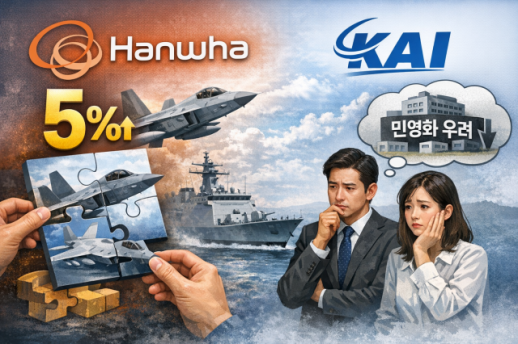 Hanwha Aerospace Buys Nearly 5% Stake in KAI, Deepening Defense Ties Hanwha Group’s move to secure nearly 5% of Korea Aerospace Industries (KAI) is drawing attention in the defense industry, as it could strengthen Hanwha’s position in fighter-jet production through closer cooperation with the aircraft maker. Industry officials said Tuesday that Hanwha Aerospace recently bought a 4.41% stake in KAI. Combined with the 0.58% held by Hanwha Systems, the group’s total stake stands at 4.99%. It marks Hanwha Aerospace’s first KAI share purchase in about seven years, after it sold its entire 5.99% stake in 2018. The purchase makes Hanwha Group KAI’s fourth-largest shareholder. The Export-Import Bank of Korea is KAI’s largest shareholder with a 26.41% stake. Hanwha Aerospace said the investment is intended to “expand cooperation in the aerospace business based on a mid- to long-term strategic partnership and strengthen global export competitiveness.” In South Korea’s defense sector, companies have increasingly pursued joint bids in which a prime contractor signs an export deal and participating firms share the proceeds. A key example is the KF-21 fighter jet, scheduled to be delivered to the Air Force starting in the second half of this year. KAI produces the airframe, while Hanwha Aerospace supplies the engine. Last month, Hanwha and KAI signed an agreement on joint cooperation in future core businesses to boost the global competitiveness of South Korea’s defense industry, and said they would expand that collaboration. Inside KAI, expectations for growth have risen as the company moves toward greater management stability. At an extraordinary shareholders meeting on March 18, shareholders will decide whether to appoint Kim Jong-chul, a former director at the Defense Acquisition Program Administration’s Defense Technology Protection Bureau, as CEO. Some observers say a management vacuum that has lasted for years is entering a resolution phase. Hanwha has expanded its defense footprint through acquisitions, leaving open the possibility of further KAI share purchases. In 2022, Hanwha secured a 49.3% stake in Daewoo Shipbuilding & Marine Engineering and reorganized it as Hanwha Ocean. Some analysts, however, say Hanwha’s recent expansion could limit the scope for a rapid increase in its KAI stake. At KAI, the labor union has expressed mixed views, citing expectations for business expansion if the company is brought under a large conglomerate, while also warning of potential conflict during any push toward privatization. “This stake purchase is more of a strategic investment to strengthen cooperation than a move to take management control,” one industry official said. “Depending on whether additional shares are bought, the direction of the relationship could change.”* This article has been translated by AI. 2026-03-17 17:10:13