

Journalist

Chang SeongWon
-
 Samsung and Posco Engage in Final Bidding for Shinbanpo Reconstruction Project As the selection meeting for the construction company for the integrated reconstruction of Shinbanpo 19 and 25 approaches, competition between Samsung C&T and Posco E&C is heating up. Samsung C&T is promoting its 'Raemian' brand and a design that highlights views of the Han River, while Posco E&C is focusing on its high-end brand 'Otier' and financial support for union members to sway votes. According to the construction industry on May 29, the Shinbanpo 19 and 25 integrated reconstruction union will hold a meeting on May 30 to finalize the construction company. This project involves the integrated reconstruction of Shinbanpo 19 and 25 and Hanshin Jinil and Jamwon CJ in the area of 61-1, Jamwon-dong, Seocho-gu, Seoul. It will consist of seven buildings with 614 units, rising from four underground floors to 49 above ground, with an estimated construction cost of about 443.4 billion won. At a briefing held in February, nine construction companies attended. The final bidding has since narrowed down to a two-way competition between Samsung C&T and Posco E&C. Samsung C&T is emphasizing its extensive construction experience in the Banpo area. It highlights its work on major projects like Raemian One Bailey and Raemian One Pentas, promoting the idea of completing a 'Banpo Raemian Town.' A key selling point is the view of the Han River. Samsung C&T has proposed a design that offers 'permanent Han River views,' reflecting developments from nearby Shinbanpo 16 and 27 reconstruction projects. According to Samsung C&T, approximately 87% of the 616 units, or 533 units, will have views of the river. The types of views include panoramic views for 163 units, wide views for 128 units, and partial views for 242 units. Posco E&C is countering with financial conditions. It has proposed the name 'The Banpo Otier' for the project. Posco E&C is attempting to differentiate itself from Samsung C&T by emphasizing conditions that reduce the financial burden on union members. The most significant aspect is the financial support for union members. Posco E&C has proposed a financial support package of 200 million won per unit for all 446 households, totaling 89.2 billion won. They promise early support after the construction company is selected, aiming to alleviate the financial burden on union members. However, there are concerns regarding the legality of the financial support conditions. Posco E&C maintains that these conditions have been officially proposed after review by the Seocho District Office and the union's board and delegates. In contrast, discussions within the union regarding the feasibility and legal risks of the financial support have reportedly continued as the meeting approaches. This bidding competition also has a 'rematch' aspect, as Samsung C&T and Posco E&C previously faced off in the redevelopment project of Busan Citizens Park in 2024, where Posco E&C secured the construction rights over Samsung C&T. Industry insiders view the Shinbanpo 19 and 25 project as significant, not because of its size but due to its prime location along the Han River and within the Banpo living area. They suggest that the outcome of this bidding could influence the strategies of major construction companies in ongoing competitive reconstruction projects in the Gangnam area. An industry source stated, "Samsung C&T is emphasizing brand and design stability, while Posco E&C is focusing on financial support conditions, which may lead to differing criteria for union members' decisions. The atmosphere is so competitive that it is difficult to predict the outcome even until the meeting day."* This article has been translated by AI. 2026-05-29 17:27:00
 -
 In South Korea, campaigns move indoors SEOUL, May 29 (AJP) -The streets used to shake. Candidate trucks blaring jingles, jackets every color of the rainbow, rallies spilling across every intersection. Growing up, elections were the noisiest thing Korea did. You knew one was coming before you checked the calendar — you could hear it. That was then. Now, with 4,227 seats on the line — governors, mayors, district chiefs, council seats, education offices — and a clutch of by-elections for lawmakers alongside the June 3 local vote, the campaign is louder than ever. You just can't hear it on the street. Seongsu-dong, a neighborhood of converted factories turned coffee shops, on a Thursday morning: a single row of candidate posters lines a brick wall between a specialty roaster and a nail salon. Nobody stops. Two women walk past without a glance. In the old playbook, this wall would have been fought over. The real war is happening in vertical video. Candidates produce Reels and Shorts the way they once printed leaflets — daily, disposable, precisely targeted. Ko Geum-ran runs a YouTube live channel. Lee Jae-jeong drops Shorts. Oh Se-hoon has a channel. Yong Hye-in has a dance challenge. Candidates who once measured success by how many hands they shook now track watch-time and comment sentiment. Young voters don't read the platform documents first. They watch the Shorts. Then they read the comments. A single slip in a debate becomes a clip in four hours. TV Hongka Cola — Hong Joon-pyo's long-running YouTube channel — pioneered the long-form political format that turned a politician's off-script moments into recurring content. The lesson was not lost on rivals. Every candidate now has someone in the room whose only job is to watch for the moment that will live forever as a screencap. This is what politics looks like when it crosses into entertainment. Park Seong-min and Kim Jae-seop — one from the Democratic Party, one from People Power — appeared together on Wavve's reality show Ideology Verification Zone: The Community. A few years ago that would have been unthinkable. Now it's a primary campaign channel. They talked about their daily lives, shared personal anecdotes, and let their guard down in ordinary conversation. For the first time, ordinary viewers could easily encounter the human side of their politicians. Proximity has become the whole strategy. Voters — especially younger ones — aren't just evaluating policy. They're asking: what kind of person is this? Political identity has stopped being an opinion and become a personality trait. Break from your candidate and you risk the group chat. Watching this election from the ground, what strikes me is how closely it resembles a K-pop fandom cycle. Candidate merchandise is collected. Support compilations are uploaded. Opposing fandoms clash in comment sections with the ferocity of stans. The algorithm, not the party machine, decides who goes viral. And yet. Anyang, Gyeonggi Province, a Thursday afternoon. A candidate's team is working a shopping-district corner with the old toolkit — jackets, handheld signs, a small speaker. Three women in their sixties stop and take a flyer. A man in his seventies photographs the banner with his phone. The crowd is almost entirely over fifty. For voters who cannot navigate kiosks or mobile authentication — and in a country where digital literacy drops sharply past seventy — the shift to online campaigning is not democratization. It is exclusion wearing a new brand identity. Banpo, southern Seoul, the morning of May 29. A man in his mid-forties stands outside a convenience store, thumbs working. He is searching for early-voting locations for the June 3 election. He doesn't look up. He finds what he needs. He puts the phone away and walks on. That's the election, right there. Quiet, individual, invisible to everyone around him. More young Koreans talk about politics than they did a decade ago. Whether they understand more is a harder question. What's certain is that the candidate who wins next week will have been decided, in large part, by an algorithm none of the voters can see and none of the candidates fully control. The trucks still drive the streets. The songs still play. But nobody's window is open. 2026-05-29 17:26:44
 -
 Youth Designers Tackle Community Issues Through Public Design Lab A new initiative called the 'Public Design Lab' is set to launch, allowing youth to identify and address local and societal issues through public design. On May 29, the Ministry of Culture, Sports and Tourism and the Korea Craft and Design Foundation announced that eight universities and affiliated research institutes were selected for this year's program, which focuses on the theme of connecting communities and daily life through public design. The Public Design Lab is a project where university students interested in public issues discover problems within their communities and develop design solutions. The proposed ideas will be implemented in various forms, including spaces, visual materials, campaigns, and workshops, serving as testbeds to validate their effectiveness through community participation. The goal is to establish a youth-led experimental public design platform. The eight selected teams will showcase public design projects that connect contemporary issues, culture, and local characteristics, focusing on experiences that citizens can feel in their daily lives. The projects will be unveiled during the Public Design Festival, scheduled from October 23 to November 1. Kongju National University plans to create community-specific spaces and facilities to revitalize urban areas, while Korea Maritime and Ocean University will design collection structures to address the issue of disposable takeout cup waste. Hoseo University will introduce a rest area that encourages physical activity to prevent drowsiness, and both Gangnam University and Yonsei University will develop tailored guidance systems reflecting the needs of children and the elderly. Baekseok Arts University will implement a nudging design and campaign for a walking path that accommodates both pet owners and non-pet owners. Sejong University will create public furniture that encourages natural interactions in urban settings, and Kyung Hee University will present a resource recycling experiential play space. Kim Kyung-bae, director of the Korea Craft and Design Foundation, stated, "As the fresh perspectives and experiences of youth accumulate, the ecosystem of public design will also grow. We will continue to disseminate excellent examples of public design that citizens can experience through collaboration among diverse stakeholders." The detailed operational schedule for each project will be announced later on the Public Design Festival website.* This article has been translated by AI. 2026-05-29 17:24:00
 -
 Samsung Electronics Surpasses 2 Trillion Won Market Cap with 5.8% Surge Samsung Electronics saw a nearly 6% surge, closing at a record high. Its market capitalization, including preferred shares, surpassed 2 trillion won for the first time in history. On May 29, the Korea Exchange reported that Samsung Electronics finished trading at 317,000 won, up 5.84% from the previous day. This surpasses the previous closing high of 307,000 won set on May 27, following a stock split in 2018. The stock opened at 309,500 won, rising to an intraday high of 319,000 won. Samsung's preferred shares also closed up 6.08% at 202,500 won. Thanks to this upward trend, Samsung's market capitalization exceeded 2 trillion won for the first time. The closing market cap for Samsung Electronics was 1,853.27 trillion won, while the preferred shares accounted for 162.48 trillion won, bringing the combined total to 2,015.75 trillion won. SK Hynix, another major player in the semiconductor industry, also continued its upward momentum. The stock reached an intraday high of 2,379,000 won, surpassing its previous peak of 2,358,000 won, and closed at 2,333,000 won, up 1.92% from the previous day. The strong performance of semiconductor stocks is attributed to improved global investor sentiment and expectations surrounding artificial intelligence (AI). The potential resolution of the U.S.-Iran conflict has led to stabilization in international oil prices and market interest rates, fostering a preference for riskier assets. Lee Kyung-min, a researcher at Daishin Securities, noted, "As expectations for the end of the U.S.-Iran conflict spread, stability in oil prices and interest rates has sustained the strength of leading stocks, including Samsung Electronics, Samsung Electro-Mechanics, and LG Innotek." U.S. markets also showed strong performance overnight. The S&P 500 and Nasdaq indices rose by 0.58% and 0.91%, respectively, reaching all-time highs, while the Dow Jones Industrial Average increased by 0.05%. The Philadelphia Semiconductor Index also rose by 1.00%, supporting investor sentiment in the semiconductor sector. Expectations for AI-related business developments have further contributed to the rise in stock prices. Samsung Electronics announced the world's first shipment of samples for HBM4E, the next-generation product of high-bandwidth memory (HBM), drawing significant investor interest.* This article has been translated by AI. 2026-05-29 17:24:00
 -
 Samyang Group Acquires Japanese Flavor Company for 390 Billion Won Samyang Group is expanding its global specialty business by acquiring a Japanese flavor company.On May 29, Samyang Group announced that its food subsidiary, Samyang Foods, will acquire 100% of the shares of Soda Aromatic, a Japanese flavor and fragrance company, through its Japanese subsidiary.The acquisition involves the complete stake held by Toray and Mitsui & Co., with a total purchase price of approximately 41 billion yen (about 390 billion won). The two companies plan to complete administrative procedures and business adjustments related to the acquisition by the end of June or early July.Soda Aromatic, headquartered in Tokyo, is recognized as one of Japan's top five flavor companies. It specializes in flavorings that enhance food taste and aroma, as well as fragrance ingredients used in perfumes and cosmetics, including key aroma chemicals like lactones. The company operates seven production facilities across five Asian countries: Japan, China, Taiwan, Thailand, and Singapore, supplying products to over 1,000 clients.With this acquisition, Samyang Foods aims to transition from a business model focused on basic materials like sugar, flour, and starch to high-value sectors such as flavors and fragrances. Samyang Group plans to reduce the time and risks associated with establishing overseas operations while securing a foundation for expanding into Asian markets like Japan and China, as well as entering advanced markets in North America and Europe.Jung Ji-seok, acting head of Samyang Foods' food group, stated, "We will organically combine the technological capabilities and business strengths of both companies to propose differentiated solutions to our customers as a comprehensive food solutions provider. We will also actively seek additional investments and growth opportunities to expand our global specialty business."Meanwhile, Kim Yoon, chairman of Samyang Group, emphasized during a New Year event in January the need to accelerate the expansion of high-value specialty business portfolios, including semiconductors, personal care, and eco-friendly materials, as a key management policy for the group.* This article has been translated by AI. 2026-05-29 17:21:00
 -
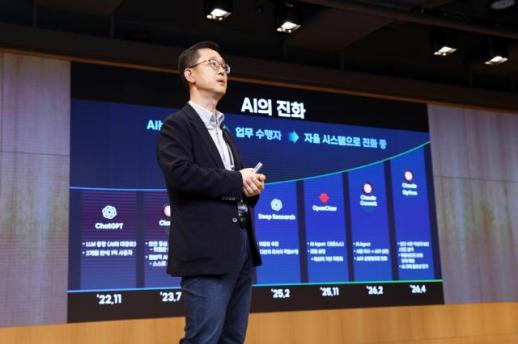 Samsung SDS Hosts AI Transformation Summit, Unveils Strategic Roadmap Samsung SDS held its "AI Transformation (AX) Summit" on May 29 at the Magellan Hall in its Jamsil campus in Seoul, where it unveiled its direction for transitioning to an AI-native company and presented a technological roadmap for AX innovation. The summit focused on practical AX implementation cases and strategies. The event attracted over 600 attendees from more than 320 companies, including clients using Samsung SDS's AI agent platform Fabricx, the work automation solution Briti Automation, and the data analytics platform Brightics AI, as well as representatives from organizations considering implementation. In his opening remarks, Kim Jong-pil, Vice President and Head of the AX Center, introduced the vision and role of the AX Center and presented offerings for work innovation based on AI agents encompassing AI infrastructure, platforms, and solutions. Following this, Kim Soo-yeon, AI leader at EY Han Young, shared key points for AI expansion and performance creation based on trends and case studies from global leading companies. During the keynote session, Shin Gye-young, Vice President and Head of the AI Business Team at Samsung SDS, discussed the "Strategy for Transitioning to an AI Native Company," outlining the direction for corporate AX initiatives. Shin introduced six key transition pillars essential for AI-driven work innovation, sharing various successful project examples. These pillars include: process redesign, securing AI-ready data, developing and operating agents, governance, talent development, and fostering organizational culture. He emphasized the importance of data refinement, metadata management, and authority management. Lee Tae-hee, Vice President and Head of the AI Development Team at Samsung SDS, presented a "Technological Roadmap for Corporate AX Innovation." He introduced an integrated AX platform for AI-native transition, focusing on advanced data integration, agent development and orchestration, and enterprise-wide sharing and management systems. Lee Dong-jae, Director of OpenAI Korea, showcased the latest features and user value of ChatGPT Enterprise, explaining how AI is transforming and redefining corporate work methods and environments. He noted that ChatGPT Enterprise is evolving to enhance corporate productivity through security, internal data integration, and user control features. Particularly, he highlighted that generative AI is advancing beyond simple Q&A chatbots to become agents capable of executing tasks, supporting work automation through custom GPTs, workspace agents, and Codex for tasks such as document creation, lead classification, email dispatch, and data updates. Additionally, Lee Yoon-ha, an AX Center professional at Samsung SDS, shared real-world application cases from industries requiring high security, such as public and financial sectors, and proposed tailored AX execution strategies and practical innovation solutions for different sectors. The hands-on session provided attendees with the opportunity to experience upcoming features and the latest version of Fabricx. Kim Jong-pil concluded, "This event was an opportunity to share insights and strategies that can be applied in real business settings. Moving forward, we will actively support our clients' transition to AI-native operations based on Samsung SDS's differentiated AX capabilities."* This article has been translated by AI. 2026-05-29 17:18:00
 -
 AI wealth gap reaches city halls as Korea's chip hubs reap tax windfall SEOUL, May 29 (AJP) - South Korea's artificial intelligence boom is creating winners far beyond the stock market, with cities hosting semiconductor plants emerging as some of the biggest beneficiaries of a tax windfall fueled by record earnings at Samsung Electronics and SK hynix. The central government is expected to collect tens of trillions of won in additional tax revenue this year as the AI-driven semiconductor boom boosts corporate profits and equity valuations. At the local level, the gains are increasingly concentrated in a handful of cities in Gyeonggi Province that host facilities of the world's two largest memory-chip makers. For local governments that only a few years ago struggled with shrinking tax bases and relied heavily on central government transfers, the turnaround has been striking. Since the semiconductor industry's recovery began in the second half of 2025, five semiconductor cities in Gyeonggi Province have collected between 60 billion won and 200 billion won ($44 million-$147 million) more in tax revenue than initially budgeted as of April, according to local government data. The rebound marks a dramatic reversal from 2023, when corporate local income tax payments from major chipmakers nearly disappeared during one of the industry's deepest downturns. The surge reflects record profits at Samsung Electronics and SK hynix, whose earnings have been turbocharged by global demand for AI servers and high-bandwidth memory chips. As tax revenue floods into South Korea's semiconductor belt, local governments are increasingly divided over whether to spend the windfall on infrastructure and public services or save part of it for the next downturn in the notoriously cyclical chip industry. The debate is most intense in Hwaseong, one of South Korea's most important semiconductor hubs and home to major Samsung Electronics production facilities. City officials have declined to disclose detailed figures, but industry estimates suggest tax revenue linked to Samsung Electronics could exceed 1 trillion won. Under South Korea's tax-sharing system, part of corporate local income taxes is distributed to municipalities where production facilities are located. "Windfall tax revenue should be invested in infrastructure for the city's long-term growth potential rather than short-term spending," said Rep. Kwon Chil-seung of the ruling Democratic Party, who represents part of Hwaseong. Other semiconductor cities are taking different approaches. Icheon, home to SK hynix's flagship memory-chip complex and one of the largest beneficiaries of the company's earnings surge, is expected to receive nearly 200 billion won in corporate local income tax revenue. Rather than spending the proceeds immediately, city officials plan to place a substantial portion into fiscal reserve funds to cushion future economic downturns. Pyeongtaek, home to Samsung Electronics' largest semiconductor manufacturing complex, expects corporate local income tax revenue linked to Samsung to nearly triple to 155.6 billion won ($115 million) in 2026 from 51.6 billion won a year earlier. City officials plan to direct much of the increase toward construction of a new municipal government complex, one of the city's largest ongoing projects, while allocating additional funds to transportation and public services. Suwon, where Samsung Electronics maintains its headquarters, expects roughly 80 billion won in additional tax revenue. Officials say the funds will support transportation projects, electric-vehicle initiatives and other public investments. Yongin, which hosts facilities operated by both Samsung Electronics and SK hynix and is positioning itself as South Korea's next-generation semiconductor cluster, projects collecting about 64.9 billion won in corporate local income taxes from the two companies this year. Officials there remain cautious about treating the increase as a permanent revenue source. "It should ultimately be used to improve residents' quality of life," said Rep. Lee Sang-sik, who represents part of Yongin. "I hope some of the funds will be invested in cultural and sports facilities in Cheoin-gu, where related infrastructure remains underdeveloped." The discussion illustrates how the AI boom is widening economic disparities not only between companies and industries but also between local governments. While semiconductor hubs enjoy overflowing coffers, many municipalities elsewhere continue to struggle with stagnant tax revenue, aging populations and rising welfare costs. Some politicians and education officials have proposed directing a portion of the windfall toward social programs and public education, while others argue the money should be used to strengthen transportation networks and industrial infrastructure that can attract future investment. The debate has taken on added political significance ahead of local elections on June 3, with competing visions emerging over how to spend what many view as the first major local-government dividend from the global AI boom. For now, one thing is clear: the benefits of South Korea's semiconductor renaissance are no longer confined to chipmakers and investors. They are increasingly reshaping the finances—and political priorities—of the cities that host the factories powering the world's AI revolution. 2026-05-29 16:59:27
 -
 Early voting for local elections gets off to strong start SEOUL, May 29 (AJP) - Early voting for the June 3 local elections began across the country on Friday, with turnout already surpassing levels seen in previous elections, as President Lee Jae Myung and other prominent figures cast their ballots. According to the National Election Commission (NEC), voter turnout stood at 7.02 percent as of 2 p.m. on the first day of early voting, up 0.96 percentage points from 6.06 percent recorded during the 2022 local elections. Of the country's 44.64 million eligible voters, about 3.13 million had already voted by Friday afternoon. South Jeolla Province recorded the highest turnout at 14.5 percent, followed by North Jeolla Province at 12.22 percent, Gangwon Province at 9.03 percent, Gwangju at 8.63 percent and Jeju Island at 7.62 percent. Turnout in Seoul stood at 6.58 percent, while Busan recorded 6.4 percent. Early voting runs for two days at some 3,571 polling stations nationwide from 6 a.m. to 6 p.m. through Saturday for those unable to vote on election day next week to cast their ballots early. Meanwhile, Lee visited a polling station near Cheong Wa Dae in central Seoul around noon with first lady Kim Hea Kyung to vote. In an apparent effort to avoid political symbolism and election neutrality, Lee wore a gray tie rather than blue, which is associated with the ruling Democratic Party (DP), or red, which represents the main opposition People Power Party (PPP). Former President Moon Jae-in and his wife Kim Jung-sook also cast their votes in the southeastern city of Yangsan, where they reside after his retirement from office. Prime Minister Kim Min-seok cast his ballot at a polling station in Yeouido near the National Assembly, while Chief Justice Cho Hee-dae did so in Seocho, southern Seoul. Samsung Electronics chairman Lee Jae-yong was also spotted casting his ballot in Seoul's posh district of Yongsan. The elections next Wednesday will choose about 4,000 officials including metropolitan mayors, provincial governors, local government heads and education superintendents, and fill other vacancies. "We will do our best to ensure the election runs smoothly and in an orderly manner so that voters do not face any inconvenience at polling stations," a National Election Commission official told AJP. 2026-05-29 16:56:51
 -
 HD Hyundai Heavy Industries begins Sweden icebreaker project SEOUL, May 29 (AJP) - HD Hyundai Heavy Industries has begun work on an icebreaker project it won from Sweden, marking the first overseas icebreaker contract secured by a South Korean shipyard. The company said Thursday that eight officials from Sweden, including Erik Eklund, director general of the Swedish Maritime Administration, and Johannes Andreasson, deputy head of mission at the Swedish Embassy in Seoul, visited its shipyard in Ulsan on Wednesday for a kickoff meeting on the project. HD Hyundai Heavy Industries earlier won a $348.9 million contract from the Swedish Maritime Administration to build one icebreaker. The vessel is scheduled to be delivered in 2029. During the visit, the Swedish delegation toured the company’s large commercial vessel yard as well as its naval and mid-sized vessel construction facilities. They also inspected its smart shipbuilding facilities, including automated equipment and advanced production systems. The two sides then held a kickoff meeting to discuss the project schedule, design and quality control plans, and cooperation framework for the construction of the icebreaker. The vessel will be designed to operate safely in the extreme conditions of the Baltic Sea in Northern Europe. HD Hyundai Heavy Industries said it plans to apply the latest eco-friendly and high-efficiency technologies to build an advanced icebreaker that meets the Swedish Maritime Administration’s operational requirements. The company said it plans to use the project as a springboard to expand its presence in the global icebreaker market. It also aims to respond to possible additional orders from the Swedish Maritime Administration and growing demand for icebreakers from countries such as the United States and Canada. “We will do our best to successfully build the icebreaker through cooperation with the Swedish government and the Swedish Maritime Administration,” said Joo Won-ho, head of naval and special ship business at HD Hyundai Heavy Industries. “We hope this project will further strengthen shipbuilding and maritime cooperation between South Korea and Sweden.” 2026-05-29 16:54:30
 -
 CJ Olive Young Launches First U.S. Store in Pasadena, California CJ Olive Young is making its entry into the U.S. market by opening its first offline store in Pasadena, California, targeting the world's largest beauty market. The company aims to expand its reach to local consumers by launching an experiential store featuring K-beauty products alongside a dedicated online store.According to industry sources, the Pasadena store, which opened on May 29, is a single-story building with a total area of 803 square meters (approximately 243 pyeong). It features over 5,000 products from around 400 brands, with more than 80% of the items sourced from domestic brands.The store layout reflects local consumers' skincare routines and concerns, with products organized by issues such as whitening, moisturizing, and blemish care. Additionally, the store will update its displays every two weeks to align with changing K-beauty trends.To enhance the shopping experience, Olive Young has introduced a self-diagnosis service using skin scanning devices. Customers can assess their skin condition and receive personalized consultations based on the results, aiming to boost brand awareness and conversion rates. The decision to open a store in the U.S. is backed by consumer data from its global mall and the growth of K-beauty. More than half of the sales from Olive Young's global mall come from the U.S. Additionally, the Ministry of Food and Drug Safety reported a 40% increase in cosmetic exports to the U.S. in the first quarter of this year compared to the same period last year. K-beauty products have also increased to 28 in Amazon's Top 100 Beauty list.In preparation for the Pasadena store opening, Olive Young invested in training local staff. In March, employees from the Pasadena store traveled to Korea to learn about store operations and customer service techniques.Alongside the offline store launch, Olive Young is also opening a dedicated online store for the U.S. market. This strategy is designed to encourage customers to experience products in-store and then reorder online. The shipping time for the new online store has been reduced to 3-5 days, compared to the previous 5-7 days for the global mall. The threshold for free shipping has also been lowered from $60 to $35.To facilitate this, Olive Young established a 3,600 square meter (approximately 1,100 pyeong) logistics center in Bloomington, California, in March. This center will handle deliveries for the U.S. online store. Olive Young plans to introduce a pickup service for online orders at its stores in the future.The company will also implement a U.S.-specific membership program. Starting in July, Olive Young will launch the 'OY Members' program, offering discounts and bonus points during the first seven days of each month.Olive Young plans to open another store in Los Angeles within the first half of the year, with a goal of expanding to five stores in the U.S. within a year. Initially, the focus will be on the West Coast, particularly in Los Angeles and California, before expanding to the Midwest and major East Coast markets, including New York.Kwon Ga-eun, head of Olive Young's U.S. operations, stated, "We will strive to help local consumers, who may be unfamiliar with K-beauty, discover and incorporate authentic K-beauty into their daily lives through our online and offline stores." 2026-05-29 16:48:00